RTCAT™ Commercial Catastrophic Program: How It Works
How the RTCAT™-Powered Commercial Catastrophic Program Works: Explore severity triage, compliance controls, processing support, and MVA intake operations.
A critical-crash program is a coordinated response pathway, not simply a lead handoff. How the RTCAT™-Powered Commercial Catastrophic Program works is through direct source introductions, optional catastrophic-case processing support, compliance monitoring, and education-first nonprofit outreach. For commercial claims, the process also includes severity triage and identifying the vendor expertise a matter may require.
For law firms, the operational details matter: scripts, disclosures, permissions, and intake controls need to align with the jurisdictions where activities may proceed. The framework’s compliance monitoring covers all 50 U.S. states and the District of Columbia, with findings intended to inform updates to those controls. This article explains how the stages fit together, what shapes the processing pathway, and how Nexus Legal Group’s MVA case acquisition and automated verification offerings connect to firms’ intake operations.
Key Takeaways
- Trace how scripts, disclosures, permissions, and intake controls shape a critical-crash response from initial routing through processing.
- Understand which operational factors determine whether a firm and its intake pathway fit the program.
- Distinguish the catastrophe risks addressed by the premium endorsement from the limits that define its scope.
- See how severity triage and vendor expertise can inform the handling of commercial catastrophic claims.
- Explore how police report-generated leads, emergency services-generated leads, and automated verification can support MVA case acquisition.
RTCAT™ critical-crash program
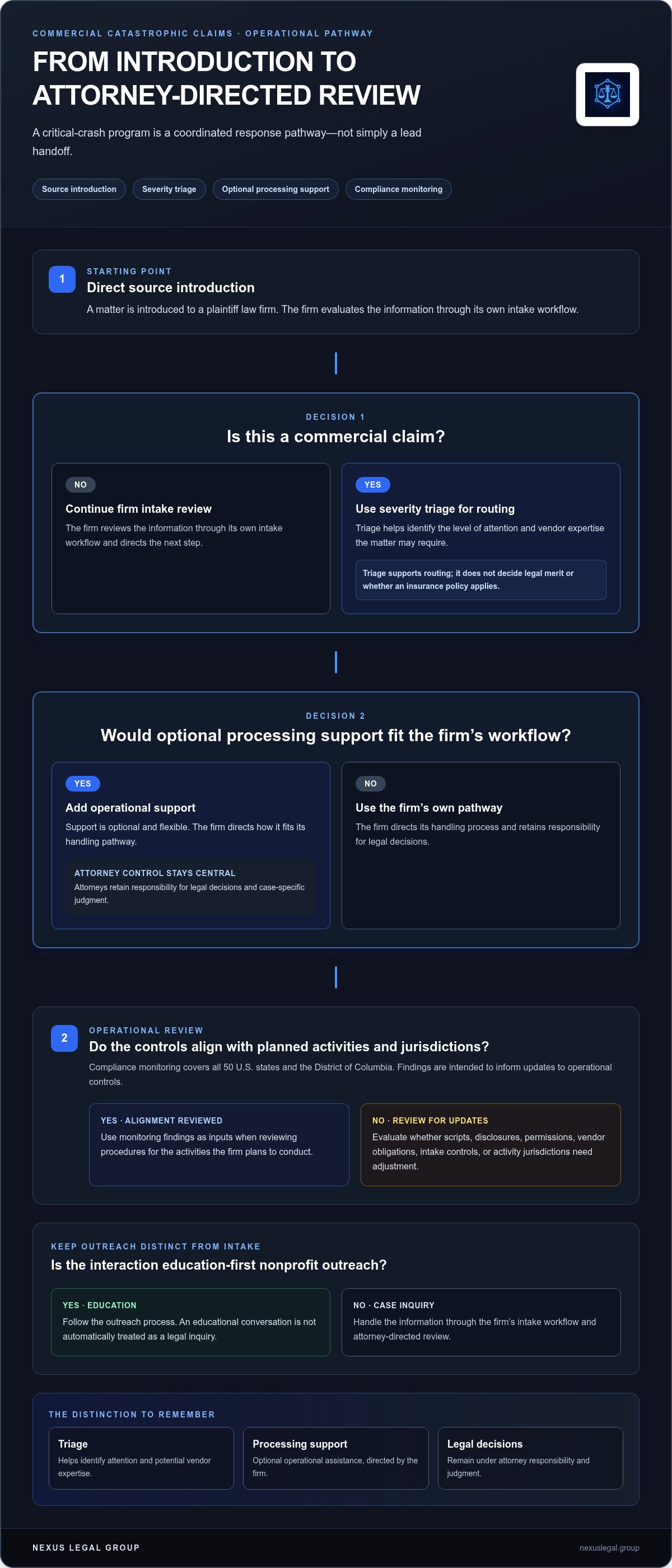
The RTCAT™ critical-crash program brings together source introductions, optional catastrophic-case processing support, compliance monitoring, and education-first nonprofit outreach. Its commercial claim pathway also includes severity triage and identifying required vendor expertise. To understand how the RTCAT™-Powered Commercial Catastrophic Program works, distinguish these operational functions from insurance coverage and legal decisions. Each serves a different stage, from receiving an introduction to routing a matter for attorney-directed review.
The process begins with a direct source introduction to a plaintiff law firm. The firm then evaluates the information through its own intake workflow. For commercial claims, severity triage helps identify the level of attention and vendor expertise a matter may require. It supports routing, but does not decide legal merit or determine whether an insurance policy applies.
Optional processing support adds an operational layer while remaining flexible and under attorney control. A firm can direct its handling pathway, decide how support fits its workflow, and retain responsibility for legal decisions. For example, attorneys can use triage findings to identify a need for specialized vendor expertise, then decide how to address it within their process.
Compliance monitoring is designed to inform operational updates. The framework covers all 50 U.S. states and the District of Columbia. Its findings are intended to guide revisions to scripts, disclosures, permissions, vendor obligations, intake controls, and jurisdictions where particular activities may proceed. A firm can use those findings as inputs when reviewing whether its procedures align with the activities it plans to conduct.
- Review monitoring findings for relevant jurisdictional implications.
- Evaluate whether scripts or disclosures need revision.
- Align permissions, vendor obligations, and intake controls with the review.
- Adjust the jurisdictions where particular activities may proceed.
Monitoring connects to daily intake operations through clear controls. Scripts guide what intake representatives communicate. Disclosures clarify information shared during an interaction, while permissions guide applicable handling steps. Vendor obligations and intake controls define operational responsibilities. Findings can inform updates, but do not replace attorney oversight or case-specific judgment.
Nonprofit outreach has a separate purpose: education, not an assumed legal handoff. This distinction helps firms separate educational interactions from case intake. For example, an educational conversation should follow the outreach process, rather than being automatically treated as a legal inquiry. Clear separation helps staff handle each activity consistently and keep its purpose in view.
The federal insurance history provides useful context for terrorism-related coverage, but it is separate from this program’s workflow. According to U.S. Congress, the Terrorism Risk Insurance Act established a federal backstop for defined acts of terrorism after the September 11, 2001, attacks in 2002. According to U.S. Congress, the 2007 Terrorism Risk Insurance Program Reauthorization Act set a $100 billion annual liability cap for insurance companies and the federal government.
Later legislation continued that history. According to U.S. Congress, the 2015 Terrorism Risk Insurance Program Reauthorization Act was signed into law on January 12, 2015. The 2015 reauthorization extended the Terrorism Risk Insurance Act until December 31, 2020, according to U.S. Congress. These insurance-law milestones do not describe the intake stages. A clear view of how the RTCAT™-Powered Commercial Catastrophic Program works keeps those subjects distinct: source introduction, triage, attorney-directed processing, monitoring, and outreach each serve a defined operational role.
Who is eligible for the RTCAT™-Powered Commercial Catastrophic Program?
Assess eligibility through operational fit, rather than assuming every firm or matter qualifies automatically. The program is intended for plaintiff law firms handling critical-crash or commercial catastrophic inquiries. Start by identifying the team responsible for these matters, the attorney who directs review, and the staff who coordinate intake. These roles indicate whether the pathway can fit the firm’s existing case-handling structure.
First, determine who owns incoming matters. Depending on the firm’s structure, this might be an intake manager, a case-acquisition lead, or an attorney. The essential point is a clear handoff: staff know who receives an inquiry, who evaluates it, and who decides the next action. Without that assignment, a new pathway can create ambiguity instead of useful coordination.
Next, assess the firm’s case mix and resource needs. A firm focused on plaintiff-side commercial or critical-crash work may operate differently from one whose intake team handles unrelated matters. Consider whether the firm has a process for reviewing unfamiliar fact patterns and assigning appropriate internal or external expertise. Focus on how the firm handles complex inquiries, not on assuming a particular case outcome.
Attorney involvement is another key fit factor. Identify who retains decision-making authority and how staff escalate questions requiring attorney review. For example, an intake representative may collect and organize initial information, while an attorney determines how the firm evaluates the matter. This division gives each role a clear purpose and separates operational coordination from legal judgment.
A firm can use a practical readiness screen:
- Ownership: Name the role responsible for receiving and routing each inquiry.
- Review: Identify the attorney or team that evaluates matters and directs follow-up.
- Capacity: Determine whether staff can manage the workflow alongside current intake responsibilities.
- Expertise: Consider how the firm identifies and assigns specialized support when a matter requires it.
Consider capacity in terms of the actual workflow. Map how an inquiry moves from receipt to attorney review, then identify potential delays or unclear handoffs. If several staff members handle intake, for instance, define who owns the record and who is responsible for escalation. This review helps determine whether the firm can follow a consistent process without relying on informal assumptions.
Purpose matters, too. A firm interested in education-focused outreach should distinguish it from case evaluation. Assigning separate owners and clear handling steps helps staff recognize whether an interaction is educational or an inquiry requiring attorney review. This distinction is useful when an organization uses different communication pathways for different audiences.
Eligibility is a structured fit assessment: confirm the relevant practice focus, assign internal ownership, define attorney oversight, and assess staff capacity. These steps help a firm decide whether its people and processes can support participation. They also reveal practical adjustments to make before introducing a new workflow, without treating a particular claim label as automatic qualification.
Firms reviewing their intake needs can consider structured case acquisition support as part of that assessment, alongside internal ownership and review responsibilities.
What coverage does the program provide, and what is excluded?
The catastrophe premium endorsement is described as covering earthquakes, defined catastrophic industrial accidents, and noncertified acts of terrorism. Understanding how the RTCAT™-Powered Commercial Catastrophic Program works also means separating this stated insurance scope from operational support. Intake, triage, and processing workflows organize a response, but do not determine what an insurance policy covers. Coverage depends on the relevant policy language and the circumstances of the reported loss.
For an earthquake-related claim, identify the reported event and applicable endorsement before drawing conclusions. Earthquakes are among the stated coverage categories, but that alone does not resolve a particular claim. The event details and policy terms must be considered together. An intake record can capture what happened, where the damage occurred, and how the loss was reported, then route that information for review.
For defined catastrophic industrial accidents, the endorsement’s wording is especially important. “Defined” signals that the category has boundaries; it does not cover every industrial incident described as severe. A firm can record known circumstances, such as the nature of the incident and reported damage, without treating an initial description as a coverage decision. The applicable definition and policy terms guide the assessment.
Noncertified acts of terrorism form the third stated category. This specific wording does not mean every event publicly described as terrorism falls within the endorsement. The event’s classification and the policy language matter. Intake teams can document the facts available at the outset and keep that record distinct from any later assessment of how the endorsement applies.
The stated categories are not a complete catalogue of contractual exclusions. Do not assume that every loss outside the three categories is excluded under every policy, or that a loss within a category is automatically covered. For example, a commercial fire may cause substantial damage, but fire is not one of the three categories named in this coverage description. Its treatment depends on the applicable policy terms and circumstances.
A practical review can keep those distinctions clear:
- Classify the reported event: Identify whether it involves an earthquake, a defined catastrophic industrial accident, or a noncertified act of terrorism.
- Document the circumstances: Record the available facts without treating the initial description as a final coverage decision.
- Separate intake from coverage analysis: Use triage to route information, not to promise that a loss is covered.
- Read the applicable terms: Compare the event details with the endorsement’s definitions and coverage language.
- Keep exclusions policy-specific: Avoid inferring contractual exclusions from a summary of covered categories.
This distinction is central to understanding how the RTCAT™-Powered Commercial Catastrophic Program works alongside insurance review. A response pathway structures how an inquiry moves through intake and processing, while policy terms define the coverage questions. Keeping these functions separate helps teams communicate carefully, document the event, and direct information to the appropriate review process.
For a commercial claim, describe the loss accurately, identify the potentially relevant category, preserve available details, and review the applicable endorsement. A high-severity assessment may affect routing or the expertise needed to evaluate a matter, but severity alone does not establish insurance coverage. Maintaining this distinction supports precise intake and avoids overstating the meaning of the stated coverage categories.
A further distinction is between catastrophe premium endorsement coverage and statutory workers' compensation. Standard workers' compensation policies cover compensable on-the-job injuries regardless of their cause, and policyholders cannot opt out of terrorism or catastrophe coverage where mandated. Regulatory endorsement changes generally do not affect baseline workers' compensation coverage or premium charges. These rules should not be conflated with whether an event fits one of the endorsement’s named categories; the relevant coverage depends on the policy type and terms.
At the broader program level, the U.S. Congress says the 2015 reauthorization increased insurers’ deductible provisions from $27.5 billion to $37.5 billion in $2 billion increments starting in January 2016. These deductible provisions describe insurers’ program-level financial responsibilities; they do not, by themselves, establish that an individual loss is covered or excluded. For claim handling, keep the reported cause, the policy type, and the applicable terms distinct, and refer any coverage decision to a review of the policy rather than treating a program threshold as a claim outcome.
Nexus Legal Group: High-Intent MVA Case Acquisition
Nexus Legal Group helps plaintiff law firms acquire high-intent motor vehicle accident cases. Its Police Report Generated MVA Leads and Emergency Services Generated MVA Leads connect firms with accident-related inquiries, while Automated Verification supports a more structured intake process. These offerings can help firms strengthen MVA inquiry sourcing and verification alongside their internal case review. They complement, but do not replace, attorney-led decisions about evaluating a matter.
For firms refining how accident inquiries enter their intake workflows, Nexus Legal Group’s MVA offerings provide a practical next step. Review the available MVA case acquisition services, then contact Nexus Legal Group to discuss your firm’s needs.
Build a Clear Next Step for Your Intake Strategy
Understanding how the RTCAT™-Powered Commercial Catastrophic Program works can help your firm determine how a critical-crash workflow should connect with its broader intake strategy. Identify where your current process needs stronger MVA inquiry sourcing or verification, then align that need with a practical case acquisition approach.
Nexus Legal Group offers High-Intent MVA Case Acquisition, Police Report Generated MVA Leads, and Automated Verification. These services can support firms refining how accident-related inquiries enter and move through intake. Define the operational goal: what information your team needs, how inquiries should be reviewed, and where verification fits into your existing process.
Ready to discuss an MVA case acquisition approach for your firm? Start a conversation with Nexus Legal Group.
A focused next step can help your team move forward with greater clarity and purpose.
Frequently Asked Questions
What is the RTCAT™-Powered Commercial Catastrophic Program?
It is an operational framework for plaintiff law firms handling critical-crash and commercial catastrophic matters, not an insurance policy. It organizes case introductions, optional processing support, compliance monitoring, and education-focused outreach around attorney-directed workflows. For example, a firm can use severity triage to identify a commercial claim that may require specialized vendor expertise, then route it through its own intake and legal review processes.