Inside RTCAT™: Converting Severe Crashes into Cases
From severe crash event to qualified inquiry: RTCAT explained. Learn how law firms verify crash details, apply intake criteria, and assess high-value claims.
A missing police report does not, by itself, determine whether a car accident inquiry qualifies. Under RTCAT™, the path from a severe crash event to a qualified inquiry is assessed against written criteria and available, verifiable crash details. A qualified inquiry is not the same as a signed case: the law firm evaluates each inquiry independently and decides whether to accept it.
A police report can be an important source of crash information, but its absence does not settle whether an inquiry qualifies. This explanation of From Severe Crash Event to Qualified Inquiry | RTCAT™ Explained shows how written criteria structure the assessment, what verification adds, and why qualification and signing are separate steps. It covers how a firm-defined priority framework supports consistent intake decisions, how an inquiry without a police report may be assessed, and how crash details inform the path from an initial event to case review.
Key Takeaways
- A missing police report doesn’t automatically resolve whether a car accident inquiry qualifies; assess the available crash details against written criteria.
- Keep inquiry qualification separate from case acceptance: the law firm independently evaluates each inquiry before deciding whether to sign a case.
- Use a firm-defined priority framework to help intake teams apply consistent criteria and identify which inquiries need attention.
- Verify crash details through a consistent sequence across lead sources, and make the basis for each qualification decision visible.
- Distinguish severe-crash signals from confirmed case facts so that event identification leads to structured review, not an assumed outcome.
Qualified inquiries versus signed cases
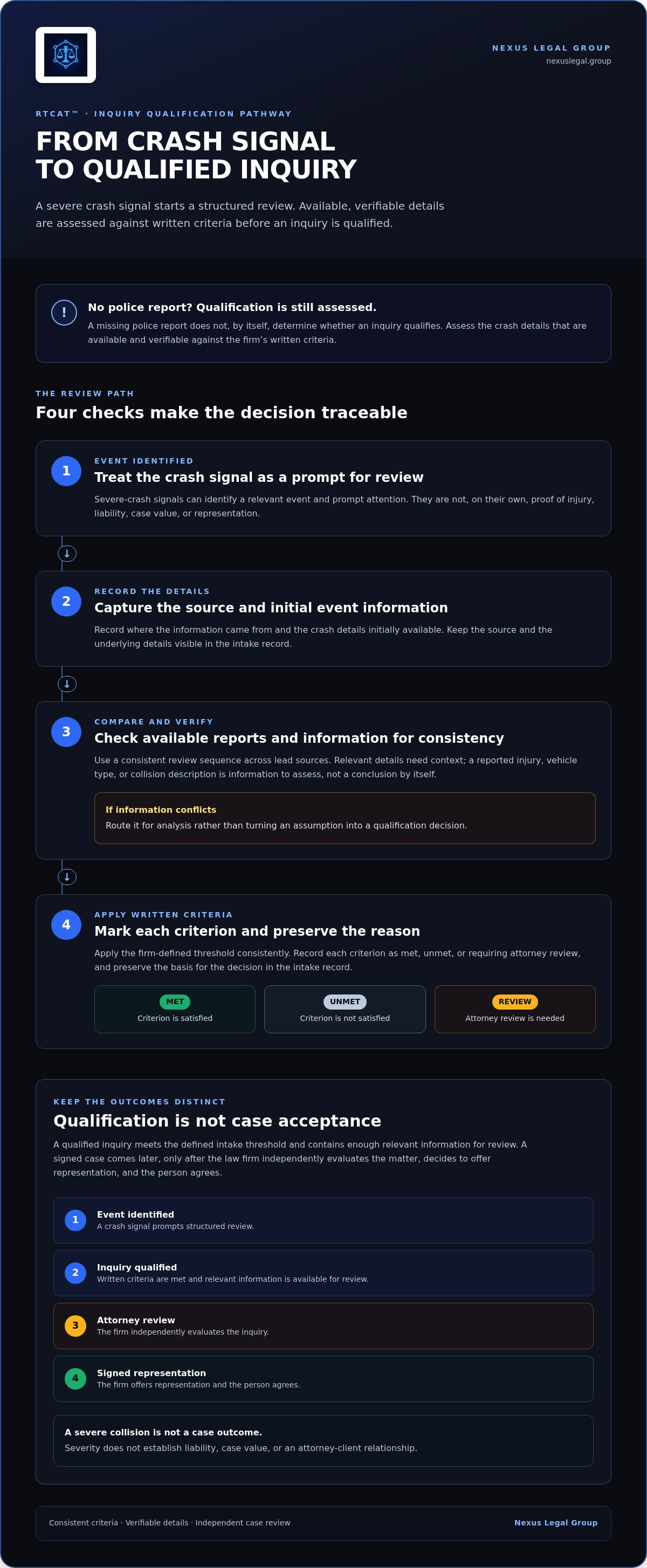
A qualified inquiry meets a defined intake threshold. A signed case exists only after a law firm decides to offer representation and the person agrees. Keep the outcomes distinct: crash severity may identify a relevant event, but it does not establish liability, case value, or an attorney-client relationship.
Inquiry Qualification and Case Outcomes
Qualification means an inquiry meets written criteria and contains enough relevant information for review. Signing is a later decision based on the firm’s independent evaluation, including whether the facts support representation and whether the firm accepts the matter. A severe collision can prompt attention, but it does not replace professional judgment or the person’s decision to proceed.
Use separate intake statuses for event identified, inquiry qualified, attorney review, and signed representation. This sequence clarifies responsibility and prevents a trucking crash signal from being counted as a signed case. The distinction matters even when records describe serious injuries or a possible operating-rule issue: each is information to assess, not a decision on its own.
Inquiry Generation and Delivery Timing
How quickly does RTCAT™ generate and deliver qualified inquiries? The process involves identifying a potential event, reviewing relevant details, and applying the compliance gate before routing an inquiry. Event timing alone does not determine delivery timing. Source access, available records, and required review steps affect when usable information reaches intake.
For a trucking collision, for example, duty-status information may help frame follow-up questions, but it doesn’t independently prove a violation. According to the Federal Motor Carrier Safety Administration, many federally regulated property-carrying drivers are subject to an 11-hour driving limit after 10 consecutive hours off duty. The agency also restricts driving beyond the 14th consecutive hour after coming on duty, and generally requires a qualifying 30-minute interruption after eight cumulative driving hours without one.
Privacy, Consent, and Regulatory Risks
What privacy, consent, and regulatory risks apply to RTCAT™ crash data and inquiries? Data use and outreach must account for applicable privacy and telemarketing requirements, data-source terms, platform policies, bar rules, and client approval. When an appropriate compliance-gated match is identified, the program may support personalized, one-to-one consented digital advertising. Participating firms remain responsible for their advertising, intake, professional obligations, case-acceptance decisions, and compliance.
State requirements can also affect which records and outreach methods are appropriate. In California, the Department of Motor Vehicles requires a driver to submit an SR-1 report within 10 days when a collision causes injury, death, or more than $1,000 in property damage. The California Department of Motor Vehicles also requires an SR-1 report when a collision causes more than $1,000 in property damage.
Is RTCAT™ available nationwide in the United States, and how does coverage vary by state? Availability and outreach methods depend on applicable law, bar rules, privacy and telemarketing requirements, source terms, platform policies, and client approval. A report or contact approach relevant in one state may not support the same process elsewhere, so state-specific constraints belong in the qualification workflow.
Written lead qualification criteria
Written criteria turn severe-crash signals into repeatable intake decisions. Define what information advances an inquiry, what requires review, and what falls short of the firm’s threshold.
Severe Crash Criteria
A written standard should identify event signals that prompt review without treating any signal as proof of injury, liability, or case value. For example, a firm can distinguish a reported commercial-vehicle collision from a record that also describes serious injury. What industries and businesses use RTCAT™ for crash-related lead generation? The relevant audience is plaintiff law firms evaluating motor vehicle accident inquiries, including commercial-vehicle crashes.
Set criteria before intake begins. Specify which event details matter, how to record each one, and who resolves conflicting information. Distinguish an initial alert from evidence supporting a particular conclusion. This helps attorneys focus on the available records rather than assume a severe event automatically qualifies for representation.
Crash Verification and Inquiry Qualification
How does RTCAT™ compare with other accident lead-generation platforms? Compare disclosed qualification criteria, verification steps, consent controls, and decision transparency rather than assuming platforms use identical methods. The RTCAT™ approach described here centers on severe-event identification and compliance-gated review. Each law firm still applies its own written threshold to an inquiry.
Use a consistent sequence for each source and document the result at every step:
- Record the source and the initial event details.
- Compare the available reports and information for consistency.
- Mark each criterion as met, unmet, or requiring attorney review.
- Preserve the reason for the decision in the intake record.
This workflow makes the basis for action clear. A reported injury, vehicle type, or collision description may be relevant, but each needs context. If reports conflict, route the inquiry for analysis instead of turning an assumption into a qualification decision. If a criterion is unmet, record that separately from a pending review.
Review the written standard when a law firm changes its case focus, intake process, or operating priorities. Keep each criterion specific enough for staff to apply consistently, while leaving liability and representation decisions to the attorney’s evaluation of evidence. For firms refining crash inquiry qualification workflows, a documented threshold provides a practical starting point for structured review.
What data sources and signals does RTCAT™ use to identify severe crash events?
RTCAT™ draws on crash-related information from sources such as police reports and emergency services data. These records can help identify an event for review, while reverse-append methods can help obtain accident reports and details about people involved. Available information varies by event and source.
Each source offers a different view. A police report may document the reported collision and people involved; emergency services information can provide another event-related signal. Direct source introductions may also connect a severe crash event with a potential inquiry. No single source establishes that a person has a qualifying claim.
Think of identification as a sequence, not a verdict:
- Capture the event details available from the source.
- Compare those details with other available records.
- Flag gaps or inconsistencies for review.
- Apply the written criteria before routing an inquiry.
For example, if a police report and another event record describe the same collision differently, treat the difference as a reason to examine the records, not to assume which account is accurate. Keeping each source and its details visible helps intake staff distinguish reported information from verified information.
Severe-event identification and inquiry qualification are separate decisions. A record may indicate a serious crash, but qualification still depends on the firm’s written criteria and the information available for review. This prevents an event alert from being treated as proof of injury, fault, or case value.
The process also depends on using information lawfully and appropriately. Program outreach methods and data use are subject to applicable privacy and telemarketing requirements, data-source terms, platform policies, bar rules, and client approval. When an appropriate compliance-gated match is identified, the program may support personalized, one-to-one consented digital advertising. A match can inform permitted outreach, but it does not replace review of the event details.
For law firms, the practical question is whether a source supports a clear next step. Record where each detail came from, preserve uncertainty instead of presenting it as fact, and apply the same verification sequence across channels. This creates an auditable path from source signal to intake review without confusing a severe crash event with a signed case.
A firm-defined priority framework can help intake staff determine what needs attention without relying on personal judgment or unsupported scoring rules. The program does not guarantee inquiries, signed clients, recoveries, liability outcomes, or case value.
What qualifies as a severe crash under RTCAT™ criteria?
Severe-crash classification is an operational screening decision, not a legal finding. The relevant question is whether available event information supports priority review under the firm’s written criteria, not whether a report uses the word “severe.”
Assess the event using documented indicators, such as reported collision circumstances, emergency response information, and injury details in available sources. A commercial-vehicle crash with an emergency-services response may warrant closer review, but that combination alone does not establish injury severity, fault, or a claim. Tie each indicator to its source and label reported information separately from verified information.
A practical assessment can consider these dimensions:
- Event identity: Match the collision’s location, timing, and involved vehicles across available records.
- Severity signals: Note documented injury descriptions, emergency response, or other indicators that support priority review.
- Information quality: Record whether details come from a report, an emergency-services source, or another record.
- Review status: Mark the event for further analysis when important details conflict or remain incomplete.
These distinctions help separate an event that merits attention from an inquiry that meets a law firm’s qualification threshold. For example, an initial alert about a serious truck collision can trigger review, while the resulting record may lack enough detail to assess the people involved. A report describing significant consequences may offer stronger grounds for priority handling, but it still requires independent evaluation.
Classification should not turn a signal into a conclusion. A crash report can identify vehicles and circumstances without establishing the cause. Emergency-services information can show that responders attended, but that alone does not prove a particular injury or legal responsibility. Keep these distinctions clear in intake notes.
Apply the same review logic to every event, regardless of source. First, identify the documented severity indicators. Next, compare them with the firm’s written priorities. Then route the event for the appropriate level of review and record why it qualified for attention. This sequence supports consistent treatment without implying that every severe event becomes a qualified inquiry or signed case.
RTCAT™ describes a critical-crash program that can connect direct source introductions with optional catastrophic-case processing support, compliance monitoring, and education-first nonprofit outreach. These program elements describe handling and outreach pathways, not a universal severity threshold. The standard remains the documented event information, applicable written criteria, and a recorded review decision.
How does RTCAT™ verify crash details and qualify an inquiry?
Verification connects an identified crash event with relevant, reviewable details and applies the firm’s written qualification criteria. The process should record the source, the information compared, and the reason for the intake decision.
Use the same verification sequence for car accident inquiries from every channel. This lets a law firm assess a police report, emergency-services information, or another source against consistent standards instead of relying on the channel that produced the inquiry. Keep source information distinct from facts independently corroborated in the available record.
A practical sequence for review is:
- Identify the event. Record the collision details available, including source and event identifiers.
- Compare records. Review whether available reports describe the same event and involved people.
- Flag discrepancies. Note conflicting or incomplete details for follow-up review.
- Apply written criteria. Mark which requirements are met and document the decision.
- Route for firm review. Send the inquiry to the appropriate intake stage without treating qualification as case acceptance.
For example, a police report may identify a collision and a vehicle involved, while a separate record provides details about people connected to the event. Available records can help provide details about an accident and the people involved. Record the source for each item so an intake reviewer can distinguish report information from details obtained through another step.
When records conflict, preserve both accounts and describe the discrepancy. A difference in collision location or vehicle description should prompt review, not an unsupported decision about which record is accurate. Likewise, a severe-event indicator may prioritize attention, but the law firm still evaluates the inquiry independently.
Make the decision trail easy to follow by recording the criterion, supporting information, and review status together. Distinguish “qualified for intake review” from “accepted for representation,” and keep unresolved issues visible. This helps attorneys assess the actual information without mistaking a completed verification step for a conclusion about liability or case value.
Every inquiry generated through the program should be evaluated independently by the law firm. The firm remains responsible for its intake, advertising, professional obligations, case-acceptance decisions, and compliance with applicable laws and bar rules. A clear verification record supports that evaluation by showing what information informed the next action.
For law firms structuring crash-record review, explore accident report and involved-party information
Apply that consistency to car accident inquiries from every channel, keeping the basis for each decision visible throughout review.
Nexus Legal Group: High-Intent MVA Case Acquisition
Nexus Legal Group supports plaintiff law firms seeking a structured path from crash information to intake review. Its High-Intent MVA Case Acquisition offering connects with Police Report Generated MVA Leads, Emergency Services Generated MVA Leads, and Automated Verification. Together, these services help firms build a process around relevant crash details and their own qualification criteria.
This approach can suit firms refining how they identify and review motor vehicle accident inquiries, particularly when police reports or emergency-services information inform intake. Qualification remains distinct from signing: the law firm independently evaluates each inquiry and decides whether to accept the case.
To discuss how Nexus Legal Group’s MVA case acquisition offerings fit your intake process, visit nexuslegal.group.
Make the Qualification Framework Operational
The next step is to turn your crash-review priorities into an intake workflow your team can apply consistently. Define how new event information enters review, who handles unresolved details, and how the firm records its decision. Then use those criteria to refine the transition from a severe crash event to a qualified inquiry through RTCAT™, without treating qualification as case acceptance.
Nexus Legal Group offers High-Intent MVA Case Acquisition, Police Report Generated MVA Leads, and Automated Verification for law firms developing this workflow. These offerings support a structured approach to identifying and reviewing motor vehicle accident inquiries while leaving case decisions with the firm.
A clear intake process gives your team a practical foundation for evaluating inquiries consistently and carefully.
Frequently Asked Questions
Can a car accident lead qualify without a police report?
Yes, if the firm’s criteria allow review using other reliable information. For intake, record how the collision was reported, which details remain unverified, and what follow-up could resolve them. For example, an inquiry may include a crash date and vehicle description but no report number. Keeping those details separate lets reviewers assess the inquiry without presenting an absent document as evidence.
Can automation qualify car accident leads without intake staff?
Automation can support information processing, but the firm should define its limits. Intake staff can handle exceptions that need context, such as when a person’s account differs from an event record. A useful workflow specifies which routine checks automation supports, which exceptions need human review, and how staff document corrections. This makes the process easier to audit and adjust.
What is RTCAT™ and what does the acronym stand for?
RTCAT™ is the name of a critical-crash program. Do not expand the acronym’s individual letters into words without an authorized definition. For readers assessing the program, the relevant question is what the process does: it supports identifying severe crash events and connecting appropriate inquiries with law-firm review. The name itself does not describe a legal standard or determine whether a particular claim qualifies.
How does RTCAT™ turn a severe crash event into a qualified inquiry?
The transition depends on whether event information meets the receiving firm’s written intake criteria. To assess the result, look for a clear qualification status and enough context for the firm to understand why the inquiry was routed. For example, the status should distinguish an event requiring follow-up from one ready for the firm’s next review stage.
What is the RTCAT™ process from crash detection to inquiry delivery?
For operational planning, map the process into defined stages: event identification, information review, any required compliance approval, and inquiry handoff. The firm can then decide what information its intake team needs at delivery and how staff will record the next status. Treat delivery as a workflow handoff, not as a signed client or a prediction of case outcome.
How does RTCAT™ compare with other accident lead-generation platforms?
Compare platforms’ disclosed qualification criteria, verification steps, consent controls, and decision transparency. RTCAT™ centers on severe-event identification and compliance-gated review, while each law firm applies its own written threshold.