How to Scale a Plaintiff Law Firm: A Systems-Based Growth Plan
Discover how to scale a plaintiff law firm with a systems-based growth plan. Balance intake capacity, streamline workflows, and grow your firm with confidence.
More case volume can expose a firm’s weakest systems faster than it creates growth. If intake cannot respond consistently or case teams are already at capacity, adding inquiries may increase friction without improving outcomes. Understanding how to scale a plaintiff law firm starts with connecting acquisition, intake, staffing, and case-handling capacity before expanding any one of them.
Growth is easier to manage when leadership can see which inquiries fit the firm’s practice, how effectively intake moves them forward, and where operational capacity is tightening. The goal is not simply to generate more demand. It is to build a repeatable system that supports relevant opportunities while maintaining quality controls.
This guide lays out a capacity-first growth plan: assess current constraints, track useful acquisition and intake indicators, and align case volume with staffing and workflows. It also explains how case-acquisition support and automated inquiry verification can fit into that system, including how Nexus Legal Group supports expansion through MVA case acquisition, verification, and mass tort case generation.
Key Takeaways
- Learn how to scale a plaintiff law firm by tying case-acquisition goals to your firm’s actual intake and case-handling capacity.
- Map each handoff from inquiry arrival to attorney review to identify workflow bottlenecks using your own operational evidence.
- Compare growth channels by inquiry relevance, verification, control, and fit with your intake process.
- Use a measured implementation sequence to set targets, pilot changes, review results, and adjust from your firm’s baseline data.
- See how case acquisition and automated verification, including MVA inquiries sourced through police reports and emergency services data, can support a broader growth system.
How to Scale a Plaintiff Law Firm Without Outrunning Its Capacity
Scaling is not simply an increase in inquiries. It is repeatable growth supported by relevant case acquisition, consistent intake, and enough operational capacity to move matters through the firm’s workflows. A practical answer to how to scale a plaintiff law firm begins with identifying constraints before committing to higher volume.
Sustainable plaintiff-firm scaling means aligning qualified case opportunities with the people and processes needed to evaluate and handle them consistently. That definition shifts the focus from activity alone to the system that turns an inquiry into a considered opportunity and, where appropriate, a signed case.
Why case volume alone is an incomplete growth measure
Incoming inquiry counts show demand, but they do not show whether that demand fits the firm. Separate inquiries from qualified inquiries and signed cases, then examine how inquiries move between those stages. If inquiry volume rises while relevant opportunities or completed intake conversations do not, the added activity may be creating work without advancing the firm’s objectives.
Intake capacity matters, too. When staff cannot respond or document inquiries consistently, follow-up can become uneven and attorney review may receive incomplete information. The result is operational strain, not necessarily sustainable growth. Set growth objectives around the firm’s case focus, the opportunities it can evaluate, and the people and workflows available to handle them. The firm’s practice areas and structure shape that operating context; Law firm structures and practice areas provides a general overview.
The operating system behind repeatable firm growth
Case growth moves through connected stages: acquisition brings inquiries into the system; verification helps establish whether information is usable; intake gathers and organizes details; staffing determines who handles each handoff; and case workflows carry matters forward. The sequence may vary by firm, but each stage depends on the quality and capacity of the others.
Consider a firm that receives more inquiries than its intake team can review promptly. The bottleneck is not necessarily acquisition. Increasing volume before addressing that constraint may enlarge the queue, delay attorney review, and make performance harder to assess. Conversely, if intake has room but incoming inquiries rarely match the firm’s case focus, adding staff may not address the underlying issue.
Map the handoffs before changing volume. Record where information arrives, who reviews it, what is needed for the next decision, and where work waits or returns for clarification. This gives leadership evidence to distinguish an acquisition problem from a verification, staffing, or workflow constraint. The broader concept of law firm growth infrastructure connects these components into a coordinated growth system.
Build a Plaintiff-Firm Growth Model Around Capacity and Case Flow
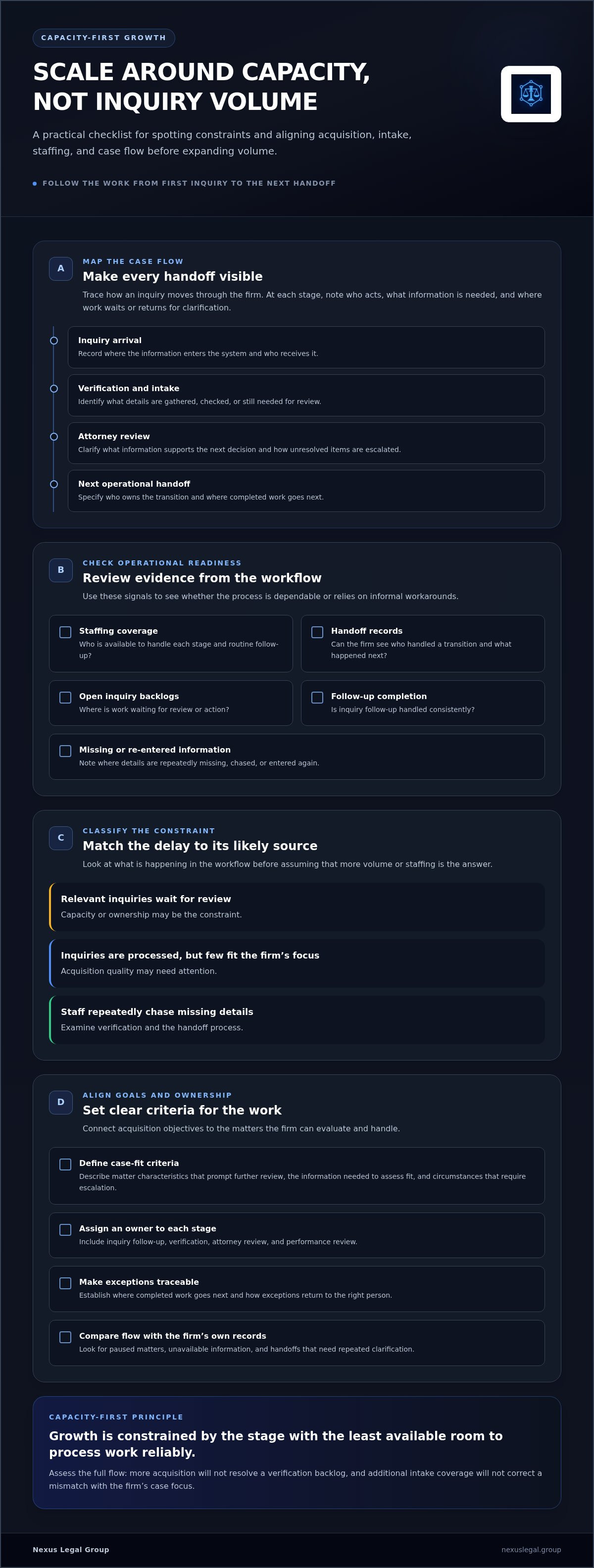
A useful growth model shows how an inquiry moves through the firm, who owns each transition, and what evidence indicates that work is progressing or waiting. Map the sequence from inquiry arrival to verification, attorney review, and the next operational handoff. At each point, record what information is required, who acts on it, and how unresolved items are escalated.
A firm’s growth capacity is limited by the stage with the least available room to process work reliably. More acquisition will not resolve a verification backlog, and additional intake coverage will not correct a mismatch between incoming inquiries and the firm’s case focus. The constraint may shift as processes change, so assess the full flow rather than optimizing a single team in isolation.
Assess intake and staffing readiness before increasing volume
Start with evidence from the workflow. Review staffing coverage, handoff records, open inquiry backlogs, follow-up completion, and the points where information is repeatedly missing or re-entered. Note who handles routine follow-up, who can escalate an issue, and who reviews overall performance. These details reveal whether the process is dependable or relies on informal workarounds.
Then classify the delay. If relevant inquiries wait for review, capacity or ownership may be the constraint. If the team can process inquiries but few match the firm’s focus, acquisition quality may need attention. If staff repeatedly chase missing details, examine the verification and handoff process. Distinguishing these causes helps leadership address the right part of the system instead of adding volume or staffing by assumption.
Connect acquisition goals to the firm’s case mix
Translate the firm’s case focus into practical criteria that attorneys and intake staff can apply consistently. Define the matter characteristics that prompt further review, the information needed to assess fit, and the circumstances that require escalation. Clear criteria help acquisition objectives reflect what the firm can evaluate and handle, not just what a channel can deliver.
Assign an owner to each stage, including inquiry follow-up, verification, attorney review, and performance review. Establish where completed work goes next and how exceptions return to the right person. Then compare inquiry flow with the firm’s own records: where do matters pause, what information is commonly unavailable, and which handoffs require repeated clarification? These observations create a working baseline without relying on generic industry benchmarks.
For firms refining the front end of this process, automated intake for plaintiff firms is a related consideration. Acquisition and automated verification can also be evaluated against the firm’s available review capacity. Nexus Legal Group provides case-acquisition and verification capabilities that fit into this assessment when a firm is planning its next stage of growth.
Compare Growth Channels by Inquiry Quality, Control, and Operational Fit
Growth channels should be evaluated by the work they create for the firm, not just by the number of inquiries they produce. Compare each source against the matter criteria attorneys use, the information available for review, how verification and duplicate handling work, and how much operational oversight the channel requires. The best fit depends on the firm’s objectives and its current ability to process additional inquiries.
Evaluate acquisition quality beyond raw lead counts
Review a sample of inquiries against the firm’s defined case criteria. Ask whether the information supports an initial assessment, whether key details are missing, and whether the same inquiry appears through multiple sources. Track what happens after intake as well: how many inquiries advance to attorney review, and what issues prevent evaluation? These firm-specific observations are more useful than an unsupported industry conversion benchmark.
For MVA acquisition, verification and the information accompanying an inquiry affect how efficiently the firm can assess relevance. This related overview of verified MVA leads for law firms addresses the role of verification in case acquisition.
Balance control, capacity, and operational complexity
Channel ownership shapes workflow visibility. Internal efforts may give the firm direct control over targeting and follow-up, while requiring staff to manage each process. Third-party acquisition can add an external source of inquiries, with quality, verification, and exclusivity dependent on the arrangement. Integrated growth infrastructure connects acquisition support with verification, while the firm continues to set criteria and manage its internal review capacity.
| Channel model | Control and visibility | Operational considerations |
|---|---|---|
| Internal efforts | The firm manages its own targeting, inquiry records, and process decisions. | Staff need clear ownership for follow-up, verification, and reporting across sources. |
| Third-party acquisition | Inquiry relevance, verification, and exclusivity depend on the acquisition arrangement. | The firm needs a defined intake handoff and a way to assess inquiry fit and duplicates. |
| Integrated growth infrastructure | Acquisition and verification can be considered as connected parts of a growth system. | Support can reduce disconnected processes, but the firm still needs capacity for review and case handling. |
Use the comparison to identify a channel’s operational fit, not to declare one universally superior. A firm with a narrow case focus may prioritize relevance and review-ready information; a firm with limited intake coverage may need to resolve process constraints before adding inquiries. In either case, define how each source will be assessed and who will review its results.
That is the practical lens for how to scale a plaintiff law firm: select acquisition that aligns with the firm’s case mix, maintain visibility into inquiry quality, and add volume only at a pace the intake process can handle responsibly.
Scale a Plaintiff Law Firm with a Measured, Repeatable Implementation Plan
A disciplined implementation plan turns growth goals into operational decisions the firm can evaluate. To determine how to scale a plaintiff law firm, start with the firm’s own workflow data, choose one constraint to address, and make a change whose effects can be observed. Avoid changing acquisition, intake procedures, and staffing assumptions at the same time. If results shift, leadership needs to know which change may have contributed.
- Diagnose the constraint. Trace a sample of inquiries through review and handoff. Identify where work waits, information is incomplete, or ownership is unclear. Use patterns in the firm’s records, not a generic benchmark, to establish what needs attention.
- Define the target direction. Specify the intended operational change, such as improving the completeness of information reaching attorney review or reducing unresolved handoffs. Set the target from the firm’s baseline and capacity, without assuming an external performance standard.
- Configure the workflow. Document who receives, verifies, reviews, and routes each inquiry. Clarify how staff record outcomes, follow up on missing information, and escalate exceptions so the process is consistent across the team.
- Pilot the change. Apply the revised process to a defined acquisition source or intake workflow before extending it more broadly. Keep the scope focused enough that the team can observe what changed and where friction remains.
- Review connected indicators. Consider inquiry quality, processing time, completed handoffs, and signed-case outcomes together. A change that moves one measure while creating delays or weaker fit elsewhere may not support the firm’s wider objective.
- Adjust based on evidence. Identify which assumption needs revision, such as targeting, verification steps, ownership, or workflow design. Record the adjustment and continue monitoring the same indicators to understand whether the change addresses the constraint.
Choose a focused starting point and establish ownership
Choose one clearly defined acquisition or intake constraint first. Name the role responsible for monitoring the workflow, the person who resolves exceptions, and the leader who reviews performance. Document the current baseline, the intended direction of change, and a review cadence that fits the firm’s operating rhythm.
This creates accountability without imposing arbitrary targets. For example, if the issue is incomplete handoffs, define what a complete handoff requires and track whether the receiving team gets that information. The team can then assess a specific process instead of debating general impressions of workload.
Use feedback loops to refine the growth system
Bring intake staff and the people responsible for case evaluation into the review. Look for recurring reasons inquiries do not advance, repeated delays, duplicate records, or missing information. Separate isolated exceptions from patterns that point to a process issue.
Use those findings to refine acquisition criteria, verification, or workflow design, then document what changed and what the next review will examine. This makes growth a managed operating cycle, not a one-time expansion decision.
How Nexus Legal Group Supports Plaintiff-Firm Case Acquisition at Scale
Case acquisition is one component of a firm’s growth system, not a substitute for the intake and review processes that determine whether an inquiry fits. Nexus Legal Group supports plaintiff firms with high-intent MVA case acquisition, automated inquiry verification, and mass tort case generation. Firms can align that support with their matter criteria, intake ownership, and available processing capacity as they plan acquisition volume.
The distinction matters: acquisition and verification can help structure the flow of opportunities, while the law firm remains responsible for legal representation, attorney review, and decisions about cases. A well-defined handoff connects external acquisition support with the firm’s existing workflow while keeping those roles clear.
Where high-intent MVA acquisition fits the growth model
Nexus’s MVA acquisition uses police reports, emergency services data, and reverse append technology to obtain detailed accident reports and information about people involved. The resulting exclusive, litigation-ready inquiries enter the firm’s intake process for evaluation against its criteria. Automated verification provides an additional input for organized review, but it does not replace attorney judgment or the firm’s own case assessment.
Before expanding this channel, define how inquiries will be received, who reviews them, and how the team records fit, missing information, or exceptions. Compare the expected inquiry flow with current intake coverage and attorney review capacity. If the team is already carrying a backlog, the operational priority may be to clarify or strengthen internal handoffs before increasing volume. If capacity is available, assess acquisition as part of a measured growth plan, reviewing inquiry quality and processing patterns together.
Extend the framework to mass tort case generation
Nexus also provides ethical and compliant mass tort case generation. As with any acquisition activity, firms should define the matter characteristics they intend to evaluate and make sure the intake workflow captures the information needed for internal review. Clear criteria help staff route inquiries consistently and give leadership a basis for examining fit, incomplete handoffs, and recurring reasons matters do not advance.
Keep the assessment grounded in the firm’s own workflow. Review how inquiries move from arrival to evaluation, where work pauses, and whether the team can manage the additional review activity. Acquisition volume alone does not establish fit or predict case outcomes. The firm’s criteria and capacity remain central to decisions about how to proceed.
For firms refining how to scale a plaintiff law firm, Nexus’s role is to provide case acquisition and verification as parts of a broader, capacity-aware growth system. Connect acquisition goals to the firm’s defined criteria and existing review process to make the next step concrete.
Make Your Next Growth Move Capacity-First
The next step is not to add another growth initiative by default. Choose one operating assumption to test: which matter types the firm can review effectively, how much inquiry flow it can absorb, or where ownership needs to become clearer before expansion. Bring the people responsible for intake and case evaluation into that decision, then define what evidence will guide the next adjustment.
That discipline turns how to scale a plaintiff law firm from an abstract ambition into an ongoing leadership practice. Growth becomes more manageable when decisions reflect actual workflow conditions, are reviewed against outcomes, and can be adjusted before strain becomes embedded in the process. The goal is not to remove every constraint before moving forward. It is to recognize the active constraint and expand in a way the firm can monitor and support.
Set a review point, make the next step clear to the team, and use what you learn to refine the plan. With a measured approach, your firm can move forward with greater clarity and build capacity deliberately.
Each deliberate improvement strengthens the foundation for sustainable growth.
Frequently Asked Questions
How can a plaintiff law firm scale without hiring too quickly?
Before opening a role, identify which responsibilities require specialized judgment and which can be redistributed among the existing team. A responsibility map can show whether work is concentrated with one person because of expertise, habit, or unclear delegation. Cross-train staff on appropriate routine tasks and document recurring procedures. If a critical function still lacks reliable coverage, leadership has a clearer basis for defining the role and its priorities. That is a practical part of how to scale a plaintiff law firm.
What metrics should a plaintiff law firm track while scaling?
Make the measurement process consistent before expanding the dashboard. Define when an inquiry enters a reporting period, how the firm categorizes its source, and what counts as a completed stage. Then distinguish early operational signals from later outcomes, so a change in current workload is not mistaken for a change in case results. Assign an owner to resolve missing or inconsistent entries. Reliable definitions make comparisons useful; a larger collection of ambiguous fields does not.
Can a small plaintiff law firm use the same growth framework as a larger firm?
Yes, but a smaller firm can keep governance lightweight. One person may coordinate several steps, provided the team knows which decisions that person owns and who provides backup when they are unavailable. A larger practice may distribute those responsibilities across teams. The useful test is continuity: can another team member understand the status of an inquiry and the next required action without depending on informal conversations or a single person’s memory?
How do you know when a law firm is ready to increase case acquisition?
Run a tabletop exercise before changing the actual inquiry flow. Walk staff through a plausible increase in incoming matters and ask who records each item, who handles an exception, and how the team would communicate a queue change. Note unanswered questions and unclear decision rights. This exercise can expose coordination gaps that routine operations do not make obvious, giving leadership a chance to clarify responsibilities before testing a change in acquisition.
Is increasing lead volume enough to scale a plaintiff law firm?
No. A firm should also consider whether its growth plan depends too heavily on one acquisition source. If that source changes, the firm may have limited visibility into how to maintain its pipeline. Compare sources over time using consistent categories, and document what each contributes to the firm’s selected matter types. This does not require every firm to use multiple channels; it helps leaders understand concentration and make deliberate decisions about reliance.
What role does intake verification play in law firm growth?
Verification can help staff apply a consistent review protocol by recording whether key fields are present, whether information requires clarification, and whether an inquiry should be routed for further review. A practical improvement is to define exception categories, such as conflicting details or incomplete records, and specify who resolves each type. This creates a clearer operational record for quality review while leaving legal assessment and case decisions with the firm’s attorneys.
How can a firm assess whether case-acquisition support fits its operations?
Use a structured onboarding review to examine how acquisition information will enter the firm’s records and how the team will report its disposition. Document the fields needed for internal evaluation, the person responsible for reconciling incomplete entries, and the method for sharing outcome feedback. Nexus Legal Group’s case-acquisition support can be aligned with those requirements. A clear operating framework gives the firm a practical reference for reviewing fit as its process evolves.