Law Firm Intake Call Scripts: Practical Templates for Better Conversations
Discover practical law firm intake call scripts to streamline your client workflow. Learn how to guide natural conversations and capture vital case details.
What if the best intake call script isn’t a sales monologue, but a decision workflow? Law firm intake call scripts help staff gather consistent information, but rigid wording can make a conversation feel impersonal. The goal is to give callers a clear, attentive experience while capturing what the firm needs to decide what happens next.
A repeatable process helps your team ask relevant questions in a useful sequence, respond to common scenarios, and set expectations without sounding robotic. It can also prevent incomplete notes and unclear handoffs. The wording matters, but so does the structure behind the conversation.
This guide provides adaptable script templates for common intake situations, from opening a call and learning why someone reached out to explaining the next step. You’ll also see how to organize information and pass it to the right person or team. Clear language and a defined workflow make intake a more reliable part of your firm’s broader case-acquisition process.
Key Takeaways
- Use law firm intake call scripts as flexible prompts that guide a human conversation, not as word-for-word monologues.
- Organize the call around the caller’s goal, incident details, unanswered questions, expectations, and a defined next step.
- Adapt responses to uncertainty and common objections while keeping the conversation focused and respectful.
- Document required information, escalation paths, and call outcomes in a shared workflow, then reinforce it with realistic role-play.
- Connect intake practices to the broader case-acquisition process. Relevant, verified inquiries can give staff a clearer starting point, but scripts alone don’t establish inquiry quality.
Why Law Firm Intake Call Scripts Need a Workflow, Not a Pitch
A useful intake call is not a sales performance. It’s a structured conversation that helps staff understand who is calling, why they reached out, and what should happen next. Effective law firm intake call scripts provide prompts and decision points so callers receive a consistent experience while staff respond to the details they share.
Consistency matters because an incomplete or unclear first contact can create avoidable gaps later. A predictable sequence helps staff capture relevant information, explain the immediate next step, and pass a concise, usable summary to the person responsible for the next decision. Intake is one part of a broader operational process, part of a legal case management system, not a standalone sales call.
That distinction sets the boundaries of the conversation. Intake gathers and routes information. It is not, by itself, legal advice, a full case evaluation, or a promise that the firm will represent the caller. Staff should follow approved firm procedures to explain what happens next without predicting an outcome. Scripts guide judgment, but they don’t replace listening or firm policy.
What an intake call script should accomplish
Start by identifying the caller and inviting them to explain why they called. For example: “Thank you for calling. I’m [name]. Could you tell me what prompted you to reach out today?” Then use prompts to gather relevant facts in a predictable order. Let the caller describe events in their own words before moving through follow-up questions. Close by summarizing what you heard and stating the next step the firm has authorized, without promising a result or representation.
Why rigid scripts can undermine a useful conversation
Reading every line verbatim can pull staff’s attention away from a caller’s tone, uncertainty, or important details. Prompts work better than a fixed speech: they keep the conversation on track while leaving room to listen, clarify, and adjust the sequence when needed. Keep escalation points and approved language alongside the prompts. Have the appropriate people at the firm review firm-specific procedures and applicable professional requirements.
A script should make the next sound decision easier. Staff can capture what the caller reported, note unanswered questions, and route the inquiry according to firm policy. That structure supports a clear handoff without asking intake personnel to make decisions beyond their role. The aim is not to make every call identical. It’s to make the process dependable while keeping each conversation responsive to the person on the line.
A Repeatable Law Firm Intake Call Script, from Opening to Next Step
A consistent call flow gives staff a practical route from the caller’s first explanation to a clear handoff. Use these law firm intake call scripts as adaptable prompts: cover the essential information, then ask follow-up questions when they help clarify the inquiry or determine what should happen next.
Opening and setting the caller’s expectations
Begin with a concise introduction, ask permission to gather relevant details, and explain that the call is intended to help the firm understand the inquiry and identify the next step. For example: “Thank you for calling [firm name]. I’m [name]. Is it okay if I ask a few questions so I can understand why you’re reaching out and explain our next step?” This sets a respectful tone without suggesting the firm has accepted the matter.
Gathering a clear, usable incident overview
Invite the caller to describe what happened before asking for specific details. For a motor vehicle accident inquiry, ask about the timing, location, people involved, and any injuries the caller reports. Use neutral language and record what the caller says rather than treating an assumption as verified fact. A brief recap gives the caller a chance to correct or clarify your understanding.
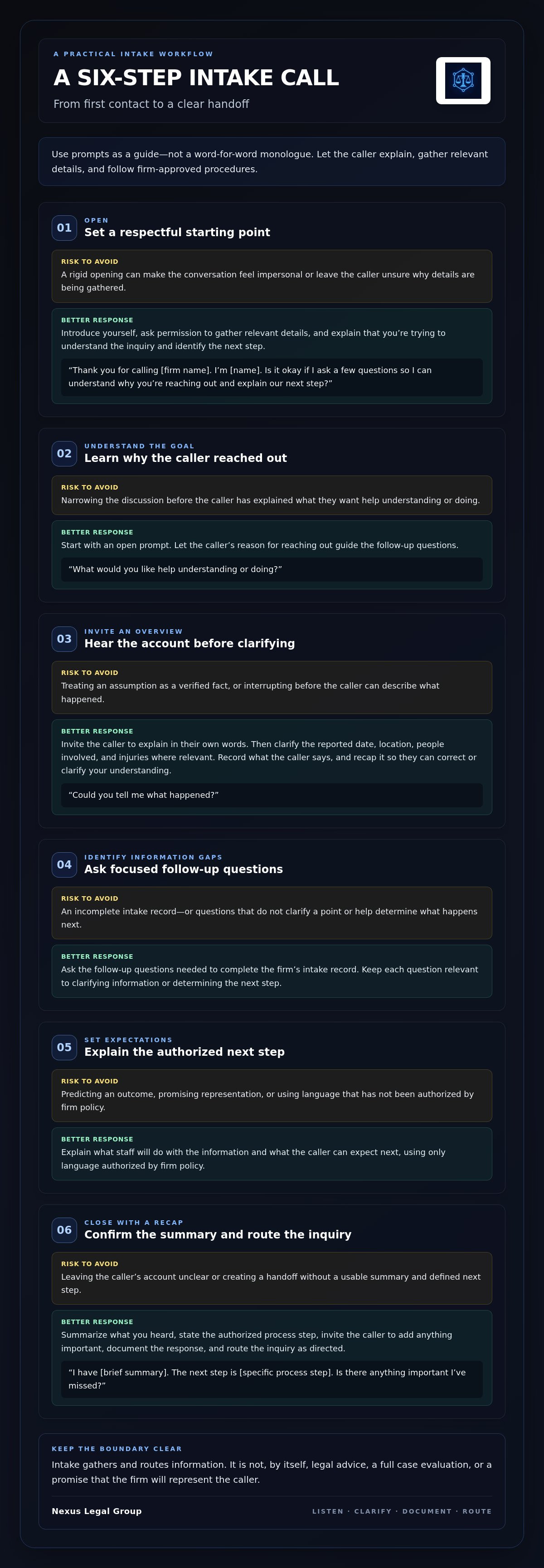
Use this six-step sequence, adjusting the wording to fit the conversation and your firm’s approved process:
- 1. Open: “You’ve reached [firm name]. I’m [name]. How can I help you today?” Confirm the caller’s name and preferred contact details using firm procedures.
- 2. Understand the caller’s goal: “What would you like help understanding or doing?” This open prompt brings out the caller’s reason for reaching out before staff narrow the discussion.
- 3. Invite an overview: “Could you tell me what happened?” Let the caller explain, then clarify the reported date, location, people involved, and injuries, where relevant.
- 4. Identify information gaps: Ask the follow-up questions needed to complete the firm’s intake record. Each question should clarify a point or help determine the next step.
- 5. Set expectations: Explain what staff will do with the information and what the caller can expect next, using only language authorized by firm policy.
- 6. Close with a recap: “I have [brief summary]. The next step is [specific process step]. Is there anything important I’ve missed?” Document the caller’s response and route the inquiry as directed.
This sequence turns the call into a usable workflow rather than a checklist read aloud. The Florida Bar’s LegalFuel resource offers additional guidance on how firms can streamline their workflow. For plaintiff firms refining the inquiries that feed intake, Nexus Legal Group’s law firm growth infrastructure connects case acquisition with automated verification. Relevant, verified inquiries can give staff a clearer starting point, while the firm retains responsibility for its own review and decisions.
Adapt Intake Call Scripts to Fit, Uncertainty, and Common Objections
A script should provide direction, not dictate every sentence. Strong law firm intake call scripts give staff a consistent way to respond while leaving room to listen, acknowledge concerns, and ask relevant follow-up questions. The caller’s situation may change the wording or order of questions, but the purpose stays the same: capture what’s known, identify what remains unclear, and explain an appropriate next step under firm procedures.
Use scenario prompts like these as a starting point, then adapt them to the firm’s approved process:
| Caller situation | Adaptable response | Next step |
|---|---|---|
| Some details are missing | “That’s okay. What do you remember about when or where it happened?” | Record the known details and mark unanswered items as unknown. |
| The caller isn’t sure what happened | “Which parts are you certain about, and which parts are you still unsure of?” | Keep reported facts separate from uncertainty in the intake notes. |
| The caller hesitates to continue | “I understand. What information about our process would help you decide what you’d like to do next?” | Answer within the staff member’s role, then follow the caller’s preference and firm procedure. |
| The caller asks for an immediate answer | “I can document what you’ve shared, but I can’t determine the firm’s decision during this intake call.” | Explain the firm’s review or routing step without predicting its outcome. |
What to say when information is incomplete or uncertain
Ask neutral questions that distinguish recollection from assumption. “Do you know the date, or is it an estimate?” and “Did you observe that yourself, or did someone tell you?” can clarify the source and certainty of a detail. If the caller doesn’t know, record that directly instead of filling the gap with a guess. Explain that the firm will determine appropriate next steps through its review process.
How to respond to hesitation without applying pressure
Hesitation calls for clarity, not persuasion. Acknowledge the concern, invite the caller to say what would help, and offer a next step that follows firm procedures and respects the caller’s stated preference. Avoid implying that the caller must act immediately, that the firm will accept the matter, or that a particular outcome is likely.
Staff should also avoid giving legal conclusions during intake. If a caller asks whether they have a case or what they should do legally, use the firm’s approved response and route the question appropriately. Prompts keep the call organized; attentive listening keeps it human.
Implement and Improve Intake Call Scripts Across the Firm
A script becomes reliable when it’s part of a shared workflow, not a document that staff interpret differently. Keep approved prompts, required intake fields, escalation paths, and call outcomes together so everyone handling an inquiry can follow the same process and make a clear handoff. This also makes updates easier: revise the workflow, communicate the change, and train the team on the current version.
For additional workflow context, see this guide to automated intake for plaintiff firms. Technology can support consistent information capture and routing, while staff remain responsible for listening and following firm procedures.
Train staff to use scripts with sound judgment
Use realistic, anonymized scenarios to practice openings, clarifying questions, summaries, and handoffs. After each role-play, discuss whether the staff member paused for the caller’s response, adapted prompts appropriately, and documented uncertainty without guessing. Make escalation points explicit so staff know which situations require a supervisor or another designated review process, rather than improvising outside their role.
Train for judgment, not recitation. A caller may answer several prompts at once, raise a concern, or need a question repeated. Staff should listen, acknowledge what they heard, and return to any essential information that remains unclear. That flexibility keeps the conversation natural while preserving the workflow’s core requirements.
Use call reviews to refine the workflow
Review calls or intake records in line with firm procedures and focus on process quality, not unsupported conversion benchmarks. Check whether key facts and the caller’s uncertainties were documented consistently, whether the next step was clear, and whether the handoff reached the appropriate person or team. Look for repeated questions, confusing wording, and avoidable delays that leave an inquiry without a defined owner or action.
- Consistent capture: Are required fields complete, with unknown details clearly marked?
- Clear expectations: Can the caller understand the next step from the notes and communication?
- Reliable routing: Is the inquiry sent through the firm’s defined review or escalation path?
- Useful revisions: Do script changes address a specific point of confusion or workflow friction?
Document the reason for each revision and bring the updated prompts back into role-play. For a broader perspective on process governance, review this compliant legal lead generation reference. A disciplined review cycle helps keep intake language, documentation, and handoffs aligned as the firm’s process evolves.
For plaintiff firms considering how inquiry generation fits into intake, explore law firm growth infrastructure from Nexus Legal Group.
Connect Intake Call Scripts to a Stronger Case-Acquisition Process
Intake scripts improve how a firm handles an inquiry, but they can’t establish the inquiry’s quality on their own. That depends on the information available before and during the conversation, as well as the firm’s own review. Treat intake as one connected stage in a larger workflow: inquiry receipt, conversation with the firm, documentation, and review. Each step has a distinct role, and gaps between them can make handoffs less useful.
Where scripts fit in the inquiry-to-review workflow
Case-acquisition activity happens upstream of the firm’s intake call. Automated verification and sources such as police reports, emergency-services data, and reverse-append technology support Nexus Legal Group’s acquisition of motor vehicle accident inquiries. Intake then gives staff a structured way to speak with the caller, document what they report, and route the information for review. These functions complement one another, but verification does not replace the firm’s conversation or determine its decision. For more context on inquiry quality, see the verified MVA leads standard.
Make clear what information arrives with an inquiry, what staff must confirm directly with the caller, and what the firm reviews before deciding on next steps. Keep reported details distinct from verified information in the intake record. That distinction helps the next person understand both what is known and where follow-up may be needed.
What firms should align before expanding intake volume
Before increasing inquiry volume, align inquiry sources with the firm’s staffing capacity, intake fields, and internal review procedures. For example, if an inquiry arrives with incident details, the call workflow should help staff clarify which details the caller can confirm, identify unanswered questions, and record information consistently. Define who receives the handoff and how the next action is documented.
- Inquiry sources: Understand what information is provided before the first conversation.
- Staff capacity: Give the intake process clear ownership and routing.
- Documentation: Use fields that distinguish caller-reported details from information verified through other means.
- Review procedures: Establish how inquiries move from intake to the firm’s next decision.
These checks focus on operational fit, not guaranteed outcomes. Nexus Legal Group provides MVA case-acquisition infrastructure, including automated verification, to complement a firm-side intake process with relevant inquiries and a clearer information starting point.
Learn more about Nexus Legal Group’s case-acquisition approach for plaintiff firms.
Build a More Consistent Intake-to-Review Workflow
Effective law firm intake call scripts give staff a dependable structure without turning calls into rehearsed pitches. Use adaptable prompts to gather information in a clear sequence, document what’s known and unknown, and explain the next step without promising representation or an outcome. Regular training and call reviews help keep the process consistent as your team and workflows evolve.
Scripts are one part of case acquisition, not a measure of inquiry quality by themselves. Relevant inquiries supported by automated verification can give intake teams a clearer starting point for conversations. Nexus Legal Group provides high-intent MVA case-acquisition infrastructure that uses police reports and emergency-services data, alongside reverse-append technology, to obtain detailed accident reports and information about those involved.
With a clear workflow and aligned inquiry sources, your team can make each handoff more useful and keep the caller’s next step clear. Build the process deliberately, then refine it based on what helps staff and callers move forward.
Frequently Asked Questions
What should a law firm intake call script include?
A law firm intake call script should include a clear opening, prompts to understand why the caller reached out, questions for gathering relevant facts, and a defined way to explain the next step. It should also help staff record unanswered questions and route the inquiry according to firm procedures. Treat the wording as a flexible guide, not a promise that the firm will accept the matter or provide a particular outcome.
How do you write a personal injury intake call script?
Start with the purpose of the call, then organize prompts from broad to specific. Invite the caller to describe what happened before asking clarifying questions about timing, location, people involved, and reported injuries. Add fields for contact information, unknown details, and the next action. Keep questions neutral, distinguish caller statements from verified information, and use firm-approved language to explain review steps without giving legal conclusions.
Should law firm intake staff read a script word for word?
No. Staff should use the script as a sequence of prompts and decision points rather than a speech to recite. Reading verbatim can make it harder to notice when a caller is confused, distressed, or sharing a relevant detail out of order. A consistent structure still matters, but staff should listen, ask clarifying questions, and adapt the wording while following the firm’s process.
What questions should intake staff ask after a car accident?
Begin with an open question such as, “Could you tell me what happened?” Then clarify when and where the accident occurred, who was involved, and what injuries the caller reports. Ask which details the caller knows directly and what remains uncertain. Record answers as reported rather than assuming they’ve been independently confirmed, and follow firm procedures for additional questions or review steps.
How can intake staff respond when a caller asks whether they have a case?
Staff can acknowledge the question while setting a clear boundary: “I can document what you’ve shared, but I can’t determine the firm’s decision during this intake call.” Then explain the firm’s review process and identify the next step using approved language. Avoid offering a legal conclusion, predicting an outcome, or suggesting that the firm has agreed to represent the caller.
How often should a law firm update its intake call scripts?
Review scripts on a planned basis and whenever the firm changes its intake fields, routing process, or approved procedures. Call reviews can also reveal when wording causes confusion, staff repeat questions, or handoffs omit useful context. Document revisions, share them with everyone who handles intake, and practice the updated prompts. A regular review process keeps the script aligned with actual firm operations without requiring arbitrary changes.
Can law firm intake call scripts improve conversion rates?
Law firm intake call scripts can support a more consistent caller experience by helping staff gather relevant details, clarify next steps, and complete handoffs. Those improvements may contribute to a stronger intake process, but a script alone can’t guarantee higher conversion rates or determine inquiry quality. Review practical indicators such as missing information, follow-up completion, and caller understanding to identify where the workflow can improve.