Identifying Uninsured Motorist Claims: Law Firm Guide
Master identifying uninsured motorist claims at intake. Learn how to screen key coverage details, verify crash reports, and streamline your firm's workflow.
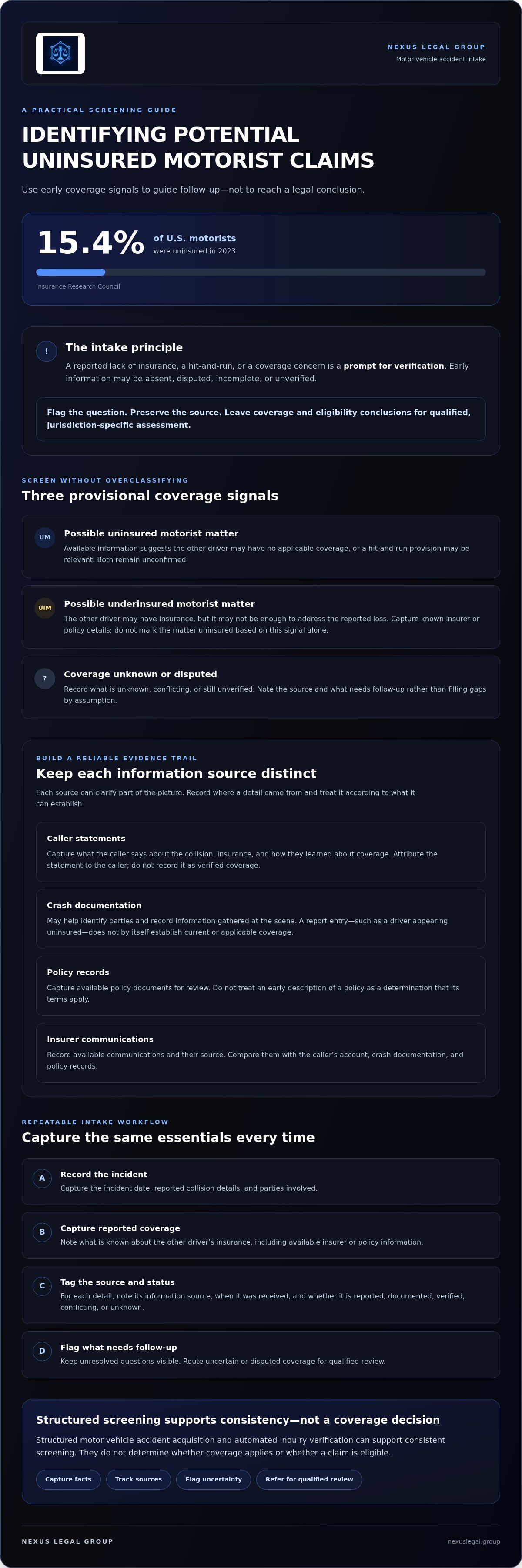
In 2023, 15.4% of U.S. motorists were uninsured, according to the Insurance Research Council. For law firm intake teams, identifying uninsured motorist claims starts with a signal, not a conclusion: a driver’s coverage may be absent, disputed, or still unverified when a potential client first calls.
That uncertainty can complicate early screening. A driver reported to have no insurance may point to a potential uninsured motorist matter. A driver who has insurance that may not cover the full loss raises a different underinsured motorist question. Incomplete incident details can make either situation harder to assess. Your team needs a consistent way to capture what’s known, flag what requires follow-up, and avoid treating an early indicator as a legal determination.
This guide explains which coverage and incident details to collect, what signals warrant verification, and how to distinguish potential uninsured from underinsured situations during intake. It also covers how structured incident information can support consistent review while leaving coverage questions and claim eligibility for qualified, jurisdiction-specific assessment.
Key Takeaways
- Use reported uninsured status, hit-and-run details, or coverage concerns as prompts for follow-up, not as confirmed claim conclusions.
- Compare caller statements, crash documentation, policy records, and insurer communications to identify what’s known and what still needs verification.
- When identifying uninsured motorist claims, distinguish reported lack of coverage from possible underinsurance and coverage that remains unknown.
- Build a repeatable intake workflow that records the incident date, parties, reported coverage, information source, and verification status.
- Structured MVA acquisition and automated inquiry verification can support consistent screening, but they don’t determine coverage or claim eligibility.
What identifying uninsured motorist claims means during accident intake
For a law firm intake team, identifying uninsured motorist claims means flagging an accident for further review when available information suggests the at-fault driver may lack applicable coverage or the incident may involve a hit-and-run. This is preliminary classification, not a decision that a policy applies or a claim qualifies. Keeping that distinction clear helps staff capture useful leads without turning incomplete information into a legal conclusion.
Keep four kinds of information distinct: incident facts, such as the reported collision and parties involved; caller statements about what happened or what they were told; policy documents, which provide terms for review; and coverage information received from an insurer or another appropriate source. For example, a police report may say a driver appeared uninsured, but that entry alone may not establish the driver’s coverage status or whether any coverage applies to the incident.
An Uninsured motorist clause provides background on the policy provision and circumstances commonly associated with uninsured motorist coverage. Use such examples to guide intake questions, not as a substitute for reviewing the specific policy and applicable rules.
What makes a claim potentially uninsured motorist-related?
A caller’s report that the other driver had no insurance is a reason to ask how they learned that and whether any insurer or policy details are available. A hit-and-run may also be a screening signal, but it doesn’t automatically establish that uninsured motorist coverage applies. The relevant policy terms and jurisdiction-specific requirements need qualified review.
A potential uninsured motorist claim is an intake matter in which reported facts suggest applicable liability coverage may be absent, or a hit-and-run provision may be relevant, while coverage remains unconfirmed. The label records a question for follow-up. It doesn’t determine coverage, liability, or eligibility.
How UM and UIM screening differ
For initial screening, distinguish the reported coverage situation rather than deciding the claim type. A possible UM matter involves an indication that the other driver may have no applicable coverage. A possible UIM matter involves an indication that the driver has coverage, but it may not be enough to address the reported loss. Both descriptions are provisional and subject to policy review.
If the caller knows the other driver was insured, capture the insurer and any available policy information instead of marking the matter uninsured. If coverage is unknown, record it as unknown and note what needs follow-up. Policy language and applicable rules can affect how either category is treated, so route uncertain or disputed coverage questions for qualified, jurisdiction-specific review.
Which evidence can help identify a potential uninsured motorist claim?
Effective intake depends on knowing where each coverage detail came from and what it can establish. A caller’s account, crash documentation, policy records, and insurer communications may each clarify part of the picture. None should be treated as conclusive without appropriate review. A consistent source trail helps staff separate reported information from documented or confirmed facts.
What to capture from the initial account
Start with the caller’s description of the collision and the parties involved. Ask what they know about the other driver’s insurance, how they learned it, and whether they have received policy documents or insurer communications. Record answers as statements attributed to the caller, not as verified coverage information.
For each detail, note its source, when it was received, and what remains unresolved. If the caller reports that the other driver was uninsured but has no supporting information, preserve that distinction. Mark conflicting or unknown details for follow-up rather than filling gaps by assumption. This source discipline is central to identifying uninsured motorist claims responsibly.
How records and data can support follow-up
- Crash documentation: An incident report may help identify involved parties and record information collected at the scene. Availability and completeness can vary, and a report entry should not be treated as confirmation of current or applicable coverage. For more context, see this MVA case-acquisition resource library.
- Policy records: Documents supplied by the caller may identify the policy and terms that require review. Record what was received and route questions about interpretation to a qualified reviewer.
- Insurer communications: A letter, email, or other communication may clarify what an insurer has said about a policy or claim. Capture the date and source, and distinguish the insurer’s stated position from a final coverage assessment.
- Incident-data enrichment: Additional participant or accident details can help organize follow-up, but data enrichment does not verify policy terms or establish insurance status. The NAIC overview of uninsured motorist rates offers broader context for why coverage questions merit a consistent screening process.
Corroborating records can strengthen the intake file, but they don’t decide whether coverage applies. For each item, log the source, date received, relevant detail, and open question. This gives the qualified reviewer a clearer handoff and reduces the risk that an unverified statement is mistaken for a confirmed fact.
Firms assessing their broader acquisition workflow can review Nexus Legal Group’s MVA case-acquisition infrastructure, which supports inquiry handling but doesn’t determine coverage or provide legal representation.
How to distinguish an uninsured motorist lead from an unverified coverage question
Intake labels should reflect the evidence available, not predict the outcome of coverage review. A caller may report that another driver had no insurance, but that report differs from verified policy information. The driver may instead have insurance that could be insufficient for the reported loss, while the policy terms and applicable rules remain unknown. Accurate classification keeps these situations distinct and gives the next reviewer a clear starting point.
- Reported uninsured status: The caller or another source says the other driver had no applicable insurance. Still unverified: whether a policy existed, applied to the incident, or may respond. Ask who provided the information and whether policy details or insurer communications are available.
- Possible underinsurance: The other driver is reported to have insurance, but the caller believes it may not cover the full loss. Still unverified: the relevant limits, terms, and how they relate to the reported loss. Ask what coverage information has been received and from whom.
- Unknown coverage: No reliable information about the other driver’s insurance is available, or sources conflict. Still unverified: the driver’s coverage status and any applicable policy provisions. Ask what has been checked and what remains outstanding.
Signals that warrant further coverage review
A reported lack of insurance warrants follow-up, not an automatic UM classification. A fleeing driver or unidentified vehicle presents a distinct fact pattern that may require review under the caller’s policy and applicable rules. If a driver, insurer, or incident report gives conflicting information, document each account and leave the discrepancy unresolved rather than choosing one version prematurely.
Coverage provisions and procedures can vary by policy and jurisdiction. Use general references to understand common UM and UIM concepts, but don’t treat them as a substitute for examining the specific policy or obtaining qualified, jurisdiction-specific review.
Questions that keep screening accurate
Use neutral, factual questions to establish what the caller knows and how they know it. Ask which vehicles were involved, what insurance information the caller received, and whether it came from a driver, insurer, document, or another source. Then ask whether the caller has their own policy documents or insurer correspondence available. Record statements as reported, and note missing or contradictory information for follow-up.
Keep the boundary clear: intake can capture facts and identify questions for review, but it shouldn’t declare fault, eligibility, or claim value based on a lead record or incident report alone. Policy terms, exclusions, deadlines, and available coverage require qualified review. That separation is central to identifying uninsured motorist claims without turning a preliminary signal into a conclusion.
How to build a repeatable workflow for identifying uninsured motorist claims
A consistent process helps intake teams move from an initial coverage signal to a documented, appropriately routed matter without implying a legal outcome. Keep the workflow simple enough to use on every inquiry, with clear fields, status labels, and escalation points.
A practical intake sequence for potential UM matters
- Flag and record the incident. Capture the incident date, involved parties and vehicles, collision details, and the caller’s reported coverage information. Record who supplied each coverage statement and when. Use a provisional label such as “potential UM review” when the available information raises a question, not a conclusion.
- Request available records and track gaps. Note whether incident reports, policy documents, or insurer communications are available or have been requested. Mark missing, conflicting, or unverified details clearly. Escalate a reported hit-and-run, conflicting accounts about insurance, or missing policy information for follow-up rather than resolving uncertainty through assumption.
- Route for qualified assessment. Send the documented facts and outstanding questions to qualified staff for policy and jurisdiction-specific review. Keep intake classification separate from decisions about applicable coverage, deadlines, fault, eligibility, or claim value.
Use a standard matter record with fields for incident date, parties and vehicles, reported coverage, source of each statement, date received, verification status, requested records, and unresolved questions. These fields give reviewers a consistent view of what is known and what still needs attention.
Quality controls for documentation and follow-up
Apply the same status vocabulary across matters, such as “reported,” “requested,” “received,” and “reviewed.” A “reviewed” label should mean a designated reviewer assessed the item, not that coverage was established. Log follow-up attempts and specific open questions so another team member can continue the review without recasting an unverified detail as fact.
Build quality checks around the firm’s approved privacy, consent, and retention procedures. Limit information collection and handling to those procedures, and confirm that any outside data workflow aligns with the firm’s approved practices. A related MVA lead-quality resource can provide broader context for structuring inquiry review. A workflow like this supports identifying uninsured motorist claims consistently while reserving coverage conclusions for qualified review.
For a look at how acquisition and verification can fit into an intake process, see MVA case acquisition and automated verification.
How case-acquisition systems can support UM claim identification
Case-acquisition systems can help firms organize motor vehicle accident inquiries so intake staff can review incident details consistently, identify missing information, and route follow-up questions. For firms identifying uninsured motorist claims, that structure can make a potential coverage issue visible in the intake record without presenting it as a confirmed UM matter.
Nexus Legal Group provides growth infrastructure and MVA case acquisition, including police-report and emergency-services-data sourcing, reverse append technology, and automated inquiry verification. Its role is operational support for firms. Nexus doesn’t represent claimants, act as an insurer, or determine coverage, liability, eligibility, or case merit.
Where acquisition and verification fit in the workflow
Think of acquisition and intake verification as stages that help organize an inquiry, not decide its legal status. Sourcing can provide incident-related information for the firm’s review. Organization can keep caller statements and record details distinct. Verification can support consistent handling of inquiry information. At each stage, make clear what is known, where it came from, and what still needs follow-up.
Police reports, emergency-services data, and enriched participant details may help staff locate or structure incident information when available and appropriately used. They don’t establish that a driver was uninsured, that a policy covers the incident, or that a matter has legal merit. Treat them as inputs for follow-up, then assess policy documents and insurer communications through the firm’s qualified review process.
Evaluate systems without overclaiming what they establish
When evaluating an acquisition or verification workflow, check whether it distinguishes exclusive inquiries, verified inquiry details, and unresolved coverage questions. Ask how the process records information sources and flags missing or conflicting details. Also confirm how data sources, permissions, and verification procedures operate before making claims about compliance or treating enriched information as confirmed.
These distinctions matter because operational verification and insurance verification are not interchangeable. A system may help structure an MVA inquiry without confirming a policy’s terms or whether UM coverage applies. Keep that boundary visible in staff guidance, records, and any handoff to qualified reviewers.
Firms assessing whether additional acquisition infrastructure fits their intake process can explore MVA case acquisition infrastructure. Evaluate the workflow against your firm’s sourcing needs and review standards, without assuming data enrichment guarantees a particular case outcome.
Make UM screening a consistent part of intake
Effective identifying uninsured motorist claims starts with a disciplined distinction between reported coverage concerns and verified policy information. Capture the source of each detail, flag gaps or conflicting accounts, and route coverage questions for qualified, jurisdiction-specific review. This gives your team a clearer record without treating an incident report or lead entry as a decision about coverage, fault, or case merit.
Structured MVA inquiry sourcing and automated verification can support consistent intake. Nexus Legal Group describes sourcing that can use police reports and emergency-services data, along with automated inquiry verification and reverse append capabilities. These tools can help organize information for follow-up, but they don’t determine coverage or guarantee a particular outcome.
With a repeatable workflow and clear review boundaries, your firm can handle potential coverage issues more consistently. For an overview of acquisition infrastructure for plaintiff firms, visit Nexus Legal Group.
Frequently Asked Questions
What is an uninsured motorist claim?
An uninsured motorist claim is a potential claim under an injured person’s own policy when the other driver may lack applicable insurance, subject to the policy terms and applicable rules. A hit-and-run may also raise a UM coverage question. For intake, treat these circumstances as indicators to investigate, not proof that coverage applies or that a claim is eligible. A qualified reviewer should assess the specific policy and jurisdiction.
How can a law firm identify a potential uninsured motorist claim during intake?
A law firm can flag a potential matter by asking what the caller knows about each involved vehicle’s insurance, how they learned it, and whether an insurer or policy document supports that information. Record the incident details, source of each coverage statement, and what remains unknown. The phrase identifying uninsured motorist claims describes this screening process, not a coverage determination. Route unresolved questions for qualified review.
Is a hit-and-run automatically an uninsured motorist claim?
No. A hit-and-run is a signal for further review, not automatic confirmation of a UM claim. The caller’s policy language and applicable jurisdiction may affect whether and how coverage applies, including what information is needed about the incident or unidentified vehicle. Intake staff should document the reported circumstances, avoid promising coverage, and route the issue for qualified review under the relevant policy and rules.
What is the difference between uninsured and underinsured motorist claims?
A potential uninsured motorist matter involves a report that the other driver may have no applicable coverage. A potential underinsured motorist matter involves a report that the driver has insurance, but the available coverage may not be enough for the reported loss. These are preliminary screening descriptions. Policy terms and jurisdiction-specific rules can affect how either situation is treated, so intake should capture the facts and leave conclusions to qualified review.
What information should intake teams collect when insurance status is unclear?
Record the incident date, involved parties and vehicles, the caller’s account of the collision, and what they know about each driver’s insurance. For each coverage statement, capture its source and when it was received. Ask whether policy documents or insurer communications are available. Mark details as reported, requested, received, or reviewed, and clearly flag unknown or conflicting information for follow-up rather than filling gaps by assumption.
Can a police crash report confirm that a driver was uninsured?
A police crash report can document incident details and may include insurance information recorded at the scene, but an entry alone doesn’t necessarily confirm applicable coverage. The report may be incomplete or reflect information that still needs verification. Treat it as one source in the intake record, compare it with available policy documents or insurer communications, and route unresolved coverage questions for qualified review.
What should a firm do when insurance information conflicts?
Document each account separately, identify who or what supplied it, and note when the information was received. Don’t select one version or mark coverage as confirmed simply because it appears in a report or lead record. Flag the discrepancy, request available supporting information through the firm’s established process, and route the issue to qualified staff for policy and jurisdiction-specific assessment. Preserve the unresolved status until review clarifies it.
To explore high-intent MVA case acquisition, automated verification, and related intake infrastructure for plaintiff firms, contact Nexus Legal Group through its website.