Law Firm Intake Verification: A Guide to High-Conversion Case Qualification
Master law firm intake verification to qualify high-value claims faster, filter bad leads, and maximize your retainer velocity with this complete guide.
Intake verification is legal risk mitigation and revenue engineering, not front-desk administration. Yet, far too many personal injury practices still treat their intake desk like a standard telephone switchboard. When motor vehicle accident inquiries hit your pipeline, slow manual screening forces specialists to waste hours chasing phantom leads while catastrophic injury claimants sign with competing firms. Mastering systematic law firm intake verification changes this dynamic entirely, transforming raw inbound contacts into qualified, litigation-ready case files before your team even conducts a formal consultation.
You already know the frustration of climbing intake labor overhead that doesn't produce proportional caseload growth. How do you verify inbound claimant details accurately without draining attorney hours or losing viable retainers? In this comprehensive guide, you will learn how to implement a repeatable qualification framework that filters unviable claims in seconds, enriches prospective files with objective crash intelligence, and maximizes retainer velocity. Ahead, we outline the exact operational architecture and verification workflows required to build a resilient, high-conversion intake engine.
Key Takeaways
- Establishing an objective framework for law firm intake verification eliminates non-viable inquiries upfront, protecting valuable team bandwidth for genuine litigation opportunities.
- Systematically screen every motor vehicle claim across four core pillars: clear liability, demonstrable damages, confirmed coverage limits, and current representation status.
- Enrich prospective claimant files with objective crash intelligence and reverse append technology to verify accident records before your initial legal consultation.
- Implement dynamic routing workflows that pair high-severity, commercial motor vehicle claims with your most experienced specialists immediately.
- Treat your intake operation as core growth infrastructure rather than administrative overhead to maximize signed retainer velocity and case margins.
The Economics of Law Firm Intake Verification in Modern Practice
Every personal injury practice depends on a healthy caseload, but high inquiry volume often hides a serious operational leak. When an intake team simply logs contact details instead of running real-time qualification, profitability plummets. True law firm intake verification is a systematic framework that validates claimant identity, clear liability, quantifiable damages, and available insurance coverage before resources are committed. Integrating this verification into your broader legal case management ecosystem separates basic data entry from objective case triage, turning an administrative cost center into a high-margin acquisition engine.
The True Cost of Unqualified Inquiries on Firm Growth
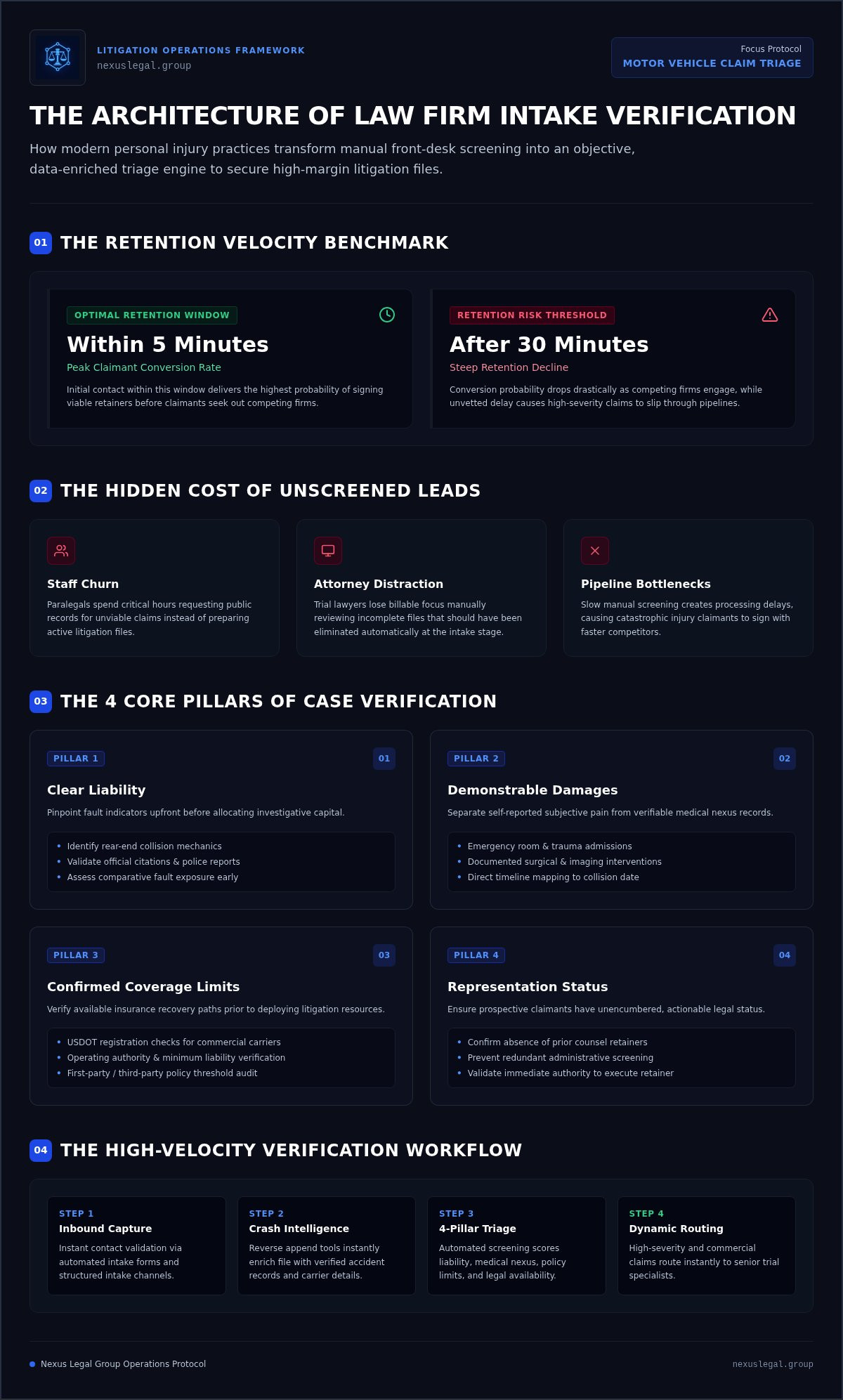
Unvetted inquiries silently drain operational capacity across your practice. When intake specialists chase bad contact information, missing accident records, or disputed-liability fender benders, firm overhead spikes without generating casework. Consider where that time actually goes:
- Paralegal and staff churn: Team members spend hours requesting public records for unviable claims rather than preparing active litigation files.
- Senior attorney distraction: Trial lawyers lose valuable billable focus reviewing incomplete files that should have been screened out instantly.
- Pipeline congestion: Bottlenecks in basic qualification delay response times, causing viable high-severity claims to slip through the cracks.
Speed Versus Scrutiny: Resolving the Law Firm Intake Dilemma
Personal injury acquisition requires balancing immediate response velocity with thorough vetting. Industry benchmarks reveal that engaging an injured claimant within five minutes yields the highest retention rate. After thirty minutes, the likelihood of signing that claimant drops steeply as competing firms step in. Yet rushing a conversation without vetting creates liability risks and bloated caseloads.
Resolving this tension requires abandoning manual cross-referencing. When staff stop calling dispatch desks or manually looking up insurer details, your intake velocity accelerates. Modern litigation practices utilize a hybrid model: automated verification tools instantly authenticate incident records and carrier coverage, while trained intake specialists provide empathetic, focused consultations to catastrophic injury victims. This dual-track approach ensures your firm moves rapidly without sacrificing evidentiary standards.
Core Pillars of an Objective Case Verification Framework
Most legal intake tools function as glorified web forms, capturing contact details without evaluating underlying case viability. That superficial approach burns attorney hours on claims doomed by low coverage or adverse liability. A robust protocol for law firm intake verification treats qualification as a clinical triage system. To build an intake funnel that consistently surfaces high-margin motor vehicle accident files, your team must systematically audit four objective pillars: clear liability, demonstrable damages, confirmed coverage thresholds, and unencumbered representation status.
Validating Clear Liability and Commercial Insurance Policy Limits
Confirming negligence before deploying costly investigative resources protects firm cash flow. Your intake screening should actively identify clear fault indicators, such as rear-end impacts or official citations, while immediately assessing comparative fault exposure. For commercial motor vehicle collisions, specialists must cross-reference carrier USDOT registrations to identify operating authority and minimum liability policies before assigning counsel. Early policy limit validation guarantees your firm only mobilizes resources for claims with viable recovery paths.
Verifying Injury Severity and Documented Medical Nexus
Subjective complaints don't build catastrophic injury dockets. Objective medical documentation does. High-conversion verification distinguishes self-reported pain from verifiable emergency room visits, trauma admissions, surgical interventions, and documented diagnostic imaging. Screening protocols must map these treatments directly against the collision timeline. Establishing this immediate medical nexus weeds out preexisting conditions or low-impact sprains, ensuring only high-severity claims advance to active review.
Pre-Screening Legal Representation Status and Retainer History
Uncovering prior representation history early saves your firm from costly attorney lien disputes. Claimants frequently seek second opinions without disclosing existing representation, creating uncollectible fee splits down the road. Screen every inbound file against common representation red flags:
- Active engagements with other personal injury practices
- Discharged counsel possessing enforceable quantum meruit claims
- Multiple recent submissions across competing firm websites
Leveraging systematic workflows for automated intake for plaintiff firms helps flag multi-firm representation and expired statutes of limitation automatically. Identity authentication protocols simultaneously screen for fraudulent submissions and duplicate entries. To protect your litigation margins, explore how the growth infrastructure at Nexus Legal Group equips elite practices with verified, exclusive case opportunities.
Integrating Crash Intelligence and Data Enrichment into Intake
Relying solely on an injured person's memory during an initial call creates blind spots. Traumatized claimants often misremember collision geometry, confuse carrier names, or omit critical details regarding the at-fault vehicle. Modern law firm intake verification solves this vulnerability by infusing real-time crash intelligence directly into the intake pipeline. Instead of waiting weeks for traditional records processing, forward-thinking practices enrich inbound records with verified collision metrics before the intake specialist dials the phone.
Adopting this operational model aligns with modern data driven case acquisition strategies that replace guesswork with verified public and dispatch data. Emergency services call logs, vehicle telemetry, and preliminary crash reports immediately reveal key details:
- Points of impact that confirm vehicle dynamics and clear fault
- Extrication requirements and emergency medical transport records verifying injury severity
- Commercial registration details that surface corporate carrier liability instantly
Reverse Append Technology for Incident Report Retrieval
Reverse append capabilities revolutionize front-end legal qualification. By cross-referencing an incoming phone number and collision date against official incident registries, the system populates the claimant's file with verified crash data in seconds. Specialists enter the conversation knowing the exact roadway conditions, citations issued, and initial fault assessments. This preparation builds trust with the prospective client while vetting the matter against the firm's strict acceptance criteria before scheduling counsel.
Commercial Fleet and Corporate Carrier Identification
Litigating trucking and commercial fleet accidents demands immediate asset identification. Tractor-trailers frequently involve multi-layered ownership structures involving leased chassis, third-party logistics brokers, and independent motor carriers. Objective data enrichment identifies the parent entities and USDOT operating authority at the point of contact. Early visibility into corporate structures allows intake specialists to confirm substantial commercial umbrella coverage, ensuring high-stakes litigation opportunities are prioritized and routed to senior trial attorneys without delay.
How to Build a High-Performing Intake Verification Workflow
Executing an elite intake model requires moving past static questionnaires and passive forms. High-conversion law firm intake verification pairs real-time data ingestion with an agile operational workflow. When an inquiry hits your system, your tech stack and staff must execute a synchronized triage sequence within seconds. Build your intake workflow around four progressive operational stages:
- Instant identity screening: Automate phone carrier authentication, location consistency checks, and fraud screening the moment a web or phone lead registers.
- Dynamic skill-based routing: Program your telephony infrastructure to instantly direct multi-vehicle collisions or commercial vehicle inquiries to your highest-converting senior specialists.
- Conversational legal vetting: Guide the prospective client through structured liability and injury confirmation using responsive question branching.
- Immediate electronic retainer execution: Deliver a pre-populated retainer agreement via text and email while the claimant is actively engaged on the phone.
Training Intake Specialists to Balance Clinical Precision with Empathy
Rigid interrogations alienate prospective clients during moments of intense vulnerability. Intake specialists must balance investigative scrutiny with compassionate active listening. Instead of firing off checklists like an insurance adjuster, train specialists to employ conversational qualification techniques. They can validate hospital admissions, surgical timelines, and property damage severity naturally while offering authentic reassurance. This empathetic framework preserves rapport while gathering unassailable evidentiary metrics needed to justify representation.
Deploying Automated Retainer Delivery and Immediate Onboarding
Retainer conversion rates drop rapidly if onboarding stalls after initial qualification. Frictionless practices utilize mobile-optimized agreements that populate automatically using verified incident data. Once the specialist confirms fault and injury severity, the agreement generates instantly. The specialist then walks the claimant through signing before ending the call. Incorporating protocols for verified MVA leads for law firms into this workflow eliminates drop-off between qualification and execution, locking in high-value representation seamlessly.
Scaling Case Acquisition with Modern Legal Infrastructure
High-growth litigation practices do not view client qualification as a clerical chore. They treat law firm intake verification as the core engine driving portfolio margins. When your firm automates the verification process, human error vanishes from initial triage. Instead of spending workdays filtering out property-only claims or non-viable comparative fault inquiries, your staff focuses solely on litigation-ready matters. Transitioning toward purpose-built legal infrastructure elevates overall case quality and brings consistency to your firm's intake pipeline.
For an overarching blueprint on replacing fragmented vendor management with unified operational systems, review our complete guide to law firm growth infrastructure.
Key Performance Indicators for Modern Intake Systems
Tracking raw inquiry counts produces misleading vanity metrics. Elite plaintiff firms evaluate intake performance through clinical financial indicators that reveal true pipeline health:
- Lead-to-retainer velocity: Monitor the exact minutes elapsed between initial submission and executed retainer across pre-verified versus unverified funnels.
- Net docket yield: Calculate the percentage of retained claims that advance to formal settlement or trial, eliminating cases abandoned due to undetected insurance lapses.
- Specialist operational capacity: Measure how many high-severity catastrophic files an intake specialist can process each week when non-viable claims are screened out upstream.
Transitioning to Turnkey Case Acquisition Infrastructure
Building internal verification software requires massive capital investment, dedicated engineering teams, and continuous API maintenance for public records. For most litigation firms, that expenditure creates unnecessary technical friction. Partnering with established acquisition platforms provides immediate nationwide scale without the internal overhead.
Proven external infrastructure delivers exclusive, high-intent inquiries enriched with objective collision data straight to your calendar. Your trial lawyers stay fully focused on negotiating claims and trying lawsuits, while the underlying pipeline operates autonomously in the background. Discover how leading motor vehicle accident practices implement high-conversion verification by visiting Nexus Legal Group.
Engineer Your Intake for Predictable Case Growth
Treating client onboarding as standard office administration leaves your practice vulnerable to low-value leads, wasted staff hours, and delayed response times. Modern law firm intake verification establishes total operational control over your pipeline. Systematically screening liability, damages, and insurance limits upfront ensures your attorneys review only viable, high-recovery opportunities.
Deploying multi-point automated verification paired with advanced crash data intelligence before police report releases positions your firm ahead of competitors. This turnkey approach delivers exclusive, litigation-ready personal injury and mass tort acquisition infrastructure directly to your team, accelerating retainer velocity without increasing staff overhead.
Your trial lawyers deserve a clear runway to litigate high-impact claims. When you modernize your verification process, you build a resilient case acquisition model designed for sustained firm expansion.
Frequently Asked Questions
What is law firm intake verification and how does it differ from standard intake?
Standard legal intake simply records claimant contact details on a static intake form. In contrast, comprehensive law firm intake verification functions as an active triage filter. It evaluates whether a motor vehicle collision meets strict legal thresholds before allocating firm time. By cross-referencing identity, clear liability indicators, insurance coverage, and prior legal representation in real time, verification ensures your team only pursues actionable, economically viable litigation files.
How does automated verification improve personal injury case conversion rates?
Automated verification increases conversion velocity by removing administrative lag between inquiry and retainer dispatch. Instead of spending hours tracking missing incident reports, specialists receive prospective claimants pre-screened for severe trauma and clear liability. Enriched crash intelligence equips your team with objective incident facts before dialing. This allows specialists to conduct consultative, high-trust conversations that guide claimants smoothly into signed representation within minutes.
Can intake verification technology confirm insurance coverage before an attorney consult?
Yes. Modern verification frameworks access corporate carrier databases, USDOT records, and commercial fleet registries during the initial inquiry sequence. While private personal auto limits may require formal declarations requests, commercial motor vehicle inquiries instantly yield operating authority details, corporate parents, and mandatory liability minimums. This objective data prevents trial attorneys from investing preparation hours into catastrophic claims that lack sufficient underlying coverage.
How do intake specialists balance rigorous case screening with client empathy?
Balancing clinical rigor with claimant empathy requires structured conversational qualification instead of sterile checklists. Distraught injury victims need validation, not an interrogation. Trained specialists acknowledge emotional distress and validate medical treatments organically within the dialogue. Asking open-ended questions about ambulance transport, surgical schedules, and vehicle points of impact gathers necessary legal metrics while reassuring the prospective client that their recovery remains the practice's chief priority.
What crash data sources should personal injury firms incorporate into intake workflows?
High-performing intake pipelines integrate municipal police dispatch registries, emergency response incident feeds, and reverse-append public crash records. Incorporating commercial vehicle data from the Federal Motor Carrier Safety Administration allows immediate carrier identification. Accessing these external feeds enriches incoming inquiries with point-of-impact diagrams, roadway condition metrics, and extrication records, providing objective verification long before standard paper records requests clear municipal archives.
How does intake verification protect law firms against legal marketing compliance risks?
Implementing systematic law firm intake verification shields practices from predatory lead generation, non-compliant third-party web forms, and state consumer privacy breaches. Rigorous multi-point validation authenticates digital consent, verifies claimant identity, and confirms that inquiries originate from ethical acquisition channels. This proactive oversight prevents unauthorized contact violations, protects prospective client confidentiality, and ensures your practice adheres strictly to applicable professional conduct guidelines and modern privacy statutes.