Law firm expansion planning: Everything You Need to Know
Master law firm expansion planning with data-driven case acquisition, automated intake, and AI tools that turn growth into a predictable revenue engine.
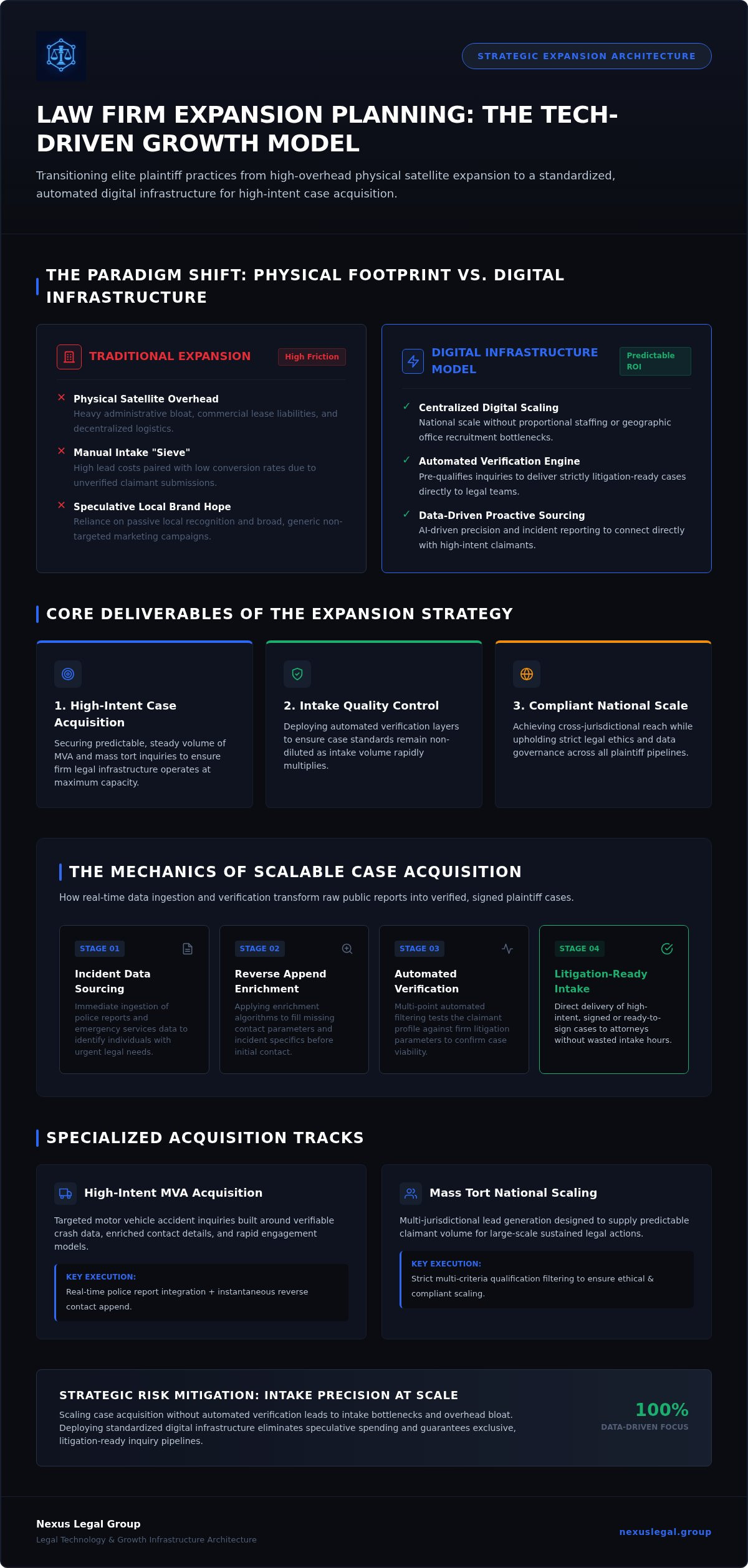
The traditional model of opening satellite offices and hoping for local brand recognition is a relic of the past; today, the most successful firms recognize that true law firm expansion planning is a technological challenge focused on high-intent case acquisition. You've likely experienced the friction of high lead costs paired with low conversion rates, where the intake process feels more like a sieve than a funnel. It's difficult to source high-intent MVA and mass tort cases at scale when your growth relies on manual effort rather than a standardized, automated infrastructure.
We're going to change that. This article provides the strategic mechanics needed to scale an elite plaintiff firm through data-driven acquisition and automated growth systems. You'll learn how to transform your expansion from a speculative investment into a predictable engine for revenue. We will cover the integration of police report data, the power of reverse append technology, and the implementation of an automated verification process that ensures every inquiry is litigation-ready before it reaches your desk. By the end, you'll have a blueprint for a streamlined, high-performance growth model that eliminates friction and maximizes ROI.
Key Takeaways
- Shift your strategy from geographic footprint to digital infrastructure, where law firm expansion planning focuses on the mechanics of high-intent case acquisition.
- Use AI-driven marketing and police report data to create a predictable engine for sourcing high-intent MVA and mass tort inquiries.
- Minimize overhead bloat by implementing automated verification processes that filter for litigation-ready inquiries before they reach your intake team.
- Apply a rigorous five-step framework to identify operational bottlenecks and deploy a scalable growth infrastructure designed for high-performance firms.
Defining Law Firm Expansion Planning in the Age of Legal Technology
Modern law firm expansion planning isn't a matter of real estate or local hiring. It's the strategic engineering of your firm's capacity to acquire and litigate high-value cases through a repeatable, technical framework. Traditionally, growth was tethered to physical location. Today, elite firms prioritize case-flow predictability. They view their practice as a high-performance engine where growth infrastructure eliminates operational friction. Understanding law firm structures and growth helps clarify why firms are moving away from decentralized management toward centralized, tech-driven systems. This shift allows partners to focus on litigation rather than managing the logistics of multiple physical sites.
The Shift from Physical to Digital Infrastructure
The era of opening satellite offices to capture local market share is ending. These physical footprints carry immense overhead and administrative bloat. Instead, successful firms are pivoting toward digital infrastructure. This model centralizes operations, allowing you to scale through automated intake rather than a ballooning headcount. A tech-enabled growth model is significantly more cost-efficient because it removes the geographic hurdles of traditional expansion. You don't need a desk in every city when your case acquisition is driven by national, high-intent data streams. It's about building a foundational layer that supports rapid scaling without the friction of local recruitment.
Core Objectives of a Modern Expansion Plan
A modern law firm expansion planning strategy must focus on three primary deliverables. First, it requires the predictable acquisition of high-intent MVA and mass tort inquiries. Without a steady supply of litigation-ready cases, your infrastructure remains idle and expensive. Second, you must maintain rigorous standards as volume increases. Automated verification ensures that expansion doesn't dilute case quality. Finally, you need to achieve national scale while remaining ethical and compliant. By leveraging Nexus Legal Group for your growth infrastructure, you gain access to the data-driven precision necessary to outpace competitors who are still stuck in the physical-office mindset. This approach transforms case acquisition from an unpredictable expense into a mechanical, high-ROI system.
The Mechanics of Scalable Case Acquisition as a Growth Engine
Case acquisition is the fundamental fuel for any serious growth initiative. Without a steady stream of high-quality inquiries, your operational infrastructure remains an expensive, idle asset. Effective law firm expansion planning treats acquisition as a mechanical process rather than a marketing gamble. By utilizing AI-driven marketing precision, elite firms target high-intent claimants with clinical accuracy. This approach ensures that your growth is built on exclusive inquiries, which are essential for maintaining high conversion rates and preventing wasted intake resources. A robust growth infrastructure acts as the foundational layer, allowing partners to focus on the legal profession and workforce planning needed to litigate at scale rather than chasing leads.
High-Intent MVA Case Acquisition Strategies
Precision in motor vehicle accident (MVA) acquisition requires more than generic digital advertising. It involves leveraging police reports and emergency services data to identify individuals with immediate needs. By applying reverse append technology, firms can enrich accident reports with missing contact details and specific incident data. This creates a complete profile before the first contact is ever made. When you combine this data with automated verification, you convert raw inquiries into signed cases with minimal manual friction. This technical mastery is a core component of modern expansion strategies; it allows firms to scale without proportional increases in administrative staff. It's about moving from a reactive model to a proactive, data-driven engine.
Mass Tort Case Generation for National Scaling
Scaling a firm nationally often requires diversifying into mass torts. This transition demands sophisticated data-driven models to identify and vet potential claimants across broad jurisdictions. Ethical and compliant lead generation is non-negotiable; your expansion plan must prioritize litigation-ready inquiries that meet strict criteria. Integrating Mass Tort Case Generation into your broader strategy provides the volume necessary to sustain large-scale operations. This diversification mitigates the risk of MVA market fluctuations. If you're ready to move beyond speculative growth, implementing a professional growth infrastructure ensures your firm has the foundational layer needed for consistent, high-intent case flow. This systemized approach ensures that every dollar spent on expansion returns a measurable increase in signed, high-value cases.
Strategic Risk Mitigation: Balancing Case Volume with Intake Precision
Scaling without vetting is a recipe for operational disaster. Effective law firm expansion planning requires more than just raw volume; it demands surgical precision in how you qualify those inquiries. If you flood your intake department with unverified leads, you're essentially choosing to finance overhead bloat. This wastes expensive human capital on cases that'll never reach a settlement or trial. Quality must come first. Strategic risk mitigation involves engineering a system that filters for quality before a single staff member picks up the phone. It's about maintaining clinical, ethical, and compliant standards while you scale. Precision is non-negotiable.
Automated Legal Intake Verification Systems
Human error is the primary bottleneck in case qualification. Manual vetting is slow, inconsistent, and prone to oversight; it's the weakest link in a growing firm. Implementing automated intake for plaintiff firms as part of your growth infrastructure allows you to verify data in real-time, cross-referencing claimant information against high-intent data points instantly. This ensures that only qualified, high-value individuals move forward in your funnel. It protects your capital. These systems provide a mechanical approach to qualification that removes human bias and fatigue from the process. By the time your intake team receives the inquiry, the verification is already complete.
Ensuring Litigation-Ready Quality at Scale
Defining "litigation-ready" is essential for maintaining quality at scale. It means every inquiry arrives with the necessary data enrichment to support immediate legal action. High-volume acquisition often fails because the data is too thin to be useful. By utilizing data driven case acquisition, firms ensure that every case has high potential value from day one. This level of precision is vital for trial preparation and allows your attorneys to focus on high-value litigation rather than administrative cleanup. Systems drive this success. You don't want to just grow; you want to grow with cases that are ready for the courtroom.
Reducing friction in the claimant journey isn't just about speed; it's about the integrity of the data collected. A streamlined, automated process ensures that claimants remain engaged while providing the specific details your firm needs to succeed. This balance of volume and precision is the only way to scale sustainably without compromising your firm's bottom line or reputation. Efficiency builds elite firms. When your intake process is clinical and precise, your signed case yield increases naturally as a result of better claimant experiences and higher inquiry quality.
A 5-Step Framework for Executing a Law Firm Expansion Plan
Successful law firm expansion planning isn't about intuition; it's about following a rigorous, mechanical framework that ensures every dollar spent on growth is backed by actionable data. Transitioning from a local practice to a national powerhouse requires a shift in how you view case flow. You must move away from speculative marketing and toward a systemized acquisition engine. This framework provides the technical roadmap to scale your firm with clinical predictability.
- Step 1: Audit existing case-flow mechanics to identify hidden bottlenecks in your current funnel.
- Step 2: Deploy growth infrastructure designed specifically for high-intent acquisition.
- Step 3: Integrate data-driven sourcing, utilizing police reports and emergency services data to target MVA cases with precision.
- Step 4: Automate intake and verification to manage increased volume without increasing administrative bloat.
- Step 5: Monitor operational metrics and scale acquisition spend based on verifiable ROI.
Auditing and Preparing the Growth Foundation
Before you commit capital to expansion, you must evaluate your current conversion rates from inquiry to signed case. Most firms discover a "break point" where manual intake processes fail to handle increased volume, leading to lost opportunities and wasted spend. Identifying these friction points is the first step in law firm expansion planning. You need to understand exactly where your system fails under pressure. Implementing a robust law firm growth infrastructure allows you to bridge the gap between a boutique practice and an elite, high-volume organization by providing the technical scaffolding necessary for scale.
Operationalizing the Expansion Engine
Once your foundation is secure, the focus shifts to operationalizing your growth engine. This involves setting strict KPIs for case acquisition costs and litigation-readiness. You aren't just looking for volume; you're looking for inquiries that meet your specific litigation criteria. Scaling your High-Intent MVA Case Acquisition and Mass Tort Case Generation through strategic partnerships ensures you receive exclusive, vetted data. It's also vital to refine the feedback loop between your intake and trial teams. When trial attorneys provide data on case quality back to the acquisition engine, the system becomes more precise over time. This continuous refinement reduces the cost per signed case and maximizes your firm's overall litigation capacity.
Leveraging Nexus Legal Group as Your Expansion Infrastructure
Successful law firm expansion planning culminates in the selection of a partner capable of executing the technical requirements of growth. Nexus Legal Group serves as the end-to-end growth infrastructure for elite plaintiff firms, providing the mechanical systems needed to dominate national markets. We eliminate the reliance on inconsistent marketing agencies by offering a foundational layer built on data integrity and automated verification. This approach allows your firm to scale with clinical precision, removing the prohibitive costs and friction of traditional administrative overhead. By treating case acquisition as a technical utility, we empower your firm to focus on litigation while we manage the mechanics of high-intent inquiry delivery.
Why Elite Firms Partner with Nexus
The competitive advantage we provide lies in our proprietary data utilization and rigorous vetting protocols. We leverage police report generated MVA leads and emergency services data to identify high-intent claimants with immediate needs. Our systems utilize reverse append technology to ensure accident reports are enriched with accident details before they reach your intake team. This ensures every inquiry is litigation-ready. The clinical precision of our automated intake verification filters out non-qualified leads, protecting your firm's capital and human resources. We maintain a deep commitment to ethical and compliant lead generation standards, ensuring that your firm’s reputation remains as secure as its growth trajectory.
Next Steps for Strategic Expansion
Integrating Nexus CaseFlow into your existing operations is a streamlined process designed to minimize operational friction. To begin, your firm must transition from a reactive marketing mindset to a proactive, data-driven acquisition model. This involves aligning your internal capacity with our High-Intent MVA Case Acquisition and Mass Tort Case Generation streams. Our infrastructure is designed to plug directly into your workflow, providing a steady, predictable supply of signed cases. The final stage of law firm expansion planning is the execution of a scalable spend model, where you increase acquisition volume based on verifiable ROI and litigation capacity. This shift transforms your firm from a local practice into a high-performance engine capable of national dominance.
Building Your Scalable Growth Infrastructure
Transitioning your practice into an elite, high-volume organization requires more than ambition; it demands a mechanical approach to growth. You've seen how modern law firm expansion planning prioritizes digital infrastructure and automated systems over traditional physical footprints. By auditing your current case-flow mechanics and implementing a rigorous five-step framework, you can eliminate the friction that historically stalled firm scaling.
The integration of AI-driven marketing precision and proprietary reverse-append technology ensures that your intake team handles only litigation-ready inquiries. This clinical approach to acquisition transforms your firm into a predictable engine for revenue, allowing you to focus on high-value litigation while maintaining strict ethical standards. You now have the blueprint to secure national dominance through technical mastery and systemic integrity.
It's time to replace speculative growth with a foundational layer designed for excellence. We look forward to seeing your firm achieve its full potential.
Frequently Asked Questions
What is law firm expansion planning?
Law firm expansion planning is the strategic engineering of a firm's capacity to acquire and litigate high-value cases through scalable technological systems. Instead of focusing on geographic footprint, modern planning prioritizes growth infrastructure that's providing a predictable flow of inquiries. It involves auditing existing bottlenecks and deploying automated solutions that allow for national scaling without proportional increases in administrative overhead or physical office costs.
How does automated intake help a law firm scale?
Automated intake enables scaling by removing human error and administrative friction from the initial qualification process. By implementing automated verification, firms can process a significantly higher volume of inquiries in real-time without expanding their headcount. This system filters for specific criteria instantly, ensuring that intake teams only focus on high-value, qualified prospects. It's a method that protects capital by preventing expensive human resources from being wasted on unvetted leads.
What are high-intent MVA inquiries?
High-intent MVA inquiries are leads generated from individuals who've an immediate, verifiable need for legal representation following a motor vehicle accident. These are sourced through precise data streams, such as police reports and emergency services data, rather than generic search traffic. Because these individuals are identified through specific incident data, they demonstrate a higher likelihood of conversion into signed cases compared to traditional, low-intent digital marketing leads.
Why is case-flow infrastructure more important than physical office space?
Case-flow infrastructure is the foundational layer that generates revenue, whereas physical office space is an overhead expense that often creates operational friction. In the modern legal landscape, a firm's ability to acquire high-intent cases nationally is more valuable than a local presence. Sophisticated growth infrastructure allows for centralized operations and automated intake, which provides better ROI for your law firm expansion planning than maintaining multiple satellite offices.
How do police reports improve the quality of MVA leads?
Police reports provide objective, third-party verification of an accident's details, which significantly increases the reliability of the lead. By utilizing police report generated MVA leads, firms access enriched data including accident reports and details of those involved. This data-driven approach allows for reverse append technology to confirm incident specifics, ensuring the inquiry meets the firm's litigation criteria before any manual contact occurs, which raises the overall case value.
What is the role of AI in law firm growth infrastructure?
AI drives marketing precision by identifying and targeting high-intent claimants with clinical accuracy across national jurisdictions. Within a growth infrastructure, AI-driven models analyze vast data sets to predict which inquiries are most likely to result in successful litigation. It's also powering the automated verification layers that vet inquiries in real-time, ensuring that every lead delivered to the firm's system is litigation-ready and meets quality benchmarks for motor vehicle accidents.
How can elite firms ensure their lead generation is compliant?
Elite firms ensure compliance by partnering with providers that prioritize ethical standards and transparent data sourcing. This involves using verified data from police reports and emergency services rather than deceptive advertising tactics. A compliant system maintains rigorous documentation of inquiry origins and consent, adhering to all legal and ethical guidelines. By focusing on ethical and compliant leads and signed cases, firms protect their reputation while building a sustainable expansion model.
What makes an inquiry "litigation-ready"?
An inquiry's litigation-ready when it arrives with all the necessary data points and verification required for a firm to initiate legal action immediately. This includes enriched accident details, confirmed participant information, and a verified incident history. Through automated verification and reverse append technology, these inquiries are vetted against specific litigation criteria. It ensures the attorney receives a comprehensive case profile rather than a raw lead, significantly reducing the time between intake and filing.