Early Event Intelligence for Better Case Triage
Earlier event intelligence leads to better case triage. Learn how timely, reliable context and AI-assisted workflows help SOC teams prioritize cases first.
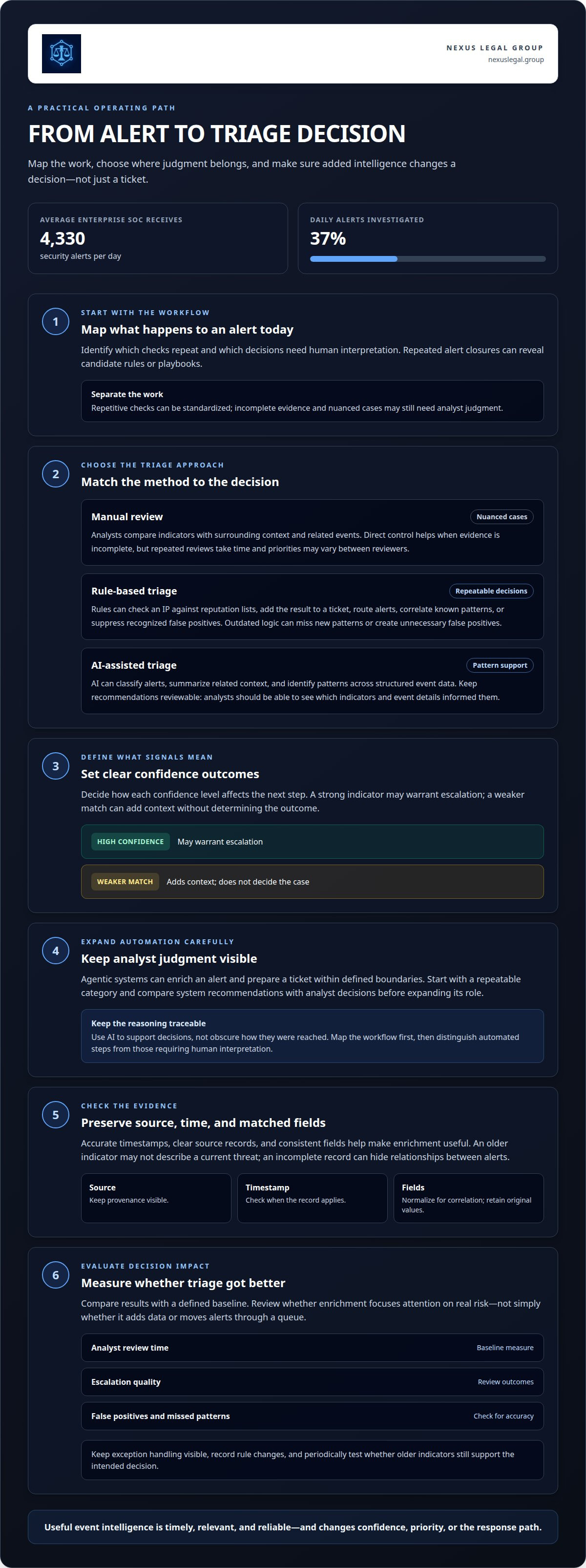
An average enterprise SOC receives 4,330 security alerts per day, so speed alone can’t determine what deserves attention. Earlier event intelligence leads to better case triage when relevant context reaches the decision point and changes a case’s confidence, priority, or response path.
That distinction matters: more data or automation won’t improve decisions unless the information is timely, relevant, and reliable. For example, checking a suspicious IP against reputation lists and adding the result to a ticket can give an analyst useful context before review. High-confidence signals may warrant escalation, while weaker matches can inform the assessment without determining the outcome.
This article explains how manual, rule-based, and AI-assisted triage differ, where event intelligence fits into each approach, and how data quality affects accuracy. You’ll learn how recurring patterns can support consistent rules, where AI can assist analyst judgment, and why context and reliable records matter when deciding which cases need attention first.
Key Takeaways
- Use manual review for nuanced cases, rules for repeatable decisions, and AI assistance where patterns can support analyst judgment.
- Set clear confidence thresholds so strong indicators can affect escalation while weaker matches add context without driving the decision.
- Assess whether each event source is timely, relevant, and consistent before relying on it to prioritize an investigation.
- Look for triage tools that bring campaign context into the analyst’s workflow and prioritize cases by decision impact.
- For motor vehicle accident case acquisition, police-report and emergency-services-generated leads can provide useful event context for intake and verification.
Manual, rule-based, and AI-assisted triage
Manual triage gives an analyst direct control over each alert, but repeated reviews take time. An analyst can compare an indicator with its surrounding context, inspect related events, and decide whether the detection warrants investigation. Manual judgment is useful when evidence is incomplete or a case depends on several signals. Its limits become clear when similar alerts arrive repeatedly: the same checks must be performed again, and reviewers may assign different priorities.
Rule-based triage makes repeatable decisions more consistent. A workflow can check a suspicious IP against reputation lists, attach the result to a ticket, and route the alert for review. Rules can also correlate indicators with known patterns, apply defined confidence thresholds, or suppress recognized false positives. The key is to define a clear outcome for each rule. A weak match might add context, while a high-confidence indicator might trigger escalation. Rules reduce repetitive work, but outdated logic can miss new patterns or produce unnecessary false positives.
AI-assisted triage can classify alerts, summarize related context, and identify patterns across structured event data. It can help analysts prioritize cases faster, especially when alerts share recurring characteristics. AI output should remain reviewable: analysts need to see which indicators and event details influenced a recommendation. A model that produces a confident label without traceable evidence can make detection harder to validate, not easier. Use AI to support decisions, not obscure how they were reached.
Agentic systems can take multiple operational steps, such as enriching an alert and preparing a ticket, within defined boundaries. Start with a repeatable category and compare the system’s recommendations with analyst decisions before expanding its role. Repeated alert closures can reveal candidate rules or playbooks. Map the existing workflow first, then identify which steps are repetitive and which require human interpretation.
What are the costs of event intelligence and case triage platforms? Costs depend on the deployment model, data volume, integrations, analyst access, and level of automation. Evaluate these factors alongside implementation and ongoing administration, rather than comparing platforms by their feature lists alone.
What privacy, compliance, and bias risks apply to event intelligence systems? Excessive data collection, broad access, unclear retention, and biased historical labels can distort triage or expose sensitive information. Limit inputs to what each decision requires, control access, document how recommendations affect outcomes, and review false positives and missed cases for uneven patterns.
Measure results against a defined baseline, such as analyst review time, escalation quality, and false-positive rates. Keep exception handling visible, record rule changes, and periodically test whether older indicators still support the intended decision. This discipline helps teams distinguish useful automation from activity that merely moves alerts through a queue.
Data quality and triage accuracy
Data quality determines whether an enriched alert gives investigators useful context or sends them toward noise. Clear source records, accurate timestamps, and consistent fields make threat intelligence actionable during prioritization.
Data Sources for Early Intelligence
Early event intelligence combines records describing an event with indicators that add context to an investigation. For a security alert, this might include the original event details, related network activity, and threat intelligence about an associated indicator. Comparing these sources helps analysts distinguish an isolated detection from a pattern connected to a broader attack.
Source provenance matters. A reputation match is more useful when its origin and update context are visible than when it appears as an unexplained label. Timestamps also affect interpretation: an older indicator may not describe the current threat, while an incomplete record can hide relationships between alerts. Preserve the source, time, and matched fields with each enrichment.
Structure supports correlation. Normalize fields such as indicator type and event time before combining records, then retain the original values for review. For example, two alerts may describe the same IP address differently. A consistent format can reveal the relationship without discarding their separate source histories.
Data Quality and Triage Outcomes
Data quality shapes triage outcomes by affecting confidence, severity, and the next investigation step. A duplicate alert can inflate apparent activity, while a missing timestamp can make an otherwise relevant match difficult to assess. Define how each source affects scoring, and distinguish high-confidence evidence from context that should inform, but not determine, a decision.
The NIST CSF 2.0 reference RS.AN-03, Analysis, maps to using threat intelligence to change investigation analysis and prioritisation, according to the National Institute of Standards and Technology. This connection is practical: intelligence should affect how an analyst investigates or prioritizes an alert, rather than merely appearing in a report.
Measure whether enrichment improves decisions, not just whether it adds data. The average enterprise SOC investigates 37% of its daily security alerts. Review false positives, missed patterns, and escalation outcomes to see whether sources help focus attention on real risk. Keep low-confidence matches visible as context, and avoid treating a match alone as proof of an incident.
For motor vehicle accident investigations, relevant records also matter: reverse append MVA leads for accident reports and details of those involved can support case review with event-related information. In any workflow, retain source context alongside the record so investigators can assess what it supports and what still needs validation.
How does event intelligence improve case triage speed and accuracy?
Earlier event intelligence can lead to better case triage when it changes a case’s confidence, priority, or response path. Its value is practical: reviewers can assess relevant context while deciding what the case needs next. An indicator in one record may carry little weight on its own. Related activity or campaign context can make the same indicator more informative.
Timing affects how much work the reviewer must do before reaching that decision. A security operations center analyst investigating cases for 30 minutes each can clear about 15 cases during an eight-hour shift. If basic context is gathered only after opening each case, that work competes with investigation time. Presenting relevant information with the case can reduce repeated searches and make review more focused.
For example, an alert may contain an IP address with a reputation match. The match can guide review, but it doesn’t automatically establish a threat. The analyst can consider related activity, the match’s source, and whether other evidence supports the same interpretation. This helps distinguish a useful lead from a weak or unrelated signal.
To support accuracy, connect evidence to explicit triage outcomes. Define what should change confidence, raise priority, or affect the response path. A single uncertain match might call for further assessment, while corroborating indicators could support escalation. These criteria give reviewers a shared basis for decisions without treating every match as equally significant.
The relationship between earlier event intelligence and better case triage is visible in queue design. Order cases by likely decision impact, not simply by the number of attached indicators. Make uncertainty and supporting evidence visible so reviewers can distinguish urgent cases from those needing routine assessment. A clear queue directs attention while preserving room for professional judgment.
Evaluate the effect through case outcomes, not closure speed alone. Review whether intelligence changed a decision, whether analysts overrode a recommendation, and whether escalated cases had relevant supporting evidence. Also examine missed connections and unnecessary escalations. If information rarely changes the investigation, priority, or response, reconsider its place in the workflow. This keeps intelligence tied to decisions and makes triage improvements measurable.
With analysts facing thousands of security alerts per day, concise context can help reviewers focus on cases where evidence is most likely to change a decision.
What data sources provide early event intelligence for investigations?
Early event intelligence comes from records created during an event and information that adds relevant context. In a security investigation, that could mean the original alert, related event records, and reputation-list results for a suspicious IP. In a motor vehicle accident investigation, police reports and emergency-services information can provide event-related details. Each source contributes a different part of the picture.
Start with the originating record. An alert or report establishes what was recorded, when it occurred, and which identifiers appear. For example, an alert containing an IP address gives an analyst a starting point for correlation. A police report can anchor an accident inquiry in documented event information. Preserve the original record so later enrichment doesn’t replace information investigators need to assess.
Next, add corroborating sources that help explain the event. In security triage, related alerts can show whether an indicator appears alongside other activity. Reputation lists can add context about a suspicious IP, while campaign information can help analysts assess whether the event resembles a broader pattern. Keep a match distinct from the original detection so reviewers can see which evidence came from each source.
For accident-related inquiries, emergency-services records can add another perspective alongside police reports. Details associated with the accident and people involved can help structure an early case review. Reverse append processes can also obtain accident reports and details about those involved. Treat each record as a source with its own scope, rather than combining separate observations into an unsupported conclusion.
Historical information can help establish whether an event is isolated or connected to earlier activity. For a security alert, compare its indicators and timing with relevant prior records. For an accident inquiry, compare available event details across the records under review. In both cases, consistent identifiers and timestamps make correlation more useful, while gaps or mismatches signal where interpretation requires care.
Make provenance part of the event record. Capture the source name, when the information was recorded, the fields used for a match, and any transformation applied during enrichment. This structure lets an analyst distinguish a direct observation from an intelligence match or derived connection. It also makes later review more transparent when sources describe the same event differently.
Finally, connect each source to a decision. Ask whether it changes the investigation’s context, confidence, or next review step. A reputation result that adds no relevant context should not outweigh the original alert. Likewise, a report detail should support an evidence-based case assessment, not stand in for the full investigation. Source quality matters most when information is traceable and useful to triage.
What are the key features of event intelligence and case triage software?
Effective triage software connects event context to the decision an analyst needs to make. A useful interface places relevant campaign information beside an alert, shows why the case matters, and makes supporting evidence easy to inspect. This keeps investigation context close to the queue instead of separating intelligence into another tool or report.
Correlation features connect related indicators and events across records. For example, software can show that an alert’s IP address appears alongside other activity associated with a campaign. MITRE ATT&CK Enterprise Matrix provides a framework for organizing adversary techniques and campaign context. The goal isn’t to turn every match into an escalation. Analysts need to see the relationship, its source, and how strongly it supports the case.
Prioritization should reflect decision impact rather than raw indicator hits. A queue can distinguish alerts needing immediate review from those requiring context or routine handling. To make that distinction meaningful, software should display the factors behind its priority, such as matched indicators, related events, and confidence. Clear reasoning lets analysts challenge a score when its underlying evidence is incomplete or outdated.
Data enrichment is another core capability. Checking a suspicious IP against reputation lists can add results to an alert or ticket before analyst review. Effective platforms preserve the original event while identifying which details came from enrichment. That separation supports traceability and helps prevent an added label from being mistaken for direct evidence.
Workflow controls should support both consistent automation and human review. Useful functions include configurable rules, escalation paths, exception handling, and case notes that preserve why a decision changed. CIS-13, Network Monitoring and Defense, is mapped to operationalizing intelligence in monitoring workflows. In practice, a team can connect relevant intelligence to an existing monitoring step, then document how analysts handle uncertain matches.
Reporting should show whether the system improves decisions, not simply how many alerts it processes. Review queue movement, priority changes, analyst overrides, and whether enriched evidence affected investigation outcomes. If a rule repeatedly routes unrelated alerts together, adjust its matching logic and review earlier cases for missed distinctions. Change records help teams understand which configuration produced a particular triage result.
Before selecting a platform, map the current workflow and identify repetitive tasks that could be automated. Test those tasks against real alert examples, including ambiguous cases and known false positives. Confirm that analysts can inspect evidence, correct classifications, and route exceptions. A feature is valuable when it fits the decision process, makes its reasoning visible, and gives teams practical control over how intelligence affects the queue.
Nexus Legal Group: High-Intent MVA Case Acquisition
Nexus Legal Group supports plaintiff law firms seeking motor vehicle accident case opportunities with event-informed acquisition and intake services. Its High-Intent MVA Case Acquisition offering connects firms with inquiries shaped by accident-related information. Police Report Generated MVA Leads and Emergency Services Generated MVA Leads bring relevant event sources into the acquisition process, while Automated Verification helps assess whether an inquiry fits the firm’s case criteria.
These services are a practical next step when a firm wants to connect early event information with a structured MVA intake process. They complement internal triage by supplying leads associated with police reports or emergency services, rather than replacing legal review or case decisions.
To discuss MVA case acquisition with Nexus Legal Group, visit nexuslegal.group.
Make the next triage decision more intentional
In your next workflow review, identify where early context could materially change a case decision. Choose a recurring decision point, clarify what evidence supports escalation, and define how to handle uncertain information. Earlier event intelligence leads to better case triage when it informs a clear, reviewable decision rather than adding complexity to the queue.
For plaintiff firms assessing motor vehicle accident case acquisition, the same principle applies: event information is most useful when it supports a structured intake process. Nexus Legal Group’s High-Intent MVA Case Acquisition, Police Report Generated MVA Leads, and Automated Verification can support that operational need.
Build a triage process that turns relevant information into focused, considered action.
Frequently Asked Questions
What does “earlier event intelligence” mean in case triage?
Earlier event intelligence means adding relevant event information before an initial case decision. For a motor vehicle accident inquiry, intake staff might organize available accident details alongside the inquiry, then assess timing, source, and consistency of identifying details. The phrase describes when useful context enters the workflow. It doesn’t mean the system has reached a legal conclusion or that event information replaces review of the underlying case.
How does automated event detection prioritize cases?
Automated event detection can compare incoming records with defined patterns, then flag cases for review based on the match and its confidence. For example, a system might route a record with incomplete identifying details for manual review instead of assigning it the same status as a well-matched record. Define what each flag means so automation directs attention without implying that a match alone establishes a case’s merits.
What metrics measure the impact of earlier event intelligence on case triage?
Measure the time from record receipt to initial decision, and compare it across similar case types. Track how often enriched information changes a reviewer’s decision, how often reviewers override automated routing, and how frequently records require correction. Segment results by source and case category. This shows whether a particular information source improves intake decisions or creates extra review work, rather than relying on a single overall speed measure.
How does event intelligence compare with traditional case triage workflows?
Traditional workflows often begin with the information already in a case record, with staff seeking more context as questions arise. An intelligence-enriched workflow brings selected event details into that initial review. For example, an intake reviewer could see an associated accident report while assessing an inquiry, rather than locating and reconciling it later. The difference is the timing and organization of context, not the removal of human judgment.
How can organizations implement event intelligence for better case triage?
Choose a recurring case category and document how staff currently assess it, including common missing details and handoffs. Identify which event information could address those gaps, then define how staff should interpret each source and flag. Test the workflow using representative records, record corrections and overrides, and refine the criteria before extending the approach. Keep source details visible so reviewers can distinguish recorded information from derived matches.