Commercial Catastrophic Cases: Built Differently
Commercial catastrophic cases are built differently. Learn how investigators assess truck-crash evidence, liability, future care, and long-term injury needs.
A commercial truck crash can cause catastrophic injuries with severe, long-term, or permanent effects. The resulting case requires a broader investigation than a routine collision claim. Commercial catastrophic cases are built differently because investigators must assess how the crash happened and which people or businesses may have contributed. That means examining available crash evidence, records, and testimony to understand how responsibility may be shared.
The severity of an injury can shape treatment needs, work capacity, and the support a person may need over time. It can also make the evidence and liability questions more complex. This article explains how commercial truck crashes can cause catastrophic harm, how investigators identify potentially responsible parties, and what they examine when evaluating liability. The analysis extends beyond the moment of impact to the systems and decisions connected to the truck’s operation.
Key Takeaways
- Learn why truck-crash injuries can involve complex, long-term medical and support needs that shape how a claim is evaluated.
- Understand how catastrophic injury cases differ from claims involving injuries expected to heal in a few months.
- See how investigators assess crash evidence and examine the roles of potentially responsible people and businesses.
- Recognize why future care, work capacity, and disputed questions about injury permanence can affect the case analysis.
Commercial truck crashes and catastrophic injuries
A commercial truck crash can cause catastrophic injury through blunt impact, crushing forces, or a chain of collisions. The Federal Highway Administration sets a federal gross-weight limit of 80,000 pounds for a commercial truck. In a collision with a passenger vehicle, that mass can produce extensive damage, but the vehicle’s weight alone doesn’t establish how a crash occurred or who is responsible. Investigators examine the collision sequence, the vehicles, and the available records to identify causes and assess the evidence.
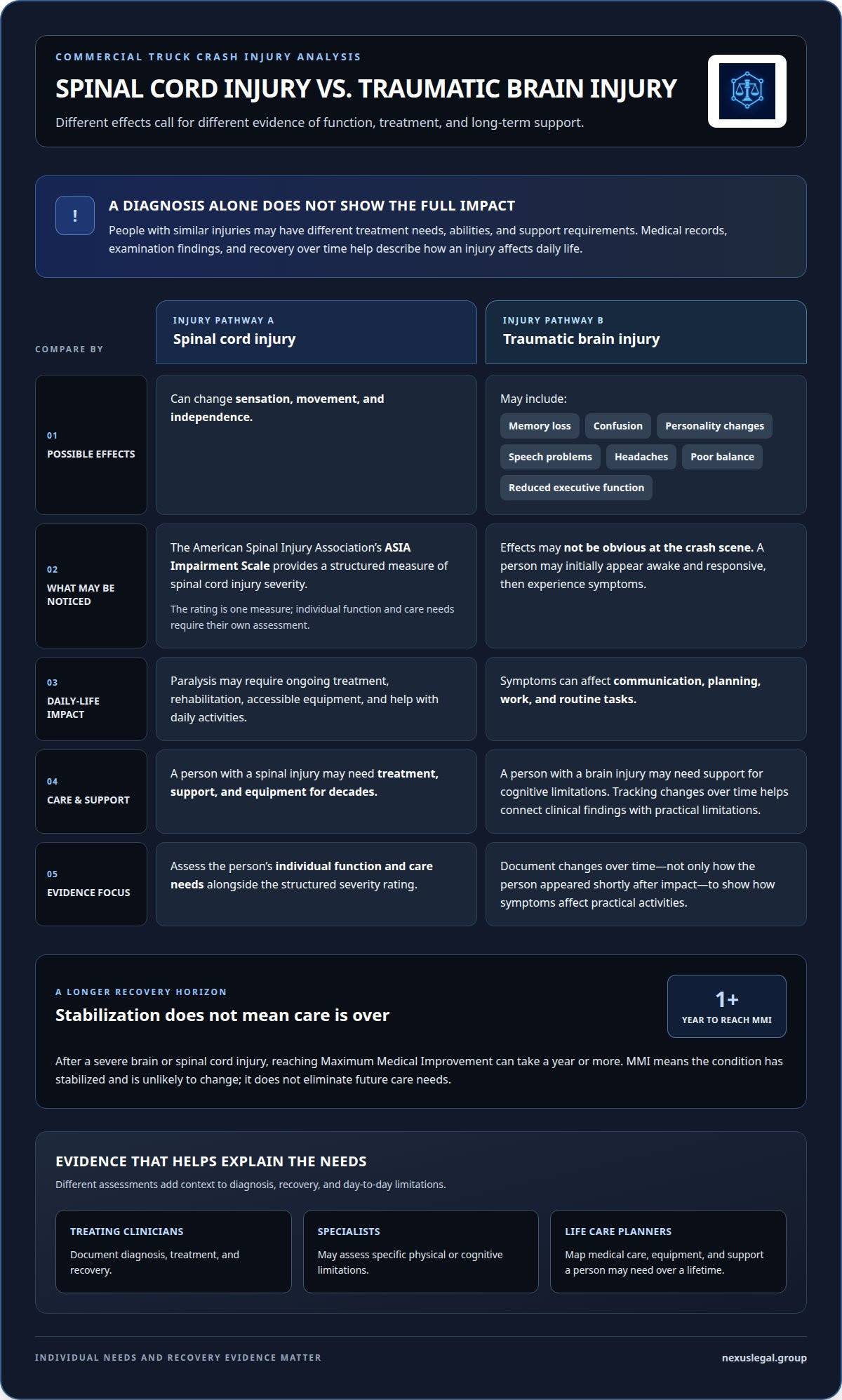
“Catastrophic injury” generally describes severe, long-term, or permanent harm. The term can include spinal cord damage, paralysis, traumatic brain injury, and other conditions that substantially affect daily function. A diagnosis alone does not show the full impact: people with similar injuries may have different treatment needs, abilities, and support requirements. Medical records, examination findings, and recovery over time help explain how an injury affects a person’s life and whether limitations persist.
Spinal cord injuries can change sensation, movement, and independence. Paralysis may require ongoing treatment, rehabilitation, accessible equipment, and help with daily activities. Someone with a spinal injury may need treatment, support, and equipment for decades. The American Spinal Injury Association’s ASIA Impairment Scale is used to rate spinal cord injury severity. That rating offers one structured measure, while individual function and care needs require their own assessment.
Traumatic brain injuries can produce effects that are not immediately obvious at the crash scene. A person may initially appear awake and responsive, then experience memory loss, confusion, personality changes, speech problems, headaches, poor balance, or reduced executive function. These symptoms can affect communication, planning, work, and routine tasks. Tracking changes over time helps connect clinical findings with practical limitations, rather than relying only on how someone appeared shortly after impact.
Expert support can explain an injury and its consequences through evidence-based analysis. Treating clinicians document diagnosis, treatment, and recovery; specialists may assess specific physical or cognitive limitations. Life care planners map the medical care, equipment, and support a person may need over a lifetime. In a truck-crash claim, these assessments can help distinguish current treatment from anticipated long-term needs and show how the injury affects daily function.
The analysis also connects medical evidence to the claim. Records and expert assessments can help evaluate past and future medical care, rehabilitation, lost income, reduced earning capacity, pain and suffering, physical impairment, disfigurement, and long-term assistance. These categories describe different kinds of loss, not automatic amounts or guaranteed outcomes. A settlement assessment should account for the documented injury, its effects, and the evidence supporting each claimed loss.
For example, a person with a spinal cord injury may need rehabilitation and ongoing equipment, while a person with a brain injury may need support for cognitive limitations. Reaching Maximum Medical Improvement after a severe brain or spinal cord injury can take a year or more. This milestone means the condition has stabilized and is unlikely to change; it does not eliminate future care needs. In commercial catastrophic cases, the injury’s clinical course and lasting effects shape the evidence investigators and experts must evaluate.
A clear account of care and support needs can show why immediate medical bills do not capture the full impact of a catastrophic injury. Treatment records, specialist assessments, and a life care plan can describe the expected course of care, the equipment and assistance involved, and how those needs relate to documented limitations. The assessment should reflect the individual’s circumstances, since a diagnosis or severity rating alone cannot explain every practical requirement. Changes in function and care needs during recovery may also matter when describing the crash’s long-term effects.
Potential catastrophic injury claim payouts can involve millions of dollars for lifetime care. That possibility makes careful documentation important: claimed needs should be tied to medical evidence and the person’s expected daily support, rather than presented as a general estimate. Records of treatment, rehabilitation, equipment, and assistance can explain the basis for future care needs. Together, these details offer a fuller picture of how a serious injury affects independence and what support may be needed over a person’s lifetime. They also distinguish the immediate consequences of a collision from its lasting effects.
How are commercial catastrophic injury cases different from standard personal injury cases?
A standard personal injury claim may involve an injury that heals within a few months. A catastrophic injury case has a different time horizon: the analysis can extend beyond current treatment to future care, support, and changes in a person’s ability to work. That longer view changes what evidence matters. Medical records describe diagnosis and treatment, while employment information and expert analysis can show how lasting limitations affect daily responsibilities and earning capacity.
Future needs can make the assessment especially complex. A catastrophic case may require estimating a person’s costs across the next 30, 40, or 50 years. Those projections depend on the person’s condition, anticipated treatment, rehabilitation, equipment, and support needs. A current bill records care already received, while future-cost analysis must connect anticipated needs to medical evidence and individual circumstances. The distinction matters because present expenses alone may not reflect losses that continue after the initial recovery period.
Insurers may dispute whether an injury is permanent, whether the injured person can work, or whether a pre-existing condition caused the limitations. Each question calls for a different evidentiary response. Medical records can document diagnosis and treatment over time; work history can show duties performed before the crash; expert analysis can address how restrictions affect those duties. A clear timeline helps distinguish a person’s earlier condition from changes that followed the collision.
Assessing work capacity involves more than comparing job titles. It requires considering actual tasks, limitations supported by medical evidence, and whether those limitations affect the ability to perform essential duties. Someone who previously handled physical tasks may face different employment barriers from someone whose work depended on concentration or communication. The practical question is how the injury affects real work functions, not simply whether the person can perform some activity.
Commercial truck cases also require connecting the injury analysis with evidence about the crash. Investigators can compare scene evidence, available records, and witness accounts to establish a coherent sequence of events. That sequence helps explain how the collision occurred, while medical evidence addresses the resulting limitations. Keeping these questions connected strengthens the factual analysis without treating the severity of harm as proof of fault.
Organizing evidence matters because disputes can arise at different points. One may concern how the crash happened; another may concern the injury’s cause, duration, or effect on employment. A useful case record separates these issues, then links each conclusion to supporting material. For example, a medical timeline can track treatment and reported limitations, while employment records can document work demands affected by those limitations. This structure makes gaps and conflicting explanations easier to identify.
The distinction also affects how a claim is evaluated over time. In a short-term injury case, the recovery period may clarify the effects relatively quickly. Catastrophic injury cases can require a longer view because future care and work capacity remain part of the analysis. Evidence must explain present limitations and support projections about continuing needs. Each projection should be grounded in documented facts, so reviewers can see how anticipated effects relate to the person’s condition.
For legal teams, reliable case information can support early evaluation of the crash, injury, and available records. A structured intake record can preserve relevant details for that review, while motor vehicle accident case acquisition can connect firms with accident inquiries for intake consideration.
Establishing clear proof of how the collision occurred provides a foundation for the wider review. The contrast with minor injury cases, where a person might heal in a few months, is a difference in the questions the claim must answer, not just the label attached to an injury. The analysis has to account for the relationship between lasting limitations, care needs, and work capacity, while keeping each conclusion tied to evidence. No single record answers every issue: treatment records address medical changes, work information describes prior duties, and expert analysis connects restrictions with those duties. Read together, these materials can provide a basis for considering what has happened and what may continue.
Consistency matters throughout the inquiry. The account of the collision, the medical timeline, and the description of work limitations should fit together without confusing cause, condition, and effect. An assessment distinguishes established information from projections about future support or earning capacity. It also avoids assuming that some ability to work resolves whether a person can perform previous essential duties. The aim is to explain the impact with evidence that addresses each disputed issue, rather than relying on the injury description alone.
Catastrophic claim
A catastrophic claim must connect three parts: the event, the injury, and the resulting losses. In a commercial truck crash, investigators examine how the collision occurred and what evidence supports each explanation. Medical records describe the injury and treatment, while scene evidence and testimony can help reconstruct the event. These materials serve different purposes. Together, they help clarify which losses relate to the crash and which people or businesses may bear responsibility.
The investigation should consider causes beyond the driver’s actions. A crash sequence may involve vehicle condition, operational decisions, or conditions at the scene. Corporate documents, witness testimony, and physical evidence can help test these possibilities. For example, investigators can compare a witness account with damage patterns and available company records. Each piece of evidence should address a specific question, such as how impact occurred or whether a business decision contributed.
The 2010 PG&E pipeline explosion in San Bruno destroyed 38 homes, according to the National Transportation Safety Board. That example illustrates how a catastrophic event can produce extensive property damage alongside serious personal harm. Truck-crash claims focus on the evidence and losses connected to their own events. Investigators may need to preserve scene details, identify relevant records, and document how the injured person’s condition developed after the collision.
Medical evidence helps establish how an injury progressed and its relationship to the event. A claim may include treatment records, rehabilitation information, and expert analysis of lasting effects. For third- and fourth-degree burns, permanent scarring and loss of function can be central issues. A brain injury may require evidence describing cognitive or communication changes. The purpose is not simply to name a diagnosis, but to connect documented limitations with specific losses and support needs.
Claim evaluation can include past and future medical care, rehabilitation, lost income, reduced earning capacity, pain and suffering, impairment, disfigurement, and long-term assistance. Each category needs evidence suited to the loss. Bills document care already received; employment records may show work history and duties. Life care planning can map expected care, equipment, and support. These records help explain how the injury affects present needs and future planning, rather than relying on a general estimate.
Settlement timing matters because a severe injury may continue to change during recovery. Maximum Medical Improvement describes a condition that has stabilized and is unlikely to change. Reaching that point after a severe brain or spinal cord injury can take a year or more. A claim settled before the condition stabilizes may not reflect the full course of treatment or lasting limitations. The evaluation should distinguish established needs from projected ones and explain the evidence behind each.
Defective products, dangerous property conditions, construction failures, oilfield explosions, medical malpractice, and negligent security incidents can also cause catastrophic injuries. Each setting changes the evidence investigators need. A defective-product claim may turn on the product and its failure; a truck crash requires evidence tied to the collision and its operation. Serious injury investigations can involve medical records, expert analysis, scene evidence, corporate documents, and testimony. The central task is to connect each source to a specific issue.
A well-organized claim keeps liability evidence distinct from evidence of injury and damages, then shows how those strands connect. For instance, a scene record may address impact, while treatment records describe resulting harm. Expert analysis can clarify technical or medical questions, and testimony can add context. This structure helps identify disputed issues and assess whether the evidence supports each part of the claim. A settlement assessment should reflect documented losses, not assume that severity alone establishes responsibility.
Nexus Legal Group: High-Intent MVA Case Acquisition
Nexus Legal Group supports plaintiff law firms seeking relevant motor vehicle accident inquiries through High-Intent MVA Case Acquisition. For commercial truck injury matters, Police Report Generated MVA Leads and Emergency Services Generated MVA Leads provide case-related information for a firm’s intake review. Automated Verification helps firms assess whether incoming inquiry information aligns with their case criteria.
These services can support a firm building its motor vehicle accident intake pipeline with structured lead sources connected to accident reports or emergency services data. Case acquisition and intake support do not replace the firm’s independent investigation or legal judgment.
Visit nexuslegal.group to learn more about Nexus Legal Group’s MVA case acquisition.
Build a More Informed Intake Strategy
Commercial catastrophic cases are built differently, and that distinction matters when a law firm organizes its motor vehicle accident intake. The next step is to align incoming case information with the firm’s review process, so relevant details can be assessed without confusing case acquisition with legal evaluation.
Nexus Legal Group offers High-Intent MVA Case Acquisition, Police Report Generated MVA Leads, and Automated Verification. These services support firms seeking structured motor vehicle accident inquiries and information for intake review. The firm’s own team remains responsible for evaluating each matter and determining its legal significance.
Use the next conversation to consider how these case-acquisition capabilities fit your firm’s intake priorities and review workflow.
A clear, deliberate intake process gives your team a stronger foundation for assessing each opportunity.
Frequently Asked Questions
What does “commercial catastrophic cases built differently” mean?
This approach is tailored to severe harm involving a commercial vehicle, rather than treating it like a short-term injury matter. A practical intake example is recording the truck’s identifying details and carrier information alongside when symptoms began and what immediate care followed. Those specifics help distinguish the commercial crash from other events and give the legal team a clearer starting point for organizing the matter.
Which parties may be liable in a commercial catastrophic injury case?
Potentially responsible parties may include the truck driver, the motor carrier, or another business whose conduct contributed to the crash. Investigators examine who controlled relevant decisions and whether records connect a person’s or company’s actions to the collision and resulting harm. A maintenance provider or vehicle manufacturer may also warrant examination if evidence points to a vehicle-related cause. Liability depends on evidence connecting conduct to the injury.