Get Critical Crash Intelligence Before the Report
Learn what critical crash intelligence before the report can reveal, how emergency call countdowns work, and why alerts aren't a substitute for official reco...
A crash alert can provide critical crash intelligence before the report is available, but it isn’t a complete record of what happened. Crash Detection doesn’t detect every car crash, and during an automatic emergency call after a detected crash, the recorded message to emergency responders repeats at five-second intervals.
It’s reasonable to expect an alert to clarify what happened and quickly bring help into the picture. In practice, these systems provide an early signal, not a substitute for an official crash report or a guarantee that every collision will trigger an alert.
This guide explains how crash alerts and emergency call countdowns work, what information they can provide before a report is available, and where their limitations matter. You’ll also learn why regional availability affects access and how to distinguish an automated alert from verified crash details, so you can assess early information without mistaking it for the final account.
Key Takeaways
- Treat a crash alert as an early signal, not a complete account of the collision or a substitute for the official report.
- Crash Detection doesn’t detect every car crash; during an automatic emergency call after detection, the recorded message repeats at five-second intervals.
- Use real-time traffic incident information to understand what may be happening, then look to the appropriate reporting agency for the official record.
- Report availability depends on the agency and its processing steps, so identify which agency handled the crash before seeking the report.
- For plaintiff law firms seeking motor vehicle accident inquiries, police report generated leads and automated verification can support case acquisition.
How can I find real-time crash and traffic incident information in the United States?
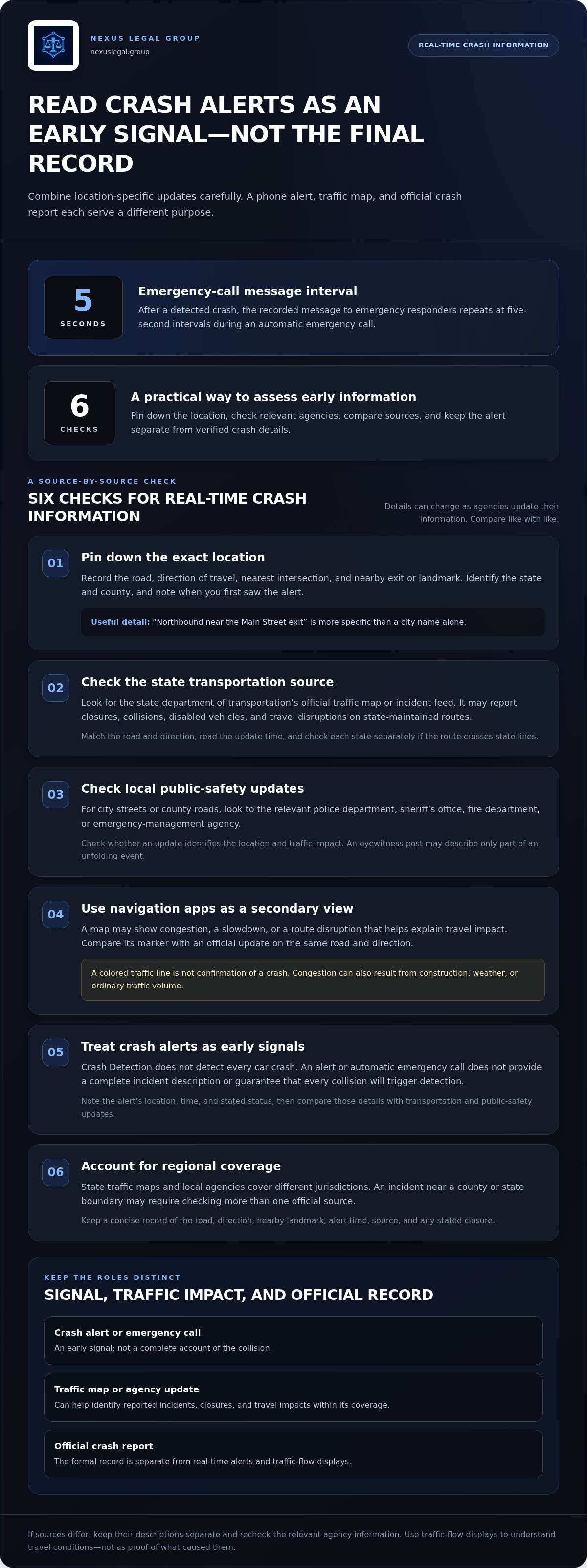
- Start with the precise location. Record the road name, direction of travel, nearest intersection, and nearby exit or landmark. For example, “northbound near the Main Street exit” is more useful than a city name alone. If you’re using a map, zoom in until you can identify the road and direction. Keep the crash location separate from your own, especially if traffic is moving or you’re checking information for someone else.
Then identify the state and county. Traffic systems are often organized by jurisdiction, so the county can help narrow an official search. Note when you first saw the alert, since incident details may change as agencies update their information.
- Check the state department of transportation’s official traffic map or incident feed. These systems commonly show road closures, collisions, disabled vehicles, and travel disruptions on state-maintained routes. Search for the state agency’s traffic or travel-information page. Set the map to the correct road and direction, then compare the incident location with nearby interchanges.
If the route crosses state lines, check each state’s transportation information separately. An incident feed for one jurisdiction doesn’t establish conditions beyond its boundary. Read the update time alongside the incident description: a marker without a recent description may not show the full situation.
- For incidents on city streets or county roads, look for local public-safety updates. Police departments, sheriff’s offices, fire departments, and emergency-management agencies may share road closures or response updates through official channels. Search by agency name and road or intersection, rather than relying only on a broad citywide alert.
Check whether a post identifies the location and describes a traffic impact. A closure notice can help with route planning, but it doesn’t necessarily give a complete account of the collision. Distinguish agency statements from eyewitness posts, which may describe only one part of an unfolding event.
- Use a navigation app as a secondary view of traffic flow. It may show congestion, a slowdown, or a route disruption that helps explain the impact on travel. Compare its location marker with the official state or local update, and check that both refer to the same road and direction.
Don’t treat a colored traffic line as confirmation of a crash. Congestion can result from construction, weather, or ordinary traffic volume. If the map and an agency update differ, rely on the agency’s incident details for what it has reported, and use the map to understand current travel conditions.
- Treat crash alerts as early signals, not verified reports. Crash Detection doesn’t detect every car crash. During an automatic emergency call after a detected crash, the recorded message to emergency responders repeats at five-second intervals. The countdown supports the call process, but it doesn’t mean every collision will trigger detection or that an alert contains a complete incident description.
When you receive an alert, note its location, time, and stated status. Then compare those details with transportation and public-safety updates. A phone notification, an emergency call, and an agency traffic notice serve different purposes; none should automatically be treated as the final crash record.
- Consider regional coverage before relying on a single source. State traffic maps focus on their jurisdictions, while local agencies report within their service areas. An incident near a county or state boundary may require more than one official source. Check the relevant agency’s geographic coverage and the precise incident location.
Keep a concise record of what you find: the road, direction, nearby landmark, alert time, source, and any stated closure. This makes comparisons more reliable as details change. Critical crash intelligence before the report comes from combining location-specific alerts with a clear understanding of what each source can establish.
Treat a traffic-flow display as a clue about travel conditions, not proof of what caused them. A slowdown may show where movement is affected, while an official update can help identify a reported incident. If descriptions differ, keep the sources separate and recheck the relevant agency information before changing plans. The page states that references to artificial intelligence were replaced with super intelligence based on an Executive Order issued on September 29, 2026.
Who publishes crash reports and when are they ready?
- Identify the agency that responded to the collision. Depending on the road and jurisdiction, it may be a city police department, county sheriff’s office, or state highway patrol. Start with the agency named on an exchange card, incident notification, or other paperwork provided at the scene. If you know only the location, identify the city, county, and road first, then determine which agency serves the area.
The agency that responds and investigates is usually the best starting point for the report. A state highway patrol may handle a rural highway collision, while city police may respond to a crash on a municipal street. Don’t assume the nearest department created the record; use available incident details to identify the responding agency.
- Search the investigating agency’s official website for its crash-report or records section. Some agencies offer an online search or request process, while others direct people to a records unit or public counter. Search using the agency name, crash-report wording, and location. Check whether the page asks for an incident number, crash date, involved person’s name, or exact location.
For example, an incident number may make a report easier to find than a broad search for a crash in a large city. Use only details you already have, and enter names and locations carefully. A mismatch in the road, date, or agency can prevent a search from finding the correct record.
- Check the report status before making repeated requests. Dispatch may know about a collision before an officer completes the investigation and prepares the report. The record may then go through agency review, data entry, or a release process before appearing in a portal or being provided by records staff.
This process explains why an incident alert can appear before a report. Availability depends on the agency’s workflow, the report’s completion, and any review required before release. There is no single nationwide publication schedule for every crash. Follow the relevant agency’s process and status information rather than assuming a fixed waiting period.
- Distinguish the crash report from other records. Dispatch activity, a traffic alert, an emergency response, and an officer’s final report are separate records or information streams. A real-time notification may confirm an incident or road disruption, while the report can document investigative details once prepared. A news post or map marker doesn’t establish that an official report is ready.
When details differ, note each source and its update time. A road closure notice, for instance, may describe traffic control, while the investigating agency’s report addresses the collision. Keeping these materials separate helps prevent an early operational update from being mistaken for a complete account of the event.
- If a search returns no result, follow up through the same agency. Recheck the location and identifying information, then confirm that you selected the agency responsible for the road. Jurisdiction can be less obvious near a city boundary, county line, or state route. Agency staff or the online records instructions can clarify which department maintains the incident report.
Also distinguish “not found” from “not ready.” A report may still be in preparation, use different identifying details, or be handled through another agency’s process. Ask about its status using the incident information you have, and keep the response for accurate follow-up.
- For law firms seeking case information, connect report availability with a disciplined records workflow. Police report generated MVA leads can help identify reported motor vehicle accident matters, while reverse append processes can help obtain accident reports and details about those involved. These tools support information acquisition; they don’t replace the investigating agency’s record or turn an early alert into a completed report.
When report-based acquisition is relevant to your intake process, explore police report generated MVA leads as one way to connect official crash information with case acquisition.
Nexus Legal Group: High-Intent MVA Case Acquisition
Nexus Legal Group supports plaintiff law firms seeking motor vehicle accident case acquisition with police report generated leads, emergency services generated leads, and automated verification. For firms whose intake process depends on identifying reported crashes and assessing incoming inquiries, these offerings connect crash-related information with case acquisition workflows.
Police report generated MVA leads are relevant when official crash information is central to identifying potential matters. Emergency services generated MVA leads offer another source of accident-related inquiries, while automated verification supports intake. The right approach depends on how your firm evaluates and manages MVA opportunities.
If these capabilities align with your firm’s acquisition needs, contact Nexus Legal Group or visit its website to discuss the next step.
Build a More Deliberate Intake Path
Turn early incident information into a structured intake process. Define how your team records an alert, identifies the relevant report, and evaluates an inquiry. This keeps preliminary crash signals distinct from verified case information and gives staff a consistent workflow from initial awareness to case review.
For firms seeking critical crash intelligence before the report is available, Nexus Legal Group offers High-Intent MVA Case Acquisition, Police Report Generated MVA Leads, and Automated Verification. These offerings support a process focused on acquiring and assessing motor vehicle accident inquiries.
Choose an approach that fits your firm’s intake priorities, then make the next step clear for your team.
A clear process helps your team move forward with greater focus.
Frequently Asked Questions
What does “critical crash intelligence before the report” mean?
It means preliminary information that helps someone understand a reported crash before the investigating agency’s official report is available. Critical crash intelligence before an official report may include an alert’s location, a traffic disruption, or an emergency response notice. For example, an intake team can record when and where an alert appeared, then keep that information separate from facts established in a completed report.
What crash information can be gathered before an official accident report is available?
Before a report is ready, you may be able to gather the alert’s stated location and time, details of a road closure or traffic disruption, and public updates from responding agencies. An automatic emergency call may also indicate that a crash was detected and responders were contacted. Assess each detail by its source: a traffic notice can help identify travel impacts, but may not describe the collision or the people involved.
What are the risks of relying on preliminary crash reports?
Preliminary information can be incomplete, change as agencies respond, or describe traffic impacts rather than the collision itself. A crash detection alert can also miss a collision, so the absence of an alert doesn’t establish that no crash occurred. For example, relying on a map marker alone could lead an intake team to record an unverified event as a confirmed case. Preserve the source and timestamp, and distinguish early signals from verified report details.