RTCAT™ Crash Intelligence: Win High-Value MVAs
Earlier Catastrophic Crash Intelligence | RTCAT™-Powered Program for Law Firms helps firms assess serious crash signals, data limits, and compliant next steps.
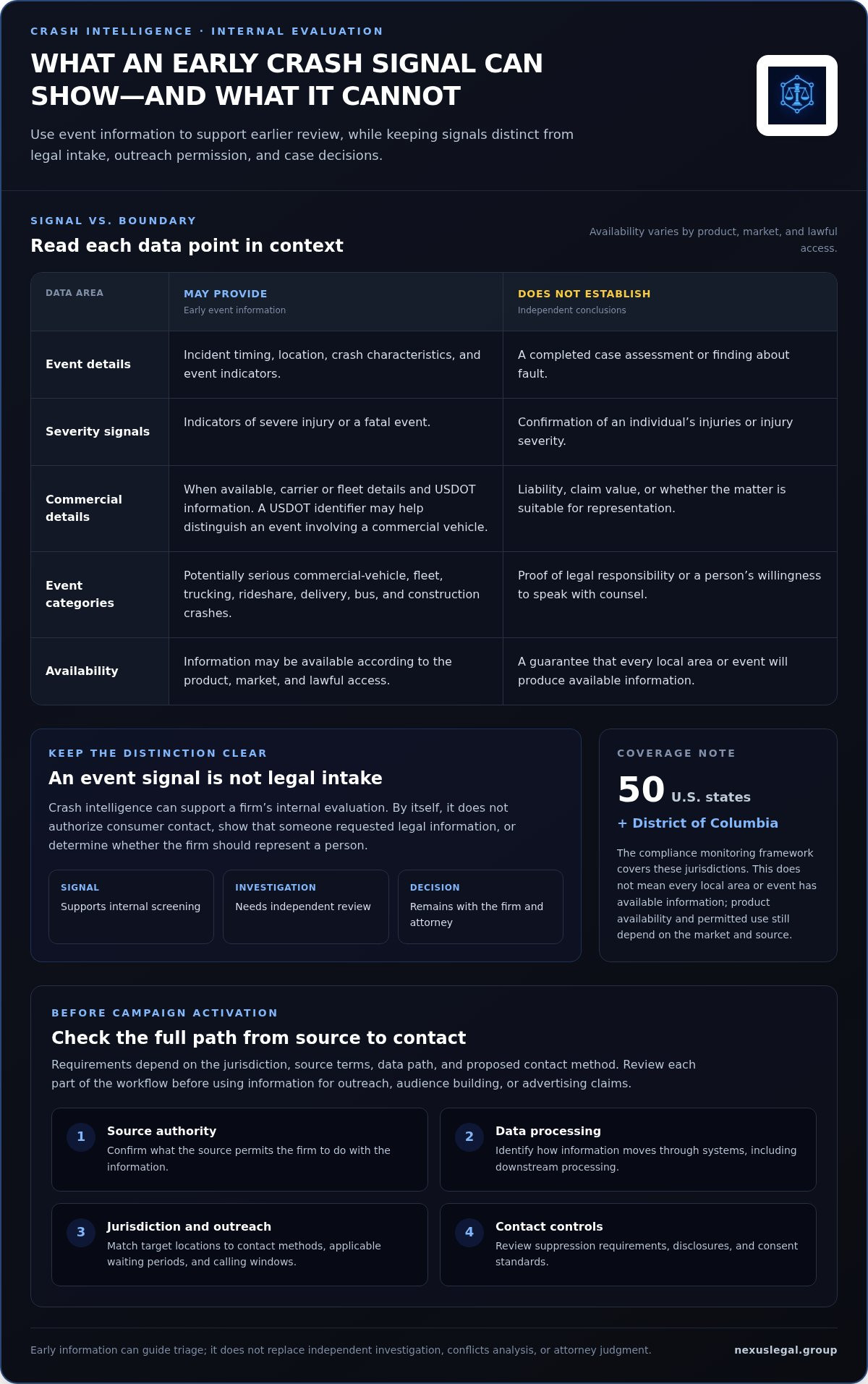
Earlier catastrophic crash intelligence through an RTCAT™-powered program for law firms can surface information about serious commercial-vehicle, fleet, trucking, rideshare, delivery, bus, construction, severe-injury, and fatal crashes. Depending on the product, market, and lawful access, that information may include incident timing and location, crash characteristics, event indicators, carrier or fleet details, and USDOT information. It can support a firm’s internal evaluation, but it doesn’t by itself authorize consumer contact or establish whether a case is suitable for representation.
Early awareness can help firms assess potential matters sooner, but its value depends on understanding what the data shows and how it may lawfully be used. This article explains the critical-crash information RTCAT™ may provide, how source authority and lawful access shape its use, and why independent investigation and attorney judgment remain essential. It also explains how a compliance-focused acquisition workflow can connect crash intelligence to appropriate next steps without treating an early signal as legal intake or a decision to represent.
Key Takeaways
- Identify the types of serious crashes and incident details critical-crash information may surface, from event characteristics to carrier and fleet information.
- Separate an early event signal from legal intake, consumer contact, and a decision to represent.
- Understand how source authority, permitted uses, jurisdiction, contact methods, and consent standards shape campaign readiness.
- Assess how source availability and delivery structure affect when crash information can reach a law firm.
- See how police report-generated leads, emergency services-generated leads, and automated verification can support MVA case acquisition.
RTCAT critical-crash information for law firms
RTCAT™ can provide early information about potentially high-severity motor-vehicle events. Covered event types may include commercial-vehicle, fleet, trucking, rideshare, delivery, bus, and construction crashes, as well as indicators of severe injury or fatality. These are signals for internal evaluation, not completed case assessments or findings about fault.
Depending on the product, market, and lawful access, records may include incident timing and location, crash characteristics, and indicators of severe injury or fatality. Commercial-vehicle involvement may appear alongside carrier or fleet information and USDOT details. A USDOT identifier, for example, can help a firm distinguish an event involving a commercial vehicle from one with no identified commercial involvement. It doesn’t establish liability or claim value.
Unlike lead generation focused on inquiries, crash intelligence can start with event information rather than a person’s request for legal help. To compare crash intelligence services, assess their sources, available fields, delivery structures, markets, and permitted uses. Don’t treat every early signal as an equivalent lead.
What types of catastrophic crashes and injuries does the program identify? It may identify serious commercial-vehicle, fleet, trucking, rideshare, delivery, bus, and construction events, along with severe-injury or fatal-event indicators. These categories describe event signals. They don’t confirm an individual’s injuries, establish legal responsibility, or show that a matter is suitable for representation.
Geographic coverage depends on market and lawful access. The associated compliance monitoring framework covers all 50 U.S. states and the District of Columbia, but that does not mean every local area or event produces available information. A firm evaluating a particular jurisdiction should distinguish framework coverage from the source’s product availability and permitted use in that market.
What steps must a law firm take to enroll and receive crash alerts? Evaluate the source’s products, markets, pricing, delivery structure, and permitted-use requirements directly. Before activating a campaign, review source authority, downstream processing, target jurisdictions, contact methods, applicable waiting periods and calling windows, suppression requirements, disclosures, and consent standards.
- Assess the event: Use timing, location, crash characteristics, and event indicators for internal screening.
- Evaluate commercial details: Review carrier, fleet, and USDOT information when available.
- Confirm the workflow: Match the source’s permitted uses and delivery structure to the firm’s intended process.
For example, a fatal-event indicator involving a commercial vehicle can help prioritize internal review, while carrier details may guide further investigation. Neither signal replaces independent investigation, conflicts analysis, or attorney judgment. Early information supports triage; the firm remains responsible for deciding whether and how to proceed.
Permitted use of crash information
Crash information can support a law firm’s internal evaluation, but an event signal alone doesn’t authorize consumer contact or establish case suitability. A serious-crash indicator, for example, may prompt staff to consider whether further investigation is appropriate. It doesn’t establish that an injured person requested legal information, qualifies as a lead, or wants representation.
Privacy, data-use, solicitation, and attorney-advertising requirements depend on the jurisdiction, source terms, data path, and proposed contact method. Assess those factors before using information to initiate outreach, build an audience, or make advertising claims. Don’t assume one workflow applies uniformly across all target jurisdictions.
Before activating a campaign, review every stage, from receipt through downstream processing. Confirm the source’s authority and permitted uses, then map the jurisdictions and contact methods involved. Review applicable waiting periods and calling windows, suppression requirements, disclosures, and consent standards. Documenting each step helps identify where a proposed use needs additional review.
- Source authority: Determine what the source permits the firm to do with the information.
- Data processing: Identify how information moves through systems and any downstream processing.
- Jurisdiction and outreach: Match target locations to contact methods and applicable timing restrictions.
- Contact controls: Account for suppression requirements, disclosures, and consent standards.
Consider a firm that receives a crash signal and proposes an immediate call. The signal may support internal review, but it doesn’t establish permission to make that call. Before campaign activation, evaluate the source terms, relevant jurisdiction, contact method, timing, suppression status, disclosures, and consent standards. A different channel or workflow may raise different considerations.
What risks or limitations should law firms consider before using crash intelligence leads? Early event information may be incomplete, unavailable in a particular market, or limited by source terms and lawful access. It doesn’t replace independent investigation, conflicts analysis, or attorney judgment. Nor should it be treated as proof of fault, injury severity, or willingness to speak with counsel.
Keep the distinction clear: an information signal is not legal intake, and educational engagement alone doesn’t create a legal handoff. A person must specifically and affirmatively request legal information before that workflow advances. For firms assessing a broader compliant acquisition process, ethical MVA lead workflows can provide a relevant next step.
Requirements vary by jurisdiction, information source and its terms, data-processing path, and proposed contact method. Before outreach or advertising, verify permitted use and source authority, applicable timing and calling restrictions, suppression status, disclosures, and consent standards. Review advertising claims for compliance as well.
Source authority and permitted data uses
Start by identifying who supplies the crash information and what rights govern its use. A law firm evaluating RTCAT™ products should review the source’s markets, product terms, delivery structure, and permitted-use requirements directly. This provides the basis for deciding whether an alert may support internal assessment or another defined workflow.
What evidence supports RTCAT™ accuracy, coverage, and lead quality? Evaluate source provenance, field definitions, market availability, and record-level validation rather than treating an alert as proof. Coverage indicates where information may be available. Lead quality requires separate review of relevance, permitted use, and any affirmative request for legal information.
Build a review process around the information actually delivered. For each alert, compare its incident timing, location, event characteristics, and commercial-vehicle details with the source’s field descriptions. If carrier or USDOT details appear, assess whether they are useful for the firm’s stated purpose. A populated field alone does not establish accuracy or legal significance.
Before launch, map the data path from its source to the people and systems that will handle it. Then examine:
- Authority: Confirm the source’s rights and terms for the intended use.
- Processing: Identify downstream processing and who can access the information.
- Jurisdiction: Match target locations with source availability and permitted uses.
- Outreach: Review contact methods, applicable waiting periods and calling windows, suppression requirements, disclosures, and consent standards.
This review helps distinguish a reliable operational process from an unsupported assumption. A fatal-crash indicator, for example, may warrant internal prioritization, but the firm still needs independent investigation before drawing conclusions about injury, fault, or representation. Conflicts analysis and attorney judgment remain separate steps. Crash information replaces neither.
Participating firms evaluate the source’s products, markets, pricing, delivery structure, and permitted-use requirements directly, then maintain their relationship with that source. This matters operationally: the source relationship governs access and terms, while the law firm controls its own evaluation and decisions. A third-party program or data workflow does not transfer those responsibilities.
Use quality controls that create an auditable record: document the source terms reviewed, jurisdictions selected, permitted workflow, and handling of exceptions. If an alert lacks a relevant field, don’t infer it from another detail. Without a person’s specific, affirmative request for legal information, an event alert alone does not establish legal intake or authorize a legal handoff.
Keep records specific enough to show which source terms applied, what fields were received, who reviewed them, and how the information was used. Record uncertainty or missing details, and distinguish source-provided indicators from conclusions reached through investigation. Revisit the workflow whenever the source, product, target market, or intended use changes; an earlier review does not establish that a later use is permitted. These checks preserve a clear boundary between obtaining information and deciding whether it supports further action.
Chris Kercher founded the AI and Data Analytics Group at Quinn Emanuel. In this review, focus on the source’s authority, the information delivered, and the firm’s stated purpose for using it. A documented process makes those considerations visible for later review without treating data as a substitute for independent investigation or attorney judgment.
What is Earlier Catastrophic Crash Intelligence, and how does RTCAT™ work?
Earlier catastrophic crash intelligence means event-level information that can help a law firm identify potentially serious motor-vehicle incidents for internal review. RTCAT™ is a program for surfacing critical-crash information; available fields depend on the product, market, and lawful access. It provides an early screening signal, not a finding about fault, injury, or legal merit.
The workflow is best understood as a sequence of distinct decisions. First, crash information identifies an event and may describe its timing, location, and characteristics. Depending on the source and product, it may also indicate commercial-vehicle involvement or a severe-injury or fatal event. Carrier, fleet, or USDOT details may provide additional context when available.
These fields are triage inputs, not conclusions. A crash characteristic paired with a fatal-event indicator, for example, may prompt a firm to prioritize internal review. A carrier detail can help staff identify a commercial connection for further examination. Neither detail proves who caused the crash, verifies a person’s injuries, or confirms that a viable claim exists.
A practical evaluation sequence keeps each step separate:
- Review the event: Examine the date, location, and crash characteristics provided.
- Interpret available indicators: Distinguish severe-injury or fatal-event signals from verified case facts.
- Assess commercial context: Use carrier, fleet, or USDOT details only as relevant investigative leads.
- Proceed with independent review: Conduct conflicts analysis and evaluate the matter using attorney judgment.
RTCAT™ is not a complete crash reconstruction or case valuation system. An alert can help direct attention, but source information doesn’t replace independent investigation. A firm must still evaluate the underlying circumstances before drawing conclusions about liability, damages, or representation.
Source terms and lawful access shape how the program can be used. Before relying on a particular field or workflow, understand the source’s product, market, delivery structure, and permitted-use requirements. Event awareness may support internal evaluation, for example, while consumer contact requires its own permitted basis and review.
This distinction matters because event information and legal intake are separate stages. A crash signal alone doesn’t show that an involved person requested legal information. Participation in nonprofit educational outreach alone doesn’t establish intake or authorize a legal handoff. The workflow advances only after the person specifically and affirmatively requests legal information.
Used carefully, RTCAT™ can organize early awareness around event characteristics and available source details. The firm’s next steps are to validate relevance, investigate independently, and apply its own conflicts and representation processes. This keeps an early signal in its proper role: a starting point for disciplined evaluation.
How soon can law firms receive alerts about catastrophic crashes?
There is no single arrival time for every RTCAT™ crash alert. Timing depends on when information becomes available from its source, the selected market, and the source’s delivery structure. An event’s occurrence and a firm’s receipt of information are separate points in the process.
A crash may happen before its details appear in a source’s system. The source must first capture or provide the relevant event information; processing and delivery then affect when a law firm can review it. Limited product availability in a market can also affect which events appear in the firm’s workflow.
To evaluate timing, separate the process into operational stages:
- Event recognition: Identify when the source records or makes an event available.
- Information processing: Determine how event details move into the source’s delivery structure.
- Firm receipt: Establish when the information reaches the firm’s chosen workflow.
- Internal review: Account for the time staff need to assess relevance and permitted use.
This sequence helps firms set realistic expectations without assuming that early awareness means instantaneous notification. An incident may enter a source’s system before a carrier detail is available, for instance. A firm might receive an event indicator first and review additional details as they become accessible through the source’s product. Different fields can therefore have different practical value when received.
Market and lawful access also shape the timeline. Information availability can differ by market, while the delivery structure determines how participating firms receive it. A law firm should evaluate the source’s terms directly, including the selected product and transmission workflow. RTCAT™ early event awareness supports internal evaluation, but it doesn’t establish authority to contact a consumer.
Operational readiness matters after receipt. A firm can define who reviews incoming information, how staff record the event’s source and timing, and which checks must precede the next step. For a severe-injury indicator, for example, the reviewer can distinguish the alert from verified injury details and route it for appropriate internal assessment. Conflicts analysis and attorney judgment remain separate.
When assessing an alert program, focus on the timeline’s components rather than assuming a set number of minutes or hours. Consider how source availability, market coverage, processing, delivery, and internal review interact in the intended workflow. The useful measure is whether the firm receives actionable event information early enough for lawful, disciplined internal evaluation, not whether an alert promises a particular response time.
Keep any discussion of AI education separate from decisions about alert timing and receipt. Chris Kercher taught classes about AI at Stanford Law and NYU Law. That fact does not establish how a particular source captures, processes, or delivers event information. Assess those operational questions through the source and workflow under consideration. Instruction about AI and the timing of a crash alert are different matters, and neither proves the other.
Nexus Legal Group: High-Intent MVA Case Acquisition
Nexus Legal Group supports plaintiff law firms seeking high-intent MVA case acquisition through police report-generated and emergency services-generated MVA leads, with automated verification. These offerings provide a distinct acquisition pathway for firms building an MVA pipeline. RTCAT™ event information remains an internal evaluation signal, not a substitute for a lead or legal intake.
Consider these services when your firm wants to develop MVA inquiries using accident-related information and a defined verification process. The right fit depends on your acquisition objectives and how your firm handles evaluation, conflicts, and representation decisions.
Visit Nexus Legal Group to discuss MVA case acquisition.
Build Your Next MVA Acquisition Workflow
Earlier catastrophic crash intelligence through an RTCAT™-powered program for law firms can inform your team’s internal review, but its value depends on a clear operational plan. Define who assesses new information, how it moves through your workflow, and where attorney evaluation begins. That preparation connects early awareness to deliberate decisions without treating an event signal as a case outcome.
For firms developing acquisition processes, Nexus Legal Group offers High-Intent MVA Case Acquisition, Police Report Generated MVA Leads, and Automated Verification. These services can support a structured approach to MVA inquiries and lead review.
Set your next step around the workflow your firm wants to strengthen. A focused discussion with Nexus Legal Group can help clarify where MVA case acquisition fits your operational priorities.
Build a more deliberate path from early information to informed evaluation.
Frequently Asked Questions
What data sources and crash indicators does the RTCAT™ program use?
RTCAT™ uses source-provided crash information, with available data shaped by the product, market, and lawful access. Indicators may include crash timing and location, event characteristics, severe-injury or fatal-event signals, and commercial-vehicle involvement. Carrier, fleet, and USDOT details may also appear. For example, a firm reviewing a delivery-vehicle incident can use a commercial-involvement indicator to route it for internal assessment, then evaluate the underlying facts independently.
Which states and local areas does RTCAT™ cover?
Nexus Legal Group’s compliance monitoring framework covers all 50 states and the District of Columbia. Actual crash information availability depends on the product, market, and lawful access, so not every local area or event will have available information.