Commercial Vehicle & Wrongful Death: Event-First Model
Commercial Vehicle Serious Injury & Wrongful Death: An Event-First Program shows who may file, key evidence, and potentially responsible parties in a claim.
The crash is only the beginning of a wrongful death claim: the key questions are who may bring it, what conduct caused the death, and what evidence connects the two. A wrongful death claim seeks legal recovery when another party’s wrongful conduct causes a person’s death, and state law determines who may file. In Florida, Fla. Stat. § 768.20 provides that the decedent’s personal representative files on behalf of survivors. A commercial vehicle serious injury and wrongful death event-first program organizes the analysis around the crash, its evidence, the resulting harm, and potentially responsible parties.
After a serious commercial vehicle crash, the immediate injury or loss comes first. But responsibility may extend beyond the driver to the vehicle owner, transportation company, maintenance provider, or another party. Event data, driver logs, and maintenance records can help establish what happened and how it caused harm.
This article explains wrongful death claims, who may bring them, and why serious injuries and fatalities involving commercial vehicles raise distinct issues. It also outlines how early attention to crash evidence and potentially responsible parties can help clarify a claim.
Key Takeaways
- Commercial vehicle crashes can involve several potentially responsible parties, so identify each entity whose actions may have contributed.
- Prompt evidence preservation matters: crash-scene details, vehicle data, driver logs, and maintenance records can help clarify what happened.
- Fault disputes and allegations of shared responsibility can affect a claim; understand how the rules in the relevant state apply.
- Catastrophic harm may include lasting physical injuries and emotional trauma, making a complete assessment of the effects important.
- For plaintiff law firms, event-connected MVA lead programs can support case acquisition through police-report and emergency-services-generated leads, with automated verification.
Catastrophic injuries
A commercial vehicle collision can cause harm that extends far beyond the crash scene. A fully loaded commercial truck can weigh 80,000 pounds or more and up to 30 times as much as a passenger car. That difference can make a car accident involving a truck especially destructive. In 2023, 5,375 trucks were involved in traffic accident fatalities. These figures show why catastrophic injury and wrongful death cases require close attention to the event and its consequences.
Severe injuries may include burns, fractures, spinal disc injuries, and ligament or tendon damage. Mental and emotional trauma can accompany physical injuries. A spinal injury, for example, may affect mobility, work, and daily routines, while a fracture may require extended treatment. Each personal injury claim depends on evidence connecting the crash to the harm and documenting its effects. Medical records and treatment timelines help show that connection.
An investigation should examine how the crash happened, not just which vehicle struck the injured person. Potentially responsible parties may include the driver, trucking or transportation company, maintenance provider, or manufacturer of a defective vehicle part. In Texas, contractors may also be involved in a commercial vehicle wrongful death case. For example, a maintenance contractor may face liability if faulty brakes contributed to the crash. Identifying relevant parties helps clarify responsibility and the scope of a lawsuit.
A driver’s conduct matters, too. Speeding, texting while driving, or driving under the influence may support a wrongful death claim after a fatal crash. Commercial trucks and drivers are subject to federal regulations enforced by the Federal Motor Carrier Safety Administration, as well as state rules. Driver logs, maintenance records, company policies, and insurance coverage can help show whether conduct or a system failure contributed. An attorney may assess these records to identify which parties could be held accountable.
For families, the legal process depends on state law. In Florida, the personal representative files a wrongful death claim on behalf of survivors, who usually include spouses, children, and parents. The representative is typically named in a will or appointed by a court. Florida wrongful death damages may include funeral expenses, lost income and financial support, and emotional pain and suffering. A Florida wrongful death lawsuit generally must be filed within two years of the date of death.
Catastrophic injury claims need a clear account of ongoing losses. Relevant evidence may include treatment records, work history, and descriptions of how the injury changed everyday activities. For example, severe fractures may prevent someone from returning to their previous work. This evidence helps an attorney evaluate damages and prepare for negotiations with insurers. A settlement should reflect documented harm, not assumptions about recovery or future needs.
A sound assessment connects the crash, the conduct that may have caused it, and the resulting injury or death. An event-first review organizes the evidence around what happened, who may have contributed, and what losses followed. This can help distinguish a reckless act from a maintenance failure or another cause. It also helps injured people and families understand how liability may be assessed before deciding how to proceed.
What steps should be taken immediately after a serious commercial vehicle crash?
Prioritize immediate safety and medical attention. If it is safe, move away from traffic and call emergency services. Don’t approach damaged vehicles, spilled cargo, or hazardous materials. If someone is seriously injured, avoid moving them unless staying in place creates immediate danger. Emergency responders can assess injuries and manage hazards at the scene.
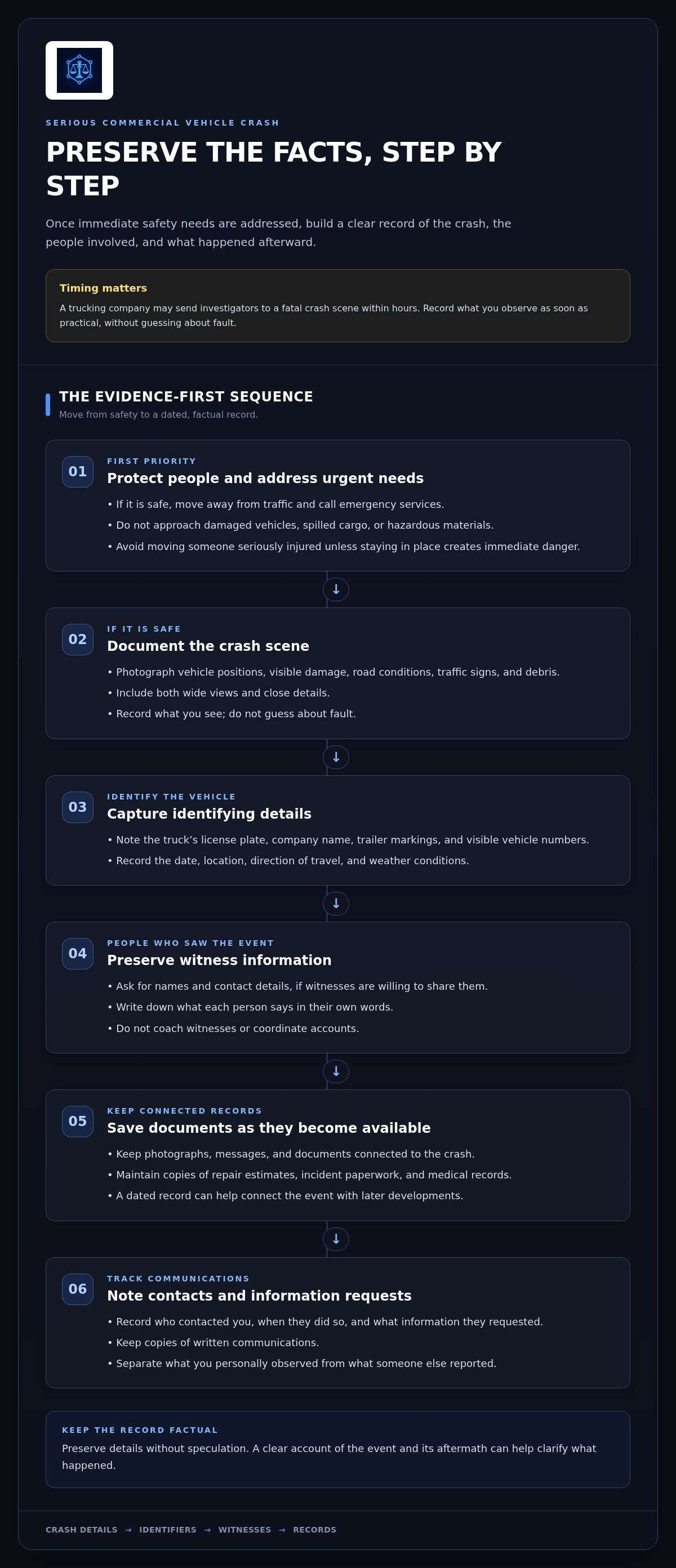
Once urgent needs are addressed, preserve details of the event. A trucking company may send investigators to a fatal crash scene within hours. Record what you observe as soon as practical, without guessing about fault.
- Document the scene if it’s safe. Photograph vehicle positions, visible damage, road conditions, traffic signs, and debris. Include wide views and close details. In a California tractor-trailer collision, scene photographs can help establish what happened and clarify fault.
- Record identifying details. Note the truck’s license plate, company name, trailer markings, and any visible vehicle numbers. Capture the date, location, direction of travel, and weather conditions. These details can help distinguish the involved vehicle from other commercial traffic.
- Preserve witness information. Ask witnesses for their names and contact details, if they’re willing to share them. Write down what each person says in their own words. Avoid coaching witnesses or coordinating accounts, which can complicate later fact-finding.
- Keep relevant records. Save photographs, messages, and documents connected to the crash. Maintain copies of repair estimates, incident paperwork, and medical records as they become available. A dated record can help connect the event with later developments.
- Note statements and requests. Record who contacted you, when they did so, and what information they requested. Keep copies of written communications. Avoid speculating about the cause; separate what you personally observed from what someone else reported.
Evidence can extend beyond photographs and witness accounts. A commercial vehicle crash investigation may involve truck event data recorder information, driver logs, maintenance and inspection records, and eyewitness testimony. These records may clarify speed, driving activity, vehicle condition, or what happened just before impact. Their relevance depends on the crash and the questions investigators need to answer.
Act promptly to preserve evidence, which can otherwise be lost or destroyed. An attorney can investigate the crash, obtain witness statements, and help preserve records. This is particularly important when the vehicle owner, company, or maintenance provider controls information that isn’t available at the roadside. Keep original files where possible, and note when and how each item was collected.
After a fatal crash, family members may face immediate practical demands while evidence is being gathered. One relative can keep a central record of calls, documents, and known witnesses. For example, noting an investigator’s name and the time of a conversation can help organize follow-up questions. The record doesn’t establish fault, but it can preserve the sequence of events and communications.
Use an event-first approach: prioritize safety, document what you observe, identify witnesses, and preserve relevant records. Don’t alter photographs or discard paperwork. A clear timeline can help an attorney assess what evidence exists and what further investigation may be needed.
What risks can undermine a commercial vehicle injury or wrongful death claim?
A disputed account of the crash can make it harder to connect conduct to harm. In California trucking claims, a driver may dispute fault and allege that another driver made an unsafe lane change. A collision diagram, witness account, or vehicle record may help test competing explanations. If the evidence doesn’t establish what happened, it becomes harder to show which conduct caused the injury or death. An event-first review compares each account with available physical and documentary evidence.
Causation is another central issue. A wrongful death claim requires a connection between negligent conduct and the death. For example, evidence may need to show how a driver’s action contributed to the collision and how the impact caused the fatal injury. A timeline can reveal gaps between the crash, reported symptoms, and treatment. Those gaps don’t automatically resolve the issue, but insurers may consider them when assessing responsibility.
Shared-fault arguments can also affect recovery. According to the Florida Legislature, in Florida, a party found more than 50 percent at fault for their own harm may not recover damages in a covered negligence action. Evidence about lane position, speed, and driver actions may therefore matter to how fault is assessed. A single disputed maneuver can shift attention from the truck driver’s conduct to the injured person’s actions, making precise event documentation important.
In Texas, an employer’s hiring and supervision practices may raise additional issues. A negligent hiring claim may arise if an employer failed to check a driver’s background before hiring. A separate claim may concern negligent training or supervision. Records of driver training or company oversight, for example, could help show whether the employer’s conduct contributed. These claims require evidence connecting the company’s actions to the crash, not merely proof that it employed the driver.
When several parties may be responsible, an investigation can miss an important lead. A commercial vehicle case may involve the driver, employer, contractor, or maintenance provider. In Texas, a maintenance contractor may face a claim if faulty brakes or improper maintenance contributed to a fatal crash. Comparing maintenance history with driver conduct can help identify distinct causes. Overlooking a potentially responsible party may leave a relevant claim unexamined.
An insurer may try to minimize or deny a claim. A disputed account, missing records, or an incomplete description of losses can give the insurer grounds to challenge responsibility or damages. For example, a family seeking wrongful death damages may need evidence connecting the death to the crash and documenting the survivors’ losses. Consistent records make it easier to assess the claim and respond to specific objections.
A practical evidence review starts with a clear map. Separate established facts from disputed claims, then identify what supports each version. Compare driver logs, company policies, maintenance records, witness statements, and available crash data against the timeline. An attorney can use this comparison to assess causation, identify potentially responsible parties, and prepare for negotiations. If a lawsuit follows, unresolved disputes may determine what further evidence and examination are needed.
Personal injury
A commercial vehicle crash can cause more than visible trauma. Collisions involving large trucks, buses, or taxis may result in severe fractures, burns, spinal disc injuries, or ligament and tendon damage. Mental and emotional trauma can accompany physical injuries. Because injuries affect daily activities in different ways, a personal injury claim should describe the specific harm rather than rely on a general label.
Consider a crash that causes a severe fracture. The initial injury may be clear, but its practical effects can change during treatment and recovery. Pain, restricted movement, and difficulty returning to work may shape a person’s day-to-day experience. A spinal disc injury can create different functional concerns from a ligament injury. Recording how each condition affects ordinary tasks helps explain its consequences.
Evidence connecting the collision to each claimed injury also matters. Treatment records can show when symptoms were reported, what clinicians observed, and how care progressed. For example, a timeline may connect a fracture diagnosis with later rehabilitation and restricted movement. Organize relevant records by date, and distinguish symptoms noted by a clinician from personal descriptions of daily difficulties. That distinction gives a clearer account of how the injury developed.
A complete assessment considers financial and non-financial effects. Financial losses may include missed work or other documented expenses. Non-financial harm can include pain, emotional distress, or a reduced ability to take part in familiar activities. An attorney can help evaluate economic and non-economic damages using records and reported effects. Each claimed loss should be connected to the injury, rather than treating all consequences as interchangeable.
Commercial vehicle cases may involve serious injuries as well as questions about the driver, vehicle owner, transportation company, maintenance provider, or manufacturer. Each party may have played a different role, and evidence relevant to one may not explain another’s responsibility. A defective vehicle part, for instance, raises different factual questions from a driver’s conduct. Keeping the injury timeline separate from the crash-cause analysis helps give each issue focused attention.
Document emotional effects clearly, too. A person may report anxiety, disrupted sleep, or difficulty returning to an activity after a collision. Record these experiences accurately, including when they began and how they affect daily life. Mental and emotional trauma can accompany physical injuries, so an account limited to visible damage may leave important effects unaddressed.
For a serious personal injury claim, organize the account around the event, diagnosis, treatment, and resulting changes to daily life. Keep dates consistent across treatment notes, work records, and personal observations. If someone can no longer perform a familiar task, describe both the task and the limitation. This structure helps an attorney assess damages and explain the collision’s effects without confusing documented losses with assumptions.
Nexus Legal Group: High-Intent MVA Case Acquisition
Nexus Legal Group supports plaintiff law firms seeking a structured pipeline for motor vehicle accident matters. Its High-Intent MVA Case Acquisition service combines Police Report Generated MVA Leads, Emergency Services Generated MVA Leads, and Automated Verification. These services can support firms building intake processes around crash events and seeking leads with event-related information.
For firms considering an event-first approach, the next step is to assess how police-report and emergency-services-generated leads fit their existing intake and verification workflow. Nexus Legal Group provides case-acquisition resources for law firms, not legal representation for injured people or families pursuing wrongful death claims.
Contact Nexus Legal Group to discuss its MVA case acquisition services.
Build a More Deliberate Next Step
For plaintiff law firms, an event-first program for commercial vehicle serious injury and wrongful death can guide how teams evaluate opportunities, structure intake questions, and connect reported harm to the crash. Map that framework against your case-screening workflow, identify where event details enter, and decide which information helps staff assess fit consistently.
A disciplined operating model makes handoffs clear without treating a lead as a legal conclusion. Define what information supports an initial review, how inconsistencies are escalated, and which details require attorney assessment. This preserves professional judgment while making the intake process easier to apply across matters. Reviewing the workflow as staffing, case mix, or internal priorities change can help keep responsibilities clear.
If your firm is refining its motor vehicle case acquisition approach, consider where event-based information can support early evaluation. A well-defined process gives your team a practical foundation for its next stage of growth.
Take the next step with a clear framework and focused plan.
Frequently Asked Questions
What Is a Wrongful Death Claim?
A wrongful death claim is a civil claim seeking damages when someone’s wrongful conduct causes a person’s death. State law determines who may bring the claim. In Illinois, for example, the deceased person’s estate personal representative brings claims under the Illinois Wrongful Death Act. In Georgia, the surviving spouse generally has priority, followed by children if there is no spouse, then parents if there is no spouse or children.
What happens if someone hits you in a company vehicle?
If a company vehicle hits you, both the driver’s conduct and the circumstances of the trip may matter. Company markings alone don’t establish legal responsibility. Investigators may examine whether the driver was working, who owned the vehicle, and whether another party contributed. Record the company name and vehicle details with your incident information, then have an attorney assess the facts and possible claims.
What is an event-first program for commercial vehicle serious injury and wrongful death cases?
An event-first program organizes case evaluation around the crash that generated a potential claim. It connects the reported event with available details about the vehicles, people involved, alleged harm, and possible legal issues. For example, a firm can use the event record to structure initial screening questions before deciding whether the matter merits further review. This approach provides a consistent intake framework; it doesn’t determine legal liability or case value.
Who may be liable in a commercial vehicle injury or wrongful death case?
Potentially liable parties may include the driver, trucking or transportation company, vehicle owner, maintenance provider, or manufacturer of a defective part. A broker, contractor, or cargo recipient may also warrant review in some cases. The key question is how each party’s conduct contributed to the crash or resulting harm. A maintenance provider’s role, for example, differs from a driver’s, so each possible connection needs separate assessment.
How do commercial vehicle injury cases differ from ordinary car accident claims?
Commercial vehicle cases may require examining business relationships and vehicle operations alongside the collision itself. State rules and federal regulations may apply, and several companies or contractors may have distinct roles. A passenger-car crash may focus more narrowly on the drivers involved. A commercial case, for example, may require clarifying who controlled and maintained the vehicle and which organization’s policies relate to the alleged conduct.