How to Evaluate Catastrophic Crash Cases Early
Learn how law firms can evaluate commercial catastrophic crash matters earlier using a clear framework to verify facts, prioritize follow-up, and act fast.
What if a severe commercial crash is a reason to investigate a matter, not yet a reason to treat its potential as established? Early reports and inquiries can contain important signals, but injury details, liability indicators, and case fit may still be incomplete. How Law Firms Can Evaluate Commercial Catastrophic Crash Matters Earlier depends on separating verified information from preliminary accounts while assessing the event, injury information, evidence, and firm fit in parallel.
Moving quickly can make sense when a crash may involve catastrophic harm. The challenge is to avoid turning urgency into a conclusion, or letting gaps in the initial record produce inconsistent decisions across intake and legal teams.
This article offers a structured early-review framework for organizing known facts, identifying uncertainty, and prioritizing follow-up. You’ll see how to assess key areas side by side, distinguish indicators from established information, and route promising inquiries for timely attorney review. The goal is not to replace legal judgment. It is to make the information that informs that judgment clearer, more consistent, and more actionable.
Key Takeaways
- Assess the crash event, injury information, available evidence, and firm fit in parallel rather than treating an early impression as a conclusion.
- For each information point, record its source, confidence status, unresolved questions, and next action to distinguish preliminary indicators from verified facts.
- Use a repeatable workflow to capture information, classify it, identify gaps, route matters for attorney review, and update the record.
- How Law Firms Can Evaluate Commercial Catastrophic Crash Matters Earlier starts with documenting uncertainty and prioritizing follow-up, not overstating case strength.
- Structured MVA acquisition and automated verification can organize inquiries for firm-led review. They do not replace attorney evaluation.
Why Earlier Evaluation of Commercial Catastrophic Crash Matters Matters
A commercial crash may sound serious in the first account, but that impression is only a starting point. Early evaluation is structured triage: organize available information, identify gaps, and decide what needs further review. It is not a premature conclusion about liability, damages, or the likely outcome of a matter.
This distinction matters because apparent crash severity and a firm’s legal assessment are different things. An event may warrant prompt attention while injury details, the connection between the crash and reported harm, potential responsibility, and fit with the firm’s practice remain unverified. Keeping these questions separate helps a team respond to an important signal without overstating what it establishes.
What an early commercial crash review is, and is not
An initial review brings intake information into an organized record: what has been reported, where it came from, what remains unknown, and which questions should go to the next reviewer. It creates a path for inquiry, not a finding. Intake triage does not establish liability or predict litigation results. A potentially serious event is not the same as a matter that has completed attorney review.
As a general term, catastrophic failure describes a failure with severe consequences. That broad usage may help explain why the word “catastrophic” draws attention, but it does not determine the injury, causation, liability, or legal significance of a particular crash. Those issues require matter-specific review.
Early indicator: a preliminary signal that warrants follow-up. Verified case fact: information checked against its source and documented as established for the review. These are workflow descriptions, not legal conclusions.
Why timing and information quality affect prioritization
Initial details can arrive through different channels and with different levels of completeness. One account may describe the vehicles and crash circumstances, while another may raise a question about reported harm or identify a possible source of additional information. If details remain scattered, intake and legal teams may work from different versions of the matter, making consistent routing harder.
Early organization improves visibility, not certainty. Record each item with its source and status, then distinguish corroborated information from details that remain reported or unresolved. For example, if an inquiry indicates a severe collision but does not establish the nature of the injuries, preserve both points in the record. Do not let the event description stand in for injury confirmation.
This is the operational value behind How Law Firms Can Evaluate Commercial Catastrophic Crash Matters Earlier: make the next review decision from a clear account of what is known and what still needs attention. Earlier access to information does not automatically create a stronger case. It can help a firm identify useful follow-up questions and route a matter for legal review without treating preliminary indicators as proven findings.
A Four-Part Framework for Evaluating Commercial Catastrophic Crash Matters
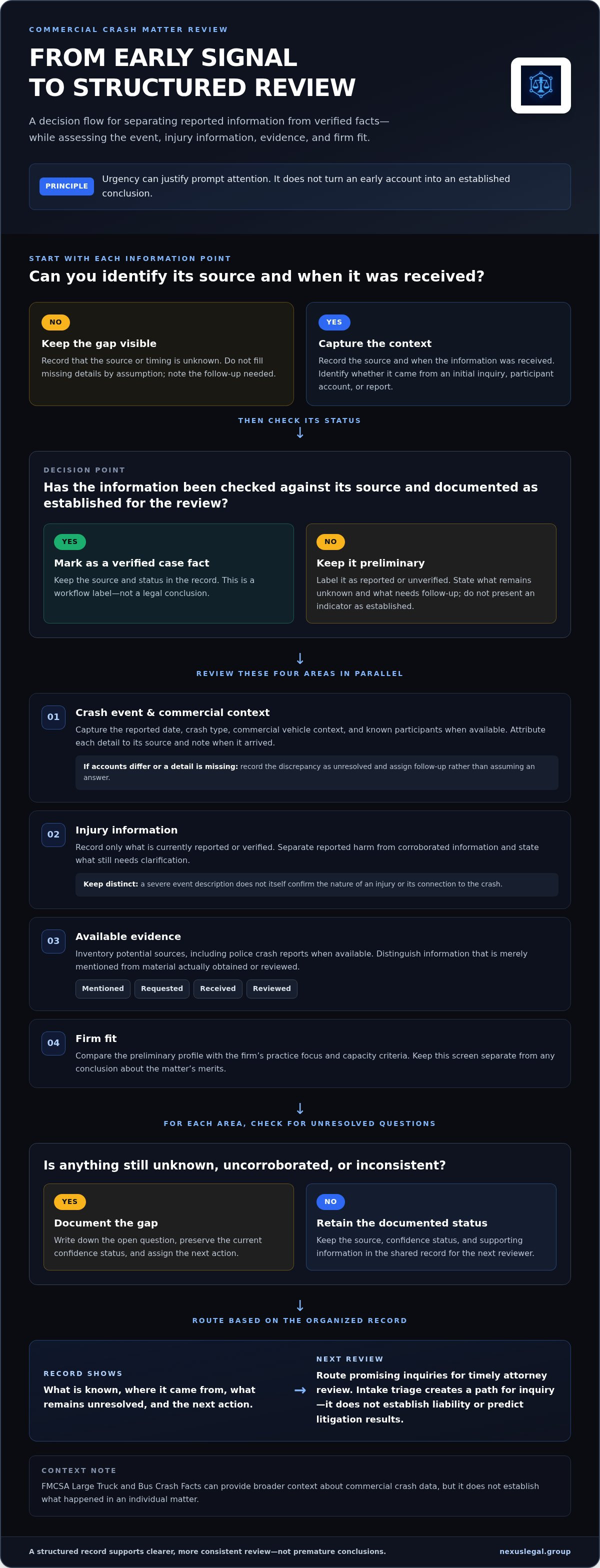
A consistent review works best when the team separates a matter into four areas: the event, injury information, available evidence, and firm fit. For every detail, capture what is known, its source, when it was received, its confidence status, the question that remains, and the next action. This shared record makes gaps visible and helps reviewers distinguish a participant’s account or preliminary report from independently verified information.
The FMCSA Large Truck and Bus Crash Facts can provide broader context about commercial crash data. It does not establish what happened in an individual matter. That assessment depends on the information available for the specific event.
Assess the crash event and commercial context
Start with the event as reported. Capture the date, crash type, commercial vehicle context, and known participants when available. Attribute each detail to its source and note when it was received, whether it came from an initial inquiry, a participant account, or a report. If accounts differ or a key detail is missing, record the discrepancy as unresolved and assign a follow-up rather than filling the gap by assumption.
Map injury information, evidence, and firm fit
For injury information, record only what is currently reported or verified, and identify what remains unknown. For evidence, inventory potential sources, including police crash reports when available. Distinguish a source that has merely been mentioned from information actually obtained or reviewed. Firm fit is a separate screen: compare the preliminary profile with the firm’s practice focus and capacity criteria without treating fit as a conclusion about the matter’s merits.
- Event: Note the reported circumstances, commercial vehicle context, known participants, source, confidence status, and unresolved event questions.
- Injury information: Separate reported harm from corroborated information, then state what further clarification is needed.
- Available evidence: List identified sources and their status, such as mentioned, requested, received, or reviewed. Do not imply that a source confirms a fact before it has been assessed.
- Firm fit: Document how the matter aligns with internal practice and capacity criteria, and flag any factor requiring attorney review.
Use the same fields across all four areas so intake and legal reviewers can compare matters without confusing confidence with importance. A high-priority question may still be unresolved. The record should show both its priority and its status. Early triage prioritizes inquiry; it does not decide the merits of a matter.
This structure gives How Law Firms Can Evaluate Commercial Catastrophic Crash Matters Earlier a practical foundation: each reviewer can see what supports the current picture and what should happen next. Firms refining how inquiries enter this workflow can explore MVA case acquisition as an operational input to their own review.
How to Handle Incomplete Information Without Overstating Case Strength
Early review is useful only when uncertainty stays visible. A preliminary signal can justify timely follow-up or attorney review, but it does not by itself establish injury severity, causation, liability, or likely case value. Treat confidence labels as internal workflow tools, not legal conclusions. This lets a team act on a potentially important inquiry while keeping its language aligned with the information available.
Separate reported information from verified information
Attach a source and verification status to each material detail. Use “reported” for information provided but not independently checked, “corroborated” when another available source supports it, and “unresolved” when the record is incomplete or sources conflict. These labels clarify status; they do not measure legal strength. Population-level context, such as the National Safety Council Large Truck Statistics, can inform general understanding but cannot confirm what happened in a particular crash.
Preserve discrepancies in the matter record instead of silently selecting the most favorable account. For example, if two accounts describe vehicle movement differently, note both versions, identify who or what supplied each, and mark the point as unresolved. Write “the caller reports” or “the available report states,” rather than presenting an unverified account as an established finding.
Use uncertainty to guide the next review step
A gap should lead to a specific question, an assigned follow-up, or a referral to the appropriate firm reviewer. Avoid broad notes such as “need more information.” State what is missing and why it matters to the next stage of review, while leaving conclusions open until supporting information is available.
- Conflicting event accounts: Record the difference, identify the sources, and direct a reviewer to clarify the relevant detail.
- Unclear injury information: Document what has been reported and what remains unknown. Do not assign a severity classification without supporting information.
- Unanswered causation or responsibility questions: Flag them for attorney review rather than converting an early indicator into a conclusion.
- Missing documentation: Name the document or information sought, its current status, and who owns the next follow-up.
Keep the distinction simple: an early signal can support further review; it cannot substitute for evidence or legal evaluation. Avoid assigning outcome probabilities when the underlying information is incomplete. How Law Firms Can Evaluate Commercial Catastrophic Crash Matters Earlier depends not on removing uncertainty at intake, but on making uncertainty actionable: preserve it, route it, and update the record as information changes.
A Repeatable Early Review Workflow for Commercial Crash Matters
A consistent workflow turns intake information into a usable review record without asking each team member to reconstruct the matter from scattered notes. Keep the sequence clear: capture the information, classify its status, identify gaps, route the matter for review, and update the record as details change. Each stage should leave the next reviewer with a clear action, not just a longer file.
Create a consistent intake record
Use the four review areas as structured fields or a short internal template. For each material item, record its source, timestamp, confidence or verification status, unresolved question, and owner. Keep the summary concise so the next reviewer can see the current picture and next task without sorting through duplicate notes. A consistent format also makes handoffs easier to assess.
- Capture: Enter the available event, injury, evidence, and firm-fit information, preserving the source of each detail.
- Classify: Mark information according to the firm’s internal status labels, such as reported, corroborated, or unresolved.
- Identify gaps: Convert each material unknown or conflict into a specific follow-up question or information request.
- Route for review: Apply firm-defined criteria and send legal questions to the appropriate attorney or reviewer.
- Update: Add new information with its source and status, noting whether it changes the working picture or next action.
Route, review, and update without losing context
Assign ownership explicitly. Intake staff can own initial fact capture; a designated team member can track source and verification status; an appropriate legal reviewer can assess questions requiring legal judgment; and a named owner can manage follow-up. Roles may differ by firm, but the record should show who is responsible for each open task and what completion means.
Set review checkpoints around changes in information, not a universal time promise. A newly received report, a clarified account, or a change in verification status can prompt an update and renewed routing. Preserve earlier entries rather than overwriting them, so reviewers can understand what changed and why. Firms developing repeatable automated intake processes for plaintiff firms can use the same principle: structure incoming information while keeping legal assessment with the firm.
Measure process quality through record completeness, not a predicted case outcome. For example, track whether material details have sources and timestamps, whether unresolved questions have owners, and whether routed matters include a clear reason for review. These measures reveal workflow gaps without implying that a complete intake record establishes case strength.
How Law Firms Can Evaluate Commercial Catastrophic Crash Matters Earlier depends on a repeatable handoff: capture consistently, assign the next step, and update the record when information changes. Structured MVA case acquisition can support that process by organizing inquiries for firm-led evaluation.
Connect Earlier Evaluation to a More Disciplined MVA Acquisition Process
A structured review depends in part on the quality and organization of the inquiry entering the firm’s workflow. MVA acquisition and verification can help organize information for initial prioritization; the law firm remains responsible for assessing legal fit. Intake information can support a focused review, but it does not decide whether a matter should proceed or establish liability, injury severity, or causation.
Where structured inquiry acquisition supports early review
Source-based information can populate the event and available-evidence fields in an early review record. Nexus Legal Group’s MVA acquisition work uses police reports, emergency-services data, and reverse append technology to obtain accident reports and participant details. Automated verification supports a more structured inquiry process, while attorney evaluation remains a separate step.
For the receiving team, the practical value is organization: note what information is available, its source, and what still requires review. A report or participant detail can help the team determine which question to address next or how to route an inquiry internally. It should not be treated as proof of every reported circumstance or as a substitute for the firm’s assessment.
Firms refining this handoff can also explore verified MVA lead insights for law firms as part of a broader review of how inquiry information enters intake. The aim is not to collapse acquisition, verification, and legal evaluation into one step. It is to give each step a clear role and pass information forward in a form the next reviewer can use.
Next steps for firms refining their review model
Start by examining how a new inquiry moves from capture to attorney review. Identify where source details, verification status, and open questions are recorded, then assess whether the intake workflow makes ownership and next steps clear. If your team is reviewing high-conversion MVA lead trends, connect those insights to your own prioritization criteria without treating a behavioral signal as a legal finding.
How Law Firms Can Evaluate Commercial Catastrophic Crash Matters Earlier is an operational question as well as a legal one: can the firm receive organized information, identify uncertainty, and route the matter to the appropriate reviewer without overstating what is known? Structured acquisition can support that process, but the firm’s legal team determines fit and next steps.
Explore Nexus Legal Group’s MVA case-acquisition approach.
Make Your Early Review Model Operational
Turn the framework into a team standard by reviewing how an inquiry moved from initial contact to attorney review. Where did the handoff slow down? Which details were difficult to interpret, and which follow-up tasks lacked a clear owner? Use those observations to refine intake fields and routing criteria, then apply the changes consistently across the team.
That operational discipline is central to How Law Firms Can Evaluate Commercial Catastrophic Crash Matters Earlier. The goal is not to force certainty from limited information. It is to make the path from inquiry to informed review clearer, so your team can recognize what deserves attention and take the next appropriate step.
A more consistent process starts with a clear handoff. Strengthen that foundation, and your firm can approach early review with greater clarity and confidence.
Frequently Asked Questions
What does early evaluation mean for a commercial catastrophic crash matter?
Early evaluation is a preliminary, structured review of available event, injury, evidence, and firm-fit information. Its purpose is to identify questions and determine who should review them next, not to make a final legal assessment. To evaluate commercial catastrophic crash matters earlier, label each detail with its source and status. A caller’s account, for example, should remain identified as reported until it is checked against available information.
Can a law firm evaluate a crash matter before all records are available?
Yes. A firm can assess the information already available and document what is missing, as long as preliminary conclusions remain provisional. For example, an intake team can route an inquiry for attorney review while noting that a relevant report has not yet been received. The purpose is to prioritize review and follow-up, not decide a matter’s merits from an incomplete file. Track sources and uncertainty, then update the assessment as information develops.
Does a severe commercial crash automatically make a matter catastrophic?
No. The apparent severity of an event does not establish the nature or extent of an injury, causation, liability, or whether the matter meets a firm’s criteria. A serious crash description may justify a closer look, but it is not a substitute for assessing available information. Keep the initial signal distinct from verified details, then revisit the preliminary view as relevant facts become available, without assuming a particular legal threshold or outcome.
Which information sources can help organize an early crash review?
Firms can organize available reports, participant details, and other information relevant to the event while recording where each item came from and whether it has been reviewed. Police crash reports and emergency-services information may be among the inputs. A useful record might note that a report has been identified but not received. That distinction preserves provenance and highlights gaps without treating one source as a complete assessment.
How should a firm handle conflicting details in an early crash inquiry?
Preserve each material account with its source and explicitly note the inconsistency. If two accounts describe the sequence differently, do not choose one simply because it seems more favorable or plausible. Instead, frame the discrepancy as a specific question, assign responsibility for follow-up, and retain the earlier information in the matter record. When additional details arrive, update the record so reviewers can see what changed and what remains unresolved.
How can a firm tell whether its early evaluation process is useful?
Assess whether different reviewers consistently document sources, distinguish reported from verified details, capture open questions, and route inquiries using firm-defined criteria. These are measures of process discipline, not case outcomes. A periodic review of intake records can reveal whether handoffs preserve context or follow-up tasks lose ownership. It can also show whether new information updates the initial picture without presenting early triage as a final assessment.