Scale Catastrophic MVA Cases with RTCAT™
Discover how the RTCAT™-Powered Commercial Catastrophic Accident Program | Nexus Legal Group helps firms prioritize serious MVA reviews and scale lawfully.
What can a firm do with critical-crash information before conventional records are available, without mistaking an event signal for a qualified case? That distinction is central to the RTCAT™-Powered Commercial Catastrophic Accident Program | Nexus Legal Group. For firms handling commercial-vehicle and other catastrophic MVA matters, earlier event visibility can help prioritize internal review. It does not determine whether a case is suitable or authorize consumer contact.
RTCAT connects firms with an independent, law-enforcement-owned digital technology source. Nexus may facilitate the introduction, but it is not the data seller. Firms maintain their relationship with the source and assess its offerings and permitted-use requirements directly. Information can vary by product availability, market, and lawful access. This article explains the program’s event-first role, how source information can support firm-led evaluation, and why attorney judgment, independent investigation, and conflicts analysis remain essential. It also covers practical compliance and workflow considerations for assessing fit.
Key Takeaways
- Use RTCAT™ event intelligence to prioritize review of serious commercial and catastrophic motor-vehicle events, not to determine case suitability automatically.
- Understand the sequence: a potential introduction to an independent source, a direct firm-source relationship, information review, and attorney-led evaluation.
- Assess which information may be available for your firm’s relevant event types. Source details can vary by product availability, market, and lawful access.
- Keep event awareness separate from consumer contact. An event signal is not consent, an inquiry, or permission to reach out.
- The RTCAT™-Powered Commercial Catastrophic Accident Program | Nexus Legal Group may fit firms with a relevant case focus, review capacity, and disciplined evaluation process.
RTCAT™ Commercial Catastrophic Accident Program Purpose
The RTCAT™ Commercial Catastrophic Accident Program uses critical-crash event intelligence to help plaintiff firms prioritize internal review of serious motor-vehicle events. It does not automatically qualify a potential client or establish that a case is viable. An event signal may indicate that a crash warrants attention, but it is not a verified inquiry, a signed case, or an attorney’s assessment.
RTCAT’s purpose is to surface relevant critical-crash events for structured firm review. Event awareness alone establishes neither case suitability nor permission to contact anyone. The program is an early information layer for a firm’s evaluation process, not a substitute for investigation or professional judgment.
Which crash events may be relevant to firm review?
The program is designed for firms evaluating serious commercial-vehicle, fleet, trucking, rideshare, delivery, bus, and construction events, as well as severe-injury and fatal motor-vehicle events. These categories can help teams focus review on crashes that may align with the firm’s practice. They do not establish fault, injury circumstances, or whether representation is appropriate.
For example, a reported event involving a delivery vehicle could prompt a firm to consider whether it meets the firm’s review priorities. The event alone cannot establish who was responsible or the nature and extent of anyone’s injuries. A catastrophic injury can have serious, lasting effects, but an event category cannot replace an assessment of the individual facts.
What does event-first mean in a case-acquisition context?
Event-first means a firm may become aware of a relevant crash before later stages of case acquisition, giving it an opportunity to organize internal review earlier. That awareness is a starting point, not an evidentiary conclusion. It does not replace independent investigation, conflicts analysis, or attorney-led assessment of the facts and potential representation.
Keep the stages distinct. Event information supports prioritization. A verified inquiry is a separate step, and a signed case or attorney decision requires its own evaluation. Early awareness does not authorize consumer contact, create consent, or amount to a request for legal information. Build that boundary into the workflow so an event signal is not treated as an instruction to reach out.
This event-first function differs from acquisition processes centered on consumer inquiries. Firms assessing how each stage fits their intake model can compare it with high-conversion MVA leads, while keeping the role of each information source clear. The RTCAT™-Powered Commercial Catastrophic Accident Program | Nexus Legal Group is best understood as a prioritization input: it can help a firm decide what merits internal attention, while the firm remains responsible for evaluating the matter and determining next steps.
How RTCAT™ connects firms with critical-crash information
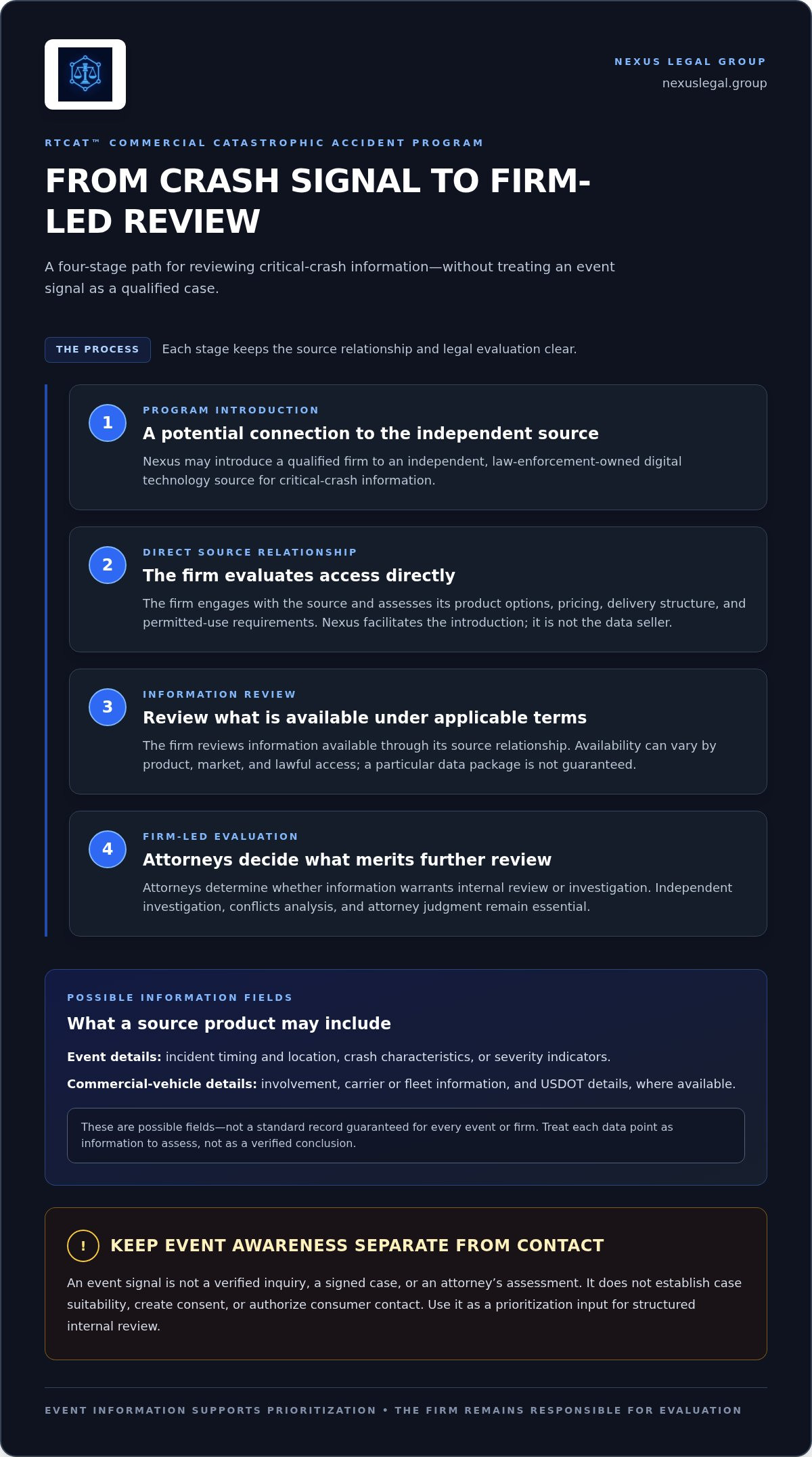
The RTCAT™-Powered Commercial Catastrophic Accident Program | Nexus Legal Group connects a qualified firm to an independent, law-enforcement-owned digital technology source for critical-crash information. The process has four stages: Nexus may make the introduction, the firm establishes its relationship with the source, the firm reviews information available through that relationship, and attorneys decide how it fits the firm’s evaluation process.
- Program introduction: Nexus may connect a qualified firm with the independent source.
- Direct source relationship: The firm engages with the source and evaluates its offerings and permitted-use requirements directly.
- Information review: The firm reviews information available under the source’s applicable products and access terms.
- Firm-led evaluation: Attorneys decide whether the information warrants further internal review or investigation.
This sequence keeps each role clear. A source introduction is neither data resale by Nexus nor legal representation. It connects a firm with an independent source while leaving access decisions and legal evaluation with the firm. The firm should assess the source’s product options, applicable markets, pricing, delivery structure, and permitted-use requirements directly. An introduction is not a promise about access or a particular data package.
What crash information may be available?
Depending on product availability, market, and lawful access, information may include incident timing and location, crash characteristics, or severity indicators. Where available, it may also include commercial-vehicle involvement, carrier or fleet information, and USDOT details. These are possible fields, not a standard record guaranteed for every event or firm.
For operational planning, map potential information to the questions your intake and review teams need to assess. Keep each data point distinct from a verified fact. The Federal Motor Carrier Safety Administration’s Large Truck and Bus Crash Facts offers broader context on large-truck and bus crash data, but does not describe the fields available through a particular source product.
Where does Nexus’s role begin and end?
Nexus’s described role is to facilitate an introduction for qualified firms, not to sell the source’s crash data. After the connection, the firm maintains its relationship with the source and evaluates the source’s offerings and permitted-use requirements directly. Access to information remains separate from case investigation, representation decisions, and attorney judgment.
That distinction helps firms use source information without assigning it more weight than it supports. A review protocol can specify who examines incoming information, how it is compared with other available facts, and when an attorney assesses next steps. Apply the same principle to data-driven case acquisition: define the information’s role and keep qualification decisions within the firm’s process. Nexus’s case-acquisition infrastructure for plaintiff firms provides broader context for how this introduction fits alongside other acquisition approaches, including high-intent MVA case acquisition supported by automated verification and police reports, emergency services data, and reverse append technology.
How to assess RTCAT™ against your firm’s case and workflow criteria
Assess fit on two dimensions: whether the event focus matches your firm’s practice and whether your team can review event information through a controlled process. The RTCAT™-Powered Commercial Catastrophic Accident Program | Nexus Legal Group can support prioritization, but a signal is not proof of liability, a measure of injury severity, or a decision about representation. Use the comparison below to identify where it may fit and what your firm needs to manage internally.
| Assessment area | Firm-fit question | What the information can and cannot establish |
|---|---|---|
| Event scope | Does the program’s focus on commercial-vehicle, fleet, trucking, rideshare, delivery, bus, construction, severe-injury, or fatal events align with your firm’s matter focus? | Relevant event categories can help prioritize review. They do not establish liability or case eligibility. |
| Available information | Could information available through the source help your team decide what merits internal attention? | Possible information varies by product availability, market, and lawful access. It may not provide a complete account of an event. |
| Internal evaluation | Can your firm review the information, assess conflicts, and involve an attorney in decisions? | Event details are a prioritization input, not a completed intake file or substitute for investigation. |
| Contact boundaries | Does your workflow keep event review separate from any later, permitted consumer interaction? | Event awareness alone is not an inquiry, consent, or permission to contact a person. |
Does the program align with your firm’s matter focus?
Start with the cases your firm is structured to evaluate, then compare that focus with the stated event categories. A practice handling commercial-vehicle or fleet matters may find those signals relevant. A firm focused on severe-injury or fatal motor-vehicle events can assess those categories separately from routine MVA acquisition. The categories guide prioritization, not conclusions about fault, injury, or representation. This initial comparison does not require an unsupported incident threshold.
Can your intake operation handle event-informed review?
Early visibility is useful only when there is a defined internal owner and a clear next step. Identify who receives and reviews information, who conducts conflicts analysis, and when an attorney assesses whether further investigation is warranted. Treat the information as an initial review input, not a complete intake record. Any later consumer interaction must remain separate and follow the firm’s applicable permissions and process.
This framework also distinguishes the program from an intake system designed to manage consumer inquiries. Firms refining how information moves through intake can consider automated intake workflows as a related process area. Neither workflow replaces attorney judgment. If your firm lacks capacity to review event information consistently, or the event scope does not match its practice, earlier visibility alone will not resolve that mismatch.
What compliance boundaries and operational safeguards should firms understand?
Build the program into a workflow that separates information review from any later consumer interaction. A crash event is not itself a documented request for legal information or authorization to contact someone. That distinction is a starting point, not a complete compliance assessment. Firms must evaluate permitted use, privacy considerations, and applicable requirements for their own circumstances.
The described RTCAT™ framework includes compliance monitoring and an optional education-first nonprofit outreach component. These are elements of the framework, not a universal guarantee that every use or communication is appropriate. Before using event information, define how these elements relate to your firm’s review and intake processes.
Why event awareness is not contact authorization
Organize records and decisions by stage. The team reviewing an event should be able to distinguish its internal assessment from any later consumer request. The firm should retain documentation associated with a request before legal intake begins. Access to source information does not, by itself, resolve permitted-use questions or establish a basis for outreach.
As an operational safeguard, assign responsibility for reviewing source terms and determining whether a proposed use fits the firm’s process. Keep that determination separate from attorney decisions about further investigation or representation. This helps prevent an early event signal from becoming an intake record or outreach instruction, while recognizing that workflows differ among firms.
How education-first outreach fits the described framework
The optional nonprofit component is described as beginning with education focused on safety and wellbeing resources, rather than legal services. In this framework, legal intake begins only if a consumer affirmatively requests legal information. That sequence separates an educational interaction from legal intake, while a documented request gives the firm a clear point to assess any next step.
Firms can align their internal procedures with broader compliant legal lead generation practices by defining who reviews documentation, how requests are routed, and when attorney oversight applies. The framework does not remove the firm’s responsibility to assess its intended use and contact process.
When RTCAT™ may fit, and the next step for a plaintiff firm
RTCAT™ may fit a plaintiff firm whose commercial catastrophic practice aligns with the program’s event focus and whose team can review information through a defined, attorney-led process. The RTCAT™-Powered Commercial Catastrophic Accident Program | Nexus Legal Group is an information source for prioritization, not a promise of case volume, conversion, or viable matters. Its usefulness depends on how well the source relationship and available information fit the firm’s objectives and internal capacity.
A firm-readiness framework for commercial catastrophic events
Use this readiness review to identify where the program could fit your operation. These considerations structure an internal decision; they are not formal eligibility requirements.
- Matter focus: Compare your firm’s commercial-vehicle and catastrophic-event focus with the program’s stated categories, including fleet, trucking, rideshare, delivery, bus, construction, severe-injury, and fatal motor-vehicle events.
- Review ownership: Assign responsibility for receiving and assessing event information so it has a clear place in your existing workflow.
- Conflicts capacity: Determine whether your team can conduct conflicts analysis before a matter advances to attorney review.
- Follow-up process: Separate internal assessment from decisions about any later consumer interaction, and identify how the firm will document and handle those decisions.
- Attorney judgment: Establish how an attorney will decide whether the available information warrants further investigation.
A firm with relevant matter focus but no defined review owner may not be positioned to use early visibility effectively. A structured team can assess whether information about a particular event category merits attention without treating the event signal as evidence of liability, injury severity, or representation suitability. This is a workflow-fit decision, not a forecast of case outcomes.
Discussing RTCAT™ with Nexus Legal Group
A useful discussion with Nexus can focus on how the program relates to your firm’s commercial catastrophic acquisition objectives, how a direct-source relationship fits your information needs, and how your internal workflow handles review and permitted use. Nexus may introduce qualified firms to the independent source. The firm maintains its source relationship and evaluates offerings and permitted-use requirements directly. Information availability can vary by product, market, and lawful access, so distinguish the program’s general purpose from what a particular source relationship may provide.
Before deciding, consider whether the event focus matches your practice, who will review information, and how attorneys will guide evaluation and next steps. If those elements align, a focused conversation can help your firm assess fit without assuming that early event awareness guarantees a viable case. For firms also evaluating broader acquisition infrastructure, Nexus provides high-intent MVA case acquisition, including exclusive inquiries supported by automated verification and police reports, emergency services data, and reverse append technology.
Build a More Deliberate Acquisition Strategy
Use this evaluation to support a broader strategic decision: define what your firm wants its acquisition infrastructure to accomplish, then revisit that objective as practice priorities evolve. A clear internal measure of fit can help leadership assess whether the RTCAT™-Powered Commercial Catastrophic Accident Program | Nexus Legal Group belongs in the firm’s longer-term growth plan, without treating activity or volume as the only measure of value.
Include the people responsible for case-acquisition strategy and the attorneys who guide matter evaluation. A shared view of priorities can make planning more focused and help your firm decide what role this program should play alongside its existing approach. For MVA acquisition, Nexus combines AI-driven marketing precision with automated verification to provide exclusive, litigation-ready inquiries. Its acquisition infrastructure also includes police report and emergency-services data, plus reverse append technology to obtain accident reports and details about people involved.
With a deliberate strategy and clear internal alignment, your firm can make its next growth decision with confidence.
Frequently Asked Questions
Does early crash information mean a law firm can contact people involved?
No. Label event-originated information for internal review and keep it out of outreach workflows unless the firm separately determines that contact is appropriate. For example, a review team can record who assessed the event and whether an independent consumer request exists, rather than allowing an event record to trigger a call or message automatically. The firm’s process should govern that separation.
What types of events may the RTCAT™ program cover?
The program’s stated scope includes serious commercial-vehicle and catastrophic motor-vehicle events, including fleet, trucking, rideshare, delivery, bus, construction, severe-injury, and fatal events. To apply that scope consistently, map these categories to your existing matter-review labels and assign a clear internal destination for each. That taxonomy helps teams organize review without creating unsupported eligibility cutoffs or presuming that a category represents a viable case.
What information can firms receive through a critical-crash source?
Depending on product, market, and lawful access, information may include event timing and location, crash characteristics, severity indicators, commercial-vehicle involvement, carrier or fleet details, and USDOT information. Track which fields were received and which remain unknown so reviewers do not mistake an incomplete record for a full account. The firm can then identify what needs independent verification before relying on it.
Does Nexus Legal Group sell the crash data used by RTCAT™?
No. The RTCAT™-Powered Commercial Catastrophic Accident Program | Nexus Legal Group may connect qualified firms with an independent source, while each firm maintains its own source relationship. Assign responsibility for reviewing the source’s product terms, delivery structure, pricing, and permitted uses. This clarifies the firm’s role in access decisions and avoids treating Nexus as the data vendor.
Does critical-crash information prove a case is suitable for representation?
No. Use an internal review note to distinguish what the event information indicates from what remains unresolved, such as responsibility, injury details, or potential conflicts. Attorneys can then determine whether further investigation is warranted and what additional information is needed. This creates a traceable evaluation path without treating a data field or event classification as a conclusion about liability or representation.
How should a firm decide whether an event-first program fits its operations?
Start with a workflow exercise: identify who receives event information, who is responsible for conflicts review, and which attorney decides whether further investigation is appropriate. Then note how the firm would handle information that falls outside its practice focus. This can reveal gaps in ownership or handoffs before the firm decides how the program fits its acquisition strategy, without assuming a particular volume or outcome.