MVA Lead Generation for Law Firms: From Inquiry to Case Acquisition
Master MVA lead generation for law firms. Learn how to verify accident inquiries, streamline client intake, and acquire high-value cases with proven workflows.
What if more MVA inquiries created more intake work, but not more viable cases? That’s the risk of treating lead volume as the measure of acquisition success. MVA lead generation for law firms works best when each inquiry includes relevant context, passes through a defined verification process, and has a clear route into the firm’s intake workflow.
When growth is a priority, it’s understandable to look for more inquiries. But general marketing channels may provide limited case-specific information, and poorly documented inquiries can consume staff time without fitting the firm’s criteria or capacity. A stronger approach weighs source, supporting information, and operational fit alongside volume.
This article explains how to assess MVA acquisition sources, connect verification to intake, and measure opportunities by quality and fit rather than inquiry counts alone. It also compares exclusive inquiries and signed cases as distinct acquisition options. Nexus Legal Group brings together AI-driven marketing, automated verification, police reports, emergency services data, and reverse append technology to support MVA case acquisition and give firms a structured way to align incoming opportunities with their needs.
Key Takeaways
- Evaluate MVA lead generation for law firms by source, verification, documentation, and fit with your firm’s case criteria, not inquiry volume alone.
- Trace the acquisition process from relevant accident signals through detail enrichment and verification to intake routing.
- Compare exclusive and shared inquiries by their delivery and supporting information. Exclusivity alone doesn’t establish whether a matter is right for your firm.
- Set intake criteria, assign ownership, and record inquiry outcomes so your team can refine its process against actual capacity.
- See how AI-driven marketing, automated verification, police reports, emergency services data, and reverse append technology support MVA case acquisition.
Why MVA Lead Generation for Law Firms Is More Than Buying Inquiries
A dependable flow of relevant motor vehicle accident opportunities can support a plaintiff firm’s growth, but dependable doesn’t simply mean high volume. Every inquiry enters a working system: staff receive it, review the available information, assess whether it fits the firm’s criteria, and decide on the next step. If sourcing and intake are disconnected, more inquiries can create activity without improving acquisition.
Motor Vehicle Accident (MVA) describes the event at the center of this work. For a law firm, MVA lead generation involves more than identifying that an accident occurred. It is the process of identifying and engaging potential motor vehicle accident matters, then providing relevant context for the firm to review through its own intake process.
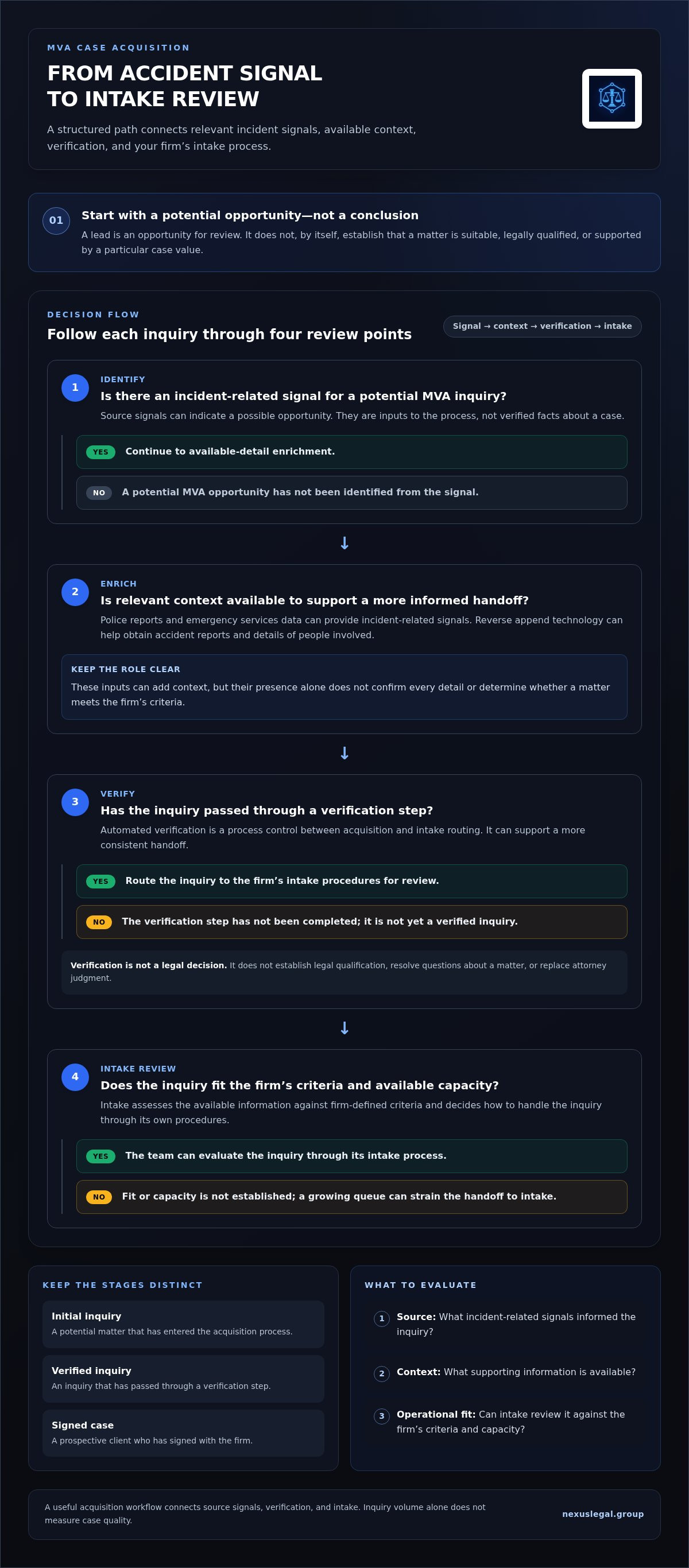
That distinction separates general awareness marketing from case acquisition. Awareness efforts aim to reach an audience and build familiarity. Acquisition is organized around the firm’s matter criteria, intake resources, and ability to follow up. A useful framework connects three elements: source signals, verification, and intake. Signals help identify a potential opportunity, verification supports a more informed handoff, and intake determines how the firm evaluates and handles it.
- Source signals indicate a possible MVA opportunity.
- Verification adds a review step before or during delivery.
- Intake assesses fit against firm-defined criteria and capacity.
No single stage establishes that an inquiry is suitable. A lead is an opportunity for review, not a conclusion about the matter.
What counts as an MVA lead for a plaintiff firm?
An initial inquiry is a potential matter that has entered the acquisition process. A verified inquiry has passed through a verification step. A signed case is a different acquisition status: the prospective client has signed with the firm. These terms describe distinct points in the process, not interchangeable measures of quality. Whether an inquiry fits depends on the firm’s criteria and review. A lead alone does not establish liability, damages, or case value.
Why can more inquiries fail to improve case acquisition?
Irrelevant or incomplete inquiries can take time away from matters with clearer fit or stronger available context. Follow-up also depends on the firm’s responsiveness and capacity. If the queue exceeds the team’s ability to review it, the handoff from acquisition to intake can suffer. Lead volume alone does not measure case quality. Assess whether the information supports timely review, whether inquiries align with firm-defined criteria, and whether the intake team can manage the flow consistently.
How MVA Lead Generation Connects Source Signals to Verified Inquiries
A structured acquisition process turns incident-related signals into inquiries an intake team can review. For MVA lead generation for law firms, the sequence matters: identify relevant signals, enrich available details, verify the inquiry, then route it to the firm. Each stage has a distinct role. Source information can indicate a potential opportunity, but it shouldn’t be treated as a verified fact or a conclusion about a case.
- Identify relevant signals. Use incident-related information to locate potential MVA inquiries.
- Enrich available details. Apply available information to support a more contextual handoff.
- Verify the inquiry. Use automated verification as a process control before routing.
- Route for review. Deliver the inquiry into the firm’s intake procedures for evaluation.
Nexus Legal Group’s MVA acquisition uses police reports and emergency services data as inputs. Reverse append technology can help obtain accident reports and details of people involved. These sources support the acquisition process, but their presence alone doesn’t confirm every detail or determine whether a matter meets a firm’s criteria. Intake staff review the information through the firm’s own procedures.
How do police reports and emergency services data inform MVA acquisition?
Police reports and emergency services data provide incident-related signals that can help identify potential inquiries and add context to the acquisition workflow. They are different inputs, not interchangeable findings or a substitute for the firm’s review. For a closer look at this source type, explore the discussion of Police Report Generated MVA Leads and how police reports fit into MVA acquisition.
What does automated verification contribute?
Automated verification adds a quality-control step between inquiry acquisition and intake routing. It can support a more consistent handoff, but it doesn’t establish legal qualification, resolve questions about a matter, or replace attorney judgment. Treat the output as information for review, then assess it against the firm’s criteria and procedures.
Verification helps organize an inquiry for review; it doesn’t decide whether the matter is a case. That distinction keeps source material, verification, and legal assessment in their proper roles. Make the workflow useful by defining what information intake staff need, where inquiries should go, and how staff should record follow-up or unresolved details.
For firms building an integrated acquisition workflow, Nexus Legal Group combines AI-driven marketing, automated verification, police reports, emergency services data, and reverse append technology. Learn more about Nexus MVA case acquisition and how it connects source signals with intake review.
How to Compare MVA Lead Generation Models and Quality
Compare acquisition models by how an inquiry is sourced, what information accompanies it, and how it reaches your intake team. For MVA lead generation for law firms, the useful question isn’t simply how many inquiries arrive. Ask whether the source, documentation, and delivery format align with your firm’s case criteria and capacity.
Use a consistent comparison framework rather than relying on labels such as “high intent” or “exclusive” alone. These distinctions clarify what each model is designed to deliver and what your team will need to review.
Source: Identify whether an inquiry comes from general marketing activity or MVA-specific inputs, such as police reports or emergency services data.
Exclusivity: An exclusive inquiry is directed to one firm; a shared inquiry may be distributed to multiple firms. Exclusivity describes distribution, not case suitability or outcome.
Verification: Note whether verification is part of the process and how it is described. Don’t assume the label means the inquiry meets your legal or intake criteria.
Available documentation: Assess what supporting information accompanies the inquiry and whether it gives intake staff useful context for review.
Delivery format: Consider how the inquiry reaches your team and whether the handoff fits current intake ownership and workflow.
These dimensions make it easier to compare models on operational fit. For related discussion of behavioral trends and data enrichment, see High Conversion MVA Leads: Behavioral Trends and Data Enrichment in 2026.
Which MVA lead-generation criteria should firms evaluate?
Start with the firm’s own matter criteria, then assess whether each model’s source and available information support an intake review against them. Examine how verification is described and what documentation accompanies the inquiry. Finally, consider whether the delivery volume and format fit the staff available to receive, review, and follow up. A model that creates more inquiries than the team can process may not serve the firm’s acquisition objectives.
How should firms distinguish inquiries from signed cases?
An inquiry is an opportunity for the firm to review. A signed case reflects a separate acquisition status and should be measured separately. For inquiries, track factors such as source, available documentation, fit with firm criteria, and intake disposition. For signed cases, evaluate how many reach that status and which acquisition process they are associated with. Keep the measures distinct: exclusivity, verification, or expressed interest does not establish representation, liability, damages, or case value.
Choose the model that matches the outcome your firm needs and the work its intake operation can support. Nexus Legal Group provides exclusive inquiries and signed cases as distinct acquisition options. Explore MVA case acquisition for plaintiff firms as an approach to structuring that process.
How to Align MVA Inquiries With Firm Intake and Measurement
An acquisition workflow is useful only if the firm can receive, assess, and track the inquiries it generates. Before increasing MVA volume, connect the firm’s case criteria to clear intake ownership and a consistent method for recording outcomes. This gives the team a basis for assessing acquisition results and operational fit.
Use a repeatable sequence:
- Define criteria. Document the firm’s matter-fit considerations and the information intake staff need to review them.
- Assign ownership. Identify who receives inquiries, who conducts follow-up, and who records dispositions.
- Review inquiries. Apply the firm’s intake procedures consistently, noting relevant information and gaps.
- Record outcomes. Track movement through inquiry, verification, contact, consultation, and signed-case stages where applicable.
- Refine the workflow. Use recorded patterns to adjust criteria, routing, and capacity planning.
Keep records useful to the people making decisions. Intake staff should be able to distinguish source information from verification status and see what documentation is available. Record the attributes your team actually uses to assess fit, rather than collecting details that don’t inform review. This creates a clearer view of where inquiries progress, stall, or fall outside firm criteria.
How can firms prepare intake before increasing MVA volume?
Set criteria and escalation paths before additional inquiries enter the workflow. Assign responsibility for review, follow-up, and outcome recording so no step depends on an unclear handoff. Then compare the anticipated flow with available intake and attorney-review capacity. If the team can’t absorb additional review work, address ownership or workflow constraints first. The objective is a manageable process, not simply a larger queue.
Which measures help firms assess acquisition performance?
Separate measures by stage: source, verification, contact, consultation, and signed case. Each describes a different point in the process, so combining them can obscure where progress changes. Review results against the firm’s own criteria and capacity rather than relying on unsupported industry averages. Include staff workload and operational fit alongside acquisition outcomes to understand whether the inquiry flow is actionable for the team.
Over time, recorded outcomes can reveal which sources and inquiry attributes tend to align with the matters the firm intends to handle. Use that information to refine criteria and plan intake resources, while keeping acquisition activity separate from legal assessment. For MVA lead generation for law firms, disciplined measurement connects sourcing decisions with what the team can review and advance.
Explore Nexus Legal Group’s MVA case acquisition approach
How Nexus Legal Group Supports MVA Case Acquisition for Law Firms
Nexus Legal Group provides legal technology and case-acquisition infrastructure for plaintiff law firms. It isn’t a law firm and doesn’t replace a firm’s legal judgment. Its role is to support acquisition by bringing together AI-driven marketing, automated verification, and MVA-specific data sources that can inform the handoff to intake.
This integrated approach addresses a central challenge in MVA lead generation for law firms: connecting potential inquiries with relevant context and a defined review process. Police reports and emergency services data inform acquisition, while reverse append technology can help obtain accident reports and details of people involved. Automated verification adds a process step to prepare inquiries for firm intake. These capabilities support review; they don’t determine whether a matter meets a firm’s criteria or establish its legal merits.
What does Nexus bring together in MVA case acquisition?
The model combines marketing with incident-related information and verification. Police reports and emergency services data serve as MVA acquisition inputs, while reverse append technology supports obtaining accident reports and participant details. Automated verification helps prepare inquiries for intake. Together, these elements provide a structured acquisition resource, with the firm retaining responsibility for reviewing the information and deciding how to proceed.
When may this acquisition model fit a plaintiff firm?
Fit depends on the matters a firm intends to handle, the criteria it uses to assess MVA inquiries, and the capacity available to review incoming opportunities. A firm considering additional acquisition should align those factors before selecting an approach. Nexus offers exclusive, litigation-ready inquiries as well as signed cases. These are distinct acquisition options: an inquiry still requires the firm’s review, while a signed case reflects a separate status. Neither option guarantees a particular legal or business outcome.
Firms retain responsibility for legal review, case decisions, and their own intake practices. Acquisition information can support a more informed workflow, but it doesn’t replace attorney assessment or firm-defined procedures. Consider whether the source information, verification process, and delivery option align with the team’s objectives and ability to manage intake.
By treating acquisition as infrastructure rather than a standalone volume channel, firms can assess how incoming opportunities fit their operational model. Nexus Legal Group brings together AI-driven marketing, automated verification, police reports, emergency services data, and reverse append technology to support MVA case acquisition for plaintiff firms, with exclusive inquiries and signed cases available as distinct options.
Make Your Next Acquisition Decision Deliberate
Translate your growth objectives into a clear acquisition decision: what the firm wants its MVA practice to support, what changes the team is prepared to absorb, and what evidence would justify adjusting the approach. This keeps MVA lead generation for law firms connected to the firm’s broader direction instead of treating it as an isolated marketing activity.
Before changing your acquisition mix, agree internally on the outcome you’re pursuing and how leadership will assess whether the approach remains appropriate. Set a review point, compare the intended direction with what the firm observes, and decide whether to refine the model or maintain course. Measured decisions help the firm respond with purpose instead of reacting to every fluctuation in inquiry flow.
With a defined objective and a disciplined decision process, your firm can pursue growth with greater clarity and confidence.
Frequently Asked Questions
Can MVA lead generation guarantee signed cases?
No lead source should be presented as guaranteeing a signed case or legal outcome. A generated inquiry, a verified inquiry, and a signed case are separate stages, and an inquiry may not progress to representation. For example, a firm may receive an inquiry that needs further review before the firm decides whether it fits. Nexus offers exclusive inquiries and signed cases as distinct acquisition options, but firms retain control of review, follow-up, and decisions.
How much does MVA lead generation cost?
Evaluate an acquisition arrangement against your firm’s requirements rather than relying on a general estimate. Consider whether it aligns with your matter criteria, intake capacity, and the outcomes you track. To discuss an acquisition approach for your firm, speak with Nexus Legal Group.
Can a law firm combine MVA lead generation with referrals and organic marketing?
Yes. A firm can use several acquisition channels, provided each has clear ownership and measurement. Referrals, organic activity, and MVA-specific acquisition may produce different inquiry patterns and require different intake context. For example, tracking each inquiry’s source separately can help the team understand which channels contribute to consultations or other outcomes. Apply consistent intake review across channels, and don’t treat one source as a guaranteed replacement for another.
What happens if an MVA inquiry does not meet a firm’s case criteria?
The firm should assess the inquiry under its own criteria and record the disposition through its intake process. A practical record might distinguish an apparent criteria mismatch from an inquiry that lacks information needed for review. That distinction can help the firm interpret results and refine its process. A mismatch alone doesn’t establish provider failure, and an intake decision shouldn’t be treated as a conclusion about the matter’s legal merit.
Should a law firm evaluate MVA lead generation by inquiry volume alone?
No. Volume doesn’t show whether inquiries fit your firm’s criteria, provide useful context, or progress through intake. Assess source and verification alongside staff workload and outcomes at relevant stages, such as contact, consultation, and signed case. For MVA lead generation for law firms, compare those results with your documented objectives and available capacity. This gives your team a firm-specific basis for deciding whether to adjust its acquisition approach.
Can MVA lead generation support firms that want signed cases rather than inquiries?
Yes. Acquisition can be structured around inquiries or signed cases, which are distinct deliverables and stages. Nexus Legal Group offers qualified MVA inquiries and signed cases; neither option should be understood as guaranteeing a particular volume, case profile, or result. Define whether your intake model is built to review inquiries or whether your acquisition objective is signed cases, then align the choice with your firm’s growth needs. Contact Nexus Legal Group to discuss MVA case acquisition for your firm.