Personal Injury Case Acquisition Strategy: A Scalable Framework for Law Firms
Build a scalable personal injury case acquisition strategy. Learn how to verify inquiries, optimize intake capacity, and consistently sign qualified cases.
What if more inquiries are making your firm’s acquisition system less predictable, not more? A strong personal injury case acquisition strategy connects the matters your firm wants to handle with sourcing, verification, intake capacity, and signed-case outcomes. Lead volume is one measure, but it does not show whether inquiries fit your criteria or whether your team can process them.
Marketing activity is easy to count, but harder to connect to qualified cases. A surge in inquiries can also overwhelm intake without improving fit. When sourcing, verification, and follow-up operate separately, it becomes difficult to identify which decisions are working and where the process needs adjustment.
This article lays out a practical framework for aligning acquisition with your firm’s case criteria and capacity, then measuring performance from initial source through intake. It covers how to connect sourcing, consent context, automated verification, and outcome tracking in one workflow. Motor vehicle accident matters offer a concrete example: police-report and emergency-services data, combined with reverse-append accident details, can help connect sourcing signals to inquiry verification and intake.
Key Takeaways
- Define acquisition around the matters your firm can handle, not inquiry volume alone.
- Set a clear process for selecting sources, preserving consent context, verifying inquiries, routing them, and reviewing results.
- Compare sourcing models by intent signals, source visibility, verification needs, and intake demand.
- Measure each funnel stage consistently, from valid contact through qualified inquiry, completed intake, and signed case.
- AI-driven marketing precision and automated verification can support a more connected motor vehicle accident inquiry workflow.
What a Personal Injury Case Acquisition Strategy Must Actually Deliver
A personal injury case acquisition strategy is the system a firm uses to define the matters it seeks, source relevant inquiries, and manage each inquiry through verification and intake. Its purpose is not simply to generate contacts. It connects the firm’s case priorities to a process that can assess fit, support a clear intake experience, and produce outcomes the firm can evaluate.
Lead generation is one part of acquisition. Branding can shape awareness and marketing can create visibility, but neither alone shows whether inquiries match the firm’s criteria or can be handled effectively. The broad category of personal injury law covers different types of matters, so each firm needs clear priorities rather than assuming every inquiry is equally suitable.
Set the firm's case-fit and growth objectives
Start by documenting the matter types the firm wants to pursue, the information intake needs to assess each inquiry, and the priorities that guide follow-up. These criteria give acquisition and intake teams a shared reference. They do not replace legal review: the firm determines legal merit and whether to represent someone. Acquisition teams focus on providing relevant inquiries and the context needed for the firm’s decision-makers to evaluate them.
- Define fit: Specify priority matter types and the screening information intake needs to collect.
- Set growth priorities: Identify opportunities that support the firm’s broader practice objectives instead of treating every inquiry as a target.
- Account for capacity: Match expected inquiry flow to available intake coverage and attorney resources, so demand does not outpace the team’s ability to respond thoughtfully.
Capacity is also part of the client experience. If more inquiries arrive than the team can process, responses may be delayed, intake may remain incomplete, and follow-up may become inconsistent. Set growth objectives around both the desired case mix and the volume and workflow the firm can manage.
Why a lead count is an incomplete measure
A raw count shows how many inquiries arrived, not whether they were relevant, reachable, or fully assessed. An inquiry’s progress depends on several steps: the source and context are understood, contact details are usable, the inquiry aligns with screening criteria, and intake reaches a meaningful stage. A high count can hide problems at any point in that sequence.
- Source: Record where the inquiry originated and what the source indicates.
- Valid contact: Establish whether the firm can reach the person using the information provided.
- Qualified inquiry: Record whether the inquiry meets the firm’s defined screening criteria.
- Completed intake: Distinguish a completed assessment from an unanswered or unfinished contact.
Track these stages separately. When inquiries stall, the team can then investigate whether the issue is source fit, missing contact information, screening criteria, or intake capacity instead of treating volume as a proxy for suitability.
Build the Acquisition System from Sourcing Through Verified Inquiry
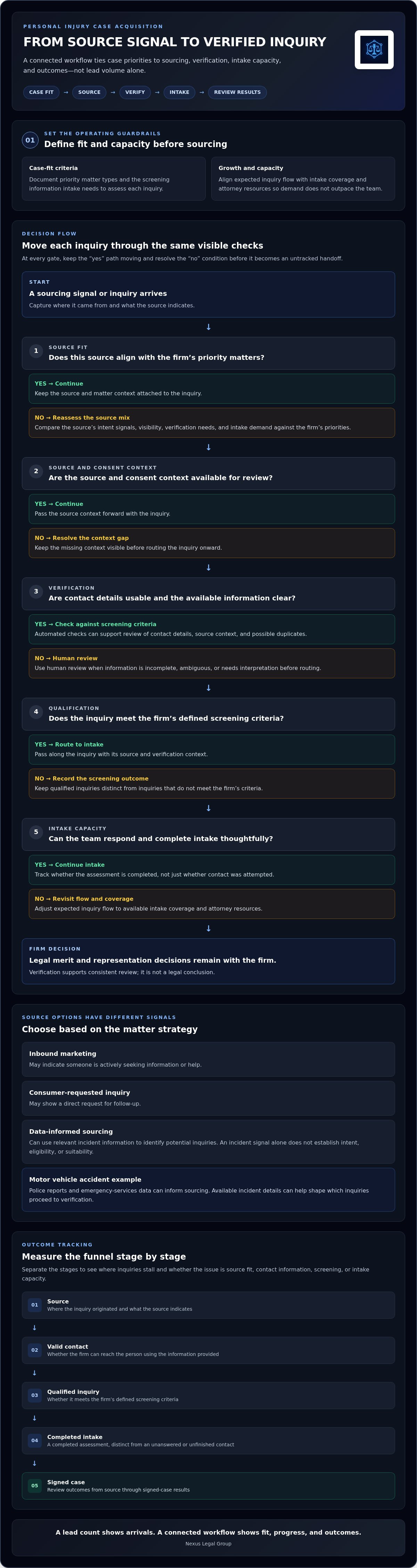
A reliable workflow makes each handoff visible, from the first signal of interest to the point when intake receives an inquiry with its source and verification context. The team should be able to tell where an inquiry came from, what the source indicates, what has been checked, and what still needs follow-up.
Build the workflow around connected stages: define case fit, select sources, preserve consent context, verify details, route inquiries to intake, and review outcomes. Treat these as steps in one operating process, not as separate campaigns or tools. For a personal injury case acquisition strategy, this creates a consistent path while leaving legal assessment and representation decisions with the firm.
Choose sources that align with the matter strategy
Inbound marketing may indicate that someone is actively seeking information or help. A consumer-requested inquiry may show a direct request for follow-up. Data-informed sourcing can use relevant incident information to identify potential inquiries, though an incident signal alone does not establish intent, eligibility, or suitability. These sources serve different roles, and none is automatically the right choice for every firm or matter type.
For motor vehicle accident acquisition, police reports and emergency-services data can inform sourcing. Available incident details can help shape which inquiries proceed to verification, but the firm still needs to assess fit and determine next steps. The Role of a Personal Injury Lawyer provides context on the legal work and case types that may inform a firm’s matter priorities. To connect data signals with inquiry workflows, consider AI-driven legal case acquisition as part of a broader sourcing approach.
Verify and route inquiries before intake follow-up
Verification checks whether inquiry details are usable and whether available information aligns with firm-defined screening criteria. Automated checks can support consistent review of contact details, source context, and possible duplicates. Human review helps where information is incomplete, ambiguous, or needs interpretation before routing. Together, these steps prepare an inquiry for intake without treating a verification result as a legal conclusion.
- Define fit: Set the matter categories and screening details intake needs.
- Select sources: Choose channels that correspond to those priorities and the firm’s capacity.
- Capture consent context: Preserve how the inquiry was generated and the context for follow-up. Review source and contact practices against applicable rules and firm policies.
- Verify: Check contact details, source information, screening alignment, and potential duplicates.
- Route: Send the inquiry and relevant context to the appropriate intake workflow.
- Review: Examine handoff results to identify incomplete information, mismatches, or process friction.
Clear routing means intake receives enough context to understand an inquiry’s origin and what has already been checked. Verification does not provide legal advice, decide whether the firm should represent someone, or establish the matter’s ultimate merit. Those determinations remain with the firm. Nexus Legal Group connects acquisition signals with automated verification for plaintiff firms seeking a structured path from source to intake.
Compare Acquisition Models by Case Fit, Control, and Intake Load
Acquisition models differ in how an inquiry begins, what the firm can see about its source, and how much screening or follow-up the workflow requires. More inquiries do not automatically mean more qualified or suitable matters. Compare each model against the firm’s criteria and intake capacity instead of treating any channel as a universal winner.
| Model | Intent signals | Source visibility | Verification needs | Operational demand |
|---|---|---|---|---|
| Broad inbound | May range from general research to a direct request for assistance. | Can vary by entry point, such as a website form or phone inquiry. | Clarify the person’s interest, contact details, and fit with screening criteria. | Requires a process for sorting inquiries with different levels of readiness. |
| Paid acquisition | Reflects a response to a specific campaign or placement, but not necessarily case suitability. | Campaign-level source information can support review when captured consistently. | Confirm contact validity, request context, and alignment with firm criteria. | Demand can change with campaign activity, so routing and follow-up need clear ownership. |
| Data-informed inquiry sourcing | May begin with an incident-related signal rather than a direct request for legal help. | Incident and sourcing context can inform how the inquiry is evaluated. | Review available details, contact information, and possible duplicate records. | Requires a defined verification and intake handoff before follow-up. |
For firms assessing motor vehicle accident workflows, verified MVA leads for law firms provides MVA-specific context. To compare models, ask whether the source signals match the firm’s matter priorities, what information accompanies each inquiry, and whether intake can handle the resulting work.
Assess quality without assuming every inquiry converts
Evaluate inquiry quality in distinct stages rather than applying one broad label. Contact validity means the firm can reach the person. Stated interest describes what the person requested. Screening fit reflects alignment with the firm’s criteria. A signed engagement is a separate outcome. A valid inquiry may still fall outside the firm’s focus or never progress to an engagement.
Keep these stages separate in reporting. Avoid conversion benchmarks unless the firm has current, attributable data and consistent definitions for each stage.
Match acquisition pace to intake capacity
Before increasing acquisition, map staffing, response workflows, follow-up ownership, and case-review bandwidth. If inquiries arrive faster than the team can process them, follow-up may lag, records may remain incomplete, and potentially suitable matters may receive inconsistent attention. That is an operational bottleneck, not proof that the source itself is ineffective.
Review source-level outcomes alongside workload. Identify where inquiries stall, which sources produce incomplete information, and whether handoffs are being completed. Use those observations to adjust the source mix or workflow without relying on arbitrary volume thresholds.
Measure and Refine Personal Injury Case Acquisition Over Time
A personal injury case acquisition strategy is easier to improve when every inquiry has a traceable path through the firm’s workflow. Stage-based reporting shows where inquiries progress, stall, or lose alignment with firm criteria. This makes it easier to diagnose performance than relying on a single headline number.
Track the stages with stable definitions: source records where an inquiry originated; valid contact indicates usable contact information; qualified inquiry reflects the firm’s screening criteria; completed intake means the firm’s intake process has been completed; and signed case records an engagement. Keep the measures distinct and use the same definitions across sources and reporting periods.
Create an accountable measurement framework
Assign an owner to maintain each part of the record: source data, verification outcomes, intake updates, and performance reporting. A customer relationship management system can support recordkeeping when the team uses consistent fields and updates. For each inquiry, record its status, relevant dates, source, and reason it did not progress when that information is available. This makes handoffs easier to review and supports consistent analysis.
For related context on compliant legal lead generation, consider how source practices and firm policies fit into the acquisition workflow. Measurement should describe what happened, not imply legal conclusions or performance that the underlying records cannot support.
- Source: Preserve the original channel or sourcing context.
- Progress: Record whether the inquiry reached each defined stage.
- Ownership: Identify who is responsible for keeping each field current.
- Attribution: Connect a signed matter to a source only when reliable tracking supports that connection.
Use feedback to improve the acquisition system
Review performance by source, matter fit, follow-up status, and intake capacity. A monthly review can be a practical way to compare stage counts by source, examine inquiries that stalled, and look for patterns in incomplete, delayed, duplicated, or mismatched records. Choose a review cadence that suits the firm’s workflow. The purpose is to create a repeatable opportunity to identify friction and act on it.
Use the findings to refine source selection, screening criteria, and routing rules. For example, if a source repeatedly produces inquiries missing information intake needs, investigate whether the capture process or handoff contributes to the gap before drawing conclusions about source quality. If suitable inquiries remain unprocessed, review workload and follow-up ownership as well as acquisition volume.
Interpret the funnel carefully. More valid contacts do not necessarily mean more qualified inquiries or signed cases. Likewise, do not credit a signed matter to a channel simply because that channel appears in an incomplete record. Reliable attribution depends on consistent source capture and updates through the engagement stage. Keep definitions stable, investigate exceptions, and make adjustments based on observed evidence rather than assumptions.
Connect the Strategy to Nexus Legal Group's Case Acquisition Infrastructure
The framework becomes operational when sourcing, verification, and intake connect to the firm’s defined matter priorities. Nexus Legal Group provides high-intent motor vehicle accident case acquisition infrastructure for plaintiff firms, combining AI-driven marketing precision with automated verification to support qualified inquiry workflows. The aim is a clearer handoff from acquisition signals to the firm’s intake process, not a substitute for legal review or representation decisions.
Where Nexus fits in a firm's acquisition workflow
For MVA matters, Nexus uses police reports, emergency-services data, and reverse-append technology to obtain detailed accident reports and information about those involved. These sources support acquisition workflows, while verification helps assess inquiry details against firm-defined screening criteria before handoff. Connecting the origin of an inquiry with relevant context gives intake information to work with while leaving legal assessment with the law firm.
AI-driven marketing precision and automated verification support different parts of the process. Marketing precision helps align acquisition signals with firm priorities, while verification structures inquiry review. Nexus provides exclusive, litigation-ready inquiries for firms to assess against their requirements for source visibility, screening information, and intake readiness. The right fit depends on the firm’s matter strategy and workflow, not on a label alone. Explore data-driven case acquisition as an approach to connecting those stages.
Outcome definitions still matter. A qualified inquiry has been assessed against agreed screening criteria; a signed case reflects a separate engagement outcome. Nexus supports both qualified inquiries and signed cases for MVA and mass tort matters, but they represent different points in the acquisition process. Keeping them distinct helps a firm set expectations, evaluate performance, and identify where its own intake decisions shape progression.
Define practical next steps for evaluating strategic fit
Before discussing infrastructure, assemble a concise operating profile. Describe the matters the firm seeks, the intake capacity available, the sourcing context that matters for evaluation, and the reporting priorities used to assess outcomes. This creates a concrete basis for discussing workflow alignment rather than beginning with volume in isolation.
- Target matters: Identify priority case types and firm-defined screening considerations.
- Intake capacity: Clarify who owns follow-up, how inquiries are routed, and where workload constraints occur.
- Source requirements: Specify the context intake needs to understand an inquiry’s origin and relevance.
- Reporting priorities: Decide which stages and outcomes the firm needs to distinguish.
This preparation turns a personal injury case acquisition strategy into an actionable operational discussion. Firms can evaluate how high-intent MVA sourcing, automated verification, and inquiry handoffs align with their objectives, without conflating acquisition support with legal representation. A focused conversation can address workflow fit, defined outcomes, and the infrastructure needed to support the firm’s growth priorities.
Turn Acquisition Priorities into a Growth Operating Plan
Growth is easier to manage when acquisition decisions are built into the firm’s operating plan rather than treated as one-off campaign adjustments. In the next planning cycle, identify who owns decisions, which trade-offs require leadership input, and how changes in caseload priorities should affect acquisition activity. This gives the personal injury case acquisition strategy direction as the firm’s needs evolve.
Choose one operational question to address first, such as whether current inquiry flow matches the team’s review capacity. Establish a shared view of the issue, agree on what evidence will inform a decision, and set a time to revisit the result. This keeps improvement focused and helps the team make deliberate adjustments instead of reacting to volume alone.
A well-aligned growth plan gives your firm a clearer basis for its next acquisition decisions. Nexus Legal Group’s infrastructure connects high-intent MVA acquisition with automated verification and structured inquiry workflows.
With clear priorities and thoughtful execution, your firm can pursue growth with greater focus and confidence.
Frequently Asked Questions
What is a personal injury case acquisition strategy?
A personal injury case acquisition strategy is a firm’s plan for sourcing and handling inquiries that may fit its practice priorities. It connects target matter types, sourcing methods, screening information, intake ownership, and evaluation criteria. For example, a firm focused on motor vehicle accident matters can align its intake questions and source tracking with those priorities, then assess whether the inquiries fit its workflow.
How can a law firm improve personal injury case acquisition?
Start by reviewing recent inquiries that did not progress and identifying where they stalled. Were contact details incomplete, was a key screening question missing, or did the handoff reach the wrong team? Use the pattern to adjust one part of the process, such as a form field or routing rule, then monitor whether that specific issue changes. This makes improvement evidence-based rather than a series of broad campaign changes.
Are personal injury leads the same as signed cases?
No. A lead is an inquiry or contact for the firm to evaluate; a signed case means the person has entered an engagement with the firm. Someone may submit an accident-related inquiry but be unreachable, fall outside the firm’s focus, or decide not to proceed. Keep lead counts and signed-case counts separate in internal reports so initial interest is not mistaken for a completed business outcome.
Which acquisition channels work best for personal injury law firms?
No single channel is best for every firm. Inbound activity, paid campaigns, referrals, and data-informed sourcing can produce different signals and require different screening workflows. Compare them against the matters the firm seeks, the source details available, and the team’s ability to handle follow-up. Start by assessing whether a channel consistently reaches the intended audience, not simply whether it produces more contacts.
How should a firm measure personal injury case acquisition performance?
Define the stages the firm wants to evaluate and apply those definitions consistently. A practical report can separate source, reachable contact, screening fit, completed intake, and signed engagement, then compare progression by source and matter type. Include pending records so recent inquiries are not mistaken for unsuccessful outcomes. Use a consistent reporting period and confirm source attribution is captured reliably before drawing conclusions about which activities contribute to signed cases.
Can automated verification determine whether a personal injury case is legally viable?
No. Automated verification can help check inquiry details, identify possible duplicates, and compare available information with firm-defined screening criteria. It cannot replace a lawyer’s assessment of legal issues or determine whether the firm should accept representation. Treat verification as an administrative and workflow checkpoint. Questions about liability, damages, or other legal considerations belong in the firm’s legal review process.
How does a firm keep case acquisition compliant?
Build review into the acquisition workflow instead of treating it as a final check. Document how each source is used, preserve relevant inquiry and consent context, and establish who reviews messaging, data practices, and follow-up processes. Have the firm assess those practices against applicable requirements and its own policies, which may depend on where and how communications occur. Keep records of decisions and revisit the process when sources or campaign methods change.