Data-Driven Personal Injury Lead Generation: A Measurable Growth Framework
Master data-driven personal injury lead generation. Learn how to track inquiry quality, connect marketing data with intake, and sign more qualifying cases.
A full lead pipeline can still hide a growth problem. If reports show inquiry volume but not which sources produce inquiries that fit your firm’s criteria, data-driven personal injury lead generation helps connect acquisition activity with the outcomes that matter. The challenge is rarely a lack of numbers. It is that source data, lead-quality signals, and intake feedback often sit in separate systems, making performance difficult to compare.
That disconnect makes it harder to decide where to invest, which inquiries need follow-up, and what to adjust when results change. A useful measurement framework follows each inquiry beyond its source. It records whether the inquiry meets the firm’s criteria, whether intake reaches the person, and whether the inquiry progresses toward a signed case.
This article explains how to define practical acquisition and lead-quality metrics, connect marketing data with intake outcomes, and establish a repeatable review process. It also covers how police reports, emergency services data, and automated verification can support a more integrated approach to motor vehicle accident acquisition, without treating an acquisition signal as proof of legal merit or a particular result.
Key Takeaways
- Use data-driven personal injury lead generation to connect acquisition signals with inquiry quality and case outcomes.
- Track each inquiry through acquisition, verification, firm intake, and outcome feedback to see where information is gained or lost.
- Compare lead sources using shared definitions for contactability, qualification, response time, and signed-case outcomes.
- Build a repeatable review process that captures source data, audits records, compares results, and informs adjustments.
- AI-driven marketing precision and automated verification can support a more integrated approach to motor vehicle accident case acquisition.
What Data-Driven Personal Injury Lead Generation Actually Measures
Data-driven personal injury lead generation uses structured evidence to guide where a firm acquires inquiries, how it assesses their fit, and what it improves based on intake and case outcomes. It goes beyond channel reports. A click or inquiry is useful when the firm can connect it to a defined decision and follow its progress.
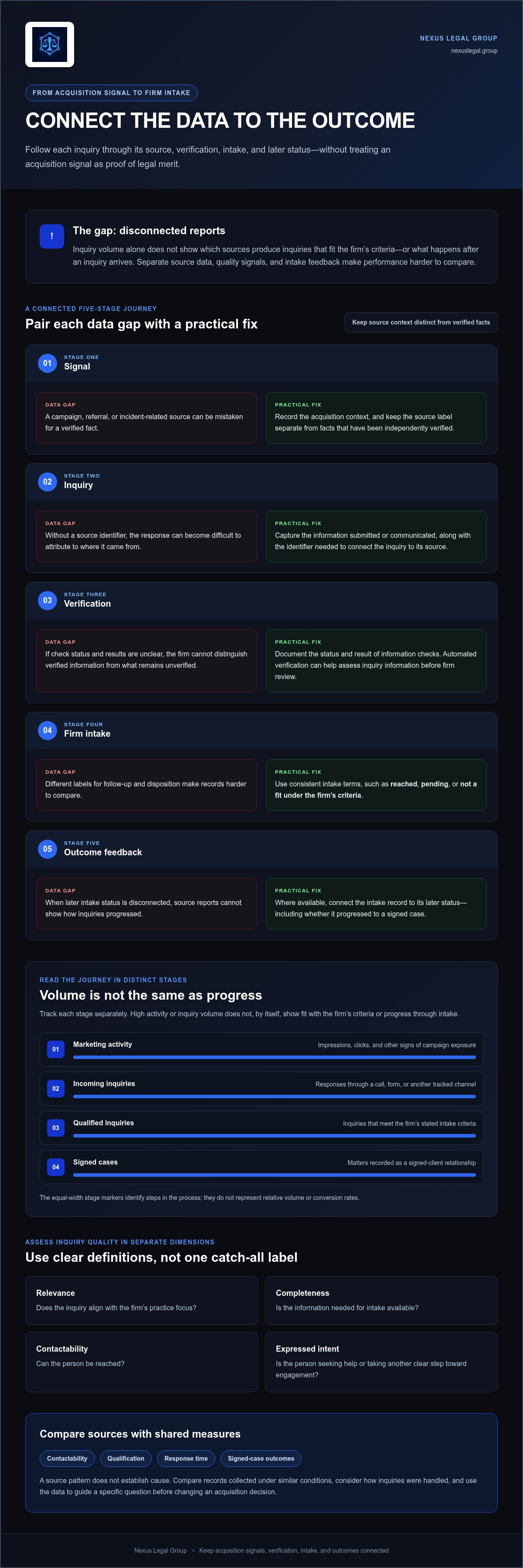
To see where results change, track four stages separately:
- Marketing activity: Impressions, clicks, and other signs that an audience encountered a campaign.
- Incoming inquiries: People who respond through a call, form, or another tracked channel.
- Qualified inquiries: Inquiries that meet the firm’s stated intake criteria for relevance and follow-up.
- Signed cases: Matters that proceed to a signed-client relationship, as recorded by the firm.
These stages answer different questions. High activity can show that a campaign is reaching people, while a high inquiry count shows that people are responding. Neither tells you whether inquiries fit the firm’s criteria or progress through intake. Measuring the full sequence helps distinguish audience reach from intake and case outcomes, without treating a marketing signal as proof of legal merit or case value.
How data-driven acquisition differs from ordinary lead volume
Basic volume reporting often stops at impressions, clicks, or total inquiries. A more useful view records each inquiry’s source and connects that information to what happens next: whether the person can be reached, whether the inquiry meets the firm’s criteria, and whether it advances through intake.
Source data can reveal patterns, but a pattern alone does not establish cause. If one channel is associated with more qualified inquiries, other factors may also contribute, including campaign timing or differences in how inquiries are handled. Use the data to form a specific question, then compare records collected under similar conditions before changing an acquisition decision. A metric earns its place when it helps the team choose a next step.
What personal injury firms need to learn from each inquiry
Assess inquiry quality across distinct dimensions rather than compressing it into a single label. Relevance indicates whether the inquiry aligns with the firm’s practice focus. Completeness reflects whether the information needed for intake is available. Contactability records whether the person can be reached. Expressed intent captures whether the person is seeking help or taking another clear step toward engagement.
Define these measures using your firm’s practice focus and intake criteria. For example, specify which information intake needs to route an inquiry and what the team records when it cannot reach someone. Consistent definitions make comparisons across sources more useful while keeping marketing classification in its proper role: organizing acquisition and follow-up evidence, not determining legal merit or predicting case value.
How Data Moves from Acquisition Signal to Firm Intake
Acquisition data becomes useful when it stays connected from the first signal through firm review and outcome feedback. A missing source field can make an inquiry difficult to attribute. Inconsistent intake labels can make otherwise comparable records hard to evaluate. Connected stages turn acquisition data into a practical decision system, not a collection of disconnected reports.
For data-driven personal injury lead generation, map the journey in five stages:
- Signal: Record the acquisition context, such as a campaign, referral, or incident-related source. Keep the source label distinct from facts that have been independently verified.
- Inquiry: Capture the information submitted or communicated, along with the source identifier needed to connect the response to its origin.
- Verification: Document the status and result of information checks. Automated verification can help assess inquiry information before firm review.
- Firm intake: Record the firm’s follow-up and disposition using consistent terms, such as reached, pending, or not a fit under the firm’s criteria.
- Outcome feedback: Where available, connect the intake record to its later status, including whether it progressed to a signed case.
From acquisition signal to documented inquiry
A campaign or referral source explains how an inquiry entered the process. It does not prove who a person is or establish what happened in an incident. For motor vehicle accident acquisition, police reports and emergency services data can serve as inputs. Record them as source context, not as a substitute for verification or firm review.
Use stable field names and clear definitions across stages. If one team records a source as “web” while another uses a campaign name, attribution can break down. The same is true when contact details are missing from an inquiry record. Preserve what is known, note what remains unverified, and do not fill gaps with assumptions.
From inquiry verification to outcome feedback
Verification creates a checkpoint before the inquiry reaches firm intake, while intake dispositions show what happened after that handoff. When teams return those dispositions and later case outcomes to acquisition reporting, they can identify patterns worth reviewing and refine future decisions. Use the feedback loop to guide analysis, not to assign cause automatically to a channel.
For a broader view of how acquisition signals and downstream results fit together, explore this personal injury case acquisition framework. Nexus connects AI-driven marketing precision with automated inquiry verification as part of its growth infrastructure for plaintiff firms.
Which Metrics Help Compare Personal Injury Lead Sources?
Useful comparisons separate what a channel produces from what happens after an inquiry reaches the firm. Channel performance describes acquisition activity; case outcomes describe downstream results. Track source, inquiry quality, intake handling, and outcomes together so your team can see where records diverge instead of relying on one headline number.
| Metric group | What to record | What it helps answer |
|---|---|---|
| Source | Channel, campaign or referral, inquiry date, and any relevant delivery attributes. | Where did the inquiry originate, and what acquisition activity preceded it? |
| Inquiry quality | Completeness, duplicate status, verification status, and fit against firm-defined criteria. | Does the inquiry contain usable information and align with the firm’s intake focus? |
| Intake | Response time, contactability, review status, and consistent disposition. | Was the person reached, and what happened during firm review? |
| Outcome | Signed-case status and cost attribution to the source or campaign. | What downstream results are associated with the acquisition activity? |
Define each measure before comparing sources. Response time is the elapsed time between receiving an inquiry and the firm’s first response attempt. Contactability records whether the firm successfully reached the person. Qualification indicates whether the inquiry meets the firm’s stated criteria, not whether marketing has assessed legal merit. Signed-case rate is the share of a defined group of inquiries that become signed cases. Specify whether the denominator is all inquiries or only qualified inquiries. Cost attribution assigns acquisition costs to a source or campaign using a consistent method.
Compare acquisition and inquiry-quality indicators
For each source, compare campaign or referral identifiers alongside inquiry completeness, duplicate status, and verification status. Exclusivity and delivery speed are attributes to document, not proof that an inquiry fits the firm. A review of MVA lead quality and acquisition insights can add context, while the firm’s own criteria should determine how fit is recorded.
Connect intake outcomes to meaningful performance analysis
Use shared definitions for dispositions such as contacted, reviewed, declined, and signed. Compare records across the same time window and account for differences in intake handling. A source cannot be evaluated fairly if its inquiries are tracked differently or follow-up is inconsistently recorded. Reporting can describe an observed pattern, but it does not by itself prove that a campaign caused the result.
With data-driven personal injury lead generation, the goal is a defensible comparison that informs the next decision. Explore Nexus’s personal injury acquisition infrastructure to see how acquisition signals and verified inquiries can be connected.
How to Build a Practical Data-Driven Acquisition Review
A repeatable review turns reporting into a management process. Agree on what a suitable inquiry means for the firm, preserve source information, check record quality, compare intake and case outcomes, then adjust one part of the process at a time. Shared definitions across marketing, intake, and firm leadership keep the review grounded in the same evidence.
- Define criteria: Document the practice focus, intended inquiry profile, required information, and intake disposition labels.
- Capture the source: Record the campaign, referral, or other acquisition context consistently for each inquiry.
- Audit records: Check for missing fields, duplicates, inconsistent labels, and unclear attribution.
- Compare outcomes: Review inquiry quality alongside firm-side dispositions and signed-case status.
- Adjust: Use recurring, well-supported findings to refine targeting, verification, or intake coordination, then review the effect.
Set firm-specific criteria before evaluating a source
Start with definitions the team can apply consistently. Specify what information is needed to route and review an inquiry. Distinguish operational fit, such as relevance to a practice focus or completeness of contact details, from any legal evaluation reserved for the firm. Qualification criteria should reflect the firm’s work; one definition will not necessarily suit every plaintiff practice.
Assign shared labels and document their meaning. For example, “incomplete” should consistently describe a missing required field, while “unreachable” should reflect the firm’s defined contact attempts and recording process. Clear categories help teams identify process gaps without treating every unconverted inquiry as evidence of a poor source.
Use a feedback loop without overclaiming
Review incomplete, duplicate, unreachable, and accepted inquiries as separate groups. Each points to a different question: Is information missing at acquisition? Are duplicate records distorting totals? Is contact information usable? Do accepted inquiries align with the intended profile? Patterns can guide targeted adjustments, but small samples or uncertain source attribution should not be treated as conclusive evidence.
Include data stewardship in the review. Assess whether records are accurate, consistently labeled, and handled according to the firm’s practices. Include applicable advertising and contact requirements as review areas, with appropriate firm personnel assessing requirements relevant to the firm’s activities. This supports oversight without assuming that one general rule applies to every campaign or situation. As part of the review, make sure each source, verification status, and intake disposition can be traced consistently through the records.
Keep the cycle focused. Select an adjustment, record why it was made, and examine later data using the same definitions. This makes data-driven personal injury lead generation a disciplined improvement process rather than a series of reactions to isolated results.
How Nexus Supports Data-Driven Personal Injury Case Acquisition
Nexus Legal Group provides growth infrastructure for plaintiff firms. Its motor vehicle accident acquisition service combines AI-driven marketing precision with automated inquiry verification, connecting acquisition signals to information firms can review through their own intake processes. This is a practical application of data-driven personal injury lead generation: acquisition and verification support the flow of inquiries, while firm-side review determines how those inquiries progress.
Connect MVA data signals with verified inquiries
Police reports and emergency services data serve as inputs in motor vehicle accident acquisition. Reverse append technology is used to obtain accident reports and details about people involved. These sources add context to the acquisition process; they do not replace firm review or determine legal merit.
Automated verification adds a checkpoint for assessing inquiry information before firm review. Combined with acquisition signals, it helps distinguish information that has been checked from details that still require assessment. The goal is a clearer handoff, not an assumption that every inquiry is equally relevant or ready for the same next step.
Make the firm’s growth process more measurable
Keep acquisition outcomes distinct. A qualified inquiry reflects alignment with firm-defined intake criteria. A signed case is a later outcome recorded by the firm. Tracking both helps separate the quality of incoming inquiries from what happens during subsequent intake and case evaluation.
For a practical review, compare source and verification information with the firm’s intake dispositions and signed-case records. That feedback can help teams identify patterns to investigate, such as recurring gaps in inquiry information or differences between acquisition sources. Use it to inform decisions, not as proof that a particular signal caused an outcome.
Nexus provides ethical and compliant lead generation. Firms should assess applicable advertising and contact requirements in the context of their own activities. No general description establishes compliance across every jurisdiction or situation. The value of an acquisition framework lies in connecting relevant signals, verified inquiry information, and firm-side outcomes while preserving clear distinctions between each stage.
Turn Acquisition Data into a Repeatable Growth Process
Data-driven personal injury lead generation gives firms a structured way to connect acquisition sources with inquiry quality, intake activity, and signed-case outcomes. The key is consistency: define what a qualified inquiry means for your practice, capture source information reliably, and use firm-side feedback to guide measured adjustments.
When teams share clear definitions, reports become more useful than channel totals alone. They can distinguish incomplete or unreachable inquiries from those that align with intake criteria, then assess outcomes without assuming a source caused them. That discipline supports informed decisions while keeping legal evaluation with the firm.
Nexus brings this connected approach to motor vehicle accident acquisition, combining AI-driven marketing precision with automated verification and using police reports, emergency services data, and reverse append technology as acquisition inputs. These capabilities support acquisition and verification; firm review remains part of the process, and no particular result is promised.
With reliable signals and consistent outcome feedback, your firm can build an acquisition process that improves through evidence and remains aligned with its growth goals.
Frequently Asked Questions
What is data-driven personal injury lead generation?
Data-driven personal injury lead generation uses structured information to guide acquisition, inquiry assessment, and improvement decisions. Rather than measuring only impressions, clicks, or total inquiries, a firm connects each source to verification, intake activity, and later outcomes. For example, recording whether an inquiry was reached, met firm-defined criteria, and became a signed case can help teams evaluate acquisition more meaningfully without treating marketing data as a legal assessment.
How can a law firm measure personal injury lead quality?
Measure lead quality through separate, consistently defined indicators: relevance to the firm’s practice focus, completeness of the inquiry, contactability, verification status, and expressed intent. Then connect those indicators to intake dispositions, such as reviewed, declined, or signed. This helps teams identify whether a source produces information the firm can use and whether inquiries progress through its process. Marketing measures should not be treated as determinations of legal merit or case value.
Which data sources can support personal injury lead generation?
Useful acquisition context can include campaign and referral information, along with inquiry details recorded during intake. For motor vehicle accident acquisition, police reports and emergency services data serve as inputs; reverse append technology can be used to obtain accident reports and participant details. Treat a source as context, not automatic proof about a person or incident. Verification and firm review remain distinct steps in evaluating the information.
What is the difference between a lead, a qualified inquiry, and a signed case?
A lead is an incoming response or inquiry associated with an acquisition source. A qualified inquiry is one that meets the firm’s defined criteria for relevance and intake review. A signed case is a later outcome recorded by the firm after its own evaluation and process. Keeping these categories separate helps teams understand where inquiries progress or stop, instead of treating every response as equivalent to a potential client relationship.
How can firms compare personal injury lead sources fairly?
Use consistent source labels, definitions, and review periods across channels. Compare indicators such as inquiry completeness, duplicate status, verification, contactability, intake disposition, and signed-case outcomes, while preserving reliable source attribution. Also account for differences in intake handling, since inconsistent follow-up can affect the records being compared. A pattern in reporting describes an association; it does not prove that a particular campaign caused an outcome.
Can automated verification improve personal injury inquiry screening?
Automated verification can help assess inquiry information before it reaches firm review, adding a defined checkpoint to the acquisition process. It supports a clearer distinction between information that has been checked and details that still require assessment. Firms should track verification status alongside intake results and apply their own criteria. Verification supports screening, but it does not determine legal merit, predict case value, or replace the firm’s review.
How should a law firm use intake outcomes to improve lead generation?
Record intake outcomes with shared labels, then return those records to acquisition reviews. Separate incomplete, duplicate, unreachable, accepted, declined, and signed inquiries so teams can identify distinct patterns. Use recurring, well-attributed findings to consider adjustments to targeting, verification, or intake coordination. Avoid treating small samples or inconsistent records as conclusive. The goal is a measured feedback loop that informs decisions while preserving the firm’s role in evaluating inquiries and cases.