High-Intent Fleet Accident Leads for Law Firms

Learn how fleet accident leads help law firms assess incident signals, verify key details, and prioritize inquiries using records, reports, and follow-up.
A fleet collision can generate useful case information before all the details appear in a final report. Fleet accident leads connect incident signals, reporting delays, vehicle downtime, and centralized accident records with the people involved and the information available.
Identifying a company vehicle is only the start. Reports may arrive late, key details can be spread across records, and time out of service can affect how quickly an incident receives attention. For law firms, evaluating fleet accident leads means distinguishing an actionable inquiry from an incomplete signal, without treating every fleet incident as a legal case.
This article explains how those factors shape lead identification, what information can strengthen a fleet accident inquiry, and why centralized records matter. It also explores how professional lead generation can connect accident-report information with verification, giving law firms a clearer picture of an inquiry before intake.
Key Takeaways
- Delayed reporting, vehicle downtime, and records held across systems can affect how quickly an incident becomes an actionable inquiry.
- Lead generation connects accident information with details about the people involved, while verification helps assess whether an inquiry is ready for intake.
- Scene photos, driver reports, witness details, repair estimates, and insurance information can help build a clearer picture of an incident.
- Exclusive and shared leads differ in how inquiries are distributed, which can shape intake workflows and follow-up priorities.
- Reverse-append services can help law firms connect accident reports with details about those involved.
Who buys fleet accident leads, and what industries use them?
Plaintiff law firms use fleet accident leads to identify potential cases involving business vehicles. Intake teams review inquiries related to collisions involving delivery vans, work trucks, or other commercial vehicles. A fleet incident may involve injury, property damage, or other harm. The lead connects the incident with the people involved and available details for the firm’s initial assessment.
Attorneys and intake professionals use these records to assess whether an inquiry fits their practice. An intake specialist might review a collision record, identify the vehicle operator, and note missing details. For example, a report may identify a company truck but offer little context about the crash. That gap shows what information needs further review.
Incidents involving vehicles in transportation, delivery, construction, utilities, and field services may be relevant to law firms evaluating fleet accident leads. These vehicles perform different tasks, but collisions can involve employees, other road users, and company records. A delivery van struck on a route and a work truck involved near a job site illustrate distinct fleet contexts.
- Transportation fleets may include trucks involved in highway collisions.
- Delivery operators use vans and other vehicles across local routes.
- Construction businesses may operate work trucks between job sites.
- Utilities and field-service companies send vehicles to customer locations.
These examples describe fleet settings, not automatic legal claims. A near miss or equipment malfunction can be an incident even when no damage or injury occurs. A fleet accident involves damage, injury, or other harm. This distinction helps firms determine whether a record describes a collision or another event before routing the inquiry for intake review.
Drivers and fleet managers can provide important incident information, though they are not usually the lead buyers. A driver may document an event, while a manager coordinates company records and the vehicle response. If a vehicle is taken out of service, repair activity can generate additional documentation. Reports may also arrive later or remain spread across company systems.
For law firms, fleet accident leads can support intake when incident details match the firm’s practice focus. A police report or emergency-services information may help establish what happened. Centralized records can bring together information held in separate files. The firm can then review the incident type, involved parties, and available documentation before deciding whether the inquiry warrants further assessment.
How are fleet accident leads generated and verified?
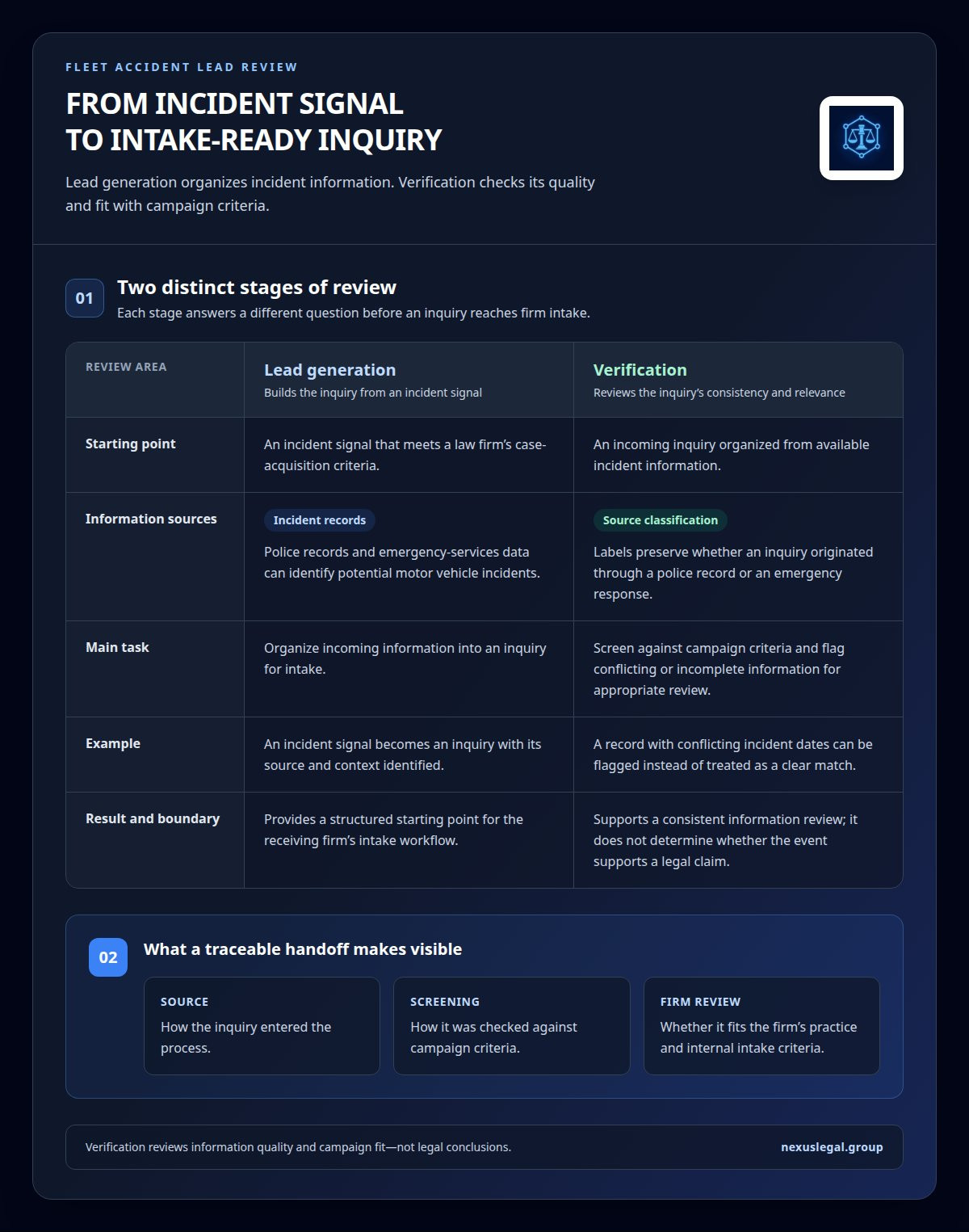
Lead generation begins when an incident signal meets a law firm’s case-acquisition criteria. Police records and emergency-services data can identify potential motor vehicle incidents. The provider organizes incoming information into an inquiry for intake. This stage establishes the source and context; it does not determine whether the event supports a legal claim.
Source classification keeps the acquisition process organized. A police-record inquiry and an emergency-response inquiry may come through different channels. The provider labels the source so the firm can see how the opportunity originated. For example, a collision identified through emergency response should remain distinguishable from one identified through a police record.
Verification checks whether an inquiry is internally consistent and relevant to the campaign. Automated verification can support consistent screening across records. A record with conflicting incident dates, for example, can be flagged for closer review instead of treated as a clear match. The review focuses on information quality and campaign criteria, not legal conclusions.
- Classify each inquiry by its originating source.
- Screen incoming records against the campaign’s defined incident criteria.
- Identify conflicting or incomplete information for appropriate review.
- Organize the verified inquiry for the receiving firm’s intake workflow.
Consider a campaign focused on collisions involving commercial vehicles. A record that clearly identifies a business vehicle may meet its criteria. An entry with no clear vehicle context may need further review before routing. These distinctions help keep the intake stream aligned with the firm’s intended case focus.
Verification is not a guarantee that a case is suitable. It supports a consistent assessment of the information provided, while attorneys and intake professionals decide whether an inquiry fits their practice. For example, a clearly categorized incident may still fall outside a firm’s jurisdiction or preferred matter type. The review can make that distinction visible earlier.
For law firms, the practical value is a traceable handoff. Source classification, screening, and verification give intake staff a structured starting point. The firm can see how an inquiry entered the process and assess it against internal criteria. This creates a clearer transition from incident-based lead generation to the firm’s independent case review.
Fleet accident documentation should generally be completed within hours of a collision. This timing is relevant when reviewing an inquiry, alongside its source and consistency, but it does not determine whether the matter fits a firm’s criteria. The financial impact also provides context: Fleet News estimates that a driver involved in an accident would need to generate approximately $25,500 more in revenue to cover the costs. Clear documentation and verification can therefore inform the handoff without replacing the firm’s own assessment.
What information is included in a fleet accident lead?
A fleet accident lead organizes incident details that help a law firm understand what happened. The record may include scene photos, a driver report, repair estimates, and insurance claim information. These materials capture different aspects of the collision. A photo may show vehicle damage, while a driver report describes the event.
Details about people and vehicles help connect the incident to those involved. Information may include third-party contact and insurance details, as well as witness information. For example, a witness’s name and contact details can help identify someone with an account of the scene. The police report number can also be recorded if officers file a report.
- Scene photos showing vehicles and visible damage.
- A driver report describing the incident.
- Third-party contact and insurance details.
- Witness information and the police report number, if filed.
- Repair estimates and related insurance claim information.
Scene documentation gives intake teams a clearer view of the reported event. Drivers should photograph all vehicles involved, exchange third-party contact and insurance details, record witness information, and note the police report number if one is filed. These details help distinguish the people, vehicles, and records associated with a collision.
Repair estimates and insurance claims add an operational perspective. An estimate can describe repairs being considered for a fleet vehicle, while a claim record may show how the incident entered the insurance process. Together, these documents help clarify what followed the collision rather than relying only on an initial account.
Completeness matters because records may be assembled at different times. A driver report might describe the scene, while a later repair estimate documents vehicle damage. If a police report number is available, it can help link the report to the same event. Organizing the records together makes missing details easier to spot.
For law firm intake, the value lies in a coherent incident file, not simply a large volume of documents. A photo, witness detail, and driver report should relate to the same collision. Clear organization helps reviewers see what information is present and what remains unclear. It also gives the firm a structured starting point for assessing the inquiry.
A fleet incident file can include events beyond collisions with visible damage. A near miss, equipment malfunction, or vehicle security breach may be recorded even when no damage or injury occurs. After a fleet vehicle accident, drivers should prioritize safety, contact emergency services, collect information, and document the scene with photos and notes. A written accident response policy should specify what drivers do after a collision, whom they notify at the company, and how they submit documentation.
A fleet accident workflow can include immediate incident response, accident documentation, first notice of loss and claims filing, repair management, subrogation, and post-incident review. Certified repair oversight, including I-CAR Platinum-certified technicians, can help identify repair issues before they lead to larger bills. Fleet safety practices include planning routes in advance when possible and tracking vehicles with GPS. These details give reviewers context about how the event was handled, how records were submitted, and what repair or review steps followed.
How do exclusive and shared fleet accident leads compare?
An exclusive lead goes to one law firm, while a shared lead is distributed to multiple firms. That difference affects how an inquiry enters intake. With an exclusive record, one firm handles the initial follow-up. With a shared record, several firms may contact the same person about the same collision.
Exclusive distribution can support a more controlled intake process. For example, one firm can assign the inquiry to a specific team member, record each contact attempt, and update its case-management workflow. Follow-up stays centralized within the firm. This can simplify internal ownership, especially when intake staff coordinate across practice areas.
Shared distribution creates a different operational environment. If several firms receive the same inquiry, each may begin outreach independently. A person involved in a delivery-van collision could receive separate calls from different intake teams. Firms need clear internal tracking to distinguish their outreach from other activity and avoid duplicate follow-up within their own systems.
- Distribution: Exclusive leads go to one firm; shared leads go to multiple firms.
- Intake ownership: Exclusive delivery gives one firm direct control over its workflow.
- Outreach: Shared delivery can mean more than one firm contacts the same person.
- Recordkeeping: Both models benefit from clear notes on lead source and follow-up.
Neither model determines whether an inquiry is a viable case. The police report, incident details, and the person’s account still need review. For instance, a well-documented collision may not fit a firm’s jurisdiction or case criteria. Distribution describes access to the lead, not its legal merits or outcome.
Operational fit depends on a firm’s intake capacity and follow-up process. A firm with centralized intake may prefer a single point of ownership for each inquiry. A team managing several incoming sources may prioritize reliable source labeling and duplicate detection. Either way, staff need enough context to identify the incident and route it correctly.
Before choosing a model, firms can define how they evaluate lead quality and measure intake performance. Useful review points include source documentation, incident clarity, duplicate records, and completeness of available contact details. Comparing these factors across exclusive and shared leads helps firms assess which approach fits their workflow, without confusing distribution access with case suitability.
What laws and regulations apply to selling fleet accident leads in the U.S.?
In the United States, lead sales require attention to how information is obtained, used, and shared. A fleet collision record may contain names, contact details, insurance information, and report data. These elements raise different compliance questions from a general business inquiry. The lead’s source, recipient, and intended use all matter.
Privacy review should start with the information fields in each record. For example, a file might combine a driver’s name, a witness’s contact details, and an accident report number. The review should identify where each field came from, why it is included, and who receives it. Data minimization helps exclude unrelated details from the transfer.
Marketing and outreach practices also warrant review. A lead transfer is separate from the law firm’s later contact with an individual, but the handoff can shape what the recipient understands. For example, intake staff should be able to distinguish an inquiry based on a police report from one submitted by an individual. Clear source labels reduce confusion about how the information was collected.
- Document the source category for each record, such as a police report or emergency response.
- Limit transferred details to information relevant to the reported collision.
- Record the recipient and permitted purpose for each transfer.
- Review outreach language separately from the lead-generation process.
State-specific requirements can affect how records are accessed, transferred, and used. Attorney advertising and referral rules may also apply when a campaign connects potential clients with a law firm. For instance, a program that supplies incident information operates differently from one that recommends a particular attorney. The campaign design and state involved shape the review.
Before distribution, a compliance review can map each stage: source acquisition, data handling, transfer, and law firm intake. A source log can show whether a record came from a report, emergency-services information, or another channel. Written procedures can define access controls, retention practices, and approved recipients. Each step should reflect the campaign’s actual data flow.
No single checklist resolves every state’s requirements or every data source’s conditions. A campaign involving multiple states, report sources, or recipient firms needs a review tailored to those details. The practical objective is traceability: the firm should understand what the lead contains, where it originated, and how it was transferred.
Nexus Legal Group: Reverse Append MVA Leads To Obtain Accident Reports and Details of those involved
Nexus Legal Group helps law firms obtain accident-report information connected to motor vehicle incidents. Its reverse-append service is designed to obtain accident reports and details about the people involved. Firms can use this process when an initial incident record lacks report or participant information needed for intake review.
For example, a fleet collision record may identify an event but leave key details incomplete. Reverse append can connect the record with available accident reports and information about the people involved. This gives the firm more context to evaluate the inquiry and decide whether it meets intake criteria.
This process can complement police report generated MVA leads, which use police reports as a lead-generation source. Emergency services generated MVA leads provide another path to incident information. These offerings draw on different source records, helping law firms align acquisition with the information available for a matter.
Automated verification supports the review of incoming information. For a firm, verification can organize lead details for intake and make gaps easier to identify. It does not replace the firm’s own assessment of case fit. Attorneys and intake teams still evaluate the incident, available information, and their practice criteria.
High-intent MVA case acquisition is useful when a firm is building a focused pipeline of motor vehicle accident inquiries. A practical next step is to define the case types and incident information the intake team prioritizes. A clear scope aligns lead acquisition with the firm’s review workflow, rather than treating every fleet-related incident as equivalent.
When planning an acquisition workflow, firms can map how source information enters intake, which details support an initial review, and how staff handle incomplete records. For instance, a police report may provide incident context, while reverse append can add report and participant details. Automated verification can support a structured review of the resulting information.
Nexus Legal Group offers MVA case acquisition, police report generated leads, emergency services generated leads, reverse append, and automated verification. These services suit law firms seeking incident-based information for intake, not legal representation. A defined intake focus helps determine how they fit into the firm’s lead-generation process.
Contact Nexus Legal Group to discuss fleet-incident lead generation for your firm.
Frequently Asked Questions
What are fleet accident leads?
Fleet accident leads are inquiries linked to collisions involving vehicles used for business. They help plaintiff law firms identify potential motor vehicle accident matters for intake review. For example, a report involving a company truck may connect the incident with the people involved and relevant accident details. A lead is an inquiry, not a confirmed legal case; the firm assesses its facts, jurisdiction, and fit with its practice.
Where can businesses buy fleet accident leads?
Law firms can obtain these inquiries through specialized motor vehicle accident case-acquisition services. Nexus Legal Group provides High-Intent MVA Case Acquisition, including police report generated leads, emergency services generated leads, reverse append, and automated verification. These options support firms that need incident-based information for intake. For example, a firm may use reverse append to obtain accident reports and details about people involved in a vehicle collision.
What is the best process for contacting and converting fleet accident leads?
Classify the inquiry by source, screen it against the firm’s criteria, and flag incomplete or conflicting details for review. Intake staff can then assess the incident, the people involved, and available documentation against the firm’s practice focus, clarify missing information, and decide whether to pursue further review.