Acquiring High-Value Trucking Law Firm Leads

Learn how to evaluate trucking law firm leads by verification, accident details, contactability, and case fit, then compare providers beyond price alone.
The lowest-priced trucking law firm leads may not be the most efficient investment. There is no standard price for trucking accident leads. Cost depends on how an inquiry was sourced, how thoroughly it was verified, and how closely it matches a firm’s case criteria.
It makes sense to consider price, but the number alone does not show whether a lead is usable. Contactability, incident details, and verification all help determine whether an inquiry can move through a firm’s intake process.
This article explains the main factors that affect lead pricing and how verification and filtering help assess quality. You’ll learn what makes an inquiry more actionable, what to consider when evaluating a lead-generation provider, and how police-report data, emergency-services data, and reverse append can support case acquisition. The goal is to offer a practical way to assess potential value without relying on price alone.
Key Takeaways
- Assess lead quality by looking at verification, accident details, contactability, and fit with your firm’s intake criteria, not price alone.
- Understand how sourcing methods shape the information available and the steps needed to turn an inquiry into a viable intake opportunity.
- Compare shared and exclusive leads by weighing competition for each inquiry against your firm’s acquisition priorities.
- Evaluate providers based on transparent sourcing, filtering processes, and attention to applicable advertising and lead-handling rules.
- Match your acquisition approach to your firm’s needs, then consider specialized case-acquisition support when stronger intake infrastructure is the priority.
How providers verify and filter trucking law firm leads
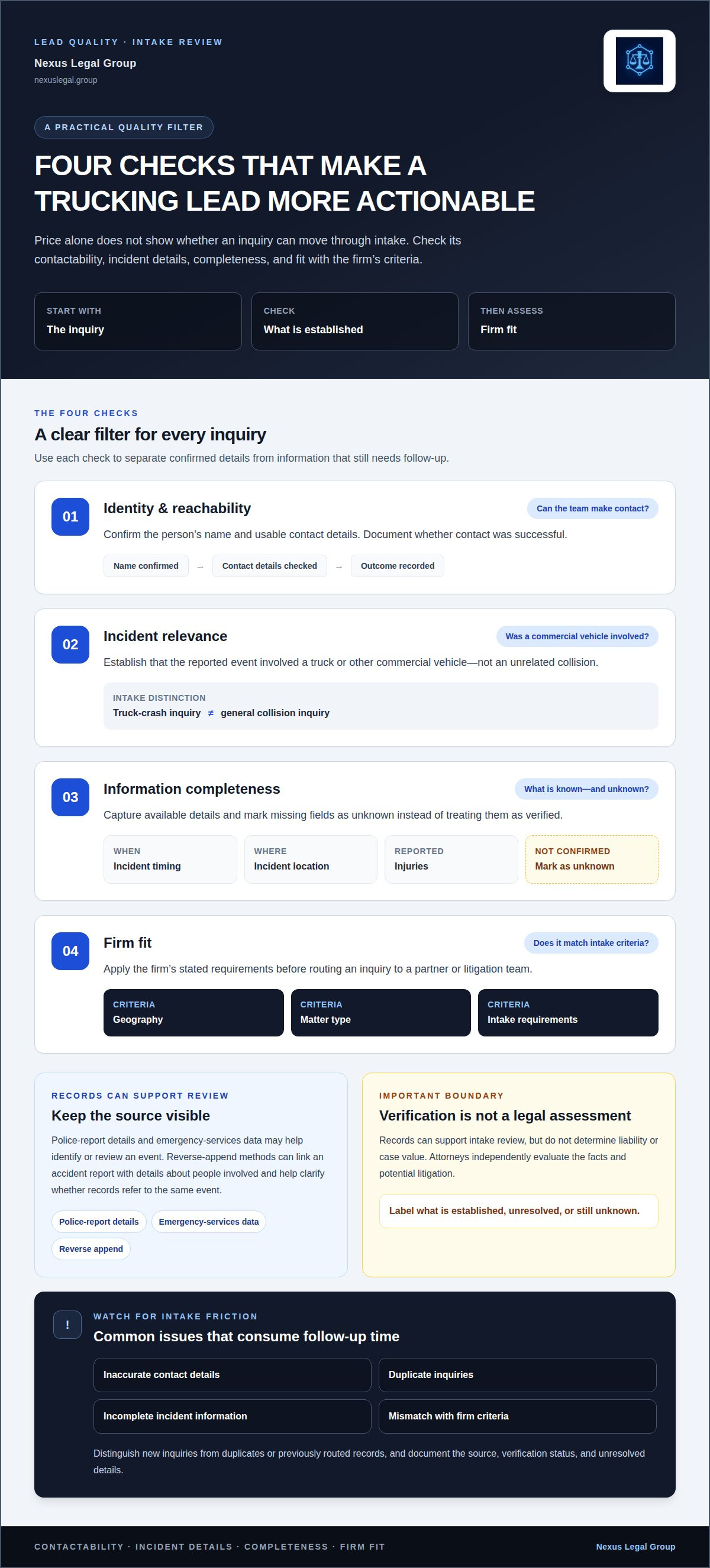
Verification works best as a defined sequence, starting with confirming the inquiry and then assessing whether it fits the firm’s intake strategy. A provider might validate contact details, confirm the person’s connection to a vehicle crash, and record when and where it happened. Each step addresses a different potential failure. A working phone number alone does not establish that an inquiry is a suitable personal injury matter.
Next, providers can check whether the information is consistent. They can compare the caller’s account with available accident-report details, confirm whether a commercial vehicle or carrier was involved, and flag missing information for follow-up. A police-report-generated lead may include details that help attorneys assess the incident, while emergency-services data can offer another way to identify an event. These records support intake review, but do not determine liability or case value.
A practical filter can assess an inquiry against criteria agreed with the firm:
- Identity and reachability: Confirm the person’s name and usable contact details, then document whether contact was successful.
- Incident relevance: Establish that the reported event involved a truck or other commercial vehicle, rather than an unrelated collision.
- Information completeness: Capture incident timing, location, reported injuries, and other available details. Mark unknown fields instead of treating them as verified.
- Firm fit: Apply the firm’s stated geographic, matter-type, and intake criteria before routing the inquiry to a partner or litigation team.
Filtering should also distinguish a new inquiry from a duplicate or previously routed record. Reverse-append methods can link an accident report with details about people involved, helping clarify whether records refer to the same event. Providers can label the source, verification status, and unresolved details so the receiving team can see what is established and what still needs intake review. This helps attorneys prioritize follow-up without overstating what the record proves.
What are the risks of buying trucking law firm leads? Inaccurate contact details, duplicate inquiries, incomplete incident information, or a mismatch with the firm’s case criteria can use up intake time without producing a viable opportunity. Verification should not be mistaken for a legal assessment: the firm’s attorneys evaluate the facts and potential litigation independently.
How do providers generate trucking law firm leads?
Providers generate inquiries through different channels and route them to firms handling truck-crash matters. A search campaign, for example, can reach someone looking for legal help after a collision involving a tractor-trailer. Educational pages might address topics such as contacting an insurer or preserving crash details. Each channel attracts a different audience, so campaign design should reflect the firm’s case criteria and intake capacity.
Paid search and online advertising can capture active demand. A campaign might use a landing page focused on commercial-vehicle collisions, with a form requesting contact details and a brief incident description. Clear, topic-specific questions help distinguish a truck-crash inquiry from a general car-accident request. Providers can then route submissions according to the firm’s geography, matter focus, and intake preferences.
Other approaches use information associated with reported incidents. Accident-report details, for example, can help identify people involved and create an opportunity for outreach. Emergency-services information may also indicate that a crash occurred. Unlike a person submitting a web form, these sources require the provider to organize available details and establish an appropriate way to make contact. Recording the source helps the receiving firm understand how the inquiry originated.
- Define the target: The firm specifies the locations, truck-crash matter types, and basic intake requirements it accepts.
- Select a channel: The provider chooses search advertising, educational content, incident-related information, or a combination aligned with that target.
- Capture relevant details: A form or record gathers the person’s contact information and available facts about the collision.
- Route the inquiry: The provider directs the record to the appropriate intake team and identifies its source.
Consider a hypothetical crash involving a delivery truck and a passenger vehicle. A person searching for help might submit a form describing the collision, while a separate incident-based process might identify report details. Both paths can produce inquiries, but they start with different information and call for different follow-up. A consistent intake structure helps attorneys distinguish a direct request for help from an incident-derived record.
Lead generation works best as a connected workflow, not a single advertising placement. Providers align campaign language, source selection, intake fields, and routing rules before launch. For example, a firm focused on serious commercial-vehicle cases can define those criteria upfront, helping the provider target relevant inquiries and keep unrelated matters out of the same queue.
Which companies sell trucking law firm leads in the United States?
In the United States, firms can obtain truck-crash inquiries through different types of providers, rather than one uniform supplier category. Legal lead-generation companies attract inquiries through advertising and route them to law firms. Data-focused providers work from incident-related records, while some vendors combine acquisition with intake verification. These models produce different records, so a provider’s name alone does not show whether its leads fit a firm’s needs.
Search-based vendors typically focus on people actively seeking legal help. A prospective client might submit a form after searching for an attorney following a collision with a commercial truck. The provider captures the inquiry and routes it according to agreed criteria. This model depends on the information the visitor submits and how the campaign is targeted, both of which can affect how closely the inquiry relates to a trucking matter.
Incident-data providers start from a different point. They may use police-report or emergency-services information to identify crashes and associated details. Reverse-append processes can add information about people connected with an accident report. Because these approaches do not begin with the same direct request for representation as a completed web form, firms should distinguish the sources when reviewing incoming records.
Some providers specialize in motor vehicle accident acquisition and offer several sourcing methods within one program. Others focus mainly on advertising or data workflows. Compare the service structure and operating process, not just the label attached to a lead.
- Source: Determine whether inquiries come from a direct submission, an accident report, emergency-services information, or a combination.
- Case focus: Check whether the provider filters for commercial-truck incidents or captures broader motor vehicle matters.
- Routing: Understand how the provider assigns inquiries based on location, matter type, or firm-defined criteria.
- Verification: Identify what information the provider validates and how it marks unknown or incomplete details.
For example, a firm seeking serious truck-collision matters may find a broad auto-injury source less aligned with its intake strategy. A provider that records whether a commercial vehicle was involved can make that distinction clearer earlier in intake. This detail supports screening, but attorneys still assess the facts and legal merits independently.
When assessing trucking law firm leads, compare providers on source transparency, case-specific filtering, and the information delivered with each inquiry. Clear explanations of these processes help a firm judge operational fit without relying on unsupported performance claims or headline promises.
Are shared or exclusive trucking accident leads better?
Neither model is automatically better. The right choice depends on a firm’s intake capacity and acquisition strategy. A shared lead is distributed to multiple firms, while an exclusive lead is routed to one firm under the provider’s stated terms. A shared inquiry, for example, may prompt several firms to contact the same person. An exclusive inquiry reduces that competition within the agreed distribution arrangement, but does not establish the case’s legal merit.
Shared distribution can suit a firm seeking a broader flow of inquiries and able to respond efficiently. The tradeoff is direct competition for attention. If one person submits a form and several firms receive it, timing and clear intake communication can affect whether that person engages. A firm with limited intake coverage may find this model harder to manage, even when inquiries match its practice focus.
Exclusive distribution can give a firm a clearer opportunity to conduct initial intake without other firms receiving the same inquiry through the provider’s arrangement. It may suit a team that prioritizes focused follow-up over broader distribution. Still, exclusivity does not guarantee contact, a complete record, or a viable matter. An inquiry involving unclear injuries or an uncertain connection to a commercial carrier still needs careful assessment.
Compare the models using the specific terms that shape delivery:
- Recipient scope: Establish whether a lead goes to one firm or multiple firms, and whether exclusivity applies to the inquiry or a defined territory.
- Distribution window: Clarify when routing begins and whether the provider continues distributing the record afterward.
- Case criteria: Match commercial-vehicle involvement, location, and matter type to the firm’s intake requirements.
- Follow-up capacity: Align lead volume and delivery patterns with the team members available to handle inquiries.
A firm handling truck-collision cases across several regions, for example, may prefer an arrangement organized by location. Another firm with a focused intake team may favor exclusive routing for inquiries that meet its criteria. These examples show why distribution terms and operational fit matter more than the label alone.
Evaluate performance using internal intake outcomes and consistent definitions for contact made, completed screening, and accepted matter. Compare shared and exclusive records with similar sourcing and case criteria. Otherwise, differences may reflect targeting rather than distribution. The strongest choice is the model that fits the firm’s capacity, preserves clear source information, and supports a reliable intake process.
What rules govern advertising and buying legal leads in the United States
In the United States, legal-lead campaigns can involve attorney-advertising standards, consumer-protection principles, privacy considerations, and rules that vary by jurisdiction. A campaign reaching people across multiple states may need review for each jurisdiction it targets. Applicable requirements depend on the message, how the inquiry was collected, and how it is routed. Treat compliance as part of campaign design, not as a final copy edit.
Advertising language deserves close review. A landing page that promises a specific result or implies a law firm has already assessed someone’s case can create a different impression from a clear invitation to request information. Firms should review headlines, forms, follow-up messages, and descriptions of attorney involvement together. For example, a form should distinguish a request for contact from an attorney-client relationship or a legal evaluation.
Before launch, structure a review around these operational questions:
- Where will the campaign run? Identify every jurisdiction targeted, including places reached through broad online distribution.
- What does the message claim? Review statements about outcomes, credentials, case acceptance, and the firm’s role for accuracy and clarity.
- How is information collected? Document what the form asks, what the person is told, and how the inquiry will be used or shared.
- Who receives the inquiry? Map each transfer from the marketing source to the provider and then to a firm’s intake team.
Lead-purchase terms matter too. A written agreement can specify whether inquiries are shared or exclusive, which records are delivered, and how source and routing information are recorded. A firm buying inquiries for truck collisions, for instance, should be able to distinguish direct submissions from records developed through incident information. This helps staff understand each contact’s origin and context.
Review privacy and outreach practices alongside the initial advertisement. A web form may collect a name, phone number, and crash description, while a later call or message is a separate communication step. Consider the campaign’s collection language, data access, retention practices, and contact process together. A lead vendor’s workflow does not replace the firm’s own legal and operational review.
Because requirements can vary by jurisdiction and campaign design, firms should have qualified counsel review applicable rules and materials before launch. A documented approval process for copy, collection, routing, and follow-up gives the firm a repeatable way to assess campaign changes.
Nexus Legal Group
Nexus Legal Group helps plaintiff law firms assess and acquire motor vehicle accident inquiries through a structured case-acquisition process. It is a relevant next step when your firm needs trucking-related inquiries with clear source information and verification, rather than relying on lead price alone. The work focuses on acquisition infrastructure, not legal representation.
Nexus Legal Group’s High-Intent MVA Case Acquisition service supports firms seeking motor vehicle accident matters that align with their intake strategy. For trucking-focused campaigns, start by defining the incidents and details that help your team assess fit. These criteria can guide how inquiries are sourced, reviewed, and routed, while attorneys remain responsible for evaluating legal merit and deciding whether to accept a matter. This creates a more structured foundation for acquiring trucking law firm leads that match the firm’s intake priorities.
Source options include Police Report Generated MVA Leads and Emergency Services Generated MVA Leads. These approaches draw on different types of incident-related information, helping firms understand how an inquiry originated. Reverse append can also obtain accident reports and details about people involved. This information adds context for intake, but does not by itself establish fault, injury severity, or case value.
Automated Verification supports a more consistent review of incoming information. It can help when a firm wants verification built into its acquisition workflow before inquiries reach intake. For example, a firm can align review and routing criteria with the details its team uses to screen commercial-vehicle incidents. Separating available record information from facts that require attorney review helps keep intake decisions grounded.
A productive engagement starts with the firm’s acquisition priorities. Consider the truck-crash matters it handles, the locations it targets, the information its intake team needs, and its capacity to follow up. These inputs help shape an acquisition approach around the firm’s process, rather than treating every inquiry alike. The result is a clearer operational basis for evaluating source, relevance, and verification when developing trucking law firm leads.
For firms evaluating trucking law firm leads, Nexus Legal Group offers a focused way to connect acquisition methods with intake requirements. Its services suit firms seeking MVA case acquisition and verification support, rather than direct legal representation or unrelated marketing work.
Contact Nexus Legal Group to discuss your case-acquisition needs.
Frequently Asked Questions
How Much Do Trucking Accident Leads Cost?
There is no standard price for trucking accident leads. Cost depends on the acquisition channel, the information supplied, verification processes, and distribution terms. Assess value by considering whether an inquiry fits your intake priorities and how much follow-up it requires. The price for a specific service depends on the case and is provided after a quote request. Compare proposals using consistent criteria, not price alone.
What are trucking law firm leads?
Trucking law firm leads are inquiries or incident-related records that may connect a law firm with someone involved in a truck crash. They can come from a person requesting legal information or from accident-related information assembled for intake. For example, a record may identify a commercial-vehicle collision but lack a detailed account. It is a potential intake opportunity, not a determination that a claim is valid or that the firm will accept it.
What do trucking accident leads cost per lead?
The per-lead cost varies with the sourcing model, the information delivered, verification steps, and whether distribution is shared or exclusive. A direct inquiry and an incident-derived record may involve different acquisition workflows. To assess a quoted amount, compare what each lead includes and how it is routed. The price for a particular service depends on the case and is provided after a quote request.
How can law firms assess a provider’s trucking lead quality and conversion rates?
Assess trucking law firm leads by tracking consistent intake outcomes, not by relying on a provider’s headline conversion claim. Define the stages your firm measures, such as successful contact, completed screening, fit with intake criteria, and progression to attorney review. Segment results by source and lead type, since combining direct requests with incident-derived records can hide performance differences. Apply the same definitions and review period to each provider.
How do providers qualify trucking leads, and what should law firms do after receiving them?
Providers qualify inquiries by organizing available contact and incident information against agreed intake criteria. After receiving a lead, the firm’s intake team can review its source, identify unanswered questions, and follow its established contact and documentation process. For example, if a record identifies a truck collision but lacks a clear incident description, intake staff can clarify that detail before routing the matter for attorney review.
How do trucking law firm lead strategies vary by state and local market?
Firms can define the locations and truck-crash matters they accept, then have providers target and route inquiries according to those geographic and intake criteria. A provider’s sourcing and verification process can also affect how closely inquiries fit the firm’s market.