Truck Accident Lead Generation: Acquire High-Value Cases
Learn how truck accident lead generation works, assess lead quality and cost per signed case, and improve intake to acquire valuable commercial truck cases.
The cheapest trucking lead can become the most expensive case acquisition. Effective truck accident lead generation is measured not only by the price of an inquiry, but by whether it reaches the right firm, becomes a signed case, and supports a viable acquisition cost.
It makes sense to look at lead prices first, but price alone cannot show whether a campaign is working. Assess lead costs alongside conversion rates and cost per signed case, and consider which factors can change the economics from one campaign to another.
You’ll also see how lead qualification and intake affect results, whether campaigns can cover 18-wheeler and other commercial truck crashes, and how motor vehicle accident case acquisition fits into a firm’s growth strategy. The goal is a clearer framework for evaluating campaign quality and the value of the cases it produces.
Key Takeaways
- Assess lead quality through accident details, eligibility, timing, and intent, not just the number of inquiries.
- Compare lead acquisition costs with conversion rates and cost per signed case to evaluate campaign performance.
- Commercial truck campaigns can cover 18-wheelers and other vehicle types, with case complexity shaping qualification needs.
- Landing-page clarity, effective intake, and performance tracking help connect marketing activity to signed cases.
- Reverse-append services can help law firms obtain accident reports and details about people involved in a crash.
What are Motor Vehicle Accident (MVA) leads?
MVA leads are inquiries from people involved in vehicle crashes who are seeking legal representation or may not know it is available. A provider can qualify each inquiry by checking accident details, timing, eligibility, and intent before routing it to attorneys.
Exclusive and Pre-Qualified Leads
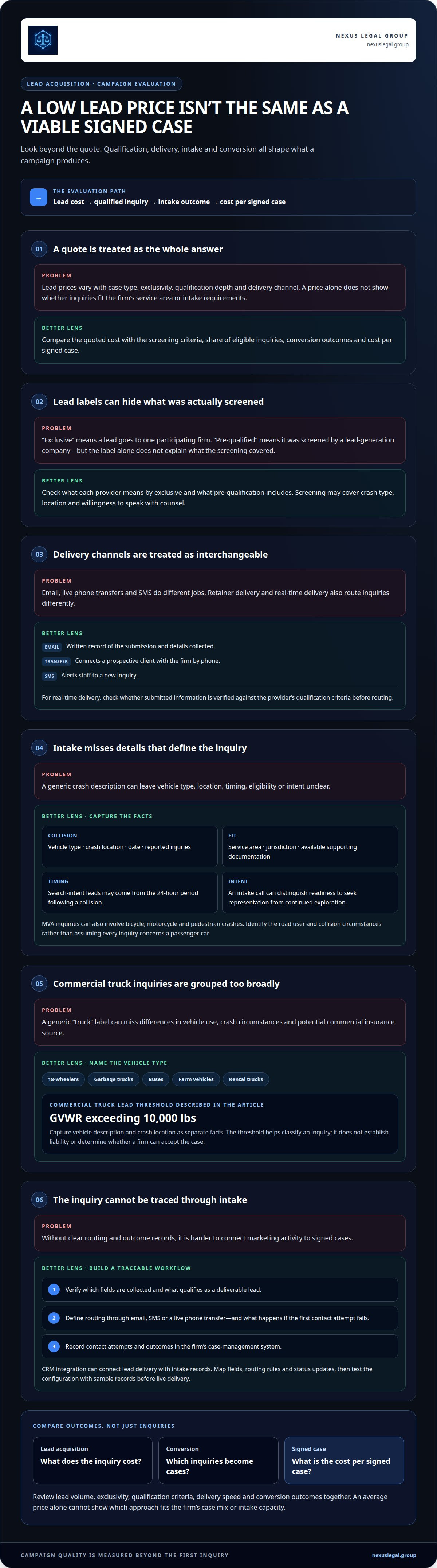
Exclusive trucking accident leads go to a single participating law firm rather than being shared among firms. Pre-qualified leads are screened by a lead-generation company before purchase. Screening may cover crash type, location, and willingness to speak with counsel. Compare what each provider means by “exclusive” and what its screening includes, because the label alone does not explain what a lead contains.
A structured intake begins with the collision: vehicle type, crash location, date, and reported injuries. In 2026, a commercial vehicle with a GVWR exceeding 10,000 pounds meets the threshold used here for a truck accident lead. Next, the provider checks whether the person and accident fall within the firm’s service area and jurisdiction, and whether supporting documentation is available.
Timing and intent add useful context. A search-intent lead may come from someone in the 24-hour period following a collision, while an intake call can distinguish a person ready to seek representation from someone still exploring options. MVA accident leads can also involve bicycle, motorcycle, and pedestrian crashes, so the intake should identify the road user and collision circumstances rather than assume every inquiry involves a passenger car.
Lead Quality, Cost, and Compliance
Federal and state rules govern legal lead generation and attorney advertising, and requirements vary by jurisdiction and campaign structure. For TCPA and privacy compliance, align outreach with applicable rules and document consent, contact channel, and opt-out status. These records help attorneys assess whether a lead can be contacted through the planned method and support a traceable intake process.
Assess lead quality against the accident details, screening criteria, delivery records, and intake outcomes. Compare cost with exclusivity, relevance to the firm’s jurisdiction, and the share of inquiries that meet its eligibility standards. Reporting should help attorneys distinguish high-volume feeds from leads that match the firm’s case criteria, including commercial-truck crashes.
How much do personal injury leads cost?
Lead cost depends on case type, exclusivity, qualification depth, and delivery channel. A commercial-truck inquiry with documented crash details differs from a general personal injury form submission, so compare the criteria behind each quote. Evaluate cost alongside the share of inquiries that match the firm’s service area and intake requirements.
Email gives intake staff a written record of each submission and the details collected through the form. A live transfer connects a prospective client with the firm by phone, while SMS can alert staff to a new inquiry. Each has a distinct role: email supports review, transfers enable a direct conversation, and text alerts can prompt follow-up.
Retainer delivery provides leads under an agreed arrangement, while real-time delivery routes inquiries as they arrive. Real-time verification can check submitted information against the provider’s qualification criteria before delivery. For example, a trucking inquiry might be screened for collision type, location, and stated intent to speak with a lawyer.
Delivery speed matters because an interested person may contact more than one accident lawyer. The firm’s intake process should specify who receives each alert, how staff respond, and what happens if the first contact attempt fails. The operational sequence is straightforward:
- Verify which fields are collected and what qualifies as a deliverable lead.
- Route the submission through email, SMS, or a live phone transfer.
- Record contact attempts and outcomes in the firm’s case-management system.
CRM integration connects lead delivery with intake records, reducing manual re-entry and helping staff track outcomes. Before launch, the provider and firm should map required fields, routing rules, and status updates. Setup time depends on the integration method and the firm’s existing workflow, so test the configuration with sample records before live delivery begins.
To compare offers, separate quoted lead cost from the cost of acquiring a signed case. Review lead volume, exclusivity, qualification criteria, delivery speed, and conversion outcomes together. For instance, a lower-cost shared inquiry may require more intake effort than an exclusive, screened submission. An average price alone cannot show which approach fits the firm’s case mix or intake capacity.
Do you cover 18-wheeler and commercial truck crashes specifically?
Commercial vehicle campaigns can target 18-wheelers, garbage trucks, buses, farm vehicles, and rental trucks. Each category needs clear intake fields so attorneys can distinguish the vehicle, crash circumstances, and potential commercial insurance source.
For example, an 18-wheeler collision differs from a garbage truck crash in vehicle use and potential parties involved. A bus incident may involve a carrier, while a farm vehicle crash may require different context. Campaign targeting should name the vehicle type rather than group every inquiry under a generic truck label.
In 2026, the qualifying threshold described for commercial truck leads is a vehicle with a GVWR exceeding 10,000 lbs. That detail helps classify an inquiry, but it does not establish liability or determine whether a law firm can accept the case. Intake should capture the vehicle description and crash location as separate facts.
Potentially responsible parties can include the driver, motor carrier, trucking company, leasing firm, cargo loader, or maintenance contractor. A faulty part may also involve its manufacturer. For a crash involving a leased tractor and a separate cargo loader, recording each entity as a possible source of relevant information gives attorneys a clearer starting point.
Insurance is another important qualification detail. Federal law requires interstate carriers to hold minimum liability coverage of often $750,000 to $1,000,000 or more, according to the Federal Motor Carrier Safety Administration. This figure concerns interstate carriers; it should not be treated as the available coverage in every commercial vehicle accident case.
Commercial carrier details can help distinguish one company from another. Intake may record the carrier name and USDOT number when available, alongside the vehicle type and crash details. These identifiers can help attorneys organize the lead and assess which business entities may be relevant to the accident.
Advertising can then target specific accident cases instead of broad vehicle-related traffic. A campaign for 18-wheeler crashes, for example, can use separate messaging from one aimed at bus or farm vehicle incidents. This sharper target makes the lead source and the prospective client’s reported crash type easier to interpret.
For law firms, the practical step is to define accepted vehicle categories and intake fields before launch. Clear specifications align campaign targeting with the firm’s case criteria, from rental truck collisions to multi-party commercial crashes.
Cost per signed case and lead conversion rates
Cost per signed case measures campaign spend against the cases the firm actually signs. Calculate it by dividing attributable marketing and lead costs by the number of signed cases from that campaign. A low cost per inquiry can still mean a high cost per signed case if few inquiries meet the firm’s criteria or progress through intake. For truck accident lead generation, this measure connects acquisition spending to the outcome the firm wants.
Lead conversion rate tracks movement between defined stages, such as landing-page visit to inquiry, inquiry to qualified lead, and qualified lead to signed personal injury case. Keep each denominator clear. A page conversion rate compares submitted forms with page visits; a signed-case rate compares signed cases with leads received. Separating the measures shows where prospects leave the process.
A personal injury landing page should make the next step clear and easy. Use a direct call to action, a concise form, relevant firm expertise, and trust signals. For a truck collision campaign, identify the case type and collect essential crash details. These elements help visitors decide whether to submit an inquiry and give intake staff useful context.
Measure the page and intake process together. Call tracking connects phone inquiries to campaigns, form analytics show where submissions begin, and a CRM records each lead’s status. If a campaign generates inquiries but few qualified consultations, review the form questions, traffic source, and follow-up workflow before changing the broader strategy.
Response timing can influence conversion. Contacting a lead within 5 minutes increases conversion odds by 400% compared with waiting 30 minutes. Use this benchmark to examine actual intake timestamps, not as a guaranteed result for every campaign. Assign responsibility for new submissions so inquiries receive prompt attention.
For truck accident lead generation, ROI tracking should connect campaign source, spend, lead status, and signed-case outcomes. Campaign-level call tracking, form analytics, and CRM data can support this analysis. The firm can then compare acquisition costs and identify whether performance changes at page conversion, qualification, or intake.
Review claims and injury case outcomes over the same reporting period. Separate unqualified inquiries from eligible prospects, then compare conversion at each stage. This shows whether the main issue is landing-page performance, lead quality, or intake workflow, so the next campaign adjustment has a measurable purpose.
Motor vehicle accident case acquisition results
Campaign results matter when marketing activity can be connected to signed cases, not just traffic. One reported law-firm example generated more than 50 potential clients each month through organic searches after reaching the top Google ranking for a local car accident lawyer search. The useful takeaway is to measure what happens after a visitor arrives: inquiries, qualified conversations, and signed cases.
A separate reported campaign signed eight motor vehicle cases in 60 days with a $5,000 monthly advertising budget. These figures show why case volume, case value, and acquisition spend should be reviewed together. Each describes a different part of campaign performance.
Another reported example involved a lawyer who gained more than 30 new cases each year through one chiropractor partnership. That result illustrates how a referral source can contribute a distinct stream of potential clients alongside digital marketing. A firm assessing the channel can record the source of each inquiry, its qualification status, and whether it becomes a signed case.
Reported campaigns have also included a $500K crash-victim case as an advertising example and $1M+ settlements as possible landing-page trust signals. Such examples can communicate case experience, but they do not predict the value of a new matter. A firm should distinguish past outcomes from the performance measures used to evaluate current acquisition.
For a clearer view, connect each call or form submission to its marketing source, then record intake outcomes and signed status. Call tracking, form analytics, and CRM records help preserve that path. If traffic rises but signed cases do not, examine whether the change occurred in lead qualification, intake follow-up, or campaign targeting.
Review results by campaign and case category. A commercial truck inquiry and a passenger-vehicle accident inquiry may have different qualification needs and potential case value. Separate reporting helps law firms identify which sources produce suitable prospects instead of treating every submission as equivalent.
The practical takeaway is to evaluate acquisition by source, qualified inquiries, signed cases, and spend. These measures help a firm determine whether a campaign contributes suitable vehicle accident cases and where to focus its next adjustment.
Nexus Legal Group: Reverse Append MVA Leads To Obtain Accident Reports and Details of those involved
Nexus Legal Group helps law firms seeking motor vehicle accident inquiries supported by relevant accident details. Its reverse-append service helps obtain accident reports and details about people involved, giving firms more information to support lead review and intake.
Reverse append is useful when an initial inquiry identifies a crash but leaves important details incomplete. For example, a firm may need the accident report and information about others involved to better understand the event. Connecting MVA leads with these details supports a more informed assessment of whether an inquiry fits the firm’s case criteria.
Police Report Generated MVA Leads offer another route for firms seeking inquiries associated with accident reports. Emergency Services Generated MVA Leads draw on emergency-services data, while Automated Verification supports the review process. Together, these offerings address different acquisition stages: identifying a potential case, enriching its details, and assessing submitted information.
High-Intent MVA Case Acquisition suits firms seeking inquiries from people who are actively considering legal representation after a vehicle accident. Lead quality depends on how well a person’s circumstances match the firm’s case requirements. Accident details, location, and readiness to discuss representation can help establish that fit during intake.
For commercial truck campaigns, report details can help clarify the vehicle involved and the parties connected to a crash. They can also give attorneys a stronger basis for organizing an inquiry before assessing its fit with the firm’s practice. These materials support lead qualification, but do not replace the firm’s legal assessment or intake process.
Nexus Legal Group’s MVA acquisition services suit firms that need a structured source of accident-related inquiries, supporting details, or verification. The right approach depends on whether the priority is acquiring high-intent leads, using report-generated leads, or enriching existing lead information through reverse append.
Contact Nexus Legal Group to discuss your firm’s MVA case acquisition needs.
Frequently Asked Questions
How Much Do Trucking Accident Leads Cost?
Truck lead pricing depends on the commercial terms attached to an inquiry. For budgeting, separate provider charges from internal intake labor, campaign setup, and follow-up costs. This helps the firm assess its full acquisition spend rather than treating the invoice as the entire expense. Keep these categories distinct in financial reports to show where the budget went.
How quickly should I contact a new lead?
Contact a new lead promptly, then document the result of each attempt in the firm’s intake record. If the person cannot speak, record a preferred time or contact method when they provide one. Assign a staff member to review unanswered submissions and route them to the right intake queue. This creates a clear handoff instead of leaving follow-up in an individual inbox.
Is buying MVA leads worth it?
Buying MVA leads can make sense when the firm has the staff and attorney capacity to process additional inquiries. A controlled trial can show whether the workload fits existing operations: define the cases the firm accepts, assign intake ownership, and review results before expanding. If staff cannot handle the additional volume, even relevant inquiries may not become useful opportunities.
How do attorneys get MVA leads?
Attorneys can receive MVA leads through a direct handoff from a lead-generation provider. For example, a provider may send an inquiry to the firm’s designated intake queue, where staff can confirm the person’s contact details and route the matter for review. A clear intake owner and recorded outcome help distinguish new inquiries from matters already being handled.
What case types generate the best ROI from purchased leads?
No case type produces the best return for every firm. Fit depends on the firm’s experience, acceptance criteria, and capacity to manage a matter through its lifecycle. For example, a practice with established processes for commercial vehicle cases may be better positioned to evaluate those inquiries than a firm without that operational focus. Match acquisition to case-handling capability, not category labels alone.
What is truck accident lead generation?
Truck accident lead generation is the process of attracting prospective clients after truck crashes and directing their inquiries to law firms for review. A lead is an inquiry, not a signed client or an attorney-client relationship. That distinction matters in reporting: label each stage separately so staff can distinguish a new submission from a qualified prospect or an opened matter.
How much do truck accident leads cost in the US?
There is no single US rate that applies to every truck lead arrangement. Before setting a budget, define the firm’s spending limit and the campaign scope it can support. Then compare proposals using the same assumptions, such as delivery format and qualification requirements. This makes budget scenarios more comparable without treating one provider’s terms as a universal market price.
What are the best sources for truck accident attorney leads?
The best source aligns with the firm’s accepted matter types and gives staff enough origin detail to understand each inquiry. Look for consistent records showing where a submission came from and what information accompanied it. For example, a lead with a clear source and useful accident context gives intake staff a more structured starting point than an unexplained contact record.