Catastrophic Commercial Vehicle Accident Intake

Learn how a catastrophic commercial vehicle accident affects compensation, long-term care, and wrongful death claims, and why results don't predict yours.
What makes a commercial vehicle crash catastrophic: the collision itself, or the lasting injuries and losses that follow? A catastrophic commercial vehicle accident can cause spinal cord damage, paralysis, severe burns, or other injuries that require long-term care and permanently affect a person’s ability to work.
It’s understandable to look for a typical settlement figure or a clear comparison with past results. But compensation depends on the specific harm and its financial impact, including medical needs, lost income, future care, and, in wrongful death claims, losses connected to the person’s death.
This article explains which injuries may be considered catastrophic, how settlement and wrongful death compensation are evaluated, and what reported commercial vehicle accident results can and can’t tell you about another case. It also outlines the evidence and liability issues that shape an assessment, helping you understand the factors behind the numbers.
Key Takeaways
- Recognize how lasting injuries, long-term care needs, and wrongful death shape the assessment of a serious truck crash.
- Understand why settlement value depends on the injuries, financial losses, liability, and available evidence rather than a single average.
- Learn how amputations, severe burns, and internal injuries can affect damages and future care needs.
- Use reported case results as context, not as a prediction of what another claim will recover.
- See how accident reports and details about people involved can support high-intent motor vehicle accident intake.
What Counts as a Catastrophic Injury in a Truck Accident?
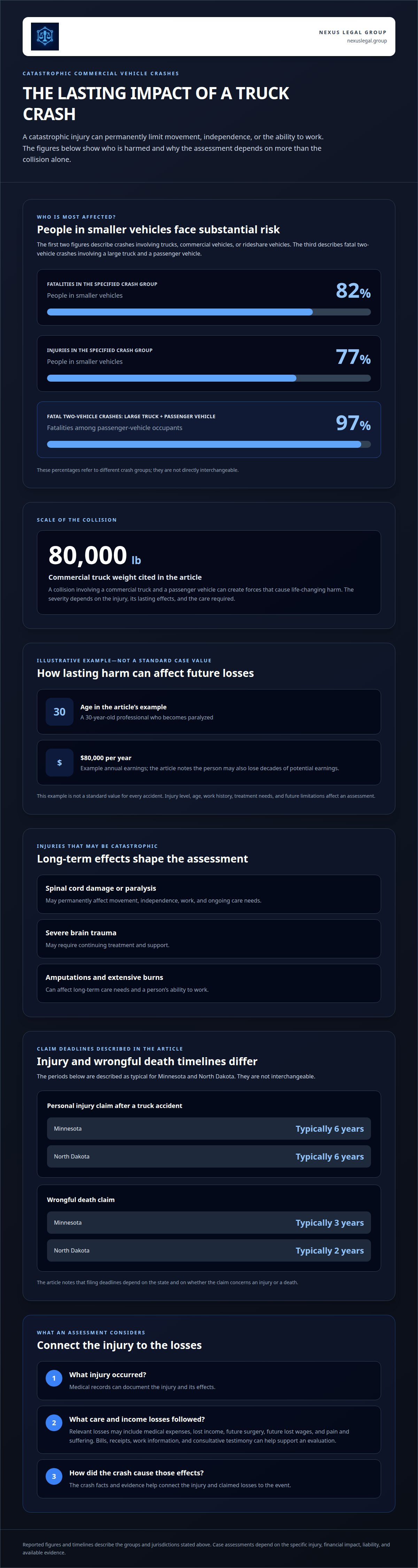
A catastrophic injury can permanently limit movement, independence, or the ability to work. Spinal cord damage, paralysis, severe brain trauma, amputations, and extensive burns may require continuing treatment and support. A collision involving an 80,000-pound commercial truck and a passenger vehicle can create forces that cause life-changing harm. The severity depends on the injury, its lasting effects, and the care required.
Smaller-vehicle occupants face substantial risks in these crashes. In crashes involving trucks, commercial vehicles, or rideshare vehicles, 82% of fatalities and 77% of injuries happen to people in smaller vehicles. In fatal two-vehicle crashes involving a large truck and a passenger vehicle, 97% of fatalities are passenger-vehicle occupants. These figures describe different crash groups, but each highlights the potential consequences for people in cars.
Spinal cord injuries illustrate how immediate trauma can create long-term needs. A 30-year-old professional earning $80,000 per year who becomes paralyzed may also lose decades of potential earnings. Those figures are examples, not standard values for every accident case. The injury level, age, work history, treatment needs, and future limitations affect the assessment.
Compensation may account for economic losses and an injury’s personal effects. Medical expenses and lost income can be assessed using records such as receipts and bills, together with consultative testimony. An evaluation may also consider future surgery, future lost wages, and pain and suffering. In a catastrophic truck accident, documenting effects on daily activities and work helps show how the crash relates to the claimed losses.
When a crash is fatal, surviving family members may pursue a wrongful death claim for compensation and accountability. These losses differ from those in an injury claim because the person who suffered the harm has died. The circumstances of the crash, evidence of responsibility, and losses connected to the death shape the claim. Punitive damages may also be considered in some truck accident cases, in addition to compensation for injuries and losses.
Filing deadlines depend on the state and on whether a claim concerns an injury or a death. In Minnesota and North Dakota, a person typically has six years from the injury date to file a personal injury claim after a truck accident. Wrongful death deadlines differ: typically two years in North Dakota and three years in Minnesota. These periods are not interchangeable, so identifying the claim type and state where the injury occurred is an important early step.
To assess a serious trucking injury, organize the evidence around three questions: What injury occurred? What care and income losses followed? How did the crash cause those effects? Medical records, bills, receipts, work information, and consultation evidence can help answer these questions. For a family considering a wrongful death claim, records describing the crash and its consequences can also support an evaluation of the losses.
What is the average semi-truck accident settlement?
There is no single average settlement for a semi-truck accident. The amount depends on the injury’s severity, documented losses, liability evidence, and available coverage. A case involving permanent impairment may require a different assessment from one involving temporary injuries. Wrongful death claims also involve losses associated with a person’s death, rather than the injured person’s treatment and recovery.
Start an assessment by separating the claim into its main components: the harm caused, the parties potentially responsible, and the evidence connecting them to the crash. Medical expenses, income losses, future needs, and pain and suffering may inform the damages analysis. Receipts, bills, and consultative testimony can help substantiate economic losses. The accident’s facts determine which losses are relevant and how they can be supported.
Responsibility may extend beyond the driver. A trucking company may be responsible when its driver’s negligence causes a catastrophic crash. Companies are also responsible for keeping vehicles in good working order and properly inspected and maintained. Liability may involve a shipment recipient or the company that loaded the vehicle, too. Each party’s role must connect to the crash; involvement alone does not establish responsibility.
Commercial vehicle liability requires attention to how the truck was operated and maintained, not only to the driver’s actions. An investigation may examine driver qualifications, training, supervision, maintenance, hours of service, inspection records, and safe operation. In a rideshare crash, the parties and circumstances differ, so evidence must establish who was involved and how each person or company contributed. Fatal and injury claims also require distinct damages assessments.
Federal and state commercial trucking safety rules address driver qualifications, training, vehicle maintenance, hours of service, inspections, and safe operation. Investigators may review records tied to those requirements, along with police reports and statements, to assess how the crash occurred and whether a safety issue contributed.
Immediately after a catastrophic crash, prioritize emergency medical care and ensure the collision is reported to law enforcement. Preserve available details, including the date, location, vehicles involved, and witness information. Avoid guessing about fault while facts are still being gathered. Timely documentation can help connect the driver, trucking company, vehicle condition, and events at the scene.
Important evidence can include the police report, victim and witness statements, driver logbooks, trucking company records, and inspection or maintenance records. Investigators may use experts to recreate the crash and assess how the truck was operated. For example, a logbook may help establish hours of service, while maintenance records may clarify the vehicle’s condition. Reviewing these sources together helps identify responsible parties and supports a fuller settlement assessment.
Amputations, severe burns, and internal organ damage
An amputation can affect mobility, independence, work capacity, and daily routines long after the crash. In a truck accident, an assessment should distinguish the immediate injury from its continuing effects. Records may document the affected limb, treatment, rehabilitation, and resulting functional limitations. A devastating injury may involve several body areas, too, so each condition and its connection to the collision needs clear documentation.
Burn severity matters, too. Third- or fourth-degree burns may qualify as catastrophic injuries, particularly when they require extensive treatment or cause lasting limitations. Records can show the affected areas, treatment, procedures, and follow-up care. They also help explain how burns affect everyday activities, work, and independence. An assessment should connect those effects to the injury rather than rely on a general description of suffering.
Internal organ damage can be less visible than an amputation or burn, making consistent documentation especially important. Medical records identify diagnosed injuries, care provided, and any continuing effects noted during treatment. For example, a record describing an organ injury and related procedures can help establish the nature and progression of the harm. A lack of visible wounds does not prove that an injury was minor.
For each injury, organize the information in sequence: diagnosis, treatment, follow-up, and documented effects on daily life. This helps distinguish initial care from ongoing needs and clarify how different injuries interact. A person with an amputation and burns, for instance, may face separate limitations that should not be reduced to one broad label. Lawyers evaluating damages can use detailed records to understand claimed losses and their connection to the crash.
The damages analysis should reflect the evidence for each injury and its consequences. Receipts and bills can document expenses, while work information may help establish income losses. Consultative testimony can also support economic-loss calculations. For an amputation, evidence of reduced work capacity may be relevant; for severe burns, records can show treatment and lasting effects. The available facts determine which losses can be substantiated in the accident case.
For a claim involving internal injuries, a timeline can be particularly useful: record the collision date, diagnosis, subsequent treatment, and any documented changes. For burns or amputations, organize records by affected body area and treatment stage. This helps reviewers see whether multiple injuries caused distinct losses or overlapping limitations. The truck driver’s conduct and crash evidence remain relevant to responsibility, while injury records explain the harm and support the damages assessment.
Commercial vehicle accident results
In the United States, large-truck crashes result in over 5,000 fatalities annually, according to the Federal Motor Carrier Safety Administration. The agency also reports approximately 500,000 police-reported large-truck crashes and 150,000 injuries annually. These figures count crashes, fatalities, and injuries differently; they should not be treated as interchangeable measures.
Reported case results offer examples of possible outcomes, not a valuation formula. A North Carolina wrongful death result was $31 million after a tractor-trailer rear-ended a vehicle, killing an adult and two children. Each figure belongs to a specific case and cannot predict another claim’s outcome.
Why do results differ? The injury or death, medical needs, income losses, pain and suffering, available evidence, and parties’ responsibility all affect the damages assessment. A personal injury claim involving an amputation presents different losses from a wrongful death claim involving multiple family members. The crash circumstances matter, too. For example, evidence about a tractor-trailer’s actions, vehicle condition, and the collision sequence can shape how responsibility is evaluated.
For victims, a useful way to assess a reported result is to identify what it represents. Check whether it concerns an injury or wrongful death, what harm occurred, and which losses were included. A case involving an amputation is more informative about injury-related damages than an unrelated fatal-crash result. Even then, differences in evidence and liability can make the figures poor comparisons.
Results need context beyond the headline amount. The total may reflect medical expenses, lost income, future needs, and other claimed damages. In a fatal case, the claim concerns losses connected to the death. In either situation, records and evidence support the link between the crash, the responsible parties, and the claimed losses. A settlement or verdict figure alone does not explain that analysis.
Use a consistent review process: identify the injury or fatality, list the losses described, note the evidence supporting responsibility, and distinguish a settlement from another reported case result when that information is available. This keeps comparisons grounded in the facts. A high figure does not establish what another claimant should receive, and a lower figure does not set a ceiling for a different case.
The central takeaway is that commercial vehicle accident results show a range of outcomes, not a guaranteed value. Annual crash and injury statistics describe the broader scale of harm; individual claims turn on case-specific facts. For a realistic assessment, connect each claimed loss to records and evidence, then evaluate how the driver, trucking company, and other potentially responsible parties contributed to the crash.
What are the most common causes of catastrophic commercial truck accidents in the United States?
Fatigue, braking problems, speed, distraction, and poor decisions can contribute to severe truck crashes. The National Transportation Safety Board estimates fatigue contributes to 30% to 40% of heavy-truck accidents. A fatigued driver may react too slowly to changing traffic, increasing the risk that a collision becomes catastrophic. Investigators examine driver records and crash circumstances to determine whether fatigue contributed.
Stopping distance adds another risk. A loaded tractor-trailer requires 20% to 40% more distance to stop than a car. If traffic slows suddenly, a truck driver may not have enough room to brake safely. Defective brakes can further reduce stopping ability. During the 2024 CVSA International Roadcheck, defective brakes accounted for 26.5% of vehicles placed out of service.
Hours-of-service violations can provide evidence of fatigue risk. During the 2024 CVSA International Roadcheck, these violations accounted for 32.3% of all driver violations. An investigation can compare driver logbooks with other records and the collision timeline. That review helps assess whether the driver had adequate rest and whether fatigue may have affected decisions behind the wheel.
Vehicle condition can also be central. Brake problems can contribute to truck crashes, but the cause of a particular collision depends on the evidence. In 2024, tire violations accounted for 22.1% of vehicle out-of-service violations during International Roadcheck. These inspection findings identify safety concerns across commercial vehicles, but they do not prove what caused a particular crash. Case-specific maintenance and inspection records help establish that connection.
Rollover crashes account for nearly 35% of fatal truck accidents, according to the research. A load’s placement, vehicle movement, speed, or driver decisions may become relevant when investigators reconstruct a rollover. The cause must be assessed from the available evidence, rather than inferred from the crash type alone. Witness accounts, vehicle records, and crash-scene details can help clarify how events unfolded.
For a specific collision, organize the investigation around four questions: Was the driver fatigued or distracted? Did speed or decision-making affect control? Were the brakes, tires, or other vehicle systems defective? Did the company’s training, supervision, inspection, or maintenance practices contribute? This framework connects possible causes to evidence and potentially responsible parties, rather than treating a common risk as proof.
CVSA inspection figures show recurring safety issues, while an individual accident case requires its own analysis. Linking driver conduct, vehicle condition, and company records to the crash helps explain causation and responsibility. Explore accident report lead solutions
Nexus Legal Group: Reverse Append MVA Leads To Obtain Accident Reports and Details of those involved
Nexus Legal Group supports plaintiff law firms seeking structured motor vehicle accident intake. Its Reverse Append MVA Leads To Obtain Accident Reports and Details of those involved connect accident information with lead generation focused on identifying the incident and the people involved. This can help a firm that needs accident-specific information to evaluate potential matters.
Police Report Generated MVA Leads and Automated Verification support a more organized intake process, while High-Intent MVA Case Acquisition focuses on relevant inquiries. These offerings support case acquisition; they do not replace a firm’s legal judgment or representation.
Build a More Structured Intake Pathway
After a catastrophic commercial vehicle accident, the next step for a plaintiff firm is operational: turn incident information into a clear intake pathway. Accurately identifying the event and the people involved gives a legal team a foundation for assessing which inquiries merit further attention.
For plaintiff firms, Nexus Legal Group connects accident information with case acquisition through Police Report Generated MVA Leads and Automated Verification. High-Intent MVA Case Acquisition can support a more focused intake workflow, while Reverse Append MVA Leads help obtain accident reports and details of those involved.
Use a consistent process to organize incoming inquiries and assess their relevance to the firm’s practice. Nexus Legal Group’s offerings support that process; they do not replace the firm’s legal analysis or representation.
A disciplined intake pathway can help your team move forward with clarity and purpose.
Frequently Asked Questions
Do truck accident cases go to trial?
Yes. A truck accident case may proceed to trial if the parties don’t reach a settlement. Resolution can take 1-3 years and may take longer when litigation is necessary. The decision to continue toward trial can depend on disputed facts, responsibility, and the parties’ positions on damages. A trial is one possible case outcome, not a required step in every truck claim.
Can I recover damages if I was partially at fault in the truck accident?
In some states, partial fault doesn’t automatically prevent recovery, but the effect depends on the state’s rule and the fault allocation. For example, under the Florida comparative-negligence rule, a claimant may recover when 50% or less at fault; a claimant who is 51% or more at fault recovers nothing. The state where the claim is brought can therefore materially affect the analysis.
If the truck driver’s actions caused the accident, would I also be able to sue the trucking company?
Potentially. An employer may be liable when its truck driver’s negligence causes a catastrophic crash. Evidence concerning driver qualifications, training, supervision, and safe operation can also help assess the company’s role. These are separate factual questions from whether the driver caused the collision. The claim’s structure depends on the available evidence connecting the employer’s conduct or responsibility to the crash.
What makes trucking, commercial vehicle, and rideshare accidents different from regular car crashes?
Commercial truck cases can involve operational records beyond driver and witness accounts. Driver logbooks, inspection records, and trucking company records may help reconstruct events and assess safety practices. Rideshare crashes can involve different participants and trip circumstances. An investigation therefore needs to identify the vehicle’s use and relevant records, rather than treating every collision as an ordinary private-car crash.
What types of damages can victims and families recover?
Recoverable damages depend on the claim and the supporting evidence. In addition to compensation for injuries and losses, punitive damages may be awarded in truck accident cases, but they are rare. They are intended to punish exceptionally egregious, reckless, or malicious conduct and deter similar behavior. Their availability depends on the conduct at issue, not simply the collision’s severity or the injury.
What qualifies as a catastrophic commercial vehicle accident?
The term generally refers to a crash that causes exceptionally severe harm, often with lasting effects on a person’s function or independence. The crash label alone doesn’t establish that an injury is catastrophic; the nature and consequences of the harm matter. For example, a collision causing permanent paralysis presents a different severity profile from one causing temporary limitations, even if both involve commercial vehicles.
What injuries and long-term disabilities commonly result from catastrophic commercial vehicle accidents?
Possible outcomes include spinal cord injuries, paralysis, amputations, severe burns, internal organ damage, and traumatic brain injuries. The specific disability depends on the injury and its effects. For example, a brain injury may affect thinking or communication, while a spinal cord injury may affect movement. Documented functional impacts help distinguish the consequences of one injury from another.
Who can be held liable after a catastrophic commercial vehicle accident?
Potentially liable parties may include the truck driver, the driver’s employer, a shipment recipient, or the company that loaded the vehicle. Which parties belong in a claim depends on their connection to the crash and the evidence about their respective roles. A party’s place in the commercial chain alone doesn’t establish liability; the facts must connect that party to the collision.