Wrongful Death Law Firm Marketing: Scale Case Volume

Wrongful death law firm marketing works best when campaigns match case intent. Align profiles, compliant ads, landing pages, and intake to attract cases.
More traffic won’t necessarily produce more wrongful death cases. Effective wrongful death law firm marketing matches case-specific campaigns to search intent, credible legal profiles, compliant advertising, and an intake process that responds with care and consistency.
It’s understandable to focus first on visibility: families need to find relevant information, and firms need a dependable way to reach them. But broad personal injury messaging can miss the distinct questions families have after a fatal incident. Weak follow-through can also waste the opportunity created by a well-targeted campaign.
This guide explains how search costs and ad policies shape campaign decisions, why accurate profiles across legal platforms matter, and how intake can support the path from inquiry to qualified case. It also shows how case-specific landing pages and campaigns can align a firm’s message with different fatal-incident circumstances.
You’ll come away with a practical framework for evaluating the full acquisition system, not just clicks or lead volume. The goal is to connect visibility, relevance, and intake operations so growth decisions reflect the cases a firm can serve.
Key Takeaways
- Assess search demand alongside click costs and competition, then build campaigns around specific case types rather than relying on broad personal injury messaging.
- Keep advertising respectful and account for solicitation restrictions when choosing campaign formats and messaging for grieving families.
- Align Google and legal-directory profiles so prospective clients encounter consistent firm information across local search.
- Connect lead generation to a clear intake and evaluation process; campaign performance depends on what happens after an inquiry arrives.
- Use case-specific landing pages to match each campaign’s message and source to the wrongful death claim it is intended to reach.
Wrongful death attorney search volume, cost per click, and SEO difficulty
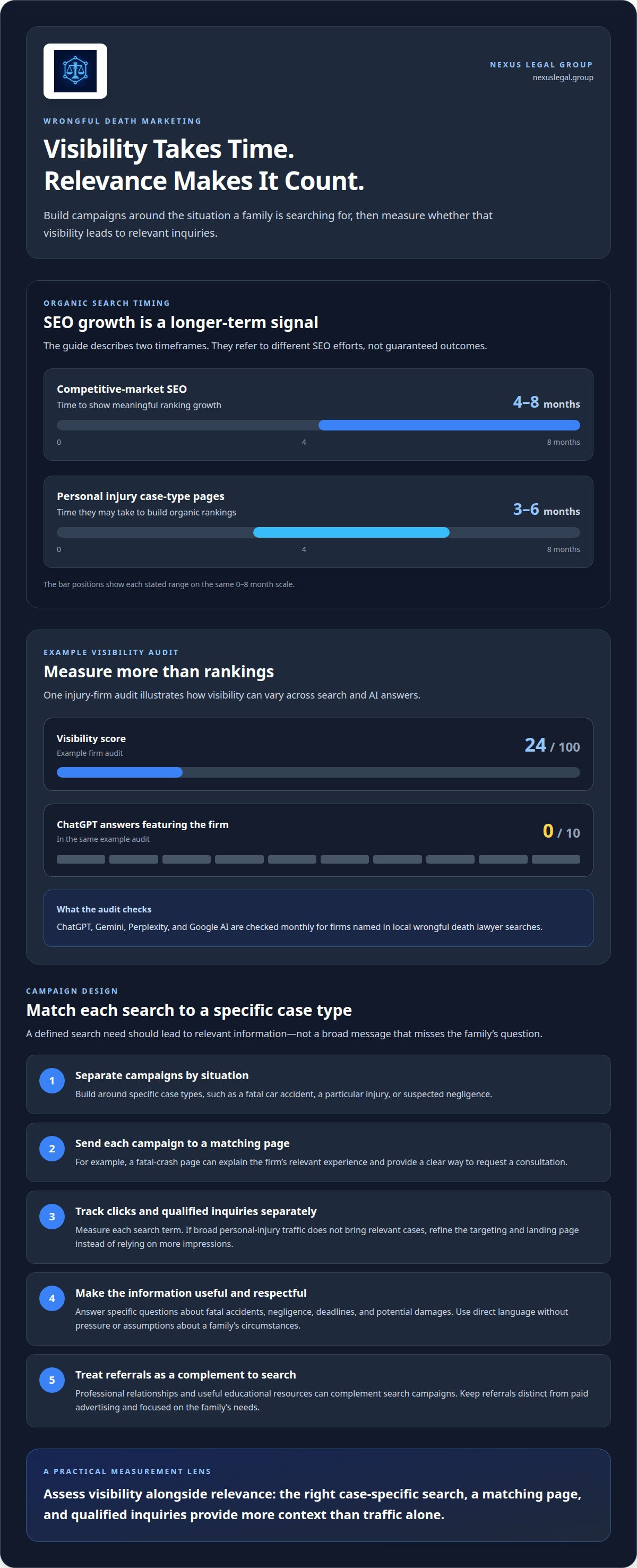
Wrongful death searches often have lower volume than broad personal injury terms, but their intent can be more specific. Families may search for a lawyer after a fatal car accident, a particular injury, or suspected negligence. Build separate campaigns around those case types, then direct each ad to a landing page that addresses the situation. A fatal-crash page should explain the firm’s relevant experience and provide a clear way to request a consultation.
Paid search requires close budget control. Treat cost figures as context, not a wrongful-death-specific forecast: actual costs depend on location, competition, keywords, and campaign settings. Track clicks and qualified inquiries for each term separately. If a broad “personal injury lawyer” campaign draws traffic without relevant cases, refine its targeting and landing page rather than assuming more impressions will solve the problem.
Organic visibility also takes time. SEO typically takes 4-8 months to show meaningful ranking growth in competitive markets, while personal injury case-type pages may build organic rankings over three to six months. Create useful pages that answer specific questions about fatal accidents, negligence, deadlines, and potential damages. Search volume alone can understate value: a narrower term may attract fewer searches while reaching people seeking help for a defined situation.
AI search adds another visibility layer. In one example injury-firm audit, the firm scored 24 out of 100 for visibility and appeared in 0 of 10 ChatGPT answers. The audit checks ChatGPT, Gemini, Perplexity, and Google AI every month for firms named in local wrongful death lawyer searches. These results make a practical point: measure visibility across platforms, then strengthen accurate, relevant case-type information. Sensitive searches call for direct, respectful language, not pressure or assumptions about a family’s circumstances.
Referral relationships can complement search campaigns. Build professional connections with useful educational resources and consistent communication with people who may encounter families after a fatal accident. Keep referrals distinct from paid advertising, and make every introduction respectful and focused on the family’s needs.
Do wrongful death ads follow Meta’s ad policies?
Meta ad approval and professional conduct rules address different risks. A platform review does not establish that an attorney’s message meets ethical solicitation standards. The ABA Model Rule 7.3 restricts live solicitation of prospective clients. Florida bars written solicitation about a personal injury or wrongful death claim until 30 days after the incident. Build campaign review around both platform requirements and the rules that apply where the firm practices.
Respectful creative avoids pressure, assumptions, and promises about compensation. An ad, for example, can explain that a firm handles fatal accident claims and offer educational information. It shouldn’t imply knowledge of a viewer’s loss or demand immediate action. On Meta, review the copy, imagery, audience settings, and destination page together. Even an informative ad can create a poor experience if its landing page shifts to urgent, aggressive language.
Google Ads, SEO, and referral marketing serve different roles. Google Ads can place a lawyer’s message in paid search results. SEO builds organic visibility through relevant pages, while referrals depend on professional relationships. Compare these channels using qualified inquiries, conversion quality, and tracking, not clicks alone. Record each lead’s source and assess whether the channel supports appropriate consultations and case screening.
For paid advertising contracts, define deliverables, campaign access, reporting, tracking, and how either party can end the engagement. For SEO agreements, clarify the work, reporting cadence, access to content, and contract term. A stated term should reflect the planned work, not guarantee rankings. Email marketing also needs careful audience and message controls: keep communications relevant to the recipient’s expressed interest and avoid pressure around a family’s loss.
ChatGPT and other AI tools raise a distinct question: advertising is not the same as appearing in an answer. Treat sensitive conversations with care by prioritizing useful, factual information over promotional language. A firm can develop educational content about wrongful death claims without implying that an AI response has assessed a reader’s circumstances. Any discussion of compensation should be accurate and avoid presenting an outcome as certain.
For campaigns built around ethical intake and case acquisition, consider a structured legal lead-generation approach alongside platform-specific advertising. That separation helps preserve clear tracking, respectful communication, and a consistent experience from initial ad through attorney review.
Google, Avvo, Justia, and Martindale profiles
Local visibility depends on how clearly Google connects a firm with its location and practice areas. In one example, an injury firm wasn’t among the top 20 Google Maps results for “car accident lawyer.” Its profile had 21 reviews, while the top nearby firm had 636. The example Maps result appeared in about 5 seconds, showing how quickly prospective clients may compare local listings.
Use Google Business Profile, Avvo, Justia, and Martindale to present consistent firm details. List wrongful death as a practice area on each profile, and align the firm name, address, phone number, and service descriptions. Consistency helps people recognize the same firm across platforms and gives each profile a clear role in local discovery.
Start profile optimization with the details prospective clients need to assess relevance. Confirm the practice areas, service locations, contact methods, and written description. Then check for outdated information and ensure the destination page matches the profile’s claims. For example, a wrongful death listing should lead to content about fatal-incident claims, not an unrelated general page.
Local SEO and Google Maps visibility depend on relevance to both the search and the location served. A firm in one city may face different competition and search behavior from a firm elsewhere. Organize location-specific pages around the communities served, making each page distinct and useful. Avoid near-duplicate pages that only swap city names, as they offer readers little additional context.
Google Ads and other PPC campaigns can complement organic visibility, but each needs a clear destination and measurement plan. Match the ad’s location and case focus to a relevant landing page, then track inquiries by campaign and source. This separates paid activity from Google’s organic results and profile interactions. Review which placements produce relevant inquiries, not just clicks, and adjust targeting or page content when the match is weak.
State and local markets also shape what information a firm should emphasize. Wrongful death eligibility and filing deadlines vary by state, so content should reflect the law and terminology relevant to its audience. Local competition affects profile visibility, while a broader service area may require distinct location pages and consistent listings. Build the profile system around accurate service locations and locally relevant explanations.
Lead generation, intake, and conversion
Lead generation creates inquiries; intake determines whether they fit the firm’s work. A wrongful death lawyer may receive a message after a fatal car accident, but first contact alone doesn’t establish case suitability. Intake should capture the incident type, location, timing, caller’s relationship to the deceased, and questions requiring attorney review. A structured process helps law firms distinguish an inquiry from a signed case.
Set lead ownership before a campaign begins. An exclusive lead goes to one firm; shared leads may reach multiple firms. Define what “exclusive” means, how inquiries are delivered, and who handles follow-up. If the firm manages intake, identify the staff responsible for recording contact attempts, outcomes, and referral sources. Clear responsibilities reduce duplicate outreach and make campaign results easier to interpret.
Response timing should fit the circumstances. Families may reach out weeks or months after a wrongful death and may compare several firms before contacting a lawyer. That differs from accident victims, who often seek legal help within hours or days. A consistent intake workflow can acknowledge the inquiry, gather relevant details respectfully, and route it for attorney review without assuming every family is ready to proceed.
Marketing costs depend on the channel, competition, targeting, landing-page performance, and resources needed to handle inquiries. A two to three percent website conversion rate is described as an industry average for legal sites, but conversion alone doesn’t show whether leads become signed cases. Track each source through inquiry, contact, qualification, consultation, and decision. That sequence reveals where prospects disengage and where staff follow-through may need attention.
Lead scoring helps prioritize review, not predict a case’s value. A practical intake score can organize details such as incident type, jurisdiction, date, available documentation, and the caller’s connection to the deceased. For example, a fatal collision inquiry with a clear location and a family contact can be routed for timely attorney assessment. The score should support consistent triage while a qualified lawyer evaluates the claim and applicable state rules.
Review performance by source and outcome over months, not just daily inquiry totals. Families’ decision timelines can extend beyond an initial campaign window, so connect advertising records with intake outcomes and signed cases. This gives firm leaders a more useful view of lead quality, conversion bottlenecks, and acquisition costs.
Wrongful death law firm campaigns and case-specific landing pages
A campaign performs better when its message, source, and destination align with a specific wrongful death claim. Case-specific landing pages make that connection clear, from the first advertisement to a consultation request.
Marketing Strategy Selection
Effective strategies connect targeted advertising, useful organic content, and professional referral channels. A campaign for fatal car accidents, for example, can direct search traffic to a page focused on collision-related claims, while referral materials explain the firm’s process. Assess each source by the relevance of its inquiries and whether prospective clients reach the right next step, such as requesting a consultation.
Client-Attracting Content
Publish practical content that addresses questions families may have after a fatal incident. A resource about negligence can explain how evidence relates to a claim; a state-specific page can describe applicable deadlines and who may bring a wrongful death claim. Use clear language, avoid promises about compensation, and provide an appropriate way to request a consultation or learn about the firm’s process.
Build each landing page around one case type and one audience need. A fatal workplace incident page, for example, shouldn’t reuse a generic car accident headline. Its opening should identify the relevant incident, explain the page’s scope, and direct readers to related information. Keep the advertising language consistent with the page so visitors recognize the source and understand why they arrived there.
Campaign structure should preserve source attribution. Tag paid search, social advertising, educational content, and referral traffic separately, then connect each inquiry to its landing page. This lets a firm see whether a campaign draws relevant requests or merely generates visits. Use those findings to refine the message, page content, and consultation path instead of expanding every channel equally.
For referrals, prepare focused resources that professionals can share without pressure. A concise guide to fatal accident questions, for instance, can explain what information a family may want to discuss with a lawyer. Make the referral route clear, but keep the content educational and respectful. The goal is a coherent path from referral or advertising source to relevant information and a voluntary consultation.
The core takeaway: match every campaign to a specific claim, audience, and landing page, then evaluate the inquiries that follow.
Nexus Legal Group
Nexus Legal Group is a practical next step for plaintiff firms seeking a structured source of motor vehicle accident inquiries. Its offerings support case acquisition and intake workflows, complementing wrongful death campaigns focused on fatal vehicle crashes. The fit is specific: these MVA offerings address motor vehicle accident cases, not every type of wrongful death claim.
For firms handling fatal collisions, Police Report Generated MVA Leads connect case acquisition with police-report information. Emergency Services Generated MVA Leads offer another MVA-focused source, while Reverse Append MVA Leads can help obtain accident reports and details of those involved. These sources relate most directly to campaigns built around vehicle incidents, rather than workplace, medical, or other non-MVA cases.
Automated Verification supports a more structured intake process by helping assess inquiries before they enter a firm’s workflow. High-Intent MVA Case Acquisition is relevant when a firm wants acquisition focused on motor vehicle matters. Together, these offerings support a defined path from lead source to review, while the firm’s legal team determines whether an inquiry fits its wrongful death practice.
Consider this model when existing campaigns generate MVA inquiries but source attribution, verification, or intake flow needs more structure. Before adopting an acquisition channel, identify the case types the firm accepts, the locations it serves, and how staff will review incoming information. A practice focused on fatal vehicle collisions, for example, can assess whether police-report or emergency-services-related leads align with its case criteria and follow-up capacity.
Nexus Legal Group provides lead acquisition and related verification, not legal representation or general SEO management. Firms seeking help with a wrongful death claim outside motor vehicle accidents need an acquisition approach suited to those cases. For MVA-focused practices, the next step is a conversation about the intended case profile, lead sources, and intake process, without assuming every inquiry will qualify.
If you’d like to discuss your firm’s MVA case acquisition needs, get in touch with Nexus Legal Group.
Build the Next Stage of Case Growth
Make your next step operational: define the cases your firm can serve, connect each campaign to a relevant inquiry path, and measure progress through intake outcomes. A disciplined approach to wrongful death law firm marketing treats visibility as one part of a broader acquisition system, with respectful communication and case fit guiding every decision.
For practices seeking MVA-related inquiries, Nexus Legal Group’s case acquisition and verification capabilities support a focused growth plan. The fit is most direct when fatal motor vehicle incidents are part of the firm’s target caseload. Firms handling other wrongful death matters can apply the same principle: align the source, message, and intake process with the cases they are equipped to review.
With clear priorities and a connected process, your firm can build a more deliberate path from campaign to meaningful case review.
Frequently Asked Questions
How do you measure success on a wrongful death campaign?
Measure success by connecting campaign activity to qualified inquiries and signed cases, not impressions alone. Compare the source, case type, consultation requests, and intake outcomes for each campaign. A campaign may generate fewer inquiries yet contribute more relevant cases. Review performance over a period that allows families time to consider their options, then use the results to refine targeting, page content, and follow-up processes.
Is it appropriate to advertise for wrongful death cases?
Yes, advertising can give families information about legal services when the message is respectful and follows applicable professional and platform rules. An educational ad can identify the types of claims a firm handles and offer a clear way to learn more. Avoid language that assumes a viewer has experienced a loss, pressures an immediate decision, or promises compensation. The goal is to make relevant information accessible without exploiting a difficult situation.
How much does wrongful death law firm marketing cost?
Marketing budgets depend on the channels used, competition, campaign scope, content requirements, and the firm’s capacity to handle inquiries. Paid search, ongoing organic content, profile management, and intake operations have different resource needs. Set a budget by defining target case types and tracking how spending relates to qualified inquiries and signed cases. No single figure applies to every firm or market.
What is the average cost per lead for wrongful death cases?
There isn’t a reliable universal average for wrongful death leads because channel, location, competition, targeting, and lead qualification all affect cost. Separate raw inquiries from qualified opportunities when evaluating results. For example, record whether an inquiry concerns a case type the firm handles, then compare that outcome with its source and acquisition expense. This provides a more useful internal benchmark than treating every form submission as an equivalent lead.
Which SEO keywords should wrongful death law firms target?
Prioritize phrases that reflect the incident, the legal question, and the audience’s location, such as fatal car accident claims, wrongful death after a workplace incident, or who may bring a claim. Build dedicated pages only when each can provide distinct, accurate information. Include related questions about negligence, deadlines, and damages, and organize them around the reader’s intent rather than repeating one broad phrase across every page.
How can law firms advertise wrongful death services while complying with state bar rules?
Create a review process before launching each campaign. Identify the states targeted, review the proposed copy and landing page against applicable professional-conduct requirements, and document who approved the final materials. Check that service and results claims are accurate, the message avoids pressure, and the inquiry path matches the ad. State requirements can differ, so include location-specific review in campaign governance rather than relying on one national template.
What ethical rules apply to wrongful death attorney advertising in the United States?
Attorney advertising is shaped by professional-conduct rules and jurisdiction-specific requirements. The ABA Model Rule 7.3 restricts live solicitation of prospective clients, while states may set additional limits on communications. For instance, Florida bars written solicitation about a personal injury or wrongful death claim until 30 days after the incident. Firms should structure campaign review around the locations and communication methods involved, not assume one rule covers every situation.
How can a wrongful death law firm improve its website conversion rate?
Make each page answer the visitor’s immediate question and present a clear next step. A fatal collision page, for example, should explain its scope, use straightforward language, and offer an accessible consultation request. Remove unrelated navigation distractions, ensure contact forms ask only for information needed at that stage, and test that submissions reach the intake team. Track visits through completed inquiries to identify where prospective clients stop.