Commercial Vehicle Serious Injury Case Acquisition
Learn how a commercial vehicle serious injury claim is assessed, from potential liability and lasting harm to insurance limits and evidence supporting a case.
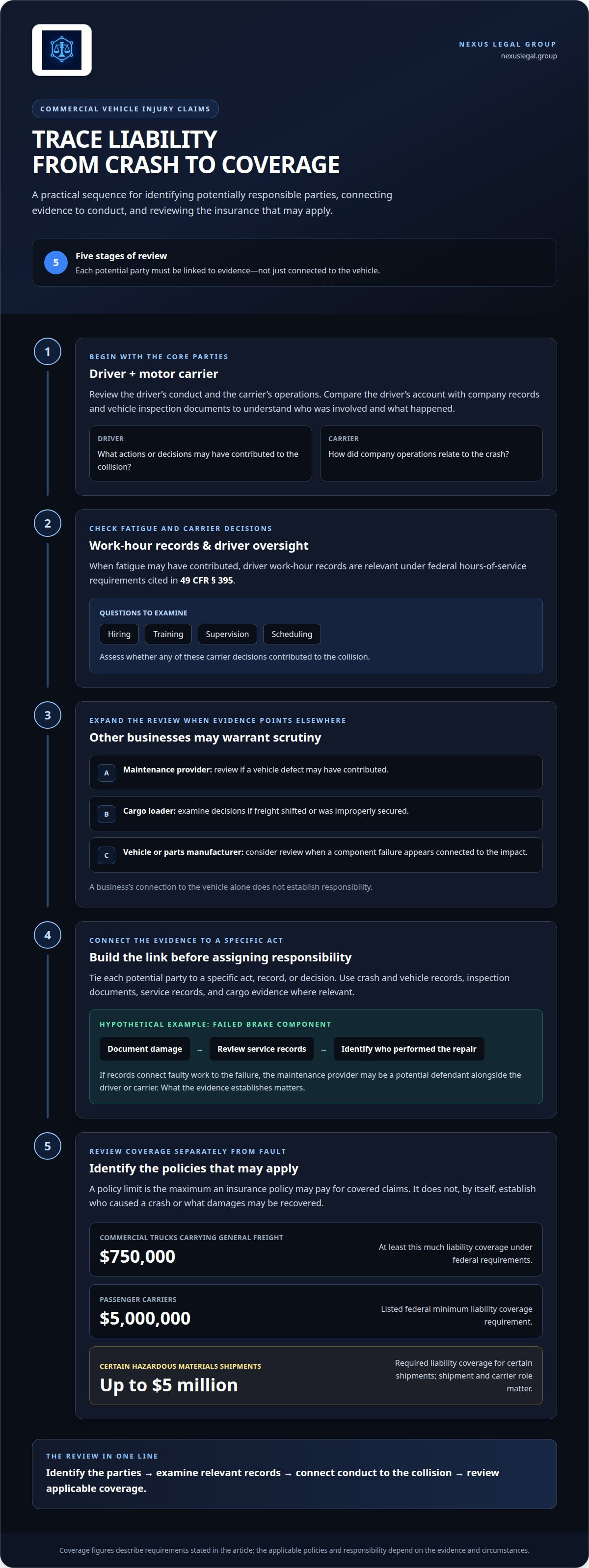
The truck is only one part of a serious crash case. In a commercial vehicle serious injury case, potential liability may extend to the driver, the motor carrier, or another business whose actions contributed to the collision. The injury’s impact, required treatment, and lasting effects help explain its severity, while insurance limits shape the coverage available. According to the Federal Motor Carrier Safety Administration, commercial trucks carrying general freight must carry at least $750,000 in liability coverage; passenger carriers must carry $5,000,000 under the listed federal minimum requirements.
After a commercial vehicle serious injury crash, it’s understandable to focus on immediate questions: who may be responsible, how serious the harm is, and whether insurance can cover the losses. These issues are connected, but each requires a separate assessment of the collision, injuries, and available policies.
This article explains which parties may face liability, what injuries can have serious and lasting effects, and how policy limits can affect a commercial vehicle claim. It also explains why evidence about the collision, the businesses involved, and the injury’s effects matters when evaluating a case.
Key Takeaways
- Map potential responsibility across the people and businesses connected to a crash, and understand why driver-hours records may matter.
- Assess injury severity by looking beyond the immediate diagnosis to treatment needs and lasting effects.
- Understand how policy limits can shape the available coverage when losses exceed an insurance policy’s cap.
- Identify how crash circumstances and supporting evidence can help explain what contributed to a collision.
- See how Nexus Legal Group’s MVA case acquisition and verification offerings can support plaintiff law firms seeking relevant case inquiries.
Multiple Potentially Liable Parties
Commercial vehicle injury claims can involve more parties than a typical car accident claim. A driver’s conduct, a carrier’s operations, and decisions about maintenance or cargo handling may all require scrutiny. Investigators may need to compare the driver’s account with company records and vehicle inspection documents to understand who was involved and what happened.
Start with the driver and motor carrier. According to the National Archives and Records Administration (Office of the Federal Register), federal hours-of-service requirements for commercial truck drivers are cited under 49 CFR § 395. Those requirements make driver work-hour records relevant when fatigue may have contributed. A separate question is whether the carrier hired, trained, supervised, or scheduled the driver in a way that contributed to the collision.
Other businesses may also be relevant. A maintenance provider’s work may matter if a vehicle defect contributed to the crash. A cargo loader’s decisions may be examined if shifting or improperly secured freight played a role. A vehicle or parts manufacturer may warrant review when a component failure appears connected to the impact. Each possibility depends on evidence linking that party’s conduct to the collision or injury.
Consider a hypothetical truck crash involving a failed brake component. Investigators document the damage, review service records, and identify who performed the repair. If the records connect faulty work to the failure, the maintenance provider may be a potential defendant alongside the driver or carrier. Responsibility depends on what the evidence establishes, not simply on a company’s connection to the vehicle.
Hazardous materials can affect the insurance picture. Federal law requires hazardous materials carriers to carry liability coverage of up to $5 million for certain shipments, according to the Federal Motor Carrier Safety Administration. The shipment and carrier’s role therefore matter when identifying applicable coverage. That coverage figure does not, by itself, establish who caused a crash or what damages may be recovered.
A practical review ties each potential party to a specific act, record, or decision. Identify the driver and carrier, examine available crash and vehicle records, then trace maintenance or cargo evidence where relevant. This approach helps distinguish a possible connection from evidence of responsibility and clarifies which insurance policies may need review.
Serious Injuries in a Car Accident
A serious crash can leave lasting consequences, but the injury’s effects matter more than a label alone. Consider Manami Ito: she lost her right arm in a car crash at age 20. She later competed in the 2008 Beijing Paralympics and the 2012 London Olympics. Her experience illustrates how an injury can reshape daily life and future activities.
Consider a hypothetical collision that causes a severe fracture. The injured person receives treatment, follows the prescribed recovery plan, and records how the injury affects work and daily tasks. These records can document treatment and resulting limitations. In another hypothetical crash involving a brain injury, documenting symptoms and care over time can help establish the injury’s effects.
Federal and state rules may both matter. Commercial-driver hours-of-service requirements are cited under 49 CFR § 395, and vehicle-maintenance records are addressed under 49 CFR § 396. State law also governs important claim issues, including filing deadlines and fault rules.
Filing deadlines vary by state. In Florida, a person generally has two years to file a personal injury lawsuit, according to the Florida Legislature. The applicable deadline depends on the state and circumstances, so identify the crash location and governing law promptly.
After a serious crash, prioritize immediate safety and medical attention. Then preserve the crash report, photographs, witness details, vehicle information, and records of treatment and missed work. These materials can help connect the collision to the injury and document its practical effects. Keep relevant documents intact.
For example, if truck damage or a road condition may help explain the impact, photographs and witness accounts can preserve details that may change over time. Record what you can safely observe and retain official documents. This can provide a clearer account when responsibility and losses are reviewed.
When looking for a lawyer, focus on attorneys who handle commercial vehicle injury claims in the state where the crash occurred. Share the crash location and date, available reports, and a concise injury summary when discussing the case. These details help assess whether the attorney’s experience and jurisdiction fit the claim.
If first responders arrive, provide accurate information about your symptoms and the crash, and follow their instructions. Keep any records of the response and treatment with your other crash-related documents.
Serious Injury and Policy Limits
A policy limit sets the maximum an insurance policy may pay for covered claims. It doesn’t establish an injury’s value or guarantee payment of the full limit. According to the Federal Motor Carrier Safety Administration, commercial trucks carrying general freight in the United States must carry at least $750,000 in liability coverage under federal requirements.
Passenger carriers must have $5,000,000 in liability coverage under the listed federal minimum requirements, according to the Federal Motor Carrier Safety Administration. Which requirement applies depends on the vehicle’s operation and coverage. In a commercial vehicle serious injury claim, the available policy limit can affect how much insurance coverage may apply.
Consider the example of $1.5 million in damages and a $1 million policy limit. The damages exceed the limit, so that policy alone wouldn’t cover the full amount. Reviewing the policyholder, covered claim, and applicable limit helps clarify available coverage. The example shows how damages compare with a policy cap, not what any particular case will recover.
People injured in commercial vehicle crashes may seek compensation for documented medical expenses, lost income, reduced ability to earn, and other injury-related losses. Treatment records, employment information, and descriptions of daily limitations can help explain those losses and connect them to the crash.
Settlement and verdict assessments consider responsibility, injury evidence, financial losses, and available policy limits. Treatment records may support medical expenses, while wage records can document lost income. A settlement is an agreement; a verdict follows a court decision. There is no single standard amount for every injury.
To assess coverage, identify potentially responsible parties and their associated policies. Compare documented losses with each relevant policy limit, then consider the evidence of responsibility. This can show whether one policy may be insufficient and whether other coverage questions need review. A policy limit is one factor in evaluating a claim, not a measure of the injury itself.
A $1 million policy limit is less than $3 million in damages. That comparison makes the difference between the amount of damages and the maximum available under one policy visible, but it does not establish what amount would ultimately be paid. The limit is a coverage ceiling, not an automatic payment, and the damages figure does not by itself resolve whether the claim is covered. The example also does not show whether another policy or potentially responsible party could be relevant. Those questions require review of the coverage and circumstances involved.
For a serious injury claim, keep damages and coverage limits distinct. Documented losses describe the harm being claimed; a policy limit describes the maximum that may be available under that policy for covered claims. If losses exceed the limit, the comparison identifies a possible gap between the damages and that policy’s cap. It does not establish that the difference will be recovered elsewhere or remain unpaid. Reviewing the policy, the claim, and evidence about responsibility can help clarify what coverage may apply. Damages and available coverage answer different questions, so neither should stand in for the other.
What Are the Most Common Causes of Serious Commercial Vehicle Crashes in the United States?
Serious crashes can result from a driver’s decision, a vehicle problem, or changing road conditions. No single cause explains every collision. For example, a truck changing lanes may strike a vehicle hidden beside its trailer. Reviewing vehicle movement, visibility, and impact evidence can help clarify what happened.
Driver distraction is one possible factor. A driver looking at a dispatch device may fail to notice slowing traffic, then be unable to stop before impact. Investigators can compare witness accounts, available video, and crash-scene evidence to assess whether distraction contributed.
Fatigue can also affect attention and reaction time. Imagine a driver who drifts across a lane marking before colliding with a nearby car. The practical inquiry examines the driver’s schedule, trip details, and other available records. Those facts can help determine whether fatigue played a role, rather than assuming it caused the crash.
Speed and following distance matter in another common scenario. A loaded truck approaches stopped traffic too quickly and strikes the vehicle ahead. Reviewing road conditions, vehicle damage, and vehicle positions can help reconstruct the sequence and show whether speed, stopping distance, or another factor contributed.
Vehicle defects and neglected repairs can create another pathway to a crash. For instance, a tire failure may cause a truck to veer into another lane. Inspecting the damaged tire and vehicle can help determine whether a mechanical problem came before the collision. A defect alone does not establish why it occurred or who may be responsible.
Cargo movement can affect vehicle control. If freight shifts during a turn, the vehicle may become unstable and leave its lane. An investigation can examine the cargo’s condition, how it was secured, and the truck’s movement before impact. Those details help distinguish a loading issue from driver action or road conditions.
Weather and visibility add another factor. Rain may reduce traction, while glare or darkness can make a vehicle harder to see. In a hypothetical wet-road crash, investigators compare roadway conditions, vehicle positions, and accounts of the event to assess whether conditions contributed alongside driver or equipment factors.
A useful review follows a consistent sequence: establish what happened, identify evidence for each possible cause, and connect that cause to the collision. A commercial vehicle crash may involve several contributing factors, so conclusions should follow the evidence rather than rely on assumptions.
How Many Serious Injuries and Fatalities Involve Commercial Vehicles Each Year?
An annual count depends on what it includes. A report limited to large trucks will differ from one that also includes buses or other commercial vehicles. Injury totals also depend on how “serious injury” is defined and recorded. Fatalities and injuries are separate measures; combining them can obscure the scale of each outcome.
For a meaningful comparison, use the same vehicle category, injury definition, and reporting period each year. Separate people injured from people killed rather than treating those outcomes as interchangeable. This makes year-to-year figures easier to interpret and helps prevent a change in category from appearing to be a change in crash risk.
Consider a hypothetical annual summary that counts only large trucks and another that also includes commercial buses and other vehicle types. The broader total may reflect more categories, not a change in underlying risk. Identify each report’s vehicle scope before comparing totals to make the comparison more accurate.
Serious injury counts also depend on how outcomes are classified. One record may describe a person as injured, while another identifies a specific severe outcome. If definitions differ between reporting periods, the totals may not measure the same thing. A consistent definition helps clarify what an annual figure represents.
For an individual crash, national totals provide context, not a finding about responsibility or injury severity. In a hypothetical collision, establish the crash details, identify the people involved, and document the injuries. This creates a case-specific account without applying a national average to one person.
Fatality figures require the same care. A total should identify which commercial vehicles it covers and whether it counts occupants, people in other vehicles, or all road users. These categories describe different impacts. When comparing figures, check the category, year, and severity measure.
Law firms reviewing commercial vehicle cases can use clearly defined crash information to connect an incident with available reports and involved parties. Accident-report case acquisition can support that process by helping obtain accident reports and details of those involved.
Nexus Legal Group
Nexus Legal Group helps plaintiff law firms build a structured pipeline of motor vehicle accident inquiries, including commercial vehicle cases. Its case acquisition services connect crash information with intake opportunities. The service is designed for firms seeking relevant motor vehicle accident matters, not for injured people seeking legal representation.
High-Intent MVA Case Acquisition helps firms reach people with potential motor vehicle accident claims. For a commercial vehicle crash, it can help identify relevant inquiries within an intake process. Police Report Generated MVA Leads add accident-report context, helping firms assess an incident and decide whether to pursue an inquiry.
Emergency Services Generated MVA Leads provide another way to source inquiries connected with emergency response activity. Automated Verification checks lead information. Together, these services address a practical challenge for plaintiff firms: creating a consistent process for receiving and reviewing inquiries without treating every lead as a viable matter.
Consider a firm developing its commercial vehicle intake workflow. It can use relevant accident reports and lead details to route inquiries for review, then apply its own intake criteria and legal judgment. This creates a more organized starting point for assessing whether a case fits the firm’s practice. Acquired leads do not determine liability, injury severity, or case value.
Nexus Legal Group is a fit for plaintiff firms looking to strengthen motor vehicle case acquisition and intake verification. Its services support lead generation and information workflows, but do not replace legal analysis or representation. Firms can assess how police-report or emergency-services-generated leads fit their intake operations and case criteria.
For firms evaluating commercial vehicle case acquisition, the key question is whether lead sources align with their intake needs. Nexus Legal Group’s MVA services combine acquisition, verification, and accident-related details to give firms a defined starting point for reviewing potential cases. The firm remains responsible for deciding whether each inquiry is suitable and what steps to take.
Get in touch with Nexus Legal Group to discuss your case acquisition needs.
Build a More Deliberate Intake Path
A commercial vehicle serious injury matter can raise complex questions, but a law firm’s intake process can begin with a clear framework: identify relevant inquiries, gather useful case information, and route each lead for review. Consistent intake helps teams assess opportunities against their own criteria while leaving legal judgment with the firm.
Nexus Legal Group supports this workflow with High-Intent MVA Case Acquisition, Police Report Generated MVA Leads, and Automated Verification. These services help plaintiff firms source and organize motor vehicle accident inquiries for intake. They are designed for firms seeking case-acquisition support, not individuals seeking legal representation.
Consider how accident-related inquiries and verification could fit your firm’s existing intake operations. A defined process can help your team review each opportunity with greater structure and focus.
Make your next intake decision with clarity and purpose.
Frequently Asked Questions
What qualifies as a serious injury in a commercial vehicle accident?
A serious injury generally involves substantial physical harm or lasting impairment, rather than a brief, minor condition. Examples may include a traumatic brain injury affecting memory, a spinal injury limiting movement, or an amputation that changes daily activities. The diagnosis alone does not establish the full impact. Records describing functional limitations, treatment, and continuing effects help explain the injury’s severity. How a claim classifies an injury can depend on applicable law and evidence.
Who can be held liable for a serious commercial vehicle injury, including the driver, carrier, or manufacturer?
Potentially liable parties can include the driver, carrier, or manufacturer, but involvement alone does not establish responsibility. The driver’s conduct, the carrier’s actions, and any alleged product defect must be assessed separately. For example, a manufacturer may be examined if evidence connects a defective component to the crash or injury. A sound review identifies each party’s specific conduct and its connection to the harm, rather than assuming one party accounts for every cause.