Catastrophic Injury Law Firm Marketing Strategy

Plan catastrophic injury law firm marketing with practical budgeting, stronger intake, and channel metrics tied to signed cases and projected fees each quarter.
What should a personal injury firm spend on marketing? A commonly cited starting point is 15% to 20% of gross revenue, but the percentage alone won’t show whether catastrophic injury law firm marketing is working. The stronger measure is whether investment is producing qualified inquiries, signed cases, and projected fees that align with the firm’s growth goals.
It makes sense to want a marketing budget tied to business outcomes, especially when complex injury cases call for careful intake and follow-up. A useful budget connects each channel to lead quality and case progress, rather than judging performance by lead volume alone.
This article explains how to set a practical marketing budget, improve lead handling, and build a focused plan for the next quarter. It also shows how to assess channels by signed cases and projected fees, so allocation decisions reflect case outcomes as well as activity.
Key Takeaways
- Set a marketing budget around business goals, then evaluate whether each channel contributes to qualified inquiries and signed cases.
- Improve conversion by making website calls to action clear and establishing a consistent process for response, intake, and follow-up.
- Use a 90-day plan to measure current performance, strengthen a priority channel, and decide where to reallocate resources.
- Compare channels by signed cases, case quality, and projected fees, not just lead volume or website activity.
- Connect marketing and intake data so budget decisions reflect the value and progression of the cases generated.
1. What should a personal injury law firm spend on marketing?
A common starting point is 15% to 20% of gross revenue for marketing. Treat that range as a planning benchmark, not a fixed allocation: a firm’s growth goals, case mix, intake capacity, and existing referral pipeline all affect the right budget. For catastrophic injury law firm marketing, connect every channel’s cost to qualified inquiries, signed cases, and projected fees.
Branding makes that investment coherent. Use the same firm name, visual identity, and practice-area descriptions across the website, advertising, and Google Business Profile. Make the distinction between general personal injury law and complex injury work clear. Someone looking for an injury lawyer after a car accident should quickly understand the firm’s experience, services, and next step.
Which marketing channels work best for catastrophic injury lawyers? Search engine optimization, paid search, local visibility, educational content, and referral relationships can all contribute. The right mix depends on the firm’s audience and intake capacity. Build pages around practice areas and service locations, maintain a Google Business Profile, and publish practical explainers about the claims process. Assess each channel by qualified leads and signed cases.
SEO helps people find a firm before they are ready to call. Organize pages around relevant services and locations, answer practical questions about the case process, and keep business details consistent across local listings. For example, a page about serious car accident injuries can explain what information an initial consultation covers without promising a settlement or suggesting every case has the same outcome.
What advertising rules apply to personal injury law firms in the United States? Requirements vary by jurisdiction, so map each campaign to the applicable professional-conduct rules before publication. How do state bar rules differ for catastrophic injury lawyer advertising? Requirements can vary between states. Review claims, testimonials, and ad formats against the rules that apply where each advertisement appears.
Target audiences include people with severe injuries who need information about legal representation, as well as family members helping them research options. Prioritize useful, accessible explanations over pressure. A clear contact path and a plain-language overview can help someone understand how to begin an inquiry.
Build trust with specific, supportable evidence: describe relevant experience, explain the case process, and use accurate case examples where appropriate. Don’t imply that a past result predicts a future settlement. Ethical and reputational risks include misleading claims, unsupported guarantees, intrusive outreach, and content that exploits distress. A documented review process can help reduce these risks.
Personal injury law firm growth depends on matching investment to operational capacity. Review the budget alongside lead quality and intake performance, then shift resources when a channel brings inquiries the firm can serve. An agency’s expertise should match the work required. Campaign execution, local SEO, content, and lead generation are distinct capabilities, not interchangeable labels.
2. Website conversion, lead response, intake, and follow-up
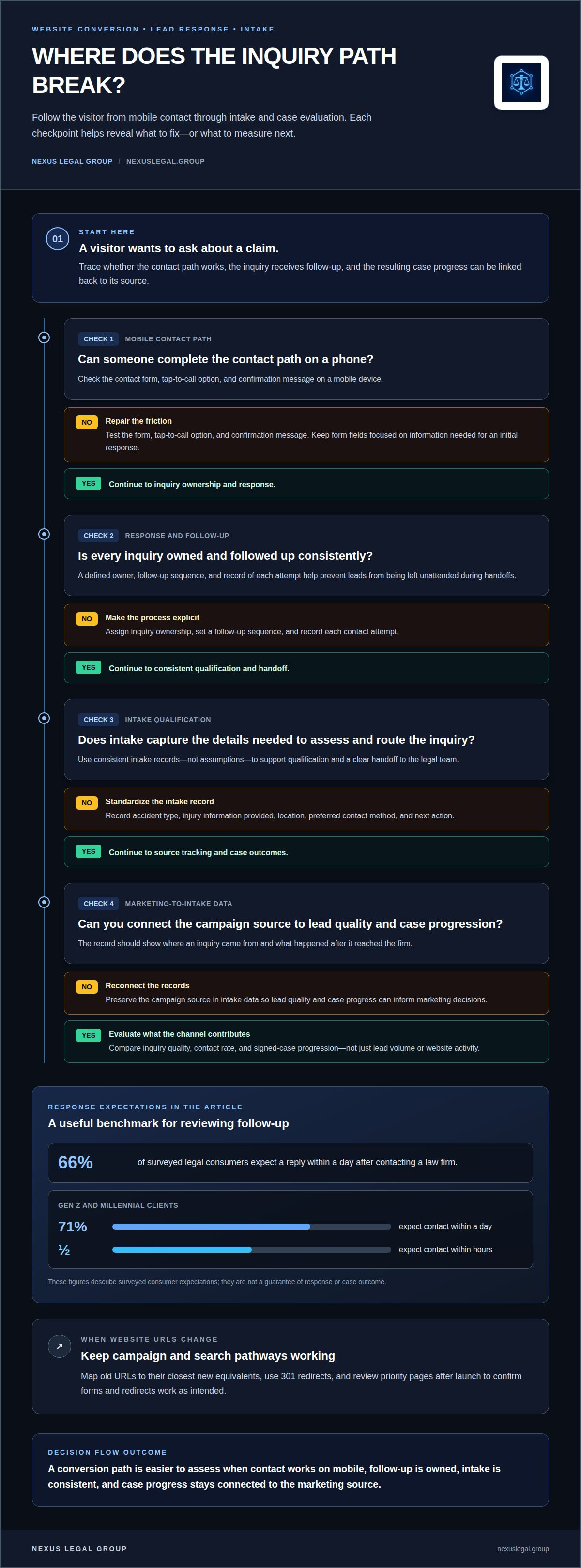
A website converts when visitors can understand the next step and take it without friction. Put a clear contact option alongside relevant practice information, then route every inquiry through a consistent intake process. For an accident campaign, the landing page, call handling, and intake record should preserve the visitor’s original intent.
Mobile access matters: more than 60 percent of U.S. searches happen on mobile devices. Test key pages on a phone, including the contact form, tap-to-call option, and confirmation message. Keep fields focused on information needed for an initial response; a lengthy form can interrupt a person trying to ask about a claim.
Response time is part of conversion. Sixty-six percent of surveyed legal consumers expect a reply within a day after contacting a law firm. Among Gen Z and Millennial clients, 71 percent expect contact within a day, and half expect it within hours. Assign inquiry ownership, set a follow-up sequence, and record each attempt so handoffs don’t leave leads unattended.
Build intake around consistent qualification, not assumptions. Staff can record the accident type, injury information provided, location, preferred contact method, and next action. A defined handoff helps the legal team assess whether an inquiry fits its practice. It also gives marketing a usable record of lead quality and campaign source.
Content should answer specific questions when visitors need the information. A case-process walkthrough can explain what happens after an inquiry, while an FAQ can address how consultations work. Match each page to its campaign targeting and intent. Someone arriving from a car accident ad should land on relevant information, not a generic homepage.
Website redesigns need careful URL management. Before changing page addresses, map old URLs to their closest new equivalents and use 301 redirects. This preserves useful pathways for visitors and helps prevent campaign links or search results from leading to error pages. Review priority pages after launch to confirm forms and redirects work as intended.
Conversion optimization is a repeatable process of testing and review. Compare pages by inquiry quality, contact rate, and signed-case progression, then adjust one element at a time, such as the headline or form placement. Tie each comparison to its campaign source so changes don’t obscure which targeting produced qualified claims.
For firms connecting motor-vehicle campaigns with intake, high-intent case acquisition can support a more direct path from inquiry to review.
3. A 90-day marketing plan
A 90-day plan gives a personal injury firm a defined cycle for measurement, execution, and adjustment. Divide the work into three stages: days 1–30 for measurement and intake, days 31–60 for building a priority channel, and days 61–90 for validating results and reallocating resources. Assign an owner to each task and record progress in a shared campaign tracker.
Days 1–30: establish the baseline. Review the existing lead record from first contact through signed case. Group inquiries by source, practice area, qualification, contact outcome, and next step. Compare the path for a serious injury case with other inquiries; this can show where intake questions or handoffs need clearer ownership. Document current response and follow-up practices before changing campaigns, so later comparisons have a meaningful starting point.
Use the first stage to identify operational gaps, not to launch every new idea. Review website forms, call routing, and the information captured when someone contacts the firm. Check whether staff can identify the campaign source and update the inquiry’s status. If an agency manages advertising, agree on shared definitions for a qualified lead, consultation, and signed case before reviewing its reports.
Days 31–60: build the priority channel. Select a channel that aligns with the firm’s target cases and capacity. If local search is the focus, develop relevant location and practice-area content. If educational content is the priority, publish a lawyer-led case-process explainer and related FAQs. Social media can distribute useful material, but each post should lead to an appropriate next step rather than rely on engagement alone.
Plan each asset around a specific audience need. A page for families researching a severe injury claim might explain the initial inquiry process, while a social post can direct readers to that resource. Use testimonials only when they are accurate, appropriate, and reviewed under the firm’s advertising standards. Keep messaging consistent across ads, landing pages, and intake scripts, then monitor lead quality as activity develops.
Days 61–90: validate and reallocate. Compare the priority channel with the baseline using qualified inquiries, contact outcomes, consultations, and signed cases. Separate activity that generated attention from activity that produced viable cases. Review missed contacts and incomplete records with intake staff; a campaign assessment is incomplete if the firm cannot trace inquiries from source to outcome.
At the end of the cycle, keep the elements linked to stronger case progression, improve weak handoffs, and redirect resources based on results. Record the decision, its supporting evidence, and the next test in the tracker. This creates a repeatable planning rhythm, so the next quarter starts with specific operational questions instead of an unstructured list of marketing ideas.
4. Marketing budgets
U.S. legal services advertising spending is projected to exceed $3 billion in 2026, compared with about $2.5 billion in 2024. That market context makes disciplined allocation essential. A firm should distinguish marketing investment from general operating expenses, then assign each campaign a defined purpose, audience, and measurement method.
Start with a channel inventory. Group spending by paid search, local visibility, content production, social media, and outside agency support. For each category, record the business objective and the result it should produce. For example, a Google Business Profile supports local discovery, while paid search can reach people actively seeking legal help.
Next, separate fixed commitments from adjustable spending. Website hosting and planned content production may follow a set schedule, while advertising campaigns can be reviewed and adjusted as results become clearer. This distinction helps attorneys protect essential infrastructure while shifting flexible resources toward channels that generate qualified inquiries and signed cases.
Assign each campaign a tracking method before committing funds. Use source fields in intake records, dedicated landing pages, or call attribution to connect inquiries with their originating channel. If a campaign generates website visits but few qualified conversations, review its targeting, page content, and intake path before increasing its allocation.
Local visibility also needs ongoing attention. Keep the Google Business Profile accurate, publish relevant updates, and align location pages with the firm’s actual service area. Evaluate these activities separately from paid advertising. A profile view, a phone inquiry, and a signed case represent different stages, not interchangeable measures of return.
Build budget reviews around clear decisions. Ask whether the campaign reached its intended audience, whether intake handled the resulting inquiries, and whether case quality supports continued investment. A channel that generates few inquiries may still deserve refinement if those inquiries fit the firm’s practice. High volume alone is not a reason to increase spending.
For catastrophic injury campaigns, align the budget with the firm’s capacity to respond to complex inquiries and assess case fit. Content, targeting, and intake should reinforce the same focus. If attorneys can’t reliably identify which campaigns produce relevant cases, improve tracking before reallocating funds. Otherwise, the budget decision will rely on incomplete attribution.
Document each allocation decision in a simple ledger: channel, campaign objective, planned investment, source-tracking method, and review date. Add qualified inquiries, consultations, and signed cases as they become available. This record gives the next budget review a consistent basis for retaining, revising, or pausing campaigns, rather than relying on impressions or memory.
5. Marketing metrics tied to signed cases and projected fees
Marketing performance is more useful when the firm connects each source to signed cases and projected fees. Lead volume shows activity, but not whether a campaign attracts viable matters. Track the path from first contact through qualification, consultation, signing, and case assessment to understand where value enters the pipeline.
Use a consistent reporting order: signed cases and projected fees; qualified leads and sign rate; consultations and contact rate; total leads; then traffic and engagement. This puts business outcomes first. A campaign with fewer inquiries may merit attention if it produces better-qualified cases and more signed matters than a high-volume campaign.
Set an acquisition ceiling using the guide’s formula: expected fees multiplied by the target contribution margin and a confidence adjustment. Apply the calculation to projected fees, not assumed outcomes. Base the expected fee estimate on the firm’s case assessment and current information about injury, liability, and the matter’s position. Keep assumptions visible so decision-makers can revisit them as case information changes.
What is the average cost per lead for catastrophic injury cases? There isn’t one useful average for every firm and campaign. Calculate cost per lead by dividing campaign spend by inquiries, then interpret it alongside qualification, sign rate, and projected fees. Channel, targeting, intake, and case criteria all affect what a lead represents.
Separate inquiry cost from signed-case acquisition cost. The first measures spending relative to incoming leads; the second connects spending with cases the firm actually signs. For example, one campaign may generate many inquiries but few qualified consultations, while another produces fewer inquiries and stronger case progression. Compare both using the same attribution window and case definitions.
Segment results by matter type and case quality. Don’t judge a catastrophic injury campaign only against a broad personal injury campaign if their intended cases differ. Track medical malpractice separately when relevant to the firm’s practice, and record whether each signed case fits the campaign’s stated audience. This makes comparisons more meaningful without treating every lead as equivalent.
Use the data to choose an action, not just describe performance. Maintain campaigns linked to suitable signed cases, revise targeting when qualified leads fail to progress, and review intake records when consultations don’t convert. For each review, record the source, signed cases, projected fees, assumptions, and next decision. This creates an auditable basis for reallocating marketing resources.
Ethical, compliant lead generation keeps clear records of source and qualification. Separate marketing attribution from legal evaluation: a lead metric measures campaign activity, while case value depends on the facts of the matter. A disciplined reporting structure helps leadership make decisions without confusing volume, case position, and projected fees.
Nexus Legal Group
Nexus Legal Group helps plaintiff firms strengthen case acquisition through lead generation and verification for motor vehicle accident inquiries. Its offerings include High-Intent MVA Case Acquisition, Police Report Generated MVA Leads, Automated Verification, and Emergency Services Generated MVA Leads. These services can help firms connect campaign activity with qualified inquiries, intake outcomes, and signed cases.
Consider this approach when your growth plan depends on a clearer path from accident-related inquiries to case review, and ethical, compliant lead acquisition can support that process. Contact Nexus Legal Group to discuss how its offerings align with your firm’s marketing and intake priorities.
Make the Next Marketing Decision Deliberate
A durable approach to catastrophic injury law firm marketing treats growth as an ongoing management function, not a series of isolated campaigns. Establish who owns marketing decisions, how intake insights reach that person, and how leadership turns those insights into priorities. This connection helps the firm adapt its strategy as its practice and case mix evolve.
Build regular reviews into leadership discussions, with clear responsibility for interpreting results and deciding what to change. Focus on whether the firm’s growth activity supports the cases it is positioned to handle, rather than chasing attention for its own sake. Consistent decisions create a stronger foundation for sustainable expansion.
With a clear owner and a purposeful next step, your firm can move forward with greater focus and confidence.
Frequently Asked Questions
What should a personal injury law firm spend on marketing?
There isn’t one fixed budget for every personal injury firm. Set spending according to growth objectives, the types of cases the firm can handle, and intake-team capacity. Separate ongoing infrastructure from campaign investment, then review whether marketing contributes to appropriate inquiries and signed matters. For example, a firm expanding a practice area may allocate resources differently from one maintaining an established referral pipeline.
Is paid search worth the cost for personal injury lawyers?
Paid search can be worthwhile when a firm connects ad spend to qualified inquiries and signed cases. Its value depends on targeting, landing-page relevance, competition, and how effectively inquiries progress through intake. An ad for a specific injury matter should direct visitors to a page that addresses it. Review lead quality and case outcomes alongside clicks before deciding whether to continue or adjust the campaign.
How Do Clients Decide Which Firm to Call?
People often assess whether a firm seems experienced with their situation, communicates clearly, and offers an accessible way to get in touch. Someone researching a serious injury may look for relevant case information, a clear explanation of the first steps, and consistent firm details. Useful educational content can address practical concerns before a call. Avoid claims that imply a particular result, and make the firm’s actual areas of focus easy to understand.
What is catastrophic injury law firm marketing?
Catastrophic injury law firm marketing means reaching people seeking legal help after severe injuries and helping them understand a firm’s relevant experience and services. It can include search visibility, educational resources, advertising, and structured intake pathways. Effective messaging addresses the needs of injured people and their families without exploiting distress or suggesting every matter will produce the same result. Campaigns should connect audience needs with the firm’s actual practice focus.
How much does marketing for a catastrophic injury law firm cost?
There is no single total that applies to every firm. Investment depends on the channels selected, advertising scope, content requirements, technology, and resources needed to manage inquiries. Keep campaign spending separate from website, content, and intake costs so leadership can see what each investment supports. Account for the firm’s ability to follow up and assess incoming matters. More advertising activity alone does not establish business value.
How do catastrophic injury firms measure marketing ROI and case quality?
Connect each inquiry to its original source, then record whether it meets the firm’s case criteria, advances to consultation, and becomes signed. Assess projected fees and case fit alongside campaign investment, keeping estimates distinct from realized results. For example, compare inquiries from a severe-injury campaign with the firm’s documented qualification criteria, rather than treating every contact as equally valuable. Apply attribution rules consistently so reporting changes don’t distort comparisons.
How should law firms compare agencies specializing in catastrophic injury marketing?
Compare agencies by the work they perform, how they define qualified inquiries, and whether their reporting connects marketing sources to signed cases. Ask for a clear description of campaign ownership, intake handoffs, attribution, and review practices. Check whether their proposed messaging reflects the firm’s actual capabilities and avoids unsupported claims. A useful comparison focuses on transparent processes and alignment with the firm’s case criteria, not polished presentations or promised outcomes.
How do state bar rules differ for catastrophic injury lawyer advertising?
Requirements vary by state. Review claims, testimonials, and ad formats against the professional-conduct rules that apply where each advertisement appears.