Acquiring High-Value Wrongful Death Cases

Learn how wrongful death cases differ by incident type, who may file, what evidence supports a claim, and how state deadlines shape case evaluation for firms.
The circumstances surrounding a death can shape the legal claim as much as the loss itself. Wrongful death cases are civil actions seeking damages after another party’s wrongful conduct causes a death. Available claims and filing deadlines vary by state and case type. A criminal investigation is separate and does not determine whether a civil claim can proceed.
It is understandable to assume every case follows the same process, but wrongful death cases arising from a fatal vehicle collision, medical malpractice, or another harmful incident can raise different questions about evidence, eligible family members, and recoverable losses. A central issue is whether the evidence connects the conduct to the death and supports the losses claimed.
This article explains what wrongful death means, who may bring or join a lawsuit, and which records and other evidence can support a claim. It also explains how filing deadlines vary by state and how the incident type shapes the issues a claim must address, offering a framework for understanding wrongful death cases and what may apply.
Key Takeaways
- Distinguish a civil wrongful death claim from criminal proceedings and a related survival action.
- Understand how state law affects who may bring a claim and qualify for compensation.
- See why filing deadlines can differ by state, case type, and circumstances surrounding the death.
- Learn how records, incident reports, witness accounts, and expert analysis can help connect conduct to the death and claimed losses.
- For plaintiff firms, explore how police-report and emergency-services MVA lead acquisition can support case intake.
What Is Wrongful Death?
A wrongful death claim is a civil action seeking financial damages when another party’s conduct causes a death. Attorney fees and consultation costs depend on the lawyer’s fee agreement and consultation policy, so there is no single charge or universal free-consultation rule.
Claims and Survival Actions
A wrongful death claim seeks damages for harm survivors experience because of a death. A survival action, by contrast, seeks damages for losses the deceased person experienced before dying. The distinction matters because wrongful death and survival claims can address different losses. A survival action may include the deceased person’s pain and suffering, medical bills, and lost wages between injury and death.
Wrongful death claims are civil, while criminal cases seek punishment, such as jail time or fines. Families may pursue a civil claim while a criminal investigation is underway, and a civil lawsuit may succeed even if criminal charges are absent or unsuccessful. If the person survived for weeks or months after the injury, the period before death may be relevant to a survival action.
Who May Bring a Claim
A wrongful death claim is generally filed by a representative on behalf of survivors harmed by the death. That representative is often the deceased person’s estate executor, but state law determines who has authority to file and which survivors may recover. In every state, spouses, children, including adopted children, and parents of unmarried children may recover through wrongful death actions.
The representative’s authority and the beneficiaries’ eligibility are related but distinct. The person who files may act on behalf of eligible survivors rather than claim every loss personally. Identifying the proper filer and beneficiaries is an early legal issue, along with determining the applicable filing deadline.
Negligence and Other Claim Bases
Negligence means failing to use the care required under the circumstances. It may support a wrongful death claim when that failure causes a death. The claim generally addresses duty of care, breach, causation, and damages. Evidence must connect the defendant’s conduct to the death and establish resulting losses, not merely show that a harmful event occurred.
Claims may also involve intentional conduct, not only negligence. State law determines the legal basis available and the damages survivors may seek. In states that apply comparative negligence, the deceased person’s share of fault may reduce damages. In states that apply contributory negligence, contributing negligence may bar recovery. These rules affect how evidence and liability are assessed.
Suicide-related claims depend on the circumstances and state law. California was the first jurisdiction to allow a wrongful death claim based on intentional infliction of emotional distress that caused the decedent to commit suicide, in 1960. That specific example does not establish a nationwide rule; the legal basis and evidence remain tied to the jurisdiction and facts.
Statutes of Limitations
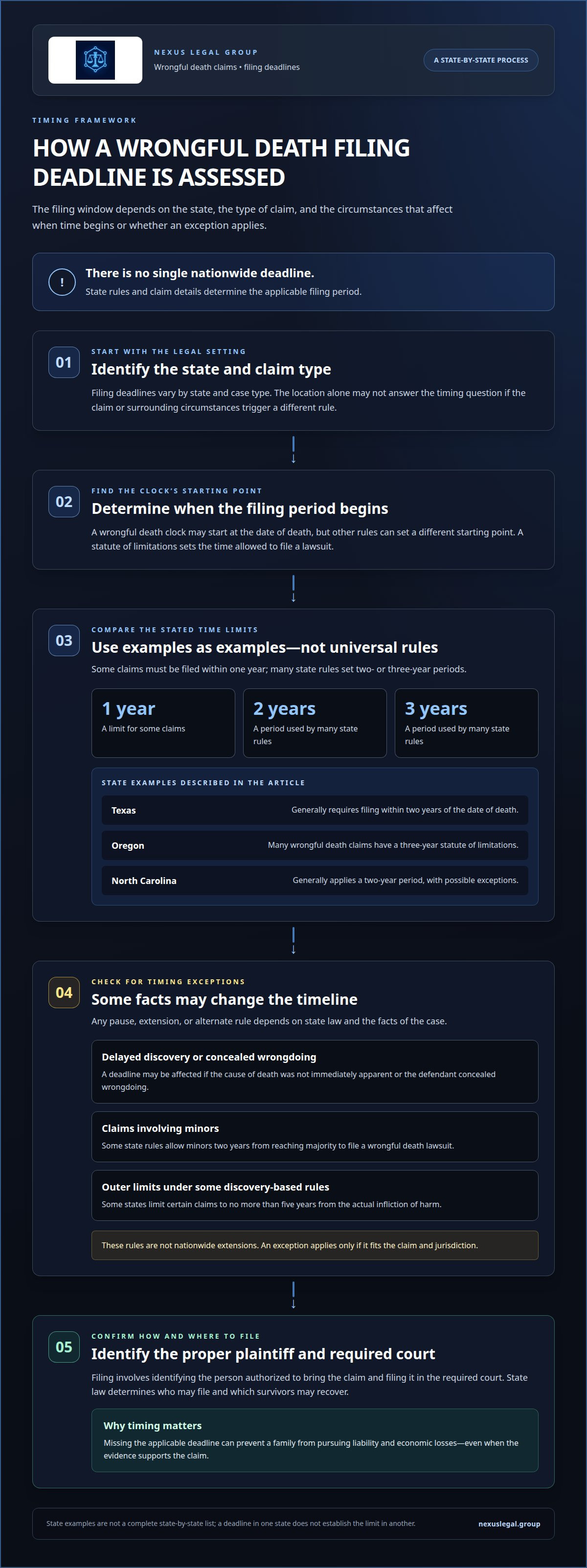
There is no single filing deadline for wrongful death claims across the United States. Deadlines vary by state and case type; some claims must be filed within one year, while many state rules set two- or three-year periods.
Filing Requirements and Deadlines
A statute of limitations sets the time allowed to file a lawsuit. Meeting the deadline preserves the ability to pursue damages. The time limit may depend on the state, the type of claim, and the event that starts the clock. For a wrongful death claim, the clock may start at death, though other rules can set a different starting point.
Filing also involves identifying the proper plaintiff and bringing the claim in the required court. In Texas, the Texas Legislature generally requires a wrongful death lawsuit within two years of the decedent’s date of death. Missing the applicable deadline can prevent a family from pursuing liability and economic losses, even when the evidence supports the claim.
Exceptions to Time Limits
Some circumstances may pause or extend a filing deadline, but any exception depends on state law and the case facts. For example, a deadline may be affected if the cause of death was not immediately apparent or the defendant concealed wrongdoing. These circumstances can change the filing timeline, but there is no single extension that applies nationwide.
Rules involving minors may also differ from the usual deadline. Some state rules allow minors two years from reaching majority to file a wrongful death lawsuit. Discovery-based rules may impose an outer limit, with some states limiting certain claims to no more than five years from the actual infliction of harm. An exception applies only if it fits the claim and jurisdiction.
Deadlines by State
State comparisons show why the location and claim type matter. Many wrongful death statutes set a deadline of two or three years from death, but some claims have a one-year limit. In Oregon, many wrongful death claims have a three-year statute of limitations. North Carolina generally applies a two-year period, although exceptions may permit a later lawsuit.
These examples are not a complete state-by-state list, and a deadline in one state cannot establish the limit in another. A claim involving delayed discovery, concealed conduct, or a minor may raise different timing questions. The filing analysis should identify the state, the type of claim, the event that starts the limitations period, and any applicable exception before assessing how time affects damages or suffering.
Evidence Used to Prove Wrongful Death
A plaintiff generally must prove duty, breach, causation, and damages. The usual civil standard is preponderance of the evidence, meaning the claim must be more likely true than not.
Investigation and Evidence Gathering
An investigation gathers records and accounts connecting an injury, the defendant’s conduct, and the death. Police and incident reports can document the event, while eyewitness statements may describe what happened. Medical records can establish the sequence from injury to death. Together, these materials provide a factual timeline for assessing the claim.
Evaluate each record for what it establishes and what remains unanswered. An incident report, for example, may describe a collision, while medical records trace subsequent treatment. The estate’s representative may also identify witnesses with direct knowledge. Comparing these accounts can reveal gaps or inconsistencies that affect how the claim is developed.
Evidence and Expert Witnesses
Expert witnesses interpret technical evidence that ordinary records may not fully explain. An accident reconstruction expert can analyze how a collision occurred, while a forensic pathologist can assess medical findings and the cause of death. Their analysis helps connect the incident with the injury and resulting death, rather than relying on assumptions about the sequence.
An economist may project the deceased person’s lost earning capacity, helping quantify a family’s economic losses alongside income and employment records. Medical documentation can support the care received before death, while witness accounts may describe family relationships and emotional losses. Each source serves a distinct evidentiary purpose.
What Must Be Proven
A wrongful death claim must establish that the defendant owed a duty of care, breached it, caused the death, and produced damages. Evidence must support each part of that chain. Proof of a harmful event alone, for instance, does not show that the defendant caused the fatal outcome or that survivors suffered the losses claimed.
The plaintiff generally must show that the defendant’s actions more likely than not led to the death. The preponderance standard applies to the evidence as a whole, including records, witness statements, and expert opinions. A lawyer can use that evidence to assess causation and damages, including any conflicting accounts or medical findings that require closer analysis.
Types of Wrongful Death Cases
The incident type shapes the evidence, liability questions, and family losses that matter. A fatal vehicle collision, medical error, or unsafe property condition calls for a different investigation. The category is only a starting point: the connection between conduct, death, and damages remains central.
Motor vehicle accidents may involve a car, truck, or pedestrian collision. Police reports, witness accounts, and accident reconstruction can help establish how the event occurred. A fatal crash may also raise questions about financial support and benefits the deceased would have provided. Those losses differ from medical bills or pain connected with an injury before death.
Medical malpractice claims focus on healthcare conduct and whether it caused a death. Medical records can document treatment and the sequence of events, while expert analysis may address medical findings and the cause of death. These cases can involve both survivors’ losses and expenses incurred before death. The evidence must connect the alleged error to the outcome, not merely show an unfavorable medical result.
Premises-related claims may arise from a fatal incident at a residence or other property. An investigation can examine the conditions surrounding the event and the property owner’s role. Nursing home elder abuse and death claims raise distinct questions, including whether the conduct caused harm and which damages state law permits. The facts determine the liability theory and evidence needed.
Compensation can include economic and non-economic losses. Economic damages may include lost financial support and benefits; non-economic damages may address lost companionship, love, and affection. Some states permit punitive damages for especially egregious wrongdoing. A homemaker parent’s household services and care may also factor into damages, so family contributions matter beyond wages.
State law determines which losses may be pursued and who may recover them. Some states allow loss-of-consortium damages, and the availability of punitive damages also varies. A fatal aviation incident, traffic collision, or nursing home death may therefore raise different legal and compensation questions across state lines. Start by classifying the incident and identifying the responsible conduct, then assess each survivor’s losses under the governing state’s rules.
Who Can File a Wrongful Death Lawsuit, and Who Qualifies as a Beneficiary?
Filing authority and beneficiary status are separate questions in a wrongful death lawsuit. The filer brings the action, while beneficiaries are survivors whose losses the claim addresses. Most states allow an executor or close relative to file. Some permit either, while others require a court-appointed personal representative to act for beneficiaries.
In every state, spouses, children, including adopted children, and parents of unmarried children may recover through wrongful death actions. That broad category does not mean every relative qualifies. A sibling, stepchild, or former spouse may face different rules depending on the jurisdiction. The relationship must fit the state’s definition, not simply reflect a close family bond.
Texas illustrates how eligibility rules can draw specific boundaries. Surviving spouses, children, and parents may file, but siblings cannot. Biological and adopted relationships qualify for parents and children; stepparents and stepchildren are excluded. An ex-spouse may file if the divorce from the deceased person was not finalized.
Texas treats remarriage after a death separately from the original marriage. A surviving spouse’s later remarriage does not affect eligibility to file. This distinction can matter when families determine who may bring a claim, because eligibility is tied to the relationship at the time of death.
The person who files may not be the only person who benefits. In Texas, an executor or estate administrator may file if immediate family members have not filed within three months, unless the family requests otherwise. The representative’s role is procedural: the claim is brought on behalf of survivors entitled to recover.
For example, a Texas family might include a surviving spouse, an adopted child, and a sibling. The spouse and adopted child fall within eligible relationship categories; the sibling cannot file under Texas law. The estate representative may have a role if immediate family has not filed within three months.
Identifying the correct filer and beneficiaries requires two separate determinations: who has authority to bring the lawsuit, and which survivors qualify under state law. This distinction affects how a claim is filed and whose losses it can address. A family tree alone does not resolve either question.
Nexus Legal Group: High-Intent MVA Case Acquisition
Nexus Legal Group supports plaintiff law firms seeking High-Intent MVA Case Acquisition. For firms handling motor vehicle matters, this provides a case-acquisition resource, not legal representation or a substitute for evaluating liability. A fatal collision may lead to a wrongful death claim, but a lead alone does not establish legal merit, prove causation, or determine whether survivors qualify to recover.
The acquisition options address different information needs. Police Report Generated MVA Leads connect inquiries with police-report information, while Emergency Services Generated MVA Leads draw on emergency-services data. Reverse append can obtain accident reports and details about people involved. These sources can give a firm relevant context for an MVA inquiry, including the incident and its participants.
Automated Verification is another part of the offering. In a structured intake operation, verification can support a consistent review of incoming inquiries. The firm still needs to assess the circumstances, identify potential legal issues, and determine whether the information supports follow-up. Report-related details may help orient that assessment, but they are not a finding of fault or proof of damages.
This acquisition service may fit firms seeking a defined pipeline for motor vehicle inquiries, particularly when police reports or emergency-response information are relevant to intake. It is less suited to firms focused exclusively on unrelated claim categories. Acquisition is most useful when the inquiry source matches the firm’s practice focus and internal review process.
For fatal-incident matters, the legal team must separately evaluate the family’s potential claim, available evidence, applicable state rules, and filing deadlines. A report can help identify the event and involved parties, while medical evidence and other records may be needed to assess causation and losses. Nexus Legal Group’s MVA acquisition services support inquiry generation and verification, not legal analysis or court filing.
If your firm is evaluating MVA case acquisition, contact Nexus Legal Group to discuss the available options.
Frequently Asked Questions
How Can You Prove Your Case?
Build a clear connection between the defendant’s conduct, the fatal outcome, and the losses claimed. Evidence should support each part of that sequence rather than relying on a single document. A report can establish incident details, while medical findings can clarify the cause of death. Expert analysis may help explain technical disputes. The civil standard is generally whether the claim is more likely true than not.
What Damages Can You Recover?
Recoverable damages depend on state law and the losses supported by evidence. They may include lost financial support and benefits, loss of companionship, and, where permitted, punitive damages. A homemaker parent’s household services and care can also have economic value. Expenses and losses the deceased experienced before death may belong to a separate survival action, rather than the survivors’ wrongful death claim.
What Defenses Might Arise?
A defendant may dispute whether their conduct caused the death, whether a duty was breached, or whether claimed losses are supported. The deceased person’s share of fault can also matter: comparative negligence may reduce damages, while contributory negligence may bar recovery. A criminal investigation does not resolve those civil issues. The defense and plaintiff rely on evidence to address liability, causation, fault, and the extent of damages.
What Is the Statute of Limitations?
The deadline depends on the state and claim type. Some claims must be filed within one year, while others allow longer. A Texas wrongful death lawsuit generally must be filed within two years of the decedent’s death. Delayed discovery, concealed wrongdoing, or a minor beneficiary may affect timing under certain state rules. These exceptions have specific conditions, so the relevant event and applicable rule matter.
What is a wrongful death claim in the United States?
A wrongful death claim is a civil action seeking damages for survivors after another party’s wrongful conduct causes a death. Every state has some form of wrongful death law, but each sets its own rules for filing and recovery. A representative usually brings the claim on behalf of eligible survivors. The civil action is separate from criminal prosecution, which seeks punishment rather than compensation for family losses.
What damages can be recovered in a wrongful death lawsuit?
Potential damages include economic losses, such as financial support and benefits the deceased would have provided, and non-economic losses, such as companionship, love, and affection. Some jurisdictions permit punitive damages for especially egregious conduct. State rules determine which categories are available and who may recover them. Evidence must support the claimed losses, including the value of household services provided by a homemaker parent.
How are wrongful death settlements and verdicts calculated?
Calculations depend on evidence of financial and personal losses, applicable state law, and liability findings. Economic assessments may consider lost support, benefits, and household services; non-economic damages address losses such as companionship. A verdict follows a trial, while the parties negotiate settlement terms. Settlements may be structured or paid as a lump sum, and many claims resolve outside court.
How do wrongful death claims differ from survival actions?
A wrongful death claim addresses survivors’ losses resulting from the death; a survival action seeks losses the deceased experienced before dying. For example, a survival action may include medical bills, lost wages, or pain and suffering between injury and death. The distinction determines whose losses are claimed and which legal action may address them. Some states require families to bring both claims.