Securing Catastrophic Injury Cases for Law Firms

Learn how law firms assess catastrophic injury cases, document future care and lost earnings, and evaluate liability and claim value with expert evidence.
The injuries most likely to reshape a person’s life aren’t limited to paralysis, limb loss, or severe brain trauma. In catastrophic injury cases, lasting effects on a person’s ability to work and manage daily life can matter as much as the diagnosis.
That distinction matters when law firms evaluate a potential claim: immediate injury severity is only part of the picture. Ongoing treatment, rehabilitation, future care needs, lost earning capacity, and evidence linking the injury to another party’s conduct can all shape negotiations with insurers and a case’s potential value.
This guide explains what may qualify as a catastrophic injury, including less obvious injury types, and how legal representation and insurance negotiations typically fit into a claim. It covers evidence used to assess liability and future losses, factors that may influence settlements and verdicts, and how MVA case acquisition can help firms identify relevant inquiries.
Key Takeaways
- Assess lasting effects on work and daily life, not just the injury’s initial severity.
- Account for how state fault rules may affect recovery and how non-economic losses may be considered.
- Evaluate settlements and verdicts through the evidence of future care, lost earning capacity, and other lasting losses.
- Look beyond commonly recognized injuries: serious burns, vision or hearing loss, crush injuries, and organ damage may also have catastrophic effects.
- Build the claim around incident documentation, medical evidence, and expert analysis of future economic damages.
What Is a Catastrophic Injury?
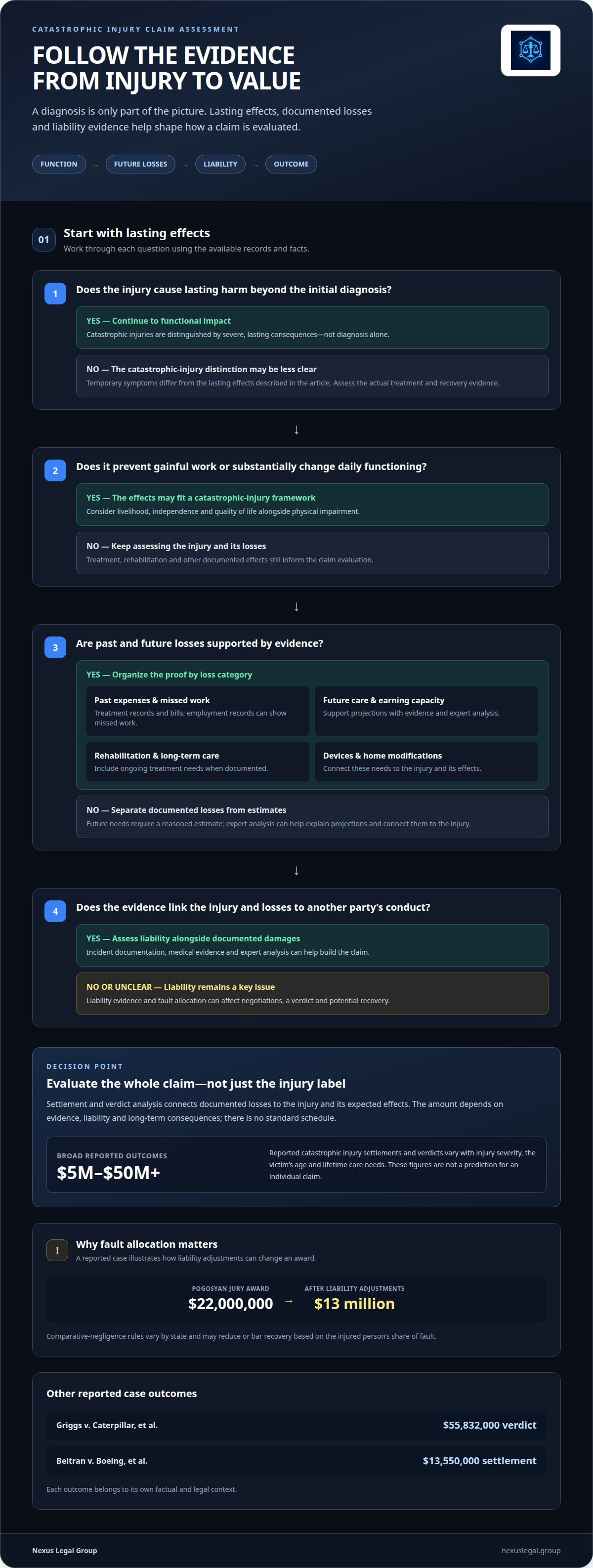
A catastrophic injury causes lasting harm that can prevent gainful work or substantially change daily functioning. Its severity is measured not only by diagnosis, but also by its effects on livelihood, independence, and quality of life. For example, spinal cord damage may lead to paralysis, ongoing care needs, and barriers to returning to work. These consequences can make a catastrophic injury case more complex than a claim involving temporary symptoms.
How do catastrophic injury cases differ from personal injury cases? They are personal injury claims distinguished by severe, lasting consequences, such as permanent disability or difficulty performing daily tasks. Medical expenses, rehabilitation, and lost earning capacity may continue well beyond initial treatment.
The American Medical Association describes catastrophic injuries as severe injuries to the spine, spinal cord, or brain, sometimes including skull or spine fractures. Federal and Georgia law also define catastrophic injury by a person’s ability to perform current or prior work, or other qualified work available in substantial numbers across the United States. These standards consider employment capacity alongside physical impairment.
Examples include traumatic brain injury, limb loss, permanent neurological damage, severe organ damage, and multiple fractures. A severe brain injury may require treatment over an extended period. Rehabilitation, mobility equipment, home care, and home modifications can add further expenses. The specific effects depend on the injury and how it changes a person’s ability to work and function.
What is the statute of limitations for catastrophic injury claims by state? There is no single nationwide deadline; filing limits vary by jurisdiction and claim type, and missing one can forfeit the right to seek compensation. Missouri personal injury lawsuits generally have a five-year filing deadline under Mo. Rev. Stat. § 516.120. Most Missouri medical malpractice cases have a two-year deadline, and Missouri wrongful death cases have a three-year deadline, according to the Missouri Revisor of Statutes.
How does comparative negligence affect catastrophic injury compensation? It can reduce or bar recovery based on the injured person’s share of fault. In some U.S. states, an injured person may be barred from recovering damages if found 50% or 51% or more at fault, depending on the state’s comparative-negligence law, according to ilga.gov.
Noneconomic damages address losses such as pain, emotional distress, and reduced enjoyment of life.
Catastrophic injury settlements and verdicts
A settlement is an agreement resolving an injury lawsuit; a verdict is the jury’s decision after trial. In either outcome, the damages analysis connects documented losses to the injury and its expected effects. A personal injury lawyer may assess medical expenses, lost wages, future earning capacity, rehabilitation, long-term care, assistive devices, and home modifications. Each category needs evidence showing how the injury caused the loss. For people with lasting impairments, future needs can carry substantial weight.
The amount depends on evidence, liability, and the injury’s long-term consequences, not a standard schedule. Catastrophic injury settlements and verdicts often range from $5 million to $50+ million, depending on injury severity, the victim’s age, and lifetime care needs. Those figures describe broad reported outcomes, not a prediction for an individual injury lawsuit.
Valuation starts with organizing losses into clear categories. Past treatment records and bills document expenses already incurred, while employment records can show missed work. Future losses require a reasoned estimate of care needs and earning capacity over time. For example, someone needing ongoing rehabilitation and mobility equipment may face different future costs from someone who returns to work. Expert analysis can help explain these projections and connect them to the injury.
Case outcomes illustrate why the details matter. In the Pogosyan pedestrian accident case, a jury awarded $22,000,000, then liability adjustments resulted in a $13 million award. The difference shows how fault allocation can affect recovery even after a substantial jury award. Other reported outcomes include a $55,832,000 verdict in Griggs v. Caterpillar, et al. and a $13,550,000 settlement in Beltran v. Boeing, et al. Each result belongs to its own factual and legal context.
A settlement may resolve a claim without trial, while a verdict follows the presentation of evidence in court. A personal injury lawyer evaluates the strength of liability evidence, support for projected losses, and the risks of proceeding to trial. Punitive damages may be awarded in rare cases involving particularly reckless or malicious conduct. State law may also limit noneconomic damages. A careful evaluation distinguishes documented losses from estimates, identifies liability issues, and considers how each could affect negotiations or a verdict.
Characteristics and examples of catastrophic injuries
The injury’s lasting effects can appear across movement, cognition, sensation, and organ function. A spinal cord injury may cause paralysis, limiting mobility and independence. More than 17,000 new spinal cord injuries occur annually in the United States. The resulting impairment may affect personal care, employment, and everyday tasks. An injury lawyer assessing claims looks beyond the initial diagnosis to the functional consequences.
Traumatic brain injuries can disrupt memory, communication, judgment, or emotional regulation. Severe cases may involve extended hospitalization, including surgeries. Traumatic brain injuries contribute to nearly one-third of injury-related deaths in the United States. Even when a person survives, lasting cognitive or behavioral changes can affect relationships and work capacity. Medical documentation can connect these effects to the injury and describe their expected duration.
Burn severity depends on depth, location, and the proportion of the body affected. Third- and fourth-degree burns requiring skin grafts are examples of catastrophic injuries. Second- or third-degree burns affecting 25% or more of the body can be deemed catastrophic. Third-degree burns affecting 5% or more of the face or hands can also qualify. These thresholds show why both burn extent and anatomical location matter.
Amputations, crush injuries, and multiple fractures may permanently restrict movement or dexterity. Limb loss can require prosthetics, mobility training, and rehabilitation. Loss of eyesight or hearing may interfere with navigation, communication, and independent living. Legal blindness is described as vision of 20/200 or less. A claimant’s specific limitations, not a label alone, help explain how an injury changes daily life.
Severe organ damage and permanent neurological impairment can cause complex, less visible effects. Nerve damage, for example, may interfere with balance or coordinated movement, while organ damage may require continued treatment. A claimant’s records can show which activities remain possible and where assistance is needed. Those details help distinguish temporary disruption from permanent, life-altering harm.
For a catastrophic injury claim, the key question is how the condition affects function over time. A spinal cord injury may limit walking, a brain injury may impair concentration, and severe burns may restrict movement. A personal injury lawyer can assess medical findings alongside limitations at work and in daily life. This comparison clarifies the injury’s physical, emotional, and practical consequences.
Other potentially catastrophic injuries
Catastrophic harm can follow accidents that do not initially appear life-altering. A fall, workplace incident, or machinery failure may cause crush injuries, multiple fractures, or severe organ damage. The lasting effects depend on resulting impairments, treatment needs, and limits on work or daily activities. For example, crush injuries may affect several body systems, making recovery and future care more complex.
Chemical burns and injuries from fires or explosions also warrant careful assessment. They may involve deep tissue damage, organ harm, or injuries to multiple areas. Treatment needs and functional limitations help show the full impact. A claim should connect the incident to documented injuries and resulting losses, rather than rely only on the accident’s label.
Dog attacks can also cause severe physical injuries and emotional trauma. Dogs attack hundreds of people a year. A serious attack may involve extensive wounds, lasting disfigurement, or impaired movement. The practical assessment considers how those effects change the person’s daily routine, work, and need for continued treatment. The incident circumstances also inform whether negligence may be relevant.
Defective products and machinery create a different path to liability. A product liability claim is often based on strict liability, which does not require proof of negligence. For example, a faulty machine may cause a crush injury, while a defective product may contribute to severe burns. Identifying the product, its role in the accident, and evidence of the injury helps clarify the basis of a claim.
Some incidents involve several potentially responsible parties. A truck crash, for example, may involve the driver, trucking company, faulty-part manufacturer, or third-party maintenance provider. Establishing each party’s connection to the accident requires evidence about the event and resulting harm. This matters because a complex injury lawsuit may require separate analysis of each defendant’s conduct, causation, and responsibility for damages.
The key takeaway is to assess an injury’s consequences, not just its familiar name. A severe fracture, chemical burn, or organ injury may disrupt work and independence for an extended period. Medical records and treatment history help describe those effects. In catastrophic injury claims, this functional picture connects less obvious injuries to economic losses and other damages, while evidence about the accident helps explain how the harm occurred.
What evidence is needed to prove a catastrophic injury claim?
A negligence claim generally requires proof of duty, breach, causation, and damages. Evidence should connect each element to the incident and resulting injury. For example, an incident report may describe a crash, while photographs show vehicle damage or the scene. Witness statements can provide firsthand details about what happened. Together, these records help establish how the event occurred and whether another party’s conduct caused harm.
Medical evidence explains the injury and its consequences. Treatment records, diagnostic findings, and specialist assessments can document the diagnosis, prognosis, and continuing care needs. A spinal injury, for instance, may require records showing mobility limitations and rehabilitation. Medical specialists can describe which impairments relate to the incident and how they affect daily functioning. Consistent documentation also clarifies how the condition changes over time.
Future losses require more than a list of expected expenses. Calculating future economic damages may require expert analysis and testimony. A specialist may assess projected treatment, rehabilitation, home care, mobility equipment, or home modifications. Employment records can help establish missed work and changes in earning capacity. These materials support a reasoned connection between the injury, future needs, and claimed financial losses.
Keep financial records tied to specific losses. Medical bills show treatment charges, receipts document out-of-pocket costs, and employment records can show missed work. For example, someone who needs mobility equipment can pair the purchase record with medical documentation explaining its purpose. Organized records help distinguish injury-related expenses from unrelated costs and make the damages calculation easier to follow.
Incident documentation can also identify people and entities connected to the event. In a truck crash, reports, photographs, and witness accounts may help establish the driver’s actions and the circumstances of the collision. Vehicle or component records may matter if a faulty part contributed. These details can guide investigation of potentially responsible parties and support the causation analysis.
Build the evidence into a connected account: incident records explain what happened, medical evidence describes the harm, and financial documentation supports claimed losses. For example, a treatment timeline can align specialist findings with rehabilitation bills and missed-work records. This structure gives a lawyer a clearer basis to evaluate duty, breach, causation, and damages in a catastrophic injury claim.
Nexus Legal Group: High-Intent MVA Case Acquisition
Nexus Legal Group supports plaintiff law firms with High-Intent MVA Case Acquisition. For firms evaluating motor vehicle accident inquiries, lead sources can connect intake activity with incident information. Police Report Generated MVA Leads and Emergency Services Generated MVA Leads offer distinct ways to identify potential matters. Automated Verification adds a verification component to the acquisition process. These services support case acquisition, while the firm’s legal team evaluates liability, injury evidence, and representation decisions.
Police reports can provide structured details about a reported motor vehicle accident. Police Report Generated MVA Leads use this source to help firms identify inquiries connected with accident reports. In a potential serious-injury matter, incident details can help intake teams understand the reported event and organize an initial review. A lead alone does not establish negligence, prove injury severity, or determine whether a claim is viable. Those issues require legal and evidentiary assessment.
Emergency Services Generated MVA Leads offer another source of motor vehicle accident inquiries. Emergency-service involvement can help identify incidents for further intake review, including events whose reported circumstances warrant closer attention. Firms can assess the information alongside the prospective claimant’s account and available case details. This supports a more informed intake process without treating an initial inquiry as a confirmed catastrophic injury claim.
Automated Verification provides a verification layer within acquisition operations. It supports the broader intake system by helping distinguish verified inquiry information from details that require further review. No verification step replaces legal analysis or the evidence needed to prove duty, breach, causation, and damages. Instead, it can support a firm’s process for routing and evaluating incoming MVA inquiries.
High-Intent MVA Case Acquisition is designed for plaintiff firms seeking motor vehicle accident inquiries, including potential serious-injury matters. Its value lies in connecting acquisition sources with a firm’s own intake and legal evaluation. Police report and emergency-services lead channels address different source types, while automated verification supports the acquisition process. Together, these services provide a defined framework for MVA case acquisition without predicting case outcomes or settlement values.
For firms refining their MVA acquisition strategy, the next step is to discuss how these offerings align with their intake objectives. Contact Nexus Legal Group to start that conversation.
Frequently Asked Questions
Can I still pursue legal action if the life-altering injury occurred months ago?
Possibly. The time that has passed does not, by itself, determine whether a claim remains timely. First establish the incident date, claim type, and jurisdiction whose deadline applies. Preserve correspondence and identify witnesses while records and memories remain accessible. A lawyer can assess timing against those details. Elapsed time alone neither confirms nor defeats a claim.
How Long Does a Serious Injury Claim Take in Ohio?
Ohio claims don’t follow one timeline based solely on the filing deadline. Progress depends on how developed the injury evidence is, whether responsibility is disputed, and whether settlement discussions resolve the matter. A claim may require investigation and negotiation before a lawsuit; litigation adds court scheduling and case preparation. For planning, distinguish the time needed to build the claim from the time needed to resolve it.
How does a trauma injury legal team handle cases involving multiple liable parties?
A legal team separates each defendant’s conduct and asks whether evidence links it to the injury. In a product-related incident, for example, the analysis may distinguish a product defect from how the product was installed or maintained. The team organizes evidence by party and assesses each causal theory separately. A party’s involvement in the events does not, by itself, establish liability.
Need Help Understanding Your Legal Options?
Start by identifying the incident jurisdiction, the type of claim, and any communications received from insurers or other parties. Those details help frame whether the matter involves negligence, a product issue, or another legal basis. Organize questions around deadlines, responsibility, and possible recovery. A lawyer can explain how those factors apply to the specific facts, rather than relying on assumptions drawn from other claims.
What Compensation Can You Recover?
Potential recovery depends on proving that claimed losses stem from the incident and are legally recoverable under the governing law. The amount requested isn’t automatically the amount an insurer or court will accept. The analysis considers supporting documentation, disputed responsibility, and applicable limits. A useful evaluation separates established losses from projections and identifies evidence for each item, rather than treating a diagnosis as a dollar value.
What is considered a life-altering injury, and how can it affect your ability to return to work?
A life-altering injury can affect a person’s ability to perform a job’s actual duties, not just return to the same job title. For example, a worker may be unable to meet lifting, concentration, or hand-use demands while remaining capable of other work. Comparing job tasks with medical restrictions and functional abilities helps clarify whether work can resume, continue with changes, or remain impractical.
What qualifies as a catastrophic injury under U.S. law?
U.S. law doesn’t apply one universal catastrophic-injury label to every legal claim. The relevant definition depends on the legal setting, so a medical description isn’t automatically the same as every statutory test. Identify the framework governing the claim, then apply its criteria to the diagnosis and functional impact. This distinction helps prevent a clinical label from being mistaken for a complete legal determination.
What are common types of catastrophic injury cases?
Common claim categories include motor vehicle collisions, workplace incidents, falls, medical negligence, defective products, and assaults. These categories describe how an injury may occur, not whether its consequences are catastrophic. An incident’s classification alone, for example, doesn’t establish the extent of harm or another party’s legal responsibility. Those questions require assessing the individual injury and the facts connecting it to the event.