Trucking Litigation: Capturing High-Value Cases

Explore trucking litigation case evaluation, from liability and evidence to injuries, insurance, and practical strategies for assessing claims and case value.
The value of a trucking litigation case depends on more than the collision itself. Liability, available evidence, the extent of injuries or property damage, and insurance issues all affect how a claim is assessed and pursued.
These cases can raise complex questions about how carriers and insurers are represented, particularly when a collision causes serious injuries or fatalities. This article explains how those issues fit together, what insurance considerations can mean for a claim, and how to organize the analysis. It also outlines how attorneys assess trucking litigation matters, from reviewing incident records to understanding the parties’ interests. The goal is a practical framework, not a one-size-fits-all formula.
Key Takeaways
- Separate the questions of driver conduct, carrier responsibility, cargo coverage, and contractual terms when assessing a trucking claim.
- Organize injury and property damage evidence to clarify how the collision affected people, vehicles, and other property.
- In fatal collisions, understand how the severity of harm shapes the claims and the parties involved.
- Track insurance and litigation developments to inform case evaluation and defense strategy.
- Use a structured case-acquisition process, including accident-report and emergency-services lead sources, to identify and verify potential matters.
Representation of Motor Carriers and Insurers
Federal Motor Carrier Safety Regulations apply to motor carriers, while state law governs liability and claims in the state where a case proceeds. The applicable rules depend on the claims, the parties, and the jurisdiction where the accident occurred.
Motor Carrier and Owner-Operator Liability
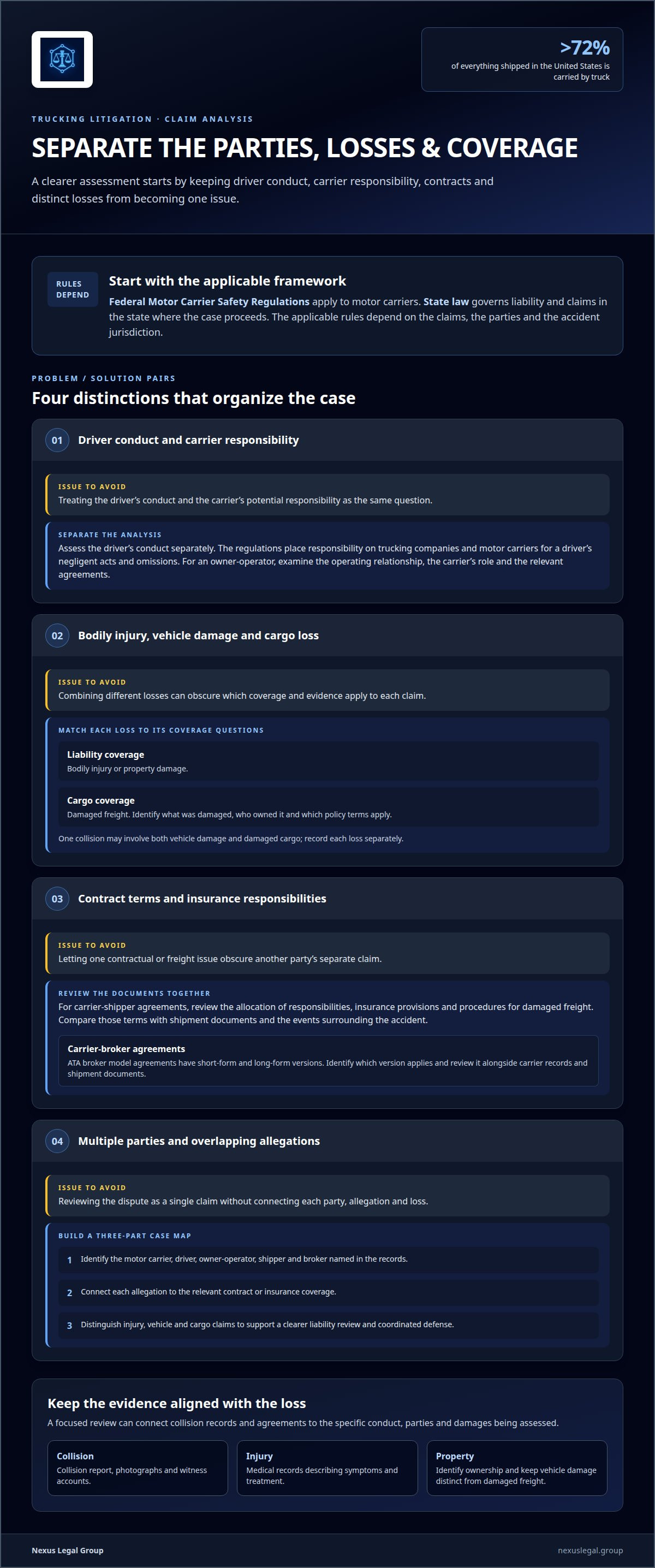
Evaluate the driver’s conduct separately from the carrier’s potential responsibility. The Federal Motor Carrier Safety Regulations place responsibility on trucking companies and motor carriers for a driver’s negligent acts and omissions. For an owner-operator, examine the operating relationship, the carrier’s role, and the relevant agreements. These details help identify which parties and insurers may need representation.
Motor Carrier Liability and Cargo Coverage
Distinguish liability coverage for bodily injury or property damage from cargo coverage for damaged freight. These policies address different losses, so identify what was damaged, who owned it, and which policy terms apply. A collision, for example, may involve both vehicle damage and damaged cargo. Recording each loss separately helps clarify the coverage questions for the carrier and insurer.
Carrier-shipper agreements add another layer to the liability analysis. Review the contract’s allocation of responsibilities, insurance provisions, and procedures for handling damaged freight. Compare those terms with the shipment documents and the events surrounding the accident. If a shipper alleges cargo loss while another party alleges vehicle damage, separating the claims helps keep one contractual issue from obscuring another.
Carrier-broker agreements also document how transportation responsibilities are allocated. The Department of Justice approved the American Trucking Associations’ provision of model agreements for motor-carrier and broker relationships. ATA’s broker model agreements come in short-form and long-form versions. Identify which version applies, then review its terms alongside the carrier’s records and shipment documents.
Organize the matter around the parties, alleged conduct, and losses. First, identify the motor carrier, driver, owner-operator, shipper, and broker named in the records. Next, connect each allegation to the relevant contract or insurance coverage. Then distinguish injury, vehicle, and cargo claims. This sequence gives carrier and insurer counsel a clearer basis for evaluating liability and coordinating the defense.
More than 72 percent of everything shipped in the United States is carried by truck, underscoring the importance of clear records when a transportation claim arises. Swift Currie published “After the Crash: What Transportation Professionals Should Do to Limit Liability” on 06.21.2019. Its title highlights liability limitation as a subject transportation professionals may consider when organizing their response to a crash.
Documentation and insurance issues also merit attention in evaluating representation. Swift Currie published “Cover All the Bases With Driver Documentation” on 11.20.2019, and “New Georgia Direct-Action Changes Aren’t Perfect: What Insurers Need to Know” on 09.10.2024. These publications can be considered alongside the particular records, contracts, and coverage questions in a dispute. Counsel can keep the driver’s documentation, the parties’ responsibilities, and the applicable insurance issues distinct while assessing the allegations. That approach supports a focused review of the carrier’s position and the insurer’s interests without treating cargo, vehicle, and injury claims as interchangeable. The materials’ titles also offer practical points of reference when deciding what documentation and insurer-related issues warrant attention in the matter.
Personal Injury and Property Damage Claims
Personal injury and property damage claims depend on documented harm, the driver’s conduct, and the connection between the collision and each loss. A sound evaluation keeps bodily injury, vehicle damage, and other property claims distinct.
Common Trucking Lawsuits
Common trucking lawsuits in the United States involve bodily injury, wrongful death, vehicle damage, or cargo and other property damage. An injured person may allege that a driver’s actions caused the collision, while a vehicle owner may seek compensation for repairs. Depending on the allegations and circumstances, the legal analysis may involve federal regulations and applicable state law.
Build the case around specific evidence. Connect the collision report, photographs, witness accounts, and medical records to the alleged conduct and resulting harm. For example, record damage to a delivery vehicle separately from damaged freight, identifying ownership and repair or replacement information for each. This helps distinguish property claims from claims for physical injury.
After a truck accident, attorneys commonly advise clients to consider steps such as:
- Moving to a safe location if possible and contacting emergency services when immediate assistance is needed.
- Obtaining a medical evaluation for injuries and retaining records describing symptoms and treatment.
- Documenting the scene, vehicle damage, and available witness details without interfering with emergency response.
- Preserving collision-related records, photographs, repair estimates, and communications about the claim.
These steps can create a clearer record of the event and its consequences. General materials from an association cannot replace evidence specific to the driver, collision, and losses.
Settlement Amounts and Jury Awards
No single average settlement or jury award reliably predicts the value of a trucking accident claim. Outcomes depend on evidence of fault, injury severity, treatment, property loss, and the strength of each party’s arguments. A claim involving lasting injury and clear supporting records raises different valuation questions from one involving limited vehicle damage.
To assess a claim, organize documented medical expenses, lost income, repair estimates, and evidence of continuing effects. Keep each category separate, then assess how clearly the records connect each loss to the collision. A jury award reflects a decision in a particular dispute; it does not set a standard amount for another case. Settlement discussions likewise depend on the facts and available evidence.
Trucking Collision Injuries and Fatalities
State laws and lawsuit deadlines vary by jurisdiction and claim type. Identify where the collision occurred, which claims may apply, and the relevant state rules early in the case.
The scale of harm is substantial: truck collisions in the United States account each year for more than 140,000 reported injuries requiring medical treatment away from the scene. Collisions involving truckers cause an average of 5,000 deaths every year. Those figures describe different outcomes, but both underscore why records must distinguish injury claims from fatality claims.
Fatal-crash trends also require careful context. The U.S. rate of fatal crashes involving a truck decreased from 2.23 to 1.47 per hundred million large truck miles traveled between 2000 and 2020. That change describes a rate, not the number of fatal collisions or the risk in a particular case. For an individual claim, the collision circumstances and supporting evidence remain central.
For an injury claim, organize evidence around the event and its consequences. Preserve the collision report, photographs, witness details, and medical treatment records. A passenger’s injury and damage to the passenger vehicle are distinct losses, even when they result from the same accident. A clear chronology helps connect the driver’s actions, the collision, and each claimed harm.
A fatal collision calls for a different evidentiary focus. Record the sequence of events, identify witnesses, and preserve available vehicle and scene information. Separate the fatality-related claim from any other injury or property claims arising from the accident. This helps attorneys assess which parties, records, and damages relate to each claim without treating multiple losses as one issue.
Because state rules vary, trucking companies and other parties should not assume a general national deadline applies. The state and claim type determine the relevant filing period. Industry resources available to members of an American trucking association may provide context, but the jurisdiction and details of the specific claim guide the analysis.
Begin by identifying where the collision occurred and which claim types are involved. Then organize records by date, source, and the harm they document. This gives attorneys a practical framework for assessing serious injuries and fatalities while accounting for state-level differences.
The applicable trucking laws and filing period depend on the state where the collision occurred and the type of claim. Identify both early rather than relying on a single national deadline.
The page estimates that more people die in collisions with trucks than in collisions involving planes, trains, ships, and buses combined. This comparison places trucking fatalities in a wider transportation context, but it does not explain the cause or circumstances of any particular collision. Case review still depends on evidence tied to the event, the people affected, and the losses claimed. Keep broad estimates separate from case-specific records, and avoid using a population-level comparison instead of documenting an individual injury or fatality. A focused record can help clarify how the collision happened and which harms are connected to it.
Trucking Insurance and Litigation Updates
Insurance terms, defense decisions, and litigation developments can affect how a trucking claim is assessed. Separate policy questions from liability questions, then organize each issue around the relevant records and parties.
Start with the policy language and identify the coverage relevant to each claim. A federal motor carrier’s liability policy and cargo coverage address different losses, so keep injury, vehicle damage, and freight claims distinct. A collision, for example, may result in a bodily injury claim and a separate dispute over damaged cargo. The policy terms and facts determine which coverage questions require analysis.
Early defense decisions can also shape how sensitive material is handled. In some instances, early defense counsel may help protect sensitive information under the work-product privilege. Lawyers can structure document handling around the claim’s needs, distinguishing ordinary accident records from materials prepared for litigation. That distinction matters when a carrier, insurer, and other parties hold overlapping records.
Verdict trends offer context, not a case-specific forecast. The average size of verdicts over $1 million against trucking firms in the United States increased by 867 percent between 2010 and 2018. This measure concerns the average size of verdicts above that threshold, not the value of every claim or the likely result in an individual dispute.
Insurance developments also require attention to jurisdiction. Georgia direct-action changes were the subject of insurance guidance published September 10, 2024. Treat a development as a prompt to examine the relevant state rules and policy implications, rather than assuming it applies nationwide. In each case, identify the state, the parties, and the specific coverage or defense question before drawing conclusions.
Fee arrangements for trucking lawyers vary by representation and agreement. Written engagement terms explain how legal fees and case-related expenses are handled; the claim’s complexity and required work can affect expected costs. No single fee or cost structure applies to every trucking case.
Industry updates can provide context for the competing interests in litigation. A U.S. Chamber of Commerce ILR paper offers legislators and courts solutions to curb excessive trucking litigation costs while ensuring injured plaintiffs have a path to just and reasonable recompense. The ATA Litigation Center also updates ATA members through a quarterly eNewsletter called the Docket. Use these developments as context, then assess the specific policy, parties, and evidence in the case.
Trucking Litigation Resources and Case Strategies
Strong case strategy connects evidence, legal questions, and claim development. A clear process helps attorneys identify what the record establishes and where gaps remain.
Evidence in Commercial Truck Accident Cases
Important evidence includes the accident report, photographs, witness accounts, medical records, and documents describing damage. Attorneys can organize each item by date and link it to a specific issue, such as the vehicle’s movement or the reported injury. Driver documentation and available vehicle data may also clarify how events unfolded.
Build an evidence map that lists each disputed fact, the supporting record, and any unanswered question. For example, compare scene photographs with the accident report to assess vehicle positions. This keeps the analysis grounded in documented details rather than assumptions.
Trucking Lawsuit Timeline
There is no single typical timeline for a trucking lawsuit. The process generally includes claim evaluation, evidence development, negotiations, and, if the dispute remains unresolved, litigation. The time required depends on factors such as disputed liability, the volume of records, the injuries involved, and the court’s schedule.
Track progress by recording key events and outstanding tasks. Attorneys can identify which records are still needed, when each party responds, and whether negotiations address the evidence. A case involving multiple parties or disputed facts may require more investigation than one with a narrower disagreement.
Risks and Challenges of Suing a Trucking Company
Challenges can include disputed responsibility, incomplete records, multiple parties, and disagreement about the connection between the collision and the claimed harm. Each issue can affect how the case develops. For instance, differing accounts of a vehicle’s movement may require attorneys to compare witness statements, scene documentation, and available vehicle information.
Use structured resources to sharpen the strategy. The American Association for Justice Trucking Litigation Group was formed in 1990 and meets at AAJ Annual and Winter Conventions. The ATA Litigation Center’s annual Trucking Legal Forum provides two and a half days of CLE-accredited sessions, and the center regularly files amicus briefs nationwide in cases with major implications for trucking. These resources offer legal and industry context, while case decisions depend on the evidence and issues in the dispute.
Nexus Legal Group
Nexus Legal Group supports plaintiff law firms seeking a more structured approach to motor vehicle accident case acquisition. Its services fit the front end of case development by connecting firms with potential matters and organizing inquiry verification. This support can help firms strengthen how they identify accident-related opportunities, while attorneys remain responsible for legal analysis, representation, and case decisions.
High-Intent MVA Case Acquisition helps firms source inquiries related to motor vehicle accident matters. Police Report Generated MVA Leads connect lead generation with police report information, while Emergency Services Generated MVA Leads use emergency services data. These offerings help firms build intake pipelines around different accident information sources rather than relying on a single channel.
Automated Verification adds a verification step to the acquisition process. Consistent verification can support a more organized review of incoming inquiries before they move through intake. Because the information available in each inquiry can vary, firms can assess whether its details align with their case criteria and internal processes.
Together, these offerings address a practical business development need: identifying potential motor vehicle accident matters and structuring the inquiry flow for review. When evaluating an approach, firms can consider which sources fit their intake capacity, the case types they handle, and how staff review new inquiries. Police report and emergency services sources provide different entry points, while automated verification adds a distinct review layer.
These services are designed for plaintiff firms focused on MVA case acquisition, not for people seeking a lawyer to represent them in a collision claim. They support firms’ acquisition and verification workflows; they do not replace attorney judgment about liability, damages, or litigation strategy. Firms can integrate the resulting inquiries into their own intake and legal review processes.
For firms evaluating their acquisition process, a useful next step is to identify the case categories and inquiry sources that fit their workflow. Nexus Legal Group offers acquisition, police-report-generated leads, emergency-services-generated leads, and automated verification, giving firms options to consider as parts of a broader intake pipeline.
Contact Nexus Legal Group to discuss the firm’s case-acquisition needs.
Frequently Asked Questions
What is trucking litigation?
Trucking litigation is the legal process for resolving disputes connected to commercial truck collisions. It can involve claims over responsibility, injury, death, vehicle damage, or freight loss. The parties may include a driver, motor carrier, owner-operator, and insurer. The specific dispute determines which parties and issues matter. For plaintiff law firms, distinguishing claim development from legal representation helps define the work each process requires.
Who can be held liable in a truck accident lawsuit?
Potentially responsible parties can include the truck driver, a motor carrier, or an owner-operator. The driver’s conduct and the carrier’s role in the operation are important considerations; contracts may also clarify relationships among carriers, brokers, and shippers. A party’s involvement alone does not establish liability. For example, a broker named in shipment records may have a different role from the carrier operating the vehicle, so the evidence and agreements require careful review.
How are damages calculated in truck accident litigation?
Assess damages by identifying each claimed loss and the evidence that supports it. An itemized review might distinguish treatment-related expenses, income losses, vehicle repairs, and other documented effects rather than combining them into one estimate. For example, a repair invoice supports a vehicle damage amount, while employment and income records address a different loss. The supporting records and their connection to the collision inform the overall assessment.
How do trucking laws and lawsuit deadlines vary by state?
State laws and filing deadlines depend on where the collision occurred and the type of claim. Identify both early in the case rather than relying on a single national deadline.