Event First Marketing: Faster Case Acquisition

Discover how event first marketing builds audience relationships, drives qualified opportunities, and turns timely follow-up into measurable business growth.
An event can do more than capture attention. It can organize how a brand attracts, engages, and follows up with its audience. Event-first marketing puts the event at the center of the experience, supported by communication before it begins and purposeful engagement afterward. A well-designed campaign ties that experience to clear business goals instead of treating it as a standalone promotion.
Planning an event takes coordination, and its impact depends on what happens before and after as well as during the event. A strong follow-up process turns conversations and expressed interest into continued engagement instead of letting them end when the event does.
This article explains what event marketing is, how an event-centered approach works, and how it can support audience relationships and business growth. It also covers planning a strategy, assessing results, and using post-event follow-up to sustain engagement.
Key Takeaways
- Build event experiences around clear business goals, audience needs, and meaningful opportunities to participate.
- Use event interactions and feedback to shape relevant follow-up, then keep the conversation going between events.
- Follow up with attendees within 48 hours and tailor the message to their interests and engagement.
- Measure outcomes such as qualified opportunities and pipeline, not attendance or booth traffic alone.
- For plaintiff firms seeking motor vehicle accident cases, Nexus Legal Group offers acquisition and lead services supported by automated verification.
Post-event follow-up and year-round engagement
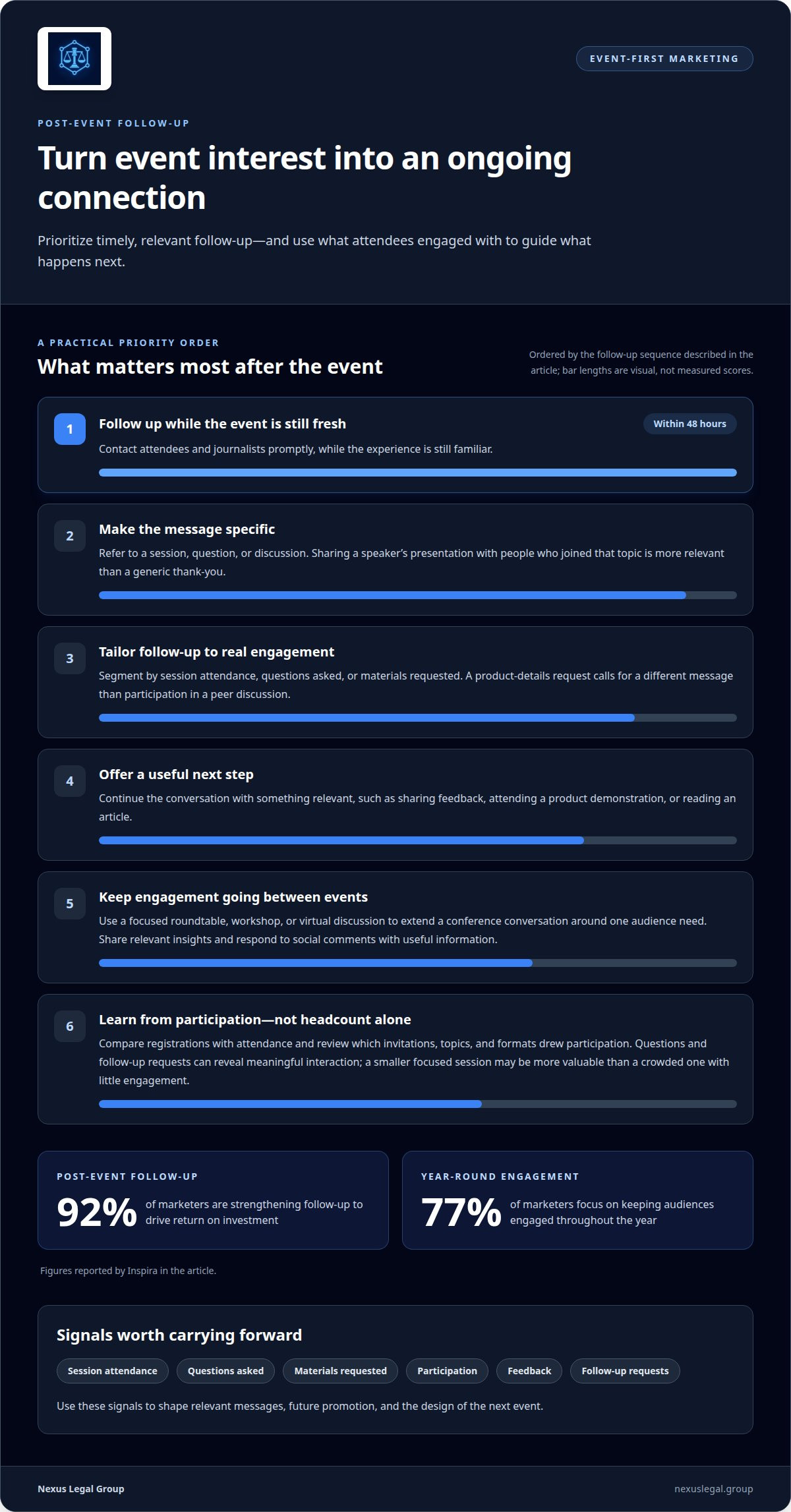
An event’s final session should begin the next stage of audience engagement, not end the conversation. Follow-up connects attendee questions, interactions, and stated interests with relevant next steps. Event marketing guidance recommends contacting attendees and journalists within 48 hours, while the conference experience is still familiar. A specific message about a session or discussion feels more authentic than a generic thank-you. For example, share a speaker’s presentation with attendees who joined that topic’s discussion.
Build authentic follow-up around what people actually engaged with. Segment messages by session attendance, questions asked, or materials requested, then tailor each one accordingly. Someone who attended a launch and requested product details needs a different follow-up from someone who joined a peer discussion. Offer a useful next step, such as sharing feedback, attending a product demonstration, or reading a relevant article. Don’t treat every badge scan as equal intent. A timely, relevant message gives people a reason to continue the connection without making it feel like an automatic sales sequence.
Micro-events can sustain engagement between larger gatherings. A small roundtable, focused workshop, or virtual discussion can extend a conference conversation by addressing one specific audience need. Keep the topic narrow and give attendees a clear reason to participate, such as sharing examples or discussing an industry challenge. Attendance is useful, but it is not the only signal. Participation, questions, and follow-up requests help show whether the event reached the right audience and prompted meaningful interaction.
Use attendance data to improve future promotion and event design. Compare registrations with actual attendance, then review which invitations, topics, and formats drew participation. A workshop with fewer attendees but focused discussion and follow-up interest may be more valuable than a crowded session with little interaction. Use that pattern to inform the next event, rather than judging success by headcount alone.
Keep the relationship active through social engagement and relevant follow-up content. Encourage attendees to share their experience online, and respond to comments with useful information that continues the conversation. Inspira reports that 92 percent of marketers are strengthening post-event follow-up to drive return on investment, while 77 percent focus on year-round engagement. Connect those efforts: use attendee feedback to shape the next promotion, share event insights between gatherings, and offer a clear next step. This turns each event into an ongoing opportunity for connections and potential conversions.
How does event-first marketing work?
Event-first marketing makes a live or virtual experience the organizing point for a campaign. Instead of treating an event as one promotion among many, a brand builds connected activity around its purpose. An event first marketing strategy might center on a product launch, bringing together demonstrations, expert discussions, audience questions, and supporting content. Each interaction reinforces the same business objective and gives attendees a direct way to experience the offering.
The process starts by defining the intended audience and the outcome the event should support. A B2B event might aim to create sales conversations, strengthen partnerships, or share industry knowledge. The format follows that objective: a conference can combine speakers, workshops, and networking, while a focused virtual session can address one specific topic. Promotion then communicates the event’s value and gives prospective attendees a clear reason to participate.
During the event, the experience creates opportunities for interaction and real-time learning. Organizers can monitor attendance, identify popular topics, and gather direct audience feedback as sessions unfold. If a product demonstration prompts repeated questions about one feature, for example, the team can explore that interest in a follow-up session. Polls, facilitated discussions, and hands-on demonstrations reveal what attendees find useful, not just what persuaded them to register.
Event-first marketing can use in-person, virtual, or hybrid formats. A hybrid conference combines onsite conversations with virtual participation, extending access beyond the room. Trade shows can connect brands with prospective buyers and company representatives, while workshops can build credibility by teaching a relevant skill. Match the format to audience needs and the kind of interaction required. A complex demonstration may benefit from hands-on participation; a peer discussion may work well online.
After the event, connect audience signals to the next marketing activity. Attendance, session participation, questions, and feedback can guide what content to share and which topics deserve another event. A session that prompts strong discussion might become a webinar, article, or smaller roundtable. Direct feedback can also inform product improvements and strengthen audience relationships. This sequence links promotion, the event experience, and continued engagement.
In practice, event-first planning means keeping the purpose visible from the first invitation through follow-up. Use a consistent brief to connect the audience, desired outcome, format, and next step, then tailor the experience without losing that thread. Before the event, decide what useful participation looks like. During it, make room for questions and conversation. Afterward, match follow-up to the interests people showed. This keeps the experience connected to the wider campaign.
Field marketing also shows how an event-led approach can be applied across a continuing program. A Reddit commenter said they executed 30+ events per year as part of their field marketing work. For teams planning repeated experiences, the useful lesson is to preserve a clear objective while adapting the topic and interaction to each audience. Reviewing questions, participation, and feedback across events can help identify what deserves a deeper follow-up, while keeping each invitation specific about the value attendees can expect.
How do you plan an event-first marketing strategy?
Start with a business objective, then define the audience and the outcome the event should support. For example, a software company might want operations leaders to evaluate a new workflow. Set measures tied to that goal, such as qualified discussions, partner introductions, or completed product demonstrations. Make these priorities explicit before building the agenda. That alignment helps ensure event decisions serve a defined purpose.
Test the concept with people who match the intended audience. Ask 5-10 customers whether they would attend or value the topic, then use their feedback to refine the format. A focused community gathering can also offer an initial setting for learning; one recommendation identifies communities organized around an ideal customer profile, including 200-member events. The purpose is to uncover real audience needs before investing effort in a larger production.
Next, create a concise message to guide the experience. Define three to five key truths the event should communicate, then connect each one to a session, demonstration, or discussion. For a product launch, one session might explain the customer problem while another demonstrates a practical application. Keep the event page, invitations, and speaker materials consistent so attendees understand why the event matters before they register.
Set the production timeline according to the work involved. AdTech and Martech preparation typically begins three to four months before an event, while event public relations planning works best when started three to six months ahead. Assign owners for registration, speakers, logistics, communications, and measurement. A hybrid format, for example, requires coordination between the onsite program and virtual participation. Account for these responsibilities from the outset.
Finally, map the full audience journey, from initial promotion to post-event learning. During the event, note which sessions attract participation and what questions arise. Afterward, use those signals to decide which topics deserve further discussion or a new format. Treat the results as inputs for future planning, not just a report on the event date. This connects goal-setting, the experience, and improvements to subsequent campaigns.
Keep the plan tied to overarching business goals, and set measurable, achievable goals for each event. Before shaping the details, research audience preferences, pain points, and aspirations, then tailor the event to make the experience more memorable.
Event professionals can also research attendee experience by attending events and observing how organizers promote them and engage guests. Use those observations alongside audience research to shape how you communicate about the event and welcome participants. The experience should reflect both what attendees value and what the business seeks. Keep the story aligned with three to five key truths, using them as a guide as the plan develops.
How does event-first marketing compare with traditional marketing?
Traditional marketing often delivers a message through channels such as email, advertising, or published content. Event-first marketing organizes those channels around a shared experience, such as a product demonstration or industry conference. Email can invite people to the event, articles can explain its topic, and social posts can extend its reach. The difference is what organizes the campaign: a message or channel in one approach, an audience experience in the other.
That difference changes how people encounter an offering. An advertisement can describe a product’s value, while an event can let attendees see a demonstration, ask questions, and discuss its use. In a study by Jack Morton Worldwide, 11 out of 14 consumers preferred learning about new products or services through personal experience. That finding illustrates the experiential advantage, but it doesn’t make events a universal replacement for advertising or other marketing channels.
Traditional channels can provide repeated exposure without requiring attendance at a scheduled gathering. A newsletter, for example, can share product updates with subscribers who cannot join a live conference. An event creates a defined occasion for interaction, but its reach depends on promotion, format, and audience participation. A hybrid conference can combine in-person conversations with virtual access, while follow-up content can share key discussions with people who missed the event.
The two approaches also produce different signals. A campaign can track responses to an email or advertisement; an event can add attendance, session participation, questions, and direct feedback. For example, a technology company can compare interest in a launch presentation with questions asked during its demonstration. These signals help put attention in context, but attendance alone does not establish purchase intent. Outcomes depend on the audience, the experience, and the next interaction.
In practice, event-first marketing can serve as the central experience within a broader campaign. Traditional channels remain useful for reaching audiences before and after the event. A conference promotion might use email and social media, then share session insights afterward. This combination is useful when direct interaction, product education, or relationship-building supports the goal. For straightforward announcements, a focused email or advertisement may be more efficient than building an event around the message.
What are the risks and challenges of event-first marketing?
A major risk is choosing an event before defining its business purpose. A crowded trade show may attract visitors without reaching the intended buyers. Forrester reports that 95% of event marketing leaders rank demonstrating return on investment as a top priority. Set the outcome first, such as qualified conversations or partner connections. Then assess whether the audience, format, and agenda can support it. Without that alignment, attendance can look strong while the event contributes little to the intended objective.
Audience fit is another challenge. A large conference can create visibility, yet its size may make relevant conversations hard to find. A niche workshop, for example, may better serve buyers seeking detailed product education. Assess the event’s audience profile, subject matter, and participation format against your target market. If the event draws broad interest but few relevant attendees, follow-up can take time without advancing useful relationships. Registration totals alone don’t show whether the right people participated.
Execution also involves operational complexity. A hybrid event requires the onsite program and virtual experience to work together. If remote attendees cannot follow a demonstration or join the discussion, they have a weaker experience. Assign owners for registration, speaker coordination, technology, and audience communication. Set a clear plan for schedule changes and attendee questions. An agenda with overlapping sessions, for instance, may split the target audience across discussions and reduce meaningful participation.
Measurement can mislead when teams track activity without connecting it to outcomes. Booth traffic, social reactions, and registrations indicate engagement, but they don’t establish business impact on their own. Define the desired result before promotion, then connect event interactions with relevant follow-up and later outcomes. For a product launch, distinguish people who watched a demonstration from those who requested a deeper conversation. Consistent definitions help teams interpret results and compare future events more reliably.
Finally, event-first programs require coordination beyond the event date. A team that plans promotion but neglects follow-up can leave attendee interest unused. A generic message to every registrant also ignores differences in session attendance and expressed needs. Build follow-up into the event plan, with messages shaped by actual interactions. If a topic prompts strong questions, develop a relevant discussion or resource. If participation is limited, review the format, promotion, and audience fit before repeating it.
Nexus Legal Group
Nexus Legal Group helps plaintiff firms connect marketing engagement with motor vehicle accident case acquisition. Event activity can create conversations and audience interest, while specialized acquisition channels help firms reach potential MVA cases. Nexus Legal Group offers High-Intent MVA Case Acquisition for firms seeking this growth infrastructure. This service is relevant when the goal extends beyond event attendance to acquiring potential MVA cases.
The right fit depends on the firm’s case acquisition priorities. Police Report Generated MVA Leads can support a strategy centered on police report information. Emergency Services Generated MVA Leads offer another pathway for firms focused on MVA inquiries associated with emergency services data. These offerings address defined lead-generation needs, not event planning or production. This distinction helps firms connect an event-led marketing strategy with the separate acquisition systems that support case growth.
Lead quality and intake processes also matter when audience engagement creates interest. Nexus Legal Group offers Automated Verification as part of its acquisition capabilities. For firms assessing their growth infrastructure, verification provides an automated layer within lead handling. Consider how the marketing channel, type of MVA inquiry, and intake verification fit together. Each component has a distinct role; an event alone does not produce a qualified case or guarantee a particular result.
These services are designed for plaintiff firms seeking MVA case acquisition support, especially those evaluating police report-generated or emergency services-generated leads. They are not event logistics, conference production, or general event promotion services. Keep event strategy distinct from case acquisition: events can support audience engagement, while Nexus Legal Group’s offerings address specific MVA acquisition and verification needs.
To discuss whether these MVA acquisition offerings align with your firm’s priorities, contact Nexus Legal Group.
Frequently Asked Questions
What is event-first marketing?
Event-first marketing centers a campaign on an experience designed to advance a specific audience or business goal. It differs from event management, which focuses on organizing, promoting, and conducting the event itself. For example, a company might use a customer workshop as the centerpiece of a product education campaign, then connect its content and audience communications to that experience. The distinction is whether the event is the marketing focal point or the operational task.
What types of events work best for event-first marketing?
The right event format depends on the audience, goal, and interaction needed. A trade show can suit product discovery among business buyers, while a workshop supports hands-on learning. A peer roundtable may work better for candid discussion among a defined group. For a product announcement, a launch event can combine a demonstration with audience questions. Choose a format for the experience it enables, not its scale or popularity.
How do you measure event-first marketing ROI and success?
Connect event results to a defined business objective. Compare event-related revenue or qualified opportunities with the total costs attributed to the event, and document how attribution is assigned. Then review supporting indicators such as registrations, attendance, session participation, and follow-up conversations. A product event, for example, may draw strong attendance but few qualified sales discussions. Reviewing outcomes alongside engagement shows where the campaign succeeded and where its design needs adjustment.
What tools and technologies support event-first marketing?
Event management and marketing software can streamline coordination and reduce manual work. Automation, generative AI for ticketing and attendee engagement, and real-time event data can also support personalized interactions and measurement.