Plaintiff Law Firm Lead Generation: Build a More Reliable Case Pipeline
Master plaintiff law firm lead generation with our practical guide. Learn how to qualify inquiries, optimize intake, and build a reliable, high-value pipeline.
A full inquiry queue can still conceal an unreliable case pipeline. For plaintiff firms, plaintiff law firm lead generation isn’t measured by how many people submit a form. It depends on whether the source produces relevant inquiries and whether intake can qualify and follow up on them consistently.
Volume gets attention because a steady flow can look like growth. But without clear source data, verification, and connected intake outcomes, firms may struggle to compare channels, evaluate acquisition processes, or see where viable matters are lost. The more useful question is which inquiries fit the firm’s practice focus and capacity.
This article offers a practical framework for evaluating acquisition models, measuring inquiry quality through intake, and connecting channel performance with firm outcomes. It also explains how specialized MVA sourcing, including police-report and emergency-services-generated leads, reverse-append data, and automated verification, can fit into a structured process. The goal is a visible, manageable pipeline, not volume for its own sake.
Key Takeaways
- Evaluate plaintiff law firm lead generation by whether inquiries support case development, not by volume alone.
- Compare owned channels, paid campaigns, referrals, and specialized acquisition partners based on how they source and deliver inquiries.
- Distinguish documented sourcing and verification processes from claims about outcomes.
- Connect inquiry routing, firm-side review, disposition, and source feedback so intake results can guide acquisition decisions.
- Assess whether MVA-focused case acquisition aligns with your firm’s practice focus, review process, and intake capacity.
What Plaintiff Law Firm Lead Generation Actually Needs to Deliver
A high inquiry count can look like growth without showing whether acquisition is supporting case development. The number of people who respond doesn’t indicate whether their needs fit the firm’s practice, whether staff can reach and review them, or what happens next. Effective plaintiff law firm lead generation connects these signals instead of treating every inquiry as a finished result.
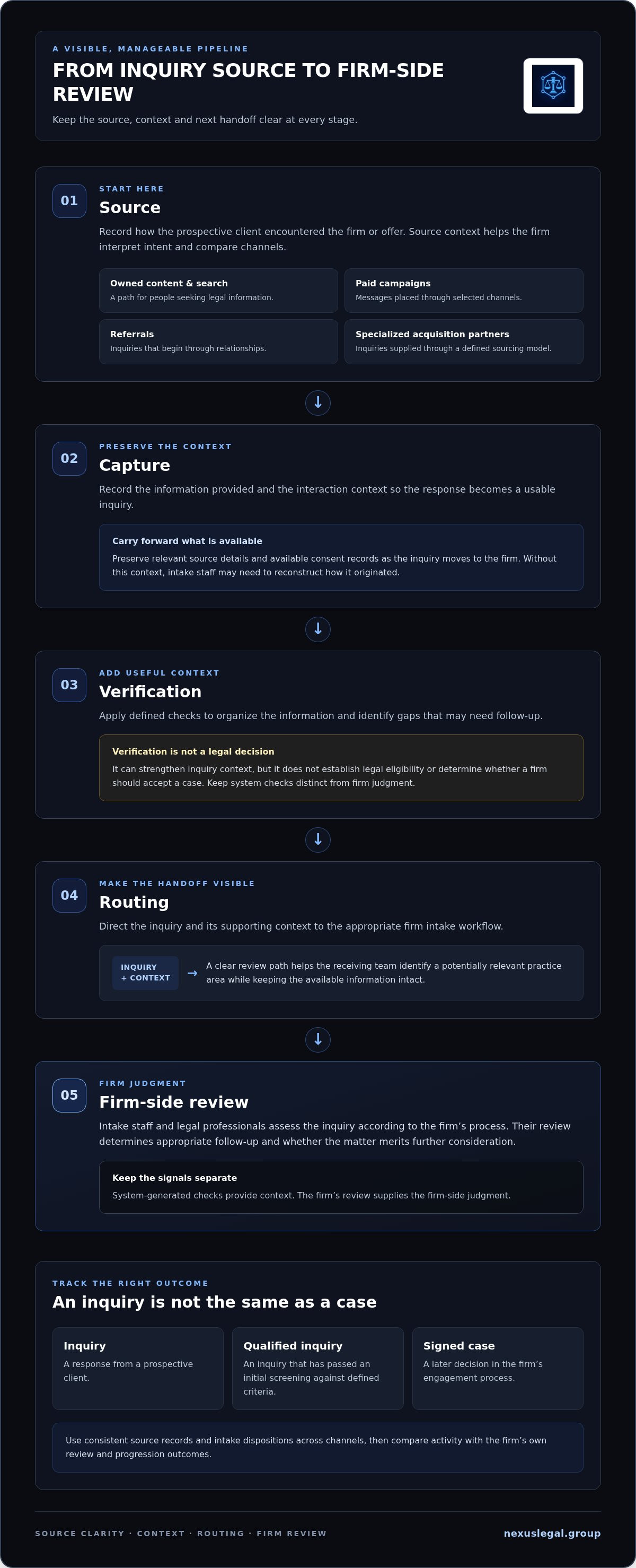
Lead generation attracts and routes prospective-client inquiries for a law firm to review. Case acquisition is the broader process of moving suitable inquiries through qualification and firm-side intake toward a potential signed case. A lead is an inquiry. A qualified inquiry has passed an initial screening against defined criteria. A signed case reflects a later decision in the firm’s engagement process. None of these labels alone determines whether the firm will provide legal representation. That decision rests with the firm’s legal professionals.
Marketing and acquisition systems can organize sourcing, capture, verification, and routing. They support the firm’s work but cannot replace legal judgment or determine whether a matter should be accepted. For a broader overview, Legal marketing strategies encompasses both traditional and digital approaches to reaching prospective clients.
How an inquiry moves from source to firm review
The process starts when someone responds to a source, such as the firm’s content, a paid campaign, a referral, or a specialized acquisition channel. The response is captured as an inquiry and routed to the firm. Preserve the available source context and consent records at each handoff so the receiving team understands how the inquiry originated and what information came with it.
Verification or screening can add useful context, but qualification is an initial signal, not a legal conclusion. An inquiry may appear relevant based on the information collected and still require follow-up and attorney review before the firm can assess fit. Clearly distinguish what a system checked from what the firm decided.
Why lead volume is an incomplete growth measure
Volume measures activity, such as inquiries captured or delivered. It doesn’t show whether they match the firm’s focus, whether staff can respond and complete reviews, or whether they progress through intake. A channel can produce many inquiries but still create friction when context is missing or follow-up ownership is unclear.
Start with a firm-specific baseline. Track each source alongside response status, review outcome, and progression to a signed case, using the same definitions across channels. This helps the firm compare activity with its own intake outcomes without relying on unsupported industry benchmarks. Over time, patterns can show whether the constraint lies in sourcing, routing, review, or follow-up, and where to adjust the process.
How Plaintiff Law Firm Lead Generation Sources and Qualifies Inquiries
A useful acquisition process makes each handoff visible, from the channel that prompted interest to the firm’s review. Plaintiff law firm lead generation can use several channels, but each produces different context. The steps below help firms see what happens before an inquiry reaches intake and what information should travel with it.
- Source: Record how the prospective client encountered the firm or offer. Owned content and search visibility can attract people seeking legal information. Paid campaigns place messages through selected channels. Referrals come through relationships, while specialized acquisition partners supply inquiries through a defined sourcing model. Source records help the firm interpret intent and compare channels.
- Capture: Record the information provided and the interaction context so the response becomes a usable inquiry. Preserve relevant source details and available consent records as it moves to the firm. Without this context, intake staff may need to reconstruct how the inquiry originated before deciding what to do next.
- Verification: Apply defined checks to organize the information and identify gaps that may need follow-up. Verification strengthens inquiry context; it does not establish legal eligibility or determine whether a firm should accept a case. It supports clearer review, not a legal decision or a guarantee of acceptance.
- Routing: Direct the inquiry and its supporting context to the appropriate firm intake workflow. Clear routing helps the receiving team identify a potentially relevant practice area or review path while preserving the information needed to assess the inquiry on its own merits.
- Firm-side review: Intake staff and legal professionals assess the inquiry according to the firm’s process. Their review determines appropriate follow-up and whether the matter merits further consideration. Keep system-generated signals distinct from the firm’s judgment.
What different acquisition channels contribute
Owned content and search visibility create a direct path for people seeking information. Paid campaigns add targeted outreach, while lead partners can introduce inquiries through a separate acquisition process. Referrals begin with a relationship rather than a campaign or content interaction, but should still be tracked. Apply consistent source records and intake dispositions across channels, then assess each by the role it plays in the firm’s mix. For broader context on legal advertising, see Cornell Law School’s overview of Regulation of legal advertising.
Where sourcing and verification fit in an MVA pipeline
For motor vehicle accident acquisition, Nexus uses police reports, emergency-services data, and reverse-append technology to obtain accident-report details. Automated verification helps structure the inquiry context for review; it doesn’t promise case acceptance. Firms evaluating verified MVA leads for law firms can consider how those sourcing and verification details connect with their intake process. Learn more about Nexus’s MVA case acquisition approach.
How to Compare Plaintiff Law Firm Lead Generation Models
Compare acquisition models by their documented processes, not volume claims alone. A consistent scorecard shows how inquiries originate, what context accompanies them, and whether the firm’s intake operation can manage delivery. Use the categories below as comparison prompts, not guarantees. Channels vary by implementation, and firm-side review remains essential.
| Sourcing | Verification | Exclusivity | Delivery | Firm-side review |
|---|---|---|---|---|
| Owned content or search response | Firm-defined checks on inquiry details | Direct inquiries to the firm’s own channel | Captured through firm-controlled forms or contact paths | Firm reviews relevance and next steps |
| Paid campaign response | Checks depend on campaign and capture process | Depends on campaign arrangement | May enter through forms or calls | Firm assesses fit and follow-up |
| Referral | Context comes through the referring relationship | Usually introduced to a particular firm | Passed through the relationship | Firm still reviews the matter |
| Specialized acquisition partner | May include a defined verification process | Clarify whether delivery is shared or exclusive | Review the documented handoff and information provided | Firm determines whether the inquiry warrants further consideration |
Shared versus exclusive delivery describes how an inquiry is distributed, not whether the matter has merit. Shared delivery may mean more than one firm receives an inquiry. Exclusive delivery may limit distribution under the arrangement. Neither establishes liability, damages, or eligibility for representation. A firm remains responsible for reviewing each inquiry through its own intake process.
Questions that reveal how an inquiry is sourced
Evaluate what source produced the inquiry, what information accompanies it, and how that context is preserved for internal review. Direct responses, data-informed sourcing, and third-party distribution are distinct models. A source can help staff decide what to examine next, but it can’t prove liability, damages, or eligibility for representation.
For example, a firm assessing plaintiff law firm lead generation for an MVA practice may value clear source context differently from a firm focused on another matter type. The key test is whether the documented process aligns with the firm’s practice focus and provides enough information for its own assessment.
How to assess quality without relying on lead counts
Define firm-specific measures for contactability, relevance to intake criteria, review outcomes, and progression through the firm’s process. Keep delivery records separate from the firm’s matter-review and signed-case records. Otherwise, a delivered inquiry can be mistaken for an intake result.
Before comparing channels, align definitions and reporting fields across teams. Check whether information fits the firm’s existing workflow, who owns follow-up, and how dispositions feed into source reporting. This makes quality assessment more useful than a headline count and helps identify where the process needs adjustment.
How to Build a Measurable Lead-to-Intake Workflow
A measurable workflow traces an inquiry from arrival to outcome and assigns responsibility for every handoff. For plaintiff law firm lead generation, define the stages first, name an owner for each, and record status consistently. This gives the firm a practical view of channel activity and the workload its intake operation can manage.
- Receive and route: Assign responsibility for receiving each inquiry and directing it to the right intake queue or team member. Record its source and available context at receipt so staff don’t have to rely on memory or separate messages.
- Track response and review: Name the person or role responsible for initial follow-up and status updates. Use a small set of shared statuses, such as awaiting review, under review, or review complete, that reflects the firm’s process.
- Record disposition: Note whether an inquiry advances, pauses, or stops, using consistent categories and a concise reason. This supports operational clarity, not a premature legal conclusion. Keep records factual and aligned with the firm’s review procedures.
- Return source feedback: Review intake outcomes alongside source information regularly. Look for patterns that may indicate a mismatch in practice focus, routing, or capacity. Treat patterns as prompts for investigation, not proof that a channel caused an outcome.
Set up routing, review, and feedback
Make responsibilities explicit: who receives inquiries, owns follow-up, updates review status, and ensures dispositions are recorded. Use a shared method to note why an inquiry advanced or stopped. Regular reviews can surface missing context, unclear handoffs, and workflow bottlenecks. Consistent records make these discussions more useful without assigning causation based on limited observations.
Choose metrics that support operational decisions
Separate delivered inquiries from verified inquiries, firm-reviewed matters, and signed cases. These are different stages, and combining them can hide where the process slows. Compare results by source and practice focus using consistent definitions over time. Interpret them in light of the firm’s caseload, intake capacity, and priorities rather than an assumed industry benchmark.
A concise dashboard can show three layers: source activity, such as inquiries by channel; verification status, such as whether information has completed defined checks; and firm outcomes, such as review disposition and signed-case status. Assign an owner to maintain each data point and resolve incomplete records. The dashboard should answer practical questions: which inquiries are reaching review, where handoffs are stalled, and what the team can handle.
Consistent intake records also help firms assess whether automated intake for plaintiff firms fits their workflow. They clarify which stages need structure and which decisions remain with the firm. Keep measures tied to operational decisions and adjust them when practice focus or capacity changes. Learn more about structured case acquisition.
When Specialized Case Acquisition Fits a Plaintiff Firm
A specialized acquisition partner can fit an established firm with a clear MVA growth priority that wants to add a focused capability alongside existing channels. Begin with operational readiness, not the assumption that another source automatically improves results. Define the target matter profile, assign responsibility for new acquisition activity, and establish how the firm will assess whether the added work fits its priorities.
Nexus Legal Group provides legal technology and acquisition infrastructure for plaintiff firms. Its role is to support firm growth, not provide legal representation or replace professional judgment. A strong fit is a firm that knows what it wants to develop and can integrate specialized acquisition into its operating plan.
What a specialized MVA acquisition model can add
A dedicated MVA acquisition model can help a firm pursue its motor vehicle accident practice priorities with a focused sourcing process. Nexus combines AI-driven marketing precision with automated verification, using police reports, emergency-services data, and reverse-append technology to obtain accident-report details and information about people involved. This provides structured inquiry context for the firm’s consideration, while attorneys retain responsibility for assessment and representation decisions.
Consider how the added acquisition activity relates to the firm’s matter mix, staffing plans, and business objectives. Nexus provides qualified inquiries and signed cases for MVA and mass-tort matters, but no acquisition model can determine in advance how a particular inquiry will fit a firm’s criteria or develop. The firm retains control of those decisions.
How to assess operational readiness before scaling
Before expanding, assess whether the team can absorb additional work without compromising existing priorities. Identify who will oversee acquisition, coordinate with intake, and review whether the activity remains aligned with the firm’s objectives. Clear ownership prevents a new initiative from becoming an unassigned task between marketing and intake.
Define success beyond a general increase in activity. It might mean strengthening a priority practice area, making better use of existing intake capacity, or improving visibility into how acquisition supports firm goals. Set criteria before scaling, then revisit them as caseload, staffing, and strategic priorities change.
When evaluating AI-driven legal case acquisition, consider how the approach fits the firm’s operating model and growth priorities. Technology alone isn’t a strategy. With clear objectives and accountable ownership, a specialized partner can become a considered part of the firm’s growth infrastructure. Explore plaintiff-firm acquisition infrastructure.
Make Your Next Acquisition Decision Measurable
Before expanding a channel, define what decision its results should inform. Set out the firm’s practice focus, the inquiries it wants to assess, who owns intake review, and what information leadership needs to evaluate progress. This operating brief lets the firm judge a new acquisition effort against its priorities rather than a headline count.
Keep the brief current. Review it when caseload, staffing, or practice priorities shift, and update the criteria that guide acquisition and intake. A disciplined approach to plaintiff law firm lead generation connects sourcing decisions to the firm’s ability to review and act on inquiries.
Nexus Legal Group offers acquisition infrastructure designed to support plaintiff-firm growth. Explore how a structured approach can align with your firm’s priorities.
Frequently Asked Questions
What is lead generation for a plaintiff law firm?
It creates opportunities for prospective clients to bring a matter to a firm’s attention. Specify the practice area and type of inquiry the firm wants to assess, then align its public-facing message with what intake is prepared to handle. For instance, if the firm prioritizes MVA matters, a broad campaign message may attract inquiries outside that focus.
Are exclusive legal leads better than shared leads?
Neither arrangement is automatically better. Consider how each fits the firm’s follow-up capacity and the prospective client’s experience. A team that needs time to coordinate an initial review may prefer a different delivery approach from a team that can promptly manage incoming inquiries. Set criteria in advance and assess results against the firm’s intake experience. Exclusivity alone doesn’t predict case merit.
How can a law firm evaluate lead quality?
Use a consistent review protocol instead of relying on informal impressions. Have intake personnel assess inquiries against the same practice criteria, then compare where their judgments differ. Differences may point to unclear screening guidance or inconsistent expectations. Refine the criteria, document changes, and apply the same method in later reviews.
What is the difference between a legal lead and a signed case?
They represent different stages in the firm’s intake and engagement process. Keep separate records for initial inquiry, completed review, and an executed engagement so reporting doesn’t confuse activity with a client relationship. If an inquiry remains under review, it shouldn’t be counted as an engagement before the firm and prospective client have completed that step.
Can law firms use more than one lead-generation channel?
Yes, if the firm can manage the workload and track each channel’s role. Assign someone to monitor intake load as new efforts begin, then adjust activity if the team can’t process inquiries consistently. Agree in advance on the conditions that would prompt a review of the channel mix, so growth stays aligned with staffing and practice priorities.
How does automated verification support legal lead generation?
Automated verification can make defined review checks more consistent, but firms should have a clear process for exceptions. For incomplete or inconsistent information, establish whether the inquiry goes to staff for clarification, remains pending, or follows another review path. Periodically review a sample of checked inquiries to see whether the information is useful to staff, and retain a human review path for unresolved cases.
How should a plaintiff firm compare lead-generation companies?
Use a structured evaluation before entering a longer-term arrangement. Review a process description or sample reporting view, then assess whether the team can interpret the information and incorporate it into existing review practices. Define how the firm will evaluate fit, who will own the relationship, and when leadership will revisit the decision. This is more useful than relying on broad claims or polished sales materials.
Does lead generation guarantee new clients for a law firm?
No. Treat acquisition as an input to the firm’s growth process, not a guaranteed client outcome. Use the firm’s own historical intake records to model conservative, expected, and higher-demand scenarios, then match planned activity to staff capacity. Revisit assumptions as the firm gathers its own results. This supports informed resource decisions without presenting future engagements as certain.