Lead Generation for Attorneys: Build a Measurable Client Pipeline in 2026
Master lead generation for attorneys in 2026. Learn how to evaluate channels, qualify inquiries, and build a measurable, high-value client pipeline today.
What if a higher lead count is masking a weaker client pipeline? A steady flow of inquiries matters, but lead generation for attorneys creates business value only when those inquiries fit the firm’s case priorities and progress toward retained matters. If channels produce inconsistent results or the team spends time on poor-fit prospects, volume alone offers little direction.
This article explains how attorney lead generation works and how to assess acquisition models by lead quality and downstream outcomes, not just inquiry totals. You’ll learn how to compare channels, connect intake performance to signed cases, and align acquisition with your firm’s capacity and growth objectives. We’ll also examine data-informed MVA case acquisition, including how police reports, emergency services data, reverse append technology, and automated verification can support a more relevant path from marketing activity to qualified plaintiff inquiries.
Key Takeaways
- Use a lead scorecard to assess source, completeness, verification, practice fit, and final disposition.
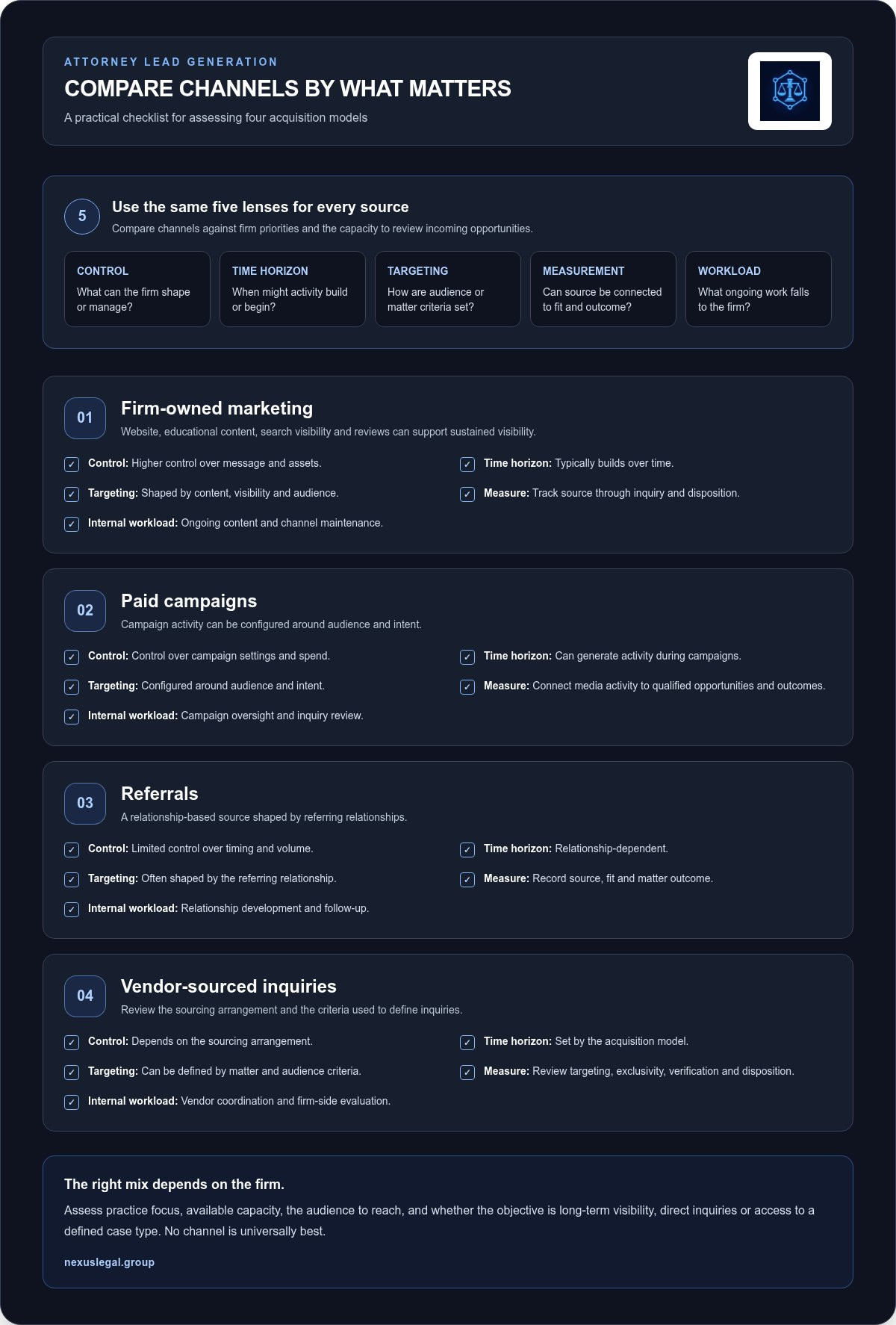
- Compare firm-owned marketing, paid campaigns, referrals, and vendor-sourced inquiries by control, time horizon, targeting, measurement, and workload.
- Measure lead generation for attorneys by separating intake activity from business outcomes, including retained matters.
- Build an acquisition plan around priority case types, firm capacity, controlled testing, and periodic performance reviews.
- See how Nexus Legal Group connects MVA case acquisition with AI-driven marketing, automated verification, and incident-data sourcing.
What Lead Generation for Attorneys Includes Beyond Getting More Inquiries
A high inquiry count can look like momentum, but it doesn’t automatically translate into sustainable firm growth. Some inquiries concern matters outside the firm’s priorities; others lack details needed for meaningful review. To assess acquisition accurately, distinguish three stages: an inquiry is an initial expression of interest, a qualified opportunity is an inquiry that appears to fit the firm’s criteria for further evaluation, and a retained client is someone who has completed the firm’s process and engaged its services. These are separate pipeline stages, not interchangeable measures of success.
Lead generation for attorneys is the process of attracting and capturing prospective-client inquiries through channels such as referrals, advertising, or educational content. The What is Lead Generation? overview describes the concept across marketing contexts. For a law firm, an operational definition should also account for what happens after someone makes contact.
Lead generation is a measurable process that moves a relevant prospective client from initial awareness to firm review, not a single marketing tactic. That distinction lets a firm evaluate acquisition as a progression instead of treating every form submission or call as an equivalent result.
How an attorney lead moves from awareness to firm review
The path generally begins when a prospective client learns about a firm or its services, then responds through a call, form, referral, or another contact point. The firm captures initial information, reviews it against its criteria, and decides whether the matter should proceed to further evaluation. Track each step: whether a response arrived, whether the information needed for review was captured, and whether the inquiry advanced.
A missed response can stop the progression before review begins. A poorly matched inquiry can also take up staff time without becoming a relevant opportunity. The firm determines suitability and whether to offer representation through its own professional processes. Lead generation supports that review but does not replace it.
Why lead volume alone can mislead firm decision-makers
Raw counts show activity, not necessarily alignment or progress. A channel that produces many inquiries may contribute little if the information is incomplete, verification is limited, or follow-up doesn’t establish a clear disposition. A smaller flow may be more useful if it consistently fits the firm’s priorities and reaches meaningful review.
Define a lead in operational terms before comparing channels. Specify the practice area, matter characteristics, and minimum information the firm needs to assess an inquiry. Then track process measures, such as response and review, alongside outcomes, such as whether an opportunity advances or becomes a retained matter. This connects marketing reports to decisions partners can use.
Acquisition works best as part of a coordinated growth system, where sourcing, review, and outcome tracking inform one another. That is the practical connection to law firm growth infrastructure: growth depends not only on generating interest, but also on making each stage visible enough to manage.
Attorney Lead Generation Channels and Acquisition Models Compared
Channels differ in the control a firm retains, how quickly activity can begin, and the ongoing work required internally. The right mix for lead generation for attorneys depends on practice focus, available capacity, the audience the firm needs to reach, and whether the objective is long-term visibility, direct inquiries, or access to a defined case type. No channel is universally best. Assess each against the firm’s priorities and its ability to review the opportunities generated.
| Acquisition model | Control | Time horizon | Targeting | Measurement needs | Internal workload |
|---|---|---|---|---|---|
| Firm-owned marketing | Higher control over message and assets | Typically builds over time | Shaped by content, visibility, and audience | Track source through inquiry and disposition | Ongoing content and channel maintenance |
| Paid campaigns | Control over campaign settings and spend | Can generate activity during campaigns | Configured around audience and intent | Connect media activity to qualified opportunities and outcomes | Campaign oversight and inquiry review |
| Referrals | Limited control over timing and volume | Relationship-dependent | Often shaped by the referring relationship | Record source, fit, and matter outcome | Relationship development and follow-up |
| Vendor-sourced inquiries | Depends on sourcing arrangement | Set by the acquisition model | Can be defined by matter and audience criteria | Review targeting, exclusivity, verification, and disposition | Vendor coordination and firm-side evaluation |
Firm-managed channels and relationship-based sources
A firm’s website, educational content, search visibility, and reviews can help prospective clients understand its work and decide whether to make contact. Professional referrals offer another relationship-based path into the pipeline. These sources give the firm meaningful control over its positioning and can support sustained visibility, but they require ongoing attention: content must be maintained, reputation monitored, and referral relationships developed. The trial-lawyer lead-generation guide offers additional context for connecting channel choices to the needs of trial practices.
Paid campaigns and external lead-generation providers
Paid campaigns purchase media exposure: the firm funds placement and manages the resulting inquiries. A provider-sourced model supplies inquiries through an external acquisition process. The models can differ in targeting, control over campaign decisions, and the information delivered for review. When comparing a provider, clarify what “exclusive” means in the arrangement, how targeting is defined, and what verification is performed. These are comparison criteria, not automatic guarantees of fit or quality. Nexus Legal Group’s case-acquisition information describes a specialized approach to plaintiff matters.
To compare options fairly, apply the same outcome framework to each source. Record where an inquiry originated, whether it fits the intended practice area, what review it received, and what happened next. A channel that generates more activity than the team can follow up on may not serve the firm’s objectives. Assess a model designed for specific matter types against those priorities, rather than judging it by raw volume alone.
How to Evaluate Attorney Leads Without Confusing Activity with Quality
A consistent review process helps a firm move beyond counting inquiries to understanding what they contribute. Build a compact scorecard with the information needed to judge fit and track progression through the firm’s process. Lead quality is assessed through fit, verification, and outcomes together. No single field or metric establishes whether an inquiry is valuable to the firm.
- Source: Record the originating channel or campaign so performance can be compared over time.
- Completeness: Note whether contact and matter details are sufficient for the firm’s next review step.
- Verification: Distinguish information that has been checked from details that remain unverified or incomplete.
- Practice fit: Assess alignment with the firm’s defined practice scope and target matter profile.
- Disposition: Document what happened next, such as review, further evaluation, no fit, or retention.
Define each scorecard field in plain terms before using it. For example, decide what the firm will record as “complete” and what qualifies as a matter fit. Consistent definitions reduce ambiguity between team members and make lead generation for attorneys easier to compare across sources.
Which lead-quality signals belong in a firm’s review
Start with relevance. An inquiry may concern a legal matter yet still fall outside the firm’s practice scope, target geography, or case profile. Evaluate it against criteria the firm has established instead of relying on a vendor label or broad category alone.
Then check whether the available contact and incident details support the next step in the firm’s process. Mark gaps clearly. A detail stated by the prospective client, one independently verified, and an assumption based on limited information are not equivalent. Recording those distinctions helps reviewers see what is known without overstating certainty.
How to interpret pipeline measures responsibly
Track the pipeline in separate stages: inquiries, qualified opportunities, consultations, and signed matters. Pair these business outcomes with operational measures, such as time to first response and whether an inquiry received a review. Operational measures help explain how work is handled; retained matters show a later business outcome. Neither should stand in for the other.
Attribution also needs context. A CRM record may identify the channel associated with an inquiry, but attribution alone doesn’t prove that the channel caused a signed matter. Matter fit and the firm’s review process also affect progression. Treat conversion rates as descriptive signals, not standalone proof of causation.
For fair comparisons, evaluate like-for-like campaigns using the same time periods, qualification criteria, and stage definitions. Document changes to targeting or review practices, since they can affect results. A CRM or equivalent firm record should consistently preserve source, stage, and disposition, allowing decision-makers to compare results without mistaking inconsistent documentation for a channel difference.
A Practical Attorney Lead Generation Plan for Firm Priorities
A workable acquisition plan starts with the matters a firm can serve well, then selects channels and measures results against that objective. This keeps lead generation for attorneys tied to caseload priorities instead of treating activity as a goal in itself. Use the steps below to establish a baseline, test deliberately, and make future decisions from comparable evidence.
- Define matter priorities. Identify the practice areas and preferred matter characteristics the firm wants to grow. Turn broad goals into review criteria the team can apply consistently, such as matter type and the information needed to decide whether an inquiry merits further consideration.
- Set capacity limits. Estimate how much inquiry volume the firm can review and follow up on with its available people and processes. Acquisition that exceeds this capacity can create backlogs and make channel performance difficult to interpret. Match the planned flow to operational reality.
- Standardize pipeline definitions. Specify what the firm records as an inquiry, a qualified opportunity, and a successful outcome. Assign responsibility for maintaining those records and decide how often the team will review performance. Shared definitions prevent different channels from being assessed by different standards.
- Select a focused test. Choose a channel or source, define its intended audience and outcome, and document the assumptions behind the choice. Keep the test’s scope clear so the team can connect results to the approach being evaluated.
- Review evidence and refine. Compare inquiry counts with fit, available information, review progress, and downstream disposition. Record what changed and what the firm learned, then use that evidence to adjust the channel mix or test a new source.
Set acquisition goals that reflect the firm’s caseload
Goals should reflect both the matters the firm prioritizes and its ability to evaluate them. If the team has limited review capacity, a narrower acquisition objective may be more useful than maximizing inquiry volume. Name an owner for reporting, set a recurring review interval, and use the same stage definitions each time so results remain comparable.
Test, assess, and refine the channel mix
For each test, document the target matter profile, source, intended result, and assumptions about fit or information quality. At review, distinguish activity from progress: inquiries are an early signal, while qualified opportunities and signed matters show later pipeline outcomes. Don’t attribute a change to the channel alone if targeting, capacity, or review practices also changed.
For motor vehicle accident acquisition, the Nexus Legal Group blog provides context on verified lead sourcing and data quality. Apply the same discipline in your reporting: document what was checked, what remains unknown, and how each inquiry progressed. Over time, these records help distinguish a promising test from a result that looks strong only at the point of capture. Learn more about Nexus Legal Group’s specialized case-acquisition approach.
How Nexus Legal Group Connects Attorney Lead Generation to Case Acquisition
General marketing can introduce a firm to prospective clients, but plaintiff firms may also need acquisition systems designed around specific matter types and the information needed for meaningful review. Nexus Legal Group focuses on high-intent motor vehicle accident (MVA) case acquisition and mass tort case generation. Its approach combines data-informed sourcing with automated verification to develop qualified inquiries or signed cases for firms to evaluate through their own processes.
A specialized acquisition model for plaintiff firms
For MVA acquisition, Nexus combines AI-driven marketing with incident-data sourcing and automated verification. Police reports and emergency services data, together with reverse append technology, help obtain detailed accident reports and information about people involved. These inputs support inquiry development; they do not replace a law firm’s own review or determine whether a matter is suitable for representation.
Automated verification supports the development of exclusive, litigation-ready inquiries, while the firm remains responsible for evaluating the information and deciding what action to take. Sourcing provides context, verification helps assess available details, and the law firm applies its own criteria. Nexus also provides qualified inquiries and signed cases for MVA and mass tort matters, without implying a particular outcome for any firm.
A general marketing inquiry signals interest; a verified, matter-relevant opportunity adds information the firm can assess against its case priorities. That distinction connects acquisition activity to a defined review process instead of assuming every inquiry has the same value.
When a focused acquisition system fits a firm’s strategy
A specialized model may suit plaintiff firms seeking structured growth in particular matter categories, provided the acquisition focus aligns with the firm’s priorities and capacity. Before adopting a source, define which matters the firm wants to evaluate, what information supports that review, and how the team will record the outcome. This makes it easier to assess whether the resulting inquiries serve the intended strategy.
Review the acquisition system as one part of a larger pipeline. Consider whether the sourcing approach provides information relevant to the firm’s target matters, whether verification supports an informed next step, and whether the team can review and follow up on the resulting inquiries. These factors help decision-makers assess alignment without confusing an acquisition process with a promise of retained cases.
For firms pursuing MVA case growth, Nexus Legal Group brings together AI-driven marketing, incident-data sources, and verification to support case acquisition. The firm can then assess the resulting inquiries against its own matter criteria and capacity.
Make Your Next Acquisition Decision Measurable
Treat lead generation for attorneys as an operating capability that can evolve with the firm, not a fixed channel mix. For the next planning cycle, identify one unresolved growth decision: whether to deepen a priority matter pipeline, rebalance existing sources, or better align demand with the team’s capacity. Define the evidence partners need before expanding activity, and use it to guide the next investment discussion. A focused decision is easier to evaluate, communicate, and adjust than a broad push for more inquiries.
For plaintiff firms considering specialized case acquisition, assess how the model could support the firm’s growth objectives and internal review process. Start with the case priorities that matter most, then determine whether the acquisition approach provides a useful foundation for pursuing them. Progress comes from making deliberate choices and learning from the results.
Build with purpose, measure what matters, and give your firm a clearer path toward sustainable growth. Explore Nexus Legal Group’s case-acquisition approach.
Frequently Asked Questions
Does attorney lead generation guarantee signed clients?
No. Lead generation can create opportunities for a firm to review, but it can’t guarantee that an inquiry will become a signed client. The prospective client’s circumstances, the matter’s fit with the firm’s criteria, and the firm’s evaluation all affect what happens next. For lead generation for attorneys, assess whether a source contributes suitable opportunities and track their progress instead of treating inquiry delivery as a promise of retention.
Can one lead generation strategy work for every law practice?
No single strategy fits every practice. A firm focused on a defined matter type may need a different audience, messaging, or sourcing approach from a practice serving a broader range of legal needs. For example, a channel that attracts general inquiries may not support a firm seeking a specific plaintiff matter profile. Set the acquisition objective first, then choose an approach that matches the firm’s audience and ability to handle the inquiries it generates.
How quickly should a firm follow up with a new attorney lead?
As promptly as the firm can manage, with a clear internal standard for acknowledging and reviewing new inquiries. Assign ownership, record when an inquiry arrives, and identify a backup for times when the usual reviewer is unavailable. Review missed or delayed contacts periodically to find workflow gaps. The right operational target depends on the firm’s capacity, but consistency helps prevent inquiries from being overlooked.
Is buying attorney leads the same as hiring an SEO agency?
No. Buying or receiving sourced leads centers on obtaining prospective-client inquiries through an acquisition model. SEO agency work generally focuses on improving a firm’s visibility in search results over time. The approaches differ in scope, process, and expected deliverables. Nexus Legal Group specializes in plaintiff-firm case acquisition, including MVA and mass tort matters, rather than general SEO agency services. Compare each approach with the firm’s growth objective and internal resources.
What should a law firm ask when evaluating a lead-generation provider?
Review the model’s intended matter types, audience criteria, sourcing methods, verification process, and whether inquiries are exclusive or shared. Clarify what information accompanies an inquiry and how its status can be tracked after delivery. Also define which firm-side records will be used to assess fit and disposition. These criteria help distinguish a clearly specified acquisition process from one that reports volume without enough context for meaningful evaluation.
Can a firm combine referrals with digital attorney lead generation?
Yes. Referrals and digital channels can serve complementary roles: referrals draw on professional relationships, while digital activity creates other paths for prospective clients to find and contact the firm. Use consistent source records so the team can see how each inquiry arrived, then evaluate fit and progression with the same criteria. This makes it easier to maintain relationship-based activity while identifying where additional acquisition capacity may be useful.