Avoiding Conflicts of Interest With Lead Providers: A Law Firm’s Guide
Protect your law firm by avoiding conflicts of interest with lead providers. Learn practical steps to audit lead sourcing, verify consent, and manage risk.
What if the lead provider helping your firm grow also sends similar prospects to a competitor? Avoiding conflicts of interest with lead providers starts with understanding how inquiries are sourced, verified, allocated, and disclosed before those practices become operational problems.
Unclear ownership or exclusivity terms can leave firms unsure who may contact a prospect or whether another firm receives the same inquiry. Limited visibility into consent and verification workflows adds uncertainty. These issues don’t automatically establish an ethical conflict, but they warrant careful review and, where appropriate, guidance from qualified ethics counsel familiar with your jurisdiction.
A structured evaluation can help your firm spot warning signs before signing or renewing a provider relationship. It can also clarify expectations for lead distribution and data handling, and establish how concerns will be documented and escalated. This guide covers practical questions about sourcing, other client relationships, allocation rules, and oversight, so your firm can make informed decisions and monitor the relationship over time.
Key Takeaways
- Review actual, potential, and perceived conflicts as issues to assess, not automatic violations.
- Trace an inquiry from sourcing and verification through allocation, delivery, and follow-up to identify where uncertainty can arise.
- Compare exclusive, shared, and firm-controlled models by their transparency, allocation rules, records, and review access, not by exclusivity alone.
- Before signing, use a consistent due-diligence process to clarify sourcing, consent records, overlapping clients, reporting, and escalation.
- Support avoiding conflicts of interest with lead providers through ongoing oversight of exceptions, duplicate inquiries, disclosures, and workflow changes.
Avoiding Conflicts of Interest With Lead Providers Starts With Clear Definitions
Outsourcing lead acquisition raises practical questions: Who can access an inquiry? How are prospects allocated? Could the provider’s incentives affect how inquiries are presented or distributed? These questions call for a structured review, but using the same provider as another firm doesn’t, by itself, establish a conflict.
A conflict of interest generally involves competing interests that could affect judgment or decision-making. In a lead-provider relationship, an actual, potential, or perceived conflict is a reason to review the facts, terms, and relevant professional obligations, not an automatic legal conclusion. A conflict indicator is a fact or arrangement that warrants review; whether it creates a legal or professional conflict depends on the circumstances and applicable rules. Consult qualified ethics counsel about jurisdiction-specific questions.
What can create a conflict in a lead-provider relationship?
Overlapping clients, unclear distribution rules, or undisclosed incentives may create competing interests that merit scrutiny. For example, a provider may serve multiple firms seeking similar prospects, while the contract or operating process doesn’t say whether an inquiry is exclusive, shared, or allocated under a defined method. That uncertainty calls for clarification. It isn’t proof of improper conduct.
It helps to distinguish two kinds of overlap. Prospect-level overlap occurs when the same inquiry may reach more than one firm. Broader competition exists when firms using one provider pursue similar types of cases or audiences, even if they don’t receive the same inquiry. The first raises questions about allocation and disclosure. The second may make the provider’s client relationships and incentives relevant to your review. Neither is inherently improper, but both can affect your firm’s assessment.
Why lead quality and conflict risk are separate questions
Verification can help establish whether an inquiry contains information that is accurate and usable for the checks performed. It doesn’t, by itself, explain how the prospect was sourced, whether consent was recorded, how the inquiry was allocated, or whether another provider client may receive it. Review these as separate dimensions: accuracy, sourcing transparency, allocation, consent, and your firm’s own decision about whether to accept a matter.
Nexus Legal Group describes offering automated verification alongside police-report- and emergency-services-generated MVA inquiries. Those offerings relate to verification and sourcing, but they don’t establish exclusivity or resolve every potential conflict. When evaluating any provider, confirm which practices and records are available, then assess the inquiry separately against your firm’s criteria. For a closer look at inquiry verification and assessment, see verified MVA lead standards.
How Lead Sourcing, Incentives, and Allocation Create Conflict Risks
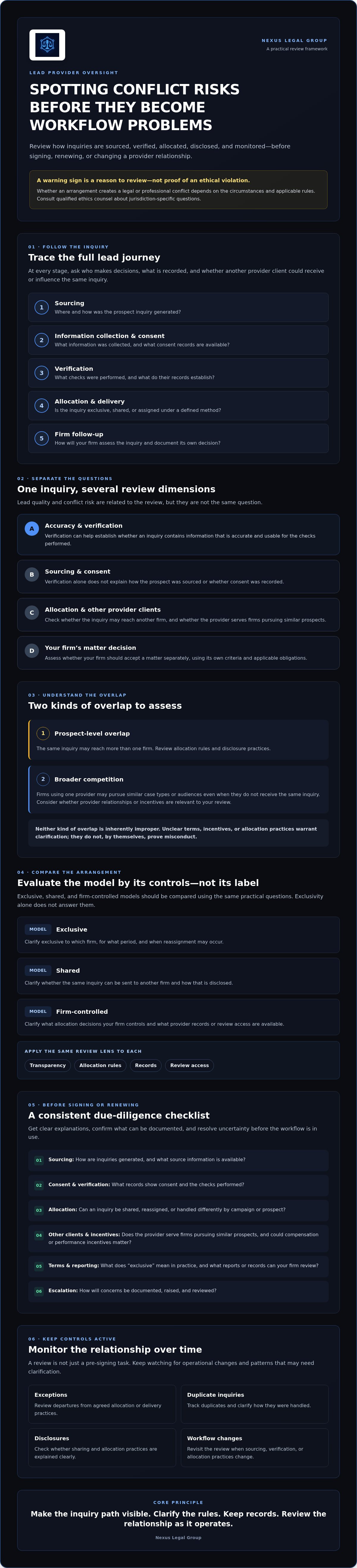
A lead’s path doesn’t end when someone submits an inquiry. Trace the process from campaign source and information collection through verification, allocation, delivery, and your firm’s follow-up. At each stage, ask who makes decisions, what information is recorded, and whether another provider client could receive or influence the same inquiry.
Assessing potential conflicts requires visibility into both the relationship terms and the workflows that put those terms into practice. A contract might describe leads as exclusive while leaving key details undefined: exclusive to which firm, for what period, and under what conditions could an inquiry be reassigned? Shared audiences or overlapping provider clients don’t automatically make a relationship improper. However, unclear answers can make it difficult to evaluate the arrangement.
Which sourcing and allocation questions should firms ask?
Before delivery begins, ask the provider to explain how inquiries are sourced, verified, allocated, and documented. Find out whether the same inquiry may be sent to another firm, whether allocation varies by campaign or prospect, and what records support the explanation. Ask what “exclusive” means in practice rather than relying on the label alone.
Ask whether the provider works with firms pursuing similar prospects, and whether those relationships could affect campaign priorities or allocation. Compensation structures and performance incentives may also be relevant, depending on the arrangement and applicable rules. The New York State Bar Association Ethics Opinion 1131 discusses issues involved in paying a for-profit service for client leads. Treat it as a reference point, not a substitute for advice from ethics counsel about your jurisdiction.
Where verification helps, and where it does not
Verification may clarify inquiry details, such as whether submitted information matches criteria the provider was asked to check. It doesn’t determine legal eligibility, case merit, or whether the inquiry was allocated as your firm expected. Ask what information supports verification, which steps the provider performs, and what your own intake and case-review process still needs to establish.
Keep the questions distinct: Is the information accurate? Is its source transparent? Was consent documented? How was the inquiry allocated? Does the matter meet your firm’s acceptance criteria? Automated intake can help organize parts of an inquiry review, but it doesn’t replace these separate assessments. Firms considering acquisition and verification options can review Nexus Legal Group’s stated offerings, then confirm provider-specific sourcing, allocation, and verification practices directly.
Compare Lead-Provider Models Without Assuming Exclusivity Solves Everything
Exclusive, shared, and firm-controlled acquisition describe different ways to generate and allocate inquiries. None guarantees quality. An exclusive label alone doesn’t establish how an inquiry was sourced, whether allocation is transparent, or whether the model fits your firm’s intake and review process. For avoiding conflicts of interest with lead providers, compare the practices and records behind the label.
What does exclusivity mean in practice?
Ask the provider to define “exclusive.” Does it apply to an individual inquiry, a campaign, a stated period, or another scope set out in the agreement? Clarify how allocation is documented and how duplicate or previously known prospects are handled. If the contract leaves these points open, request clarification rather than treating the gap as proof of misconduct.
| Review area | Exclusive model | Shared model | Firm-controlled model |
|---|---|---|---|
| Sourcing visibility | Depends on the provider’s disclosures and records. | Depends on the provider’s disclosures and records. | The firm should define what source information it can access. |
| Allocation clarity | Confirm the scope and any exceptions to exclusivity. | Clarify how inquiries may be distributed among firms. | Document the firm’s process for directing inquiries. |
| Verification | Ask what information is checked and recorded. | Ask what information is checked and recorded. | Define the firm’s own verification steps. |
| Documentation | Review allocation records and contract terms. | Review distribution records and contract terms. | Set internal documentation practices. |
| Review access | Confirm what reporting the provider makes available. | Confirm what reporting the provider makes available. | Assess whether internal systems support review. |
This table lists questions to investigate, not guaranteed features of any model. Ask what the provider documents and what your firm can review, then compare the answers with your requirements. For firm-controlled acquisition, assign responsibility for sourcing decisions, inquiry review, and recordkeeping so there is a clear internal process to assess.
Which provider model fits your firm’s operating needs?
Start with your firm’s capacity and existing processes. A firm with established intake workflows may prioritize predictable delivery and records that support internal monitoring. A firm that controls more of its acquisition process may want direct access to sourcing and allocation decisions. In either case, assess whether reporting can help your team identify exceptions and review activity over time. Don’t treat reporting as a promise of particular outcomes.
Use Nexus Legal Group’s lead-acquisition information as one reference point when evaluating available offerings, and verify specific sourcing, allocation, and reporting practices directly. Consult qualified ethics counsel about jurisdiction-specific questions concerning provider terms.
Use a Lead-Provider Due-Diligence Checklist Before Signing
A repeatable review turns broad assurances into questions your firm can answer before approving a provider. For avoiding conflicts of interest with lead providers, use the same documented process for each evaluation or renewal. Record unanswered questions as unresolved rather than treating them as settled.
- Define firm requirements. Identify the sourcing, verification, allocation, consent, reporting, and record-access information your team needs to assess the relationship.
- Request disclosures. Ask for plain-language explanations of lead origin, provider-client relationships, campaign arrangements, and any factors that may affect inquiry distribution.
- Inspect workflows. Trace information from collection through verification and allocation to delivery. Ask what records are created and which ones your firm can review.
- Review the terms. Compare the contract with the provider’s explanations about sourcing, use, access, allocation, and any stated exclusivity. Request clarification about terms that are undefined or inconsistent.
- Document approval. Record responses, unresolved questions, responsible reviewers, and any conditions attached to approval. Assign follow-up when a decision depends on information not yet provided.
Questions to ask during provider evaluation
Ask where inquiries originate, what verification steps occur, how distribution decisions are made, and what documentation is available. Clarify whether an inquiry may be shared, how duplicate or previously known prospects are handled, and whether other provider-client relationships could affect a campaign or allocation. Identify which answers should be reviewed by your firm’s ethics, privacy, or contracting advisers.
Make the assessment record specific. For each answer, note whether it is supported by a contract term, written explanation, or workflow description. “Leads are exclusive” may not be specific enough to evaluate without knowing the scope and exceptions.
How to review terms and escalate unresolved issues
Compare the written agreement with the provider’s explanation of its operations. If a sales statement describes an allocation practice but the contract is silent or uses broader language, flag the gap and request written clarification before relying on the statement in a procurement decision. Keep the response with your assessment record.
Record unresolved issues, who is responsible for reviewing them, and whether approval depends on resolution. Escalate jurisdiction-dependent or legal questions to qualified counsel. Don’t infer a universal rule from a provider’s general assurances. Documented diligence makes provider assumptions testable over time. It also gives your firm a baseline for later review if terms, disclosures, or workflows change.
Maintain Conflict Controls After Choosing a Lead Provider
Approval is the start of oversight, not the end. Assign an owner to maintain the provider record, review delivery and performance documentation, and route concerns to the appropriate decision-makers. A designated owner can help catch changes to provider workflows or your firm’s intake requirements. Ongoing review is central to avoiding conflicts of interest with lead providers.
Build a repeatable monitoring workflow
Set a review schedule that fits your firm’s policies and the nature of the relationship. At each review, compare delivered inquiry records with the provider’s agreed descriptions of sourcing, allocation, and verification. Check for allocation exceptions, duplicate inquiries, missing or unresolved disclosures, and changes to sourcing or delivery workflows. A discrepancy doesn’t prove misconduct, but it should have an owner and a documented path to resolution.
Maintain an issue log with the date, relevant evidence, accountable reviewer, and current status. Define a pause-and-review process for material changes, unexplained inconsistencies, or newly identified overlap. Depending on the issue, your firm may need to request clarification, assess whether its requirements are still met, or consult qualified counsel before deciding whether to continue under the existing arrangement.
Revisit the provider’s disclosures and your firm’s requirements when a contract or operating process changes. Keep current terms, written explanations, review notes, and approvals together. This makes it easier for the oversight owner to compare current practices with the information behind the original decision.
Evaluate a provider through transparent operating criteria
Assess whether the provider can explain its acquisition, verification, and delivery workflows in terms your team can review. A clear explanation helps your firm evaluate the process, but it doesn’t prove that every inquiry is exclusive or that every potential conflict has been resolved. Continue to assess specific practices and take jurisdiction-dependent ethics questions to qualified counsel.
Nexus Legal Group states that it offers high-intent MVA case acquisition and automated verification. Firms can compare those capabilities with their documented criteria, then verify specific sourcing, allocation, consent, and oversight practices directly. A provider’s general positioning should not be treated as a blanket conflict-free guarantee.
Make Provider Oversight Part of Your Growth Process
A sound lead-provider review doesn’t end when the contract is signed. Define what counts as a conflict indicator, examine sourcing and allocation practices, and compare provider explanations with written terms and delivered records. Exclusivity may clarify one part of an arrangement, but it doesn’t replace transparent workflows, documented approval, or ongoing review.
A structured approach to avoiding conflicts of interest with lead providers gives your firm a practical way to identify questions early, assign responsibility, and escalate unresolved concerns. Consult qualified ethics counsel about jurisdiction-specific professional conduct questions.
Nexus Legal Group describes its services as high-intent MVA case acquisition, with stated offerings that include automated verification and police-report- and emergency-services-generated inquiries. Evaluate those capabilities against your firm’s requirements and verify provider-specific practices as part of your diligence.
Set your criteria, document your review, and contact Nexus Legal Group to evaluate its high-intent MVA case-acquisition approach against your firm’s requirements.
Frequently Asked Questions
Is using the same lead provider as another law firm a conflict of interest?
Not automatically. The provider relationship alone doesn’t establish a conflict, but your firm should assess whether inquiries are shared, how allocation works, and what each party understands about the arrangement. Request written explanations of distribution and overlapping provider-client relationships, then document the answers and any remaining uncertainty. If the assessment depends on jurisdiction-specific requirements or facts about a particular matter, consult qualified ethics counsel.
Can an exclusive lead still create a conflict of interest?
Yes. Exclusivity doesn’t resolve every potential concern. Clarify what the term covers, such as an individual inquiry or campaign, and how long it applies. Ask how the provider handles duplicates, prior contacts, and overlapping campaigns, then compare the written terms with delivery practices. Treat exclusivity as one factor in your review, not proof that every incentive, sourcing practice, or allocation question has been addressed.
How can a law firm check whether a lead provider serves competing firms?
Ask the provider to explain relevant client relationships, campaign arrangements, and inquiry allocation practices in enough detail for your firm to assess them. Clarify what information can be disclosed and recorded, especially if confidentiality limits the response. Compare the information with your firm’s documented requirements and applicable professional guidance. If important uncertainty remains, consult qualified counsel before deciding whether the relationship is appropriate for your firm.
What should a law firm ask a lead provider before signing?
Ask how inquiries are sourced, verified, allocated, and documented; whether they may be delivered to another firm; and how any exclusivity terms are defined. Clarify relevant provider-client relationships, available review records, workflow-change notifications, and escalation procedures. Compare the answers with the proposed contract, document unresolved questions, and involve appropriate internal reviewers before approval. Don’t rely on broad assurances when specific operational details can be assessed.
What happens if a lead provider doesn’t disclose how leads are allocated?
Document what your firm requested, what the provider disclosed, and what remains unclear. Request clarification through the provider’s designated contact, then compare the response with contract language and available delivery records. Nondisclosure alone doesn’t establish misconduct or a legal violation. If your firm still can’t assess the arrangement, pause the evaluation or escalate it through your review process, and seek qualified counsel about jurisdiction-specific concerns.
Does automated lead verification eliminate conflicts of interest?
No. Automated verification may help assess inquiry details against defined operational criteria, but it doesn’t resolve overlapping provider-client relationships, allocation terms, incentives, or legal and ethical questions. Evaluate verification alongside sourcing transparency, documentation, contract terms, and ongoing oversight. Ask what the process checks, what records your firm can review, and which assessments remain your firm’s responsibility, including whether an inquiry meets its case-acceptance criteria.
How often should a law firm review its lead-provider relationship?
Choose a review cadence that reflects your firm’s oversight process and the nature of the arrangement. There’s no universal schedule for every provider. Reassess when contracts, sourcing, allocation, provider relationships, or delivery workflows change. Review documented terms and delivery records for exceptions and unresolved questions rather than relying only on initial assurances. Follow your firm’s policies and consult qualified counsel when the review raises jurisdiction-specific concerns.