High-Volume Case Acquisition: How Plaintiff Firms Scale Without Losing Quality
Master high volume case acquisition without sacrificing quality. Learn how plaintiff firms streamline intake, verify leads, and scale case growth effectively.
What if acquiring more cases depends less on generating inquiries and more on what happens between first contact and a signed case? High volume case acquisition can support growth, but raw lead counts don’t show whether inquiries are qualified, verified, or manageable for your intake team. When volume fluctuates or follow-up slows, opportunity and capacity can quickly fall out of sync.
Increasing acquisition volume without weakening case quality requires a repeatable process, not just a larger flow of leads. This article explains how to align sourcing, verification, and intake capacity so your firm can see what each stage is producing. You’ll learn how to distinguish inquiries from qualified opportunities and signed cases, and why each measure matters for forecasting and staffing.
We’ll also cover practical ways to assess an acquisition partner, including how to evaluate inquiry quality, verification processes, follow-up readiness, and outcomes alongside volume. The goal is a scalable acquisition model that gives your team useful signals for decision-making, rather than a headline lead count that obscures performance.
Key Takeaways
- Build high volume case acquisition around a repeatable flow, and define what separates an inquiry from a qualified opportunity and a signed case.
- Map the path from sourcing through verification and firm intake, confirming which steps apply to each acquisition program.
- Compare acquisition models by sourcing transparency, qualification criteria, exclusivity, and delivery format.
- Scale through a measured pilot: establish a baseline, match volume to intake capacity, then review dispositions and outcomes before adjusting.
- Assess how an acquisition partner’s capabilities, such as MVA sourcing and automated verification, fit your firm’s workflow and desired deliverables.
What High Volume Case Acquisition Means for a Plaintiff Firm
High volume case acquisition is a repeatable flow of relevant inquiries that a firm can assess and handle through a defined intake process. It isn’t simply a large inquiry count. Volume matters when it aligns with the firm’s practice focus, qualification criteria, and capacity to follow up and evaluate potential cases.
Acquisition volume measures how many inquiries enter the process; case quality depends on what those inquiries become after screening and review. This distinction gives firm leaders a more useful basis for planning than a raw lead total, which can conceal whether inquiries fit the practice or progress through intake.
How to distinguish volume from acquisition performance
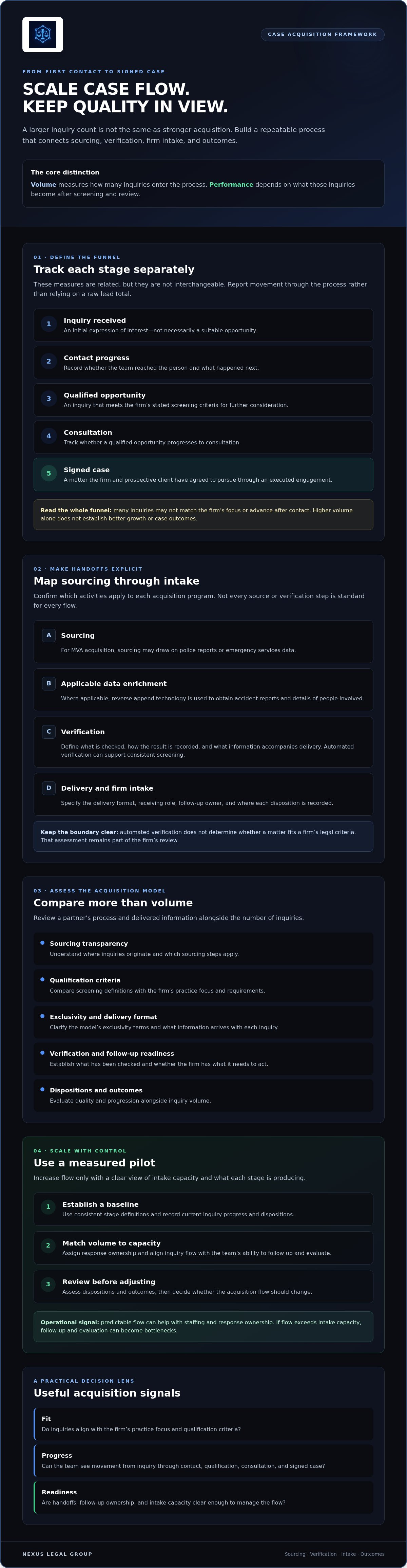
Use consistent funnel stages and report each separately. A raw inquiry is an initial expression of interest, not necessarily a suitable opportunity. A qualified opportunity meets the firm’s stated screening criteria for further consideration. A signed case is a matter the firm and prospective client have agreed to pursue through an executed engagement. These stages aren’t interchangeable.
Track movement between stages: inquiries received, contact progress, qualification, consultations, and signed cases. For example, a firm may receive many inquiries but find that relatively few match its focus or advance after contact. Without stage-by-stage reporting, that distinction disappears. Higher volume alone doesn’t establish better growth or case outcomes. The firm needs to assess fit and progress against its own objectives.
Why plaintiff firms pursue scalable case flow
A predictable flow can help a firm plan staffing, assign response ownership, and manage intake capacity. When inquiry levels are inconsistent, teams may struggle to forecast workload. When flow exceeds what the intake operation can handle, follow-up and evaluation can become bottlenecks. Scalable acquisition means matching the flow to operational readiness, not maximizing volume without regard to what happens next.
The right level depends on practice focus and process design. A firm evaluating matters connected to a class action lawsuit, for instance, should distinguish the broader procedural context from the individual inquiries its team must assess. Acquisition processes and qualification criteria should reflect the firm’s actual work, rather than assume every inquiry represents the same kind of opportunity.
Before increasing volume, clarify who owns each intake stage, what information is needed to assess an inquiry, and how the team records its disposition. This makes it easier to identify capacity constraints and determine whether additional flow is useful. For a broader view of how technology can support connected acquisition workflows, explore AI-driven legal case acquisition.
How a High Volume Acquisition System Moves from Sourcing to Intake
A reliable workflow makes each handoff explicit, from the way an inquiry is sourced to the point when the firm receives and reviews it. Between an MVA inquiry and firm intake, the process may include sourcing, applicable data enrichment, verification, delivery, and firm-owned review. The exact steps vary by program, so confirm which sources and verification activities apply before treating them as standard.
Where sourcing and verification fit in the workflow
For MVA acquisition, sourcing may draw on police reports or emergency services data. Where applicable, reverse append technology is used to obtain accident reports and details of people involved. These are distinct sourcing or information-gathering methods, not steps that should be assumed to apply to every program.
Next, establish what verification means for the specific flow: what is checked, how the result is recorded, and what information accompanies delivery. Automated verification can support consistent screening, but it doesn’t determine whether a matter fits a firm’s legal criteria. That assessment remains part of the firm’s review. A clear scope prevents an inquiry from being mistaken for a fully assessed case.
How intake teams receive and work inquiries
Before delivery begins, decide which team or role receives inquiries, who owns follow-up, and where each disposition is recorded. If those responsibilities are unclear, an inquiry can sit between the provider’s delivery process and the firm’s intake queue without a clear next step. Define the handoff and the information needed to act on it.
For example, the receiving team might record whether an inquiry was reached, whether it met the firm’s screening criteria, and whether it moved to consultation or another disposition. Use the firm’s own stages and definitions, then review them consistently. This creates a feedback loop: intake can identify recurring gaps, while acquisition partners can understand how delivered inquiries are being evaluated. Plaintiff firm teams are part of a professional community represented by the American Association for Justice.
For a deeper look at workflow design, see automated intake for plaintiff firms. Firms assessing how acquisition sourcing and automated verification may fit their process can also explore Nexus Legal Group.
How to Compare High Volume Case Acquisition Models
Compare acquisition models by how clearly they define what is sourced, screened, delivered, and reported. A high volume case acquisition model should be evaluated against your firm’s workflow, not just the volume it promises. Use the same questions for each provider so differences in terminology don’t obscure what your team will actually receive.
| Evaluation area | Questions to ask | Why it matters |
|---|---|---|
| Sourcing transparency | Which sources inform the inquiry? What supporting details accompany delivery? | Clarifies the information available for your team’s initial review. |
| Qualification | How are “verified” and “qualified” defined? Which checks are completed, and by whom? | Prevents different screening stages from being treated as equivalent. |
| Exclusivity | Does exclusivity apply to the inquiry, the case, or another defined scope? | Makes the meaning and limits of an exclusivity claim clear. |
| Delivery and reporting | What fields are provided, how is delivery organized, and what follow-up is expected from the firm? | Shows whether the handoff fits your intake process and reporting needs. |
What to ask about sourcing, qualification, and exclusivity
Ask for precise definitions rather than relying on labels. “Verified” might refer to a specific check, while “qualified” should identify the criteria an inquiry has met. Likewise, confirm what “signed” means in the provider’s reporting and what documentation or status indicates that a case has been signed. For MVA inquiries, ask whether police reports, emergency services data, or other sources inform the program, and which details are included with delivery. Available steps can differ by program.
Exclusivity also needs a defined scope. Ask whether it applies to a particular inquiry or to a signed case, and how that status is communicated. For additional quality considerations, see verified MVA leads for law firms.
Which delivery model fits the firm’s intake operation
Qualified inquiries and signed cases are different deliverables. With inquiry delivery, the firm evaluates the opportunity through its own intake and review process. Signed-case delivery represents a later stage, but it shouldn’t be treated as interchangeable with an inquiry or as a guarantee of any particular case outcome.
Before choosing, compare available reporting fields, delivery cadence, and follow-up responsibilities with your team’s staffing and practice focus. A model may provide useful sourcing detail yet still create friction if the firm can’t act on the information in its preferred workflow. Confirm how each status is recorded, who owns the next step, and whether the expected flow fits available intake capacity.
How to Scale Case Volume Without Overloading Intake
Scaling case volume should be a controlled operating change, not an open-ended increase in inquiries. For high volume case acquisition to remain manageable, the firm needs a clear view of current intake performance, available capacity, and how new inquiries move through its process. Use the firm’s own data to set operating limits rather than adopting a generic benchmark.
Set an intake capacity baseline before increasing volume
Map who receives, reviews, contacts, and records the disposition of each inquiry. Then examine where work accumulates: unassigned inquiries, delayed contact attempts, pending reviews, or follow-up with no clear owner. These patterns help reveal whether the constraint is staffing, workflow, or the mix of inquiries arriving.
Use existing records to establish a baseline and decide how often the team will review performance. A practical scale-up sequence is:
- Establish the baseline: Document current inquiry flow, contact progress, qualification, and signed-case outcomes.
- Define capacity: Identify who owns each step and what volume the team can process while maintaining its normal review and follow-up practices.
- Pilot a bounded flow: Introduce a limited increase that the team can track and manage.
- Review and adjust: Compare results with the baseline, then maintain, modify, or pause the flow based on operational capacity and qualification patterns.
Set review intervals and operating limits based on your team’s actual workload and historical data. The objective isn’t to hit an outside threshold; it’s to identify a flow the firm can consistently handle.
Use feedback loops to refine acquisition quality
Track inquiry disposition, contact progress, qualification, and signed-case outcomes using consistent definitions. Record why inquiries don’t progress, such as inability to make contact, a mismatch with the firm’s practice focus, or another reason established in the firm’s own intake process. These records help separate acquisition-source performance from intake execution. A gap in qualification may point to sourcing alignment, while stalled contact progress may indicate an ownership or capacity issue.
Share structured disposition feedback with the acquisition partner for review. Avoid conclusions based on raw totals alone: assess whether inquiries fit the agreed criteria and whether the intake team had a fair opportunity to work them. Related discussion of behavior and enrichment appears in high-conversion MVA lead trends.
Increase or adjust volume only after reviewing operational readiness and qualification patterns. If the team is struggling to complete its existing workflow, adding inquiries may compound the bottleneck. If capacity is available and the inquiry mix aligns with the firm’s focus, evaluate a measured adjustment against the same baseline.
How Nexus Legal Group Supports High Intent Case Acquisition
Once a firm has defined its intake stages, capacity, and evaluation criteria, it can assess whether an acquisition partner’s capabilities fit its operating model. Nexus Legal Group provides acquisition infrastructure for plaintiff firms, including high-intent MVA case acquisition, automated verification, and delivery of qualified inquiries or signed cases. These are distinct delivery outcomes, so firms should identify which they’re evaluating before comparing program performance.
What Nexus brings to an MVA acquisition program
MVA sourcing may use police reports or emergency services data. Reverse append technology is used to obtain accident reports and details of people involved. Which sourcing and verification steps apply depends on the specific program, so firms should confirm the scope rather than assume every capability is used in every acquisition flow.
Automated verification is part of the acquisition offering. It can support a defined process, but it doesn’t replace the firm’s own assessment of whether an inquiry fits its criteria. Nexus can provide qualified inquiries or signed cases. One represents an opportunity for firm review, while the other reflects a later point in the acquisition process. They should be measured separately.
What firms should clarify before evaluating fit
Assess the program against your firm’s practice focus, intake resources, and desired delivery. Before setting scope, clarify:
- Sourcing and verification: Which sources and checks apply to the specific program, and what information accompanies delivery?
- Qualification and exclusivity: How are these terms defined, and what does exclusivity apply to?
- Delivery and workflow: Are you evaluating qualified inquiries or signed cases, and who owns each next step after delivery?
- Measurement: Which intake stages and outcomes will your team track to assess fit?
Then compare the proposed flow with the capacity your team has established. A program may align with a firm’s practice focus but still require adjustments if intake resources cannot manage the expected handoffs. Define success measures in advance, using your firm’s own baseline, and review results by stage rather than relying on inquiry volume alone. This makes the acquisition scope easier to assess and refine without assuming a particular conversion rate or case outcome.
Build a Case Acquisition Process Your Team Can Sustain
Effective high volume case acquisition depends on a clear path from inquiry to outcome, not on inquiry count alone. Separate qualified inquiries from signed cases, define ownership at each intake stage, and use your firm’s own data to decide when capacity can support a measured increase.
When evaluating an acquisition program, confirm its sourcing, verification, delivery, and exclusivity details, then assess how each fits your practice focus and intake resources. Nexus Legal Group’s capabilities include MVA sourcing that may incorporate police reports and emergency services data, automated verification, and delivery of qualified inquiries or signed cases. Confirm which steps apply to the specific program, and evaluate each delivery type on its own terms.
A disciplined process gives your team a stronger basis for growth decisions. Start with the workflow you can manage, track meaningful outcomes, and adjust as your operational picture becomes clearer.
With clear definitions and intentional capacity planning, your firm can pursue growth while keeping quality and intake readiness in view.
Frequently Asked Questions
What does high volume case acquisition mean for a law firm?
High volume case acquisition means creating a repeatable flow of relevant inquiries that the firm can assess and manage, not simply receiving a large number of leads. The process should distinguish initial inquiries from qualified opportunities and signed cases. For a plaintiff firm, useful volume depends on practice focus, screening criteria, and intake capacity. Tracking progress through each stage helps leaders assess whether acquisition supports the firm’s objectives.
How can a law firm increase case volume without overwhelming intake?
Increase volume in stages, using the firm’s current intake data as a baseline. First map who receives, reviews, contacts, and records each inquiry. Identify workload constraints and clarify response ownership, then test a bounded increase that the team can manage. Review contact progress, qualification, dispositions, and signed-case outcomes before adjusting. This approach helps distinguish a sourcing issue from an intake bottleneck without relying on generic volume thresholds.
How do firms measure the quality of high volume case acquisition?
Measure quality by tracking what happens after an inquiry arrives, not by counting inquiries alone. Use consistent stages for contact progress, qualification, consultation where applicable, and signed-case outcomes. Record why inquiries do or don’t advance, using criteria relevant to the firm’s practice. Review source performance separately from intake execution so that a mismatch in inquiry fit isn’t confused with a delay or gap in the firm’s follow-up process.
Are exclusive legal inquiries better than shared leads?
Not automatically. Exclusivity can matter to a firm’s evaluation, but the term needs a clear scope: ask whether it applies to an inquiry, a case, or another defined deliverable, and how that status is reported. Then compare the model with your intake workflow, practice focus, and capacity. Also examine sourcing transparency, qualification definitions, and delivery details. These criteria provide a more useful basis for assessment than exclusivity alone.
What is the difference between a qualified inquiry and a signed case?
A qualified inquiry has met stated screening criteria for further consideration, while a signed case is at a later stage, after the firm and prospective client have agreed to proceed through an engagement. They represent different points in the acquisition process and shouldn’t be treated as interchangeable deliverables. Ask the provider to define each term, explain what verification involves, and specify how the status is documented in reporting.
Can police reports and emergency services data support MVA case acquisition?
Yes. Police reports and emergency services data can inform motor vehicle accident inquiry sourcing, depending on the acquisition program. Reverse append technology may also be used to obtain accident reports and details of people involved. These capabilities shouldn’t be assumed to apply in the same way across every program. Before evaluating fit, ask which sources are used, what details accompany delivery, and which verification steps are included.
What should a law firm ask a high volume case acquisition provider?
Ask how the provider defines verified, qualified, exclusive, and signed; which sources inform inquiries; what details and reporting fields are delivered; and who owns follow-up after handoff. Confirm whether you’ll receive qualified inquiries or signed cases, and clarify program-specific sourcing, verification, and exclusivity. Finally, compare the proposed flow with your practice focus and intake capacity, then set success measures using your firm’s own baseline.