Using Police Reports for Case Acquisition: The 2026 Strategic Framework
Master using police reports for case acquisition with our 2026 framework. Lower your CPA and build a litigation-ready pipeline before your competition.
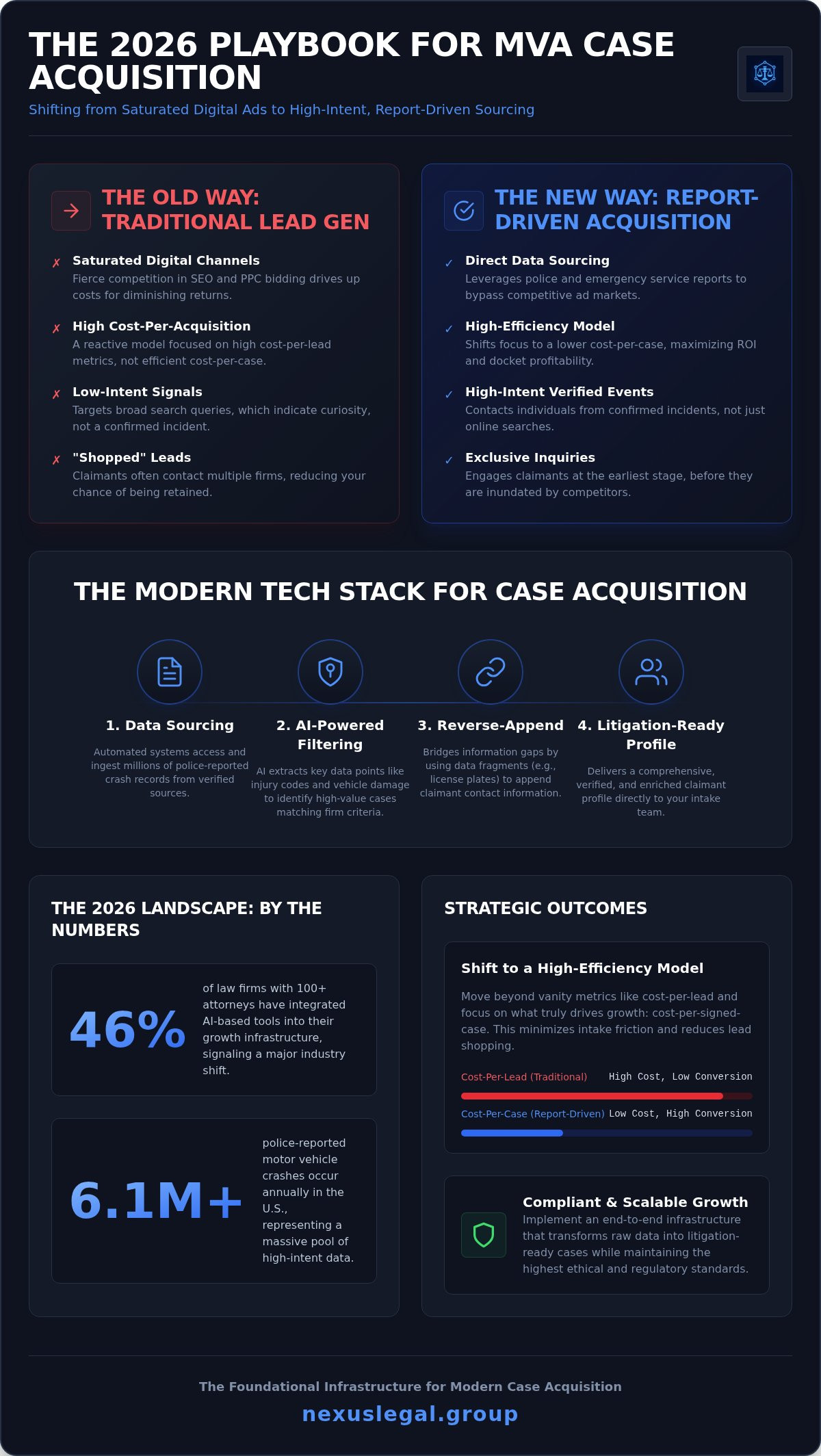
In 2026, 46% of law firms with 100 or more attorneys have already integrated AI-based tools into their growth infrastructure, yet many practices still find themselves trapped in a cycle of high cost-per-acquisition on traditional digital channels. You likely recognize that the efficiency of standard lead generation is declining as competition for high-intent MVA cases intensifies. Shifting your strategy toward using police reports for case acquisition offers a way to eliminate this friction by sourcing data directly from the point of incident. This method provides a level of certainty that digital bidding simply cannot match, positioning your firm as a foundational leader in a crowded market.
Securing a scalable pipeline requires more than just raw data; it demands a system that handles compliance and verification with clinical precision. We will teach you how elite plaintiff firms leverage automated police report data and reverse-append technology to identify high-intent participants before they are lost to the broader market. This article explores the 2026 strategic framework for building a litigation-ready pipeline through automated intake and sophisticated data integration. You'll discover how to lower your operational overhead while maintaining the highest ethical standards in your outreach efforts, ensuring your firm remains both profitable and compliant.
Key Takeaways
- Understand the transition from saturated digital marketing channels toward high-precision, report-driven data sourcing to bypass hyper-competitive 2026 bidding environments.
- Master the technical process of using police reports for case acquisition by leveraging automated data extraction and AI-driven enrichment for immediate claimant identification.
- Discover how reverse-append technology bridges critical information gaps, allowing your firm to build comprehensive, high-intent profiles from raw incident data.
- Analyze the shift from traditional cost-per-lead metrics to a high-efficiency cost-per-case model that minimizes intake friction and reduces claimant lead shopping.
- Learn the essential steps for implementing a compliant, end-to-end growth infrastructure that transforms emergency services data into litigation-ready inquiries.
The Evolution of MVA Case Acquisition: From Broad Marketing to Report-Driven Precision
The legal market in 2026 has reached a saturation point where traditional digital marketing often yields diminishing returns. Relying on search engine optimization and pay-per-click bidding creates a volatile environment where firms compete for the same generic inquiries. This reactive model forces you to wait for a potential claimant to realize they need help, search for a term, and click your ad. By contrast, using police reports for case acquisition allows your firm to transition into a proactive, data-informed strategy. This approach defines report-driven acquisition as the strategic utilization of verified accident data to identify and engage claimants at the earliest possible stage of their legal journey.
Police reports represent the highest tier of intent because they confirm a physical event has occurred. While a Google search for "car accident lawyer" might indicate curiosity, a police report confirms an actual collision with documented damages or injuries. This shift from broad marketing to report-driven precision moves your firm away from the "noise" of the open market and into a specialized lane of verified opportunities. It’s about moving from a wide net to a surgical strike.
The Role of High-Intent Data in 2026
There's a critical gap between being an accident victim and becoming a litigation-ready claimant. With the National Highway Traffic Safety Administration reporting over 6.14 million police-reported crashes annually, the volume of raw data is massive. However, not every incident justifies a high-value MVA case. High-intent data filters this volume by focusing on specific markers found within the report, such as vehicle damage severity or injury codes. This precision is the hallmark of an institutional-grade law firm growth infrastructure. By focusing only on incidents that meet your firm's specific criteria, you eliminate the wasted time and overhead associated with vetting unqualified leads from general social media campaigns.
Why Raw Data Outperforms General Lead Generation
Conversion rates for report-generated leads consistently outperform general inquiries because the outreach is grounded in fact. When you use data derived from a traffic collision reconstruction or a standard police narrative, you're contacting someone who has just experienced a documented trauma. Immediate identification is vital; the window for securing a high-intent case is narrow. General lead generation often produces "shopped" leads where the claimant has already spoken to multiple firms. Sourcing data directly from police and emergency services ensures you're engaging with individuals before they've been inundated by generic advertising. It’s a faster, cleaner, and more efficient way to build a high-performing MVA docket.
The Mechanics of Report-Based Acquisition: Reverse Append and AI Enrichment
In 2026, manual data entry is an operational liability that elite firms can no longer afford. The transition from a physical police report to a signed case requires a sophisticated technological pipeline that digitizes, enriches, and vets data in real time. When using police reports for case acquisition, the raw document is merely the starting point. The true value lies in the ability to extract fragmented data points, such as vehicle identification numbers or incident timestamps, and transform them into a comprehensive claimant profile through automated systems. This process eliminates the friction of traditional intake by ensuring that every inquiry hitting your desk is already verified and enriched with actionable details.
Reverse-Append Technology Explained
Reverse-append technology acts as the bridge between raw incident data and actionable claimant contact info. Often, an initial police record or emergency services log contains limited identifiers, such as a license plate number or a partial name. High-performance systems use these fragments to query authoritative databases, appending missing contact information, residential history, and insurance details. This multi-source verification ensures that your firm isn't just chasing names, but is connecting with the correct individuals involved in the incident. By maintaining strict adherence to the Driver's Privacy Protection Act (DPPA), this technology allows for the ethical and legal acquisition of data necessary for professional outreach.
AI-Driven Data Enrichment and Vetting
Once the contact profile is complete, the system must determine if the case meets your firm's specific litigation criteria. This is where AI driven legal case acquisition becomes a force multiplier. Machine learning algorithms analyze the narrative of the report to assess accident severity, medical transport status, and potential liability factors. For example, the AI can cross-reference vehicle damage descriptions with historical settlement patterns to predict case value before a human ever reviews the file. This automated vetting ensures your intake team only spends time on high-impact inquiries, significantly lowering your overhead.
By integrating these technical layers, your firm moves away from the uncertainty of general lead generation and toward a model of clinical precision. You're no longer just buying leads; you're engineering a consistent flow of litigation-ready opportunities. If you're ready to modernize your intake, exploring a dedicated case acquisition infrastructure is the next logical step in your firm's expansion. This technical mastery doesn't just improve your workflow; it secures your position at the top of the market by ensuring you reach the highest-intent claimants first.
Traditional Lead Gen vs. High-Intent Report Acquisition
The financial architecture of a modern plaintiff practice depends on the distinction between cost-per-lead and cost-per-case. In 2026, the national average for exclusive MVA leads has reached a range of $200 to $500, with high-demand states often exceeding $550. While these figures represent the entry price for digital inquiries, they don't account for the high attrition rates common in traditional lead generation. Using police reports for case acquisition fundamentally alters this math by shifting the focus toward litigation-ready data. Instead of bidding on broad keywords, your firm secures inquiries backed by verified incident reports, which significantly lowers the ultimate cost of a signed retainer.
Operational efficiency is the primary driver of this shift. Traditional digital leads often require extensive manual vetting to determine if a caller was actually involved in a collision or if they have already retained counsel. By contrast, report-driven data arrives with these variables pre-verified. This automation reduces the burden on your intake team, allowing them to focus on high-intent inquiries rather than filtering through unqualified noise. Scalability becomes a matter of data volume rather than increasing headcount, providing a more stable foundation for long-term growth.
The Problem with Shared Lead Models
Shared lead models create a "race to contact" that frequently erodes profit margins. When multiple firms receive the same inquiry, the claimant is often subjected to "lead shopping," where they compare firms based on speed rather than expertise. This environment results in lower retention rates and increased frustration for your intake staff. Transitioning to verified MVA leads for law firms ensures exclusivity. Because the data is sourced directly from police and emergency services, you are engaging with claimants based on a documented event rather than a shared digital footprint. This exclusivity secures the inquiry and establishes a professional connection before the claimant is overwhelmed by competing advertisements.
Operational Metrics and ROI
Calculating the "True Cost" of a signed case requires looking beyond the initial acquisition fee. You must factor in the time your staff spends on intake, the cost of manual verification, and the duration of the sales cycle. Data enrichment shortens the time from the initial accident to a signed retainer by providing all necessary participant details upfront. A clinical framework for evaluating acquisition partners should prioritize the conversion rate from inquiry to signed case. When your growth infrastructure is built on enriched report data, the path to a positive ROI is clearer, more predictable, and less dependent on the volatile fluctuations of the 2026 digital ad market.
Strategic Implementation: Building a Compliant Acquisition Pipeline
Implementing a systematic framework for using police reports for case acquisition requires a shift from sporadic lead buying to a disciplined, five-stage operational pipeline. Success in 2026 isn't defined by the volume of raw data you collect; it's defined by the precision of the infrastructure used to process it. By treating data acquisition as a foundational business process, your firm can bypass the inefficiencies of traditional marketing and secure a consistent flow of high-intent inquiries.
- Source Identification: Secure reliable access to high-quality data streams from police departments and emergency services to ensure your pipeline begins with verified incident logs.
- Profile Enrichment: Integrate reverse-append technology to transform fragmented identifiers, such as license plates or partial names, into comprehensive claimant profiles with verified contact details.
- Automated Vetting: Deploy AI-driven verification layers to assess liability markers and injury severity, ensuring every inquiry aligns with your firm's specific litigation criteria.
- Ethical Outreach: Align your communication strategy with current state bar regulations, focusing on professional transparency and the ethical handling of public record data.
- Intake Conversion: Utilize a high-performance intake system designed to handle high-intent inquiries with immediate, clinical precision to secure the signed retainer.
Compliance and Ethical Standards in 2026
The regulatory environment for plaintiff firms has evolved significantly, making it essential to distinguish between prohibited solicitation and legitimate educational outreach. Transparency regarding data sourcing is no longer optional; it's a foundational requirement for maintaining institutional integrity. Firms must ensure their acquisition strategies respect data privacy while providing clear value to the claimant. Adopting a framework for compliant legal lead generation protects your firm from regulatory scrutiny while building trust with potential clients from the first point of contact. This involves clear disclosures and a focus on providing assistance to those with a documented legal need.
Automated Intake and Verification
High-performance firms rely on AI to manage the initial vetting process without human intervention, allowing staff to focus exclusively on litigation-ready files. These systems analyze incident narratives and medical transport data to predict case viability with remarkable accuracy, often identifying high-value cases within 24 to 72 hours of an incident. Automated verification is an absolute necessity for high-volume firms seeking to eliminate the overhead of manual intake while maintaining a premium docket quality. This technical mastery ensures that your attorneys only review cases that have already passed through multiple layers of rigorous, data-driven scrutiny.
Nexus Legal Group: The Foundational Infrastructure for Case Acquisition
Nexus Legal Group doesn't just provide a peripheral tool; we engineer the foundational layer for high-performance plaintiff firms. By integrating the sophisticated technical processes of data extraction and enrichment into a unified system, we transform raw incident data into a reliable revenue engine. Using police reports for case acquisition is the core of this infrastructure, ensuring that your practice remains insulated from the volatility of traditional digital marketing. We focus on the clinical mechanics of business expansion, allowing your attorneys to focus on the legal mastery required to resolve high-value cases.
In a landscape where 39% of law firms reported a data breach within the last year, our commitment to systemic integrity and data security is paramount. We provide a secure, institutional-grade environment that handles sensitive information with absolute precision. This level of technical mastery ensures that your firm isn't just growing, but is doing so on a stable, compliant, and highly efficient platform designed for the rigors of the 2026 legal market.
Engineering Scalability for Elite Firms
The CaseFlow infrastructure is specifically designed to eliminate the operational friction that typically slows down firm growth. We manage the heavy lifting of data sourcing from police and emergency services, providing a seamless transition from the initial incident to the final intake. Our systems are built to handle massive data volumes without sacrificing the surgical precision required for each individual inquiry. This level of automation is what allows elite firms to maintain a dominant position in the 2026 market, where AI adoption among lawyers has already surged to 30%. By automating the vetting process, we ensure that your team's energy is spent only on inquiries that meet your exact litigation criteria.
The Nexus Advantage: Beyond Lead Generation
Most providers stop at delivering a name and a phone number, but Nexus Legal Group moves beyond this by focusing on police report generated MVA leads that have already undergone rigorous verification. Our technical mastery in reverse-append technology ensures that every inquiry is enriched with detailed participant data and accident narratives. This allows your intake team to move straight to a signed retainer with the confidence that the case is litigation-ready. We don't just deliver leads; we deliver the data-driven certainty required to build a premium docket.
Dominance in the 2026 personal injury market requires a move away from reactive, broad-based acquisition models. By adopting a framework built on clinical data precision and automated verification, you position your firm as an institutional leader. Nexus Legal Group provides the high-intent MVA case acquisition infrastructure needed to scale with confidence, ensuring your practice is always powered by the highest-quality data available.
Engineering the Future of Plaintiff Firm Growth
Adopting a report-driven strategy is the foundational requirement for firms seeking to dominate the 2026 MVA market. You've seen how shifting from broad digital bidding to using police reports for case acquisition allows your practice to bypass hyper-competitive environments. By integrating AI-driven automated verification and reverse-append technology, you transform raw incident data into a streamlined, litigation-ready pipeline. This technical mastery doesn't just lower your overhead; it secures your firm's position as an institutional leader. Our elite growth infrastructure provides the national reach and precision needed to scale with absolute confidence.
Success requires a focus on clinical precision during the intake process and a commitment to ethical standards. When your practice is powered by verified emergency services data, you eliminate the noise of unqualified leads and focus exclusively on high-intent inquiries. It's time to move beyond the limitations of traditional lead generation and embrace a system built for high-performance results. We look forward to seeing your firm achieve its next level of expansion.
Frequently Asked Questions
Is using police reports for case acquisition legal and ethical?
Sourcing data from public records is a standard legal practice when conducted within the boundaries of federal and state regulations. In 2026, using police reports for case acquisition remains legal as long as firms adhere to the Driver's Privacy Protection Act (DPPA) and specific state bar advertising rules. Nexus Legal Group ensures all data acquisition meets these rigorous ethical standards, providing a compliant foundation for professional outreach that respects privacy while serving individuals with documented legal needs.
What is reverse-append technology in the context of legal leads?
Reverse-append technology is the technical process of using fragmented incident identifiers to query authoritative databases and retrieve comprehensive participant profiles. In the legal sector, this involves taking a license plate number or an incident ID from a police report and appending missing contact information, residential addresses, and insurance details. This system ensures that firms have the necessary data to initiate professional communication with verified accident participants without the friction of manual data searching or unverified inquiries.
How does report-based acquisition differ from traditional PPC leads?
Report-based acquisition relies on documented physical events rather than digital search intent. Unlike traditional PPC leads, which involve bidding on keywords and waiting for a user to click an ad, report-driven data confirms that a collision has actually occurred. This methodology provides a higher tier of intent and exclusivity. It bypasses the hyper-competitive 2026 bidding market, delivering litigation-ready inquiries that haven't been subjected to the "lead shopping" common in shared digital models.
Can police report data help identify mass tort claimants?
Police and emergency services data can be a vital catalyst for identifying potential mass tort claimants. While often associated with individual MVA cases, large-scale incidents documented in public records can reveal patterns of liability involving specific manufacturers, commercial fleets, or environmental hazards. Nexus Legal Group utilizes this data to help elite firms source qualified inquiries for mass tort litigation, providing the technical infrastructure needed to verify incident participation across broad geographic areas with clinical precision.
What information is typically included in an enriched accident report lead?
An enriched accident report lead typically includes a comprehensive dataset that goes beyond the basic police narrative. You can expect to receive verified participant names, residential addresses, and phone numbers, alongside critical incident details like vehicle damage severity and medical transport status. Advanced enrichment also incorporates AI-driven assessments of liability and injury codes. This level of detail allows your intake team to prioritize high-value cases with absolute certainty before the first phone call is even made.
How quickly can a firm contact a claimant after an accident using this data?
High-performance systems can identify and verify potential claimants within 24 to 72 hours of an incident. Speed is essential in the 2026 legal landscape, as the window for securing high-intent cases is narrow. By automating the extraction and enrichment of police report data, firms can initiate outreach while the event is still fresh. This rapid response time, powered by automated verification, ensures your firm reaches the claimant before they are lost to the general digital marketing funnel.
Does Nexus Legal Group provide raw data or signed cases?
Nexus Legal Group provides a comprehensive growth infrastructure that delivers both qualified inquiries and signed cases. We don't just sell raw data; we provide litigation-ready opportunities that have passed through multiple layers of AI-driven verification. Our platform is designed to handle the entire acquisition pipeline, from sourcing accident reports to delivering a signed retainer. This end-to-end service allows elite firms to scale their practices without the overhead of manual intake or unverified lead generation.
What are the compliance requirements for using incident data in 2026?
Compliance in 2026 requires strict adherence to the DPPA, the TCPA, and evolving state bar regulations regarding attorney advertising. For instance, several states have recently updated rules to require clear disclosures on how a lawyer became aware of a person's legal need. Firms must maintain rigorous data privacy standards and ensure all outreach is labeled correctly as advertising material where required. Using police reports for case acquisition demands a technically precise system that automatically integrates these regulatory safeguards into every inquiry.