RTCAT™: Compliant Crash Data Case Acquisition
Explore RTCAT™ Critical Crash Intelligence + Compliance-Forward Client Acquisition to refine law firm intake, crash data compliance, and operational growth.
Crash case acquisition is only as dependable as the process behind it. RTCAT™ Critical Crash Intelligence + Compliance-Forward Client Acquisition emphasizes advertising review, adherence to standard operating procedures, and a stronger compliance culture, connecting growth activity with disciplined operations.
For plaintiff law firms, acquiring more inquiries is only one consideration. How advertising is reviewed and intake procedures are followed also affects how consistently potential cases move through the acquisition process.
This article explains how RTCAT™ relates to that work, what advertising review and SOP adherence contribute, and how a compliance-forward approach can support case acquisition. It also shows how crash intelligence and structured processes fit together, helping you assess the approach against your firm’s operational priorities.
Key Takeaways
- Understand what the RTCAT™ name refers to and how advertising review and SOP adherence fit into a compliance-forward acquisition process.
- Learn which criteria can help structure the identification and qualification of potential crash-injury clients.
- Assess crash-data sources by considering their relevance, accuracy, and timeliness rather than treating every record as equally useful.
- Compare acquisition approaches by looking at how data, verification, and operational processes work together.
- Explore how police report generated MVA leads, emergency services generated MVA leads, and automated verification can support case acquisition.
Who developed RTCAT™ and what does the trademark refer to?
The information presented here does not identify who developed RTCAT™. The name in the title alone cannot establish its creator, what its letters mean, or whether it refers to a method, organization, or service. Naming a person or company without supporting evidence would turn an inference into a claim of fact.
The ™ symbol beside RTCAT does not explain the name or identify its creator. These are separate questions: attribution requires a source naming the developer, while interpretation requires a source defining the term. Capitalization, the symbol, and the article title cannot settle either question.
Reliable attribution begins with a primary source that directly names RTCAT’s developer. For example, a company description might state, “Developed by [named entity],” and identify the work associated with the name. A third-party mention that repeats RTCAT without tracing its origin does not establish who developed it.
Look next for an explicit definition of the letters. An acronym’s spelling may suggest possible expansions, but a suggestion is not evidence. A source should spell out the full name and link that definition to RTCAT. Without that connection, expanding the initials risks assigning a meaning the creator did not intend.
Distinguish the developer from other parties named in connection with RTCAT. A publisher, service provider, trademark claimant, or organization discussing it may not be its creator. An article describing a process, for example, does not by itself prove that its publisher invented it. Attribution should reflect the role the source actually states.
Version details matter, too. If a primary source describes RTCAT as a framework or operating process, record its title, authoring organization, and version together. A later page may use the same name differently. Keeping these details together helps prevent an earlier description from being mistaken for the definition of every later use.
This distinction has practical value in crash case acquisition. When evaluating claims about RTCAT, a firm can separate documented capabilities from language describing a service. Advertising review and SOP adherence are topics raised in this article, but they do not independently establish RTCAT’s developer or the meaning of its acronym.
Use a simple attribution test: identify a named source, find its direct statement about RTCAT, and determine whether it names a developer, defines the term, or does both. Record only what the statement supports. Until a source makes those connections, the accurate description is limited: RTCAT™ is the name used in this article, while its developer and expanded meaning are not attributed here.
The information presented here does not identify a developer, and the ™ symbol does not establish what RTCAT refers to.
How does RTCAT™ identify and qualify potential crash-injury clients?
For a law firm, qualification starts with a clear definition of the cases it wants to pursue. The phrase RTCAT™ Critical Crash Intelligence + Compliance-Forward Client Acquisition can frame this planning discussion, but practical criteria should reflect the firm’s own priorities. Define the matter types, client needs, and intake capacity that make an inquiry relevant before evaluating acquisition activity.
Turn those priorities into practical guidance. For example, a firm focused on particular crash circumstances can describe that focus in plain language for its intake team. Clear definitions help staff distinguish potentially relevant inquiries from those outside the firm’s current scope, without relying on undefined labels or assumptions.
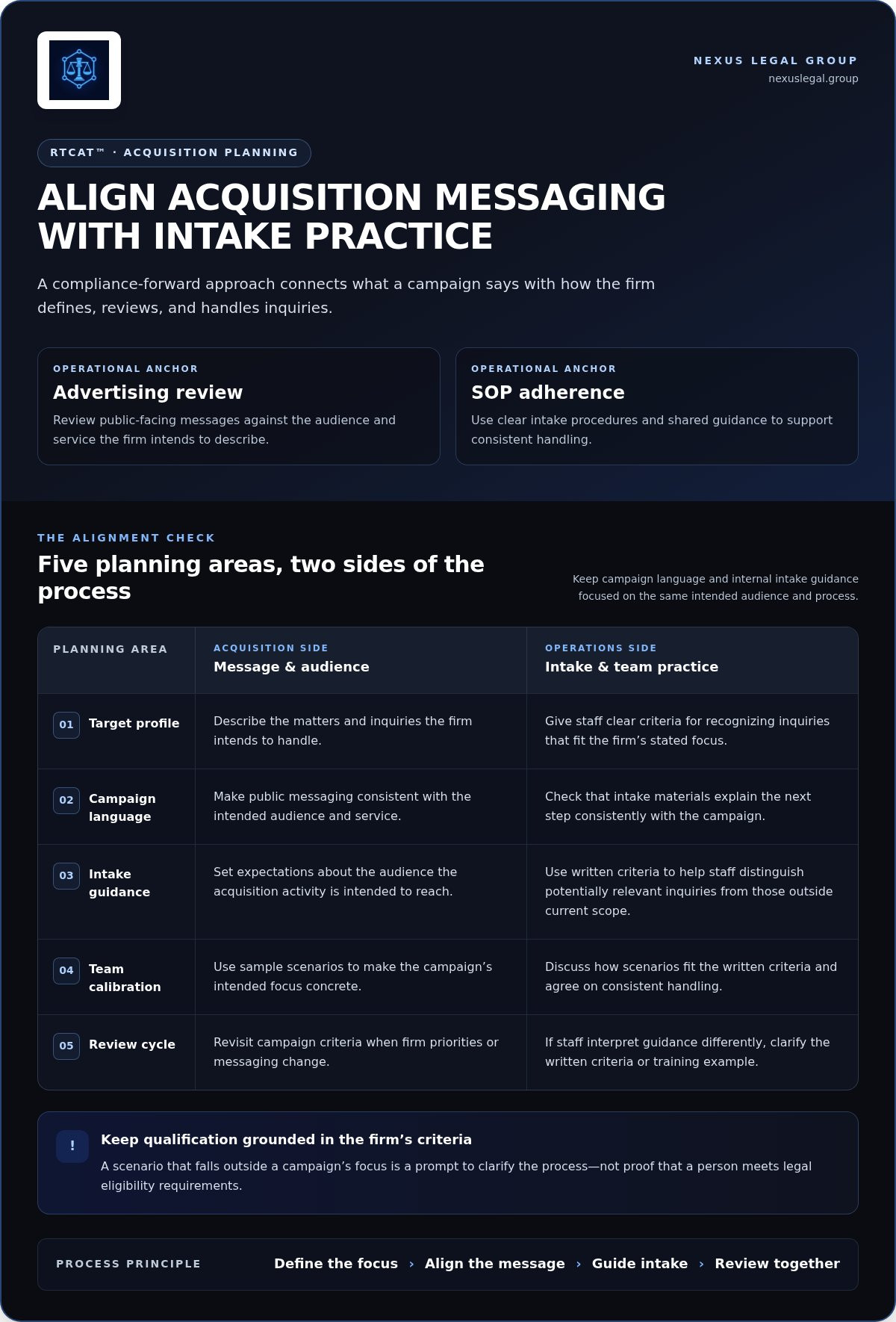
Review public-facing messages alongside the firm’s intake language. If an advertisement describes a particular type of assistance, intake materials should explain the next step consistently. RTCAT™ Critical Crash Intelligence + Compliance-Forward Client Acquisition offers a useful lens for reviewing that connection: assess whether acquisition messages and internal procedures describe the same intended audience and process.
Staff training adds another layer. Teams can review sample scenarios and discuss how each fits the firm’s written criteria. One scenario, for example, might involve someone seeking help for a different matter than the campaign describes. Agreeing on how to handle it reduces reliance on individual interpretation and supports consistent intake decisions.
When evaluating an acquisition approach, consider these planning elements:
- Target profile: describe the matters and inquiries the firm intends to handle.
- Campaign language: align public messaging with the intended audience and service.
- Intake guidance: give staff clear criteria for recognizing appropriate inquiries.
- Team calibration: use shared scenarios to build consistent interpretation.
- Review cycle: revisit criteria when firm priorities or campaign messaging change.
Periodic reviews can reveal where teams interpret the same guidance differently. If intake staff give inconsistent answers about whether a scenario fits the firm’s focus, for instance, clarify the written criteria or training example. This is an opportunity to improve the process, not evidence that a lead or person meets legal eligibility requirements.
To assess how a structured MVA case acquisition process aligns with your firm’s priorities, compare its intended audience and messaging with your intake guidance.
Keep qualification discussions tied to the firm’s stated intake criteria. A campaign can identify the audience it seeks to reach, while intake guidance helps staff determine whether an inquiry fits that focus. These steps support consistent handling, but they do not establish whether someone has a valid claim or meets a legal requirement. If a question falls outside the written criteria, staff can follow the firm’s established process to clarify it rather than treating an acquisition label as a decision. Reviewing campaign messages and intake guidance together can also reveal where wording needs clarification.
Quality-management material may provide a separate reference point, but it should not be treated as a substitute for the firm’s own criteria. The page discusses the transition to ISO 13485:2016 for quality management systems. Separately, Lumanity lists “Mid-Year Quality Pulse: What 5 FDA Trends Are Signaling to Life Sciences Leaders” with the date Jun 24, 2026. These details concern quality-management information; they do not, by themselves, define which crash-injury inquiries a law firm should accept. Keep any such reference distinct from case qualification, and use the firm’s written priorities and intake procedures to guide decisions.
What data sources does RTCAT™ use, and how accurate and current are they?
RTCAT™ alone does not identify a particular record source or update schedule. To assess crash intelligence, separate the source category, the information in each record, and when it becomes available. Police reports and emergency-services records are distinct source categories used in motor vehicle accident lead generation. Their inclusion in a workflow does not establish that every record is complete or current.
A police report may provide incident details and identify people involved. An emergency-services record can offer a separate incident signal. These records serve different purposes, so compare their contents rather than treating them as interchangeable. For example, a person named in a police report can be compared with other available crash details before the information enters an intake workflow.
Reverse append is another process used in crash-data acquisition to obtain accident reports and details about people involved. That distinction matters: obtaining records does not, by itself, prove that their details are accurate, recently updated, or independently verified. Evaluate the source record separately from the method used to connect it with an individual.
Accuracy depends on the specific field being assessed. Incident location, event details, and a person’s identifying information may each need different checks. A matching name, for instance, may not resolve a discrepancy in the reported incident details. Keep the original source visible, compare fields that should align, and flag conflicts rather than treating them as settled facts.
Currentness also depends on a record’s lifecycle. An incident must be recorded, made available, and then obtained or processed before it can support acquisition. Each stage can affect timeliness. When assessing freshness, distinguish the event date from the date the record became available and the date it entered the intake process.
Use a source review that records these practical elements:
- Origin: note whether information comes from a police report, emergency-services record, or another identified source.
- Field: specify which detail the record supports, such as the incident or an involved person.
- Timing: distinguish the event date from the record’s availability and processing dates.
- Consistency: compare matching details and preserve discrepancies for review.
- Status: separate source-record information from details subsequently verified through intake.
A police report and an emergency-services record, for example, may relate to the same crash but contain different fields. Treating them as complementary information while retaining their individual sources and timing gives intake teams a clearer basis for assessing relevance. Claims about RTCAT™ should describe only source types and verification steps specifically attributed to its process.
How does RTCAT™ compare with other legal client-acquisition and crash-data services
The name RTCAT™ alone does not show how it compares with another acquisition service. A useful comparison examines the work performed, the information provided, and how each process supports a firm’s intake. A service that identifies crash events, for example, may serve a different purpose from one that verifies inquiries or reviews advertising.
Start by identifying the service model. General legal client acquisition can generate inquiries through advertising, while crash-data services use incident-related information to identify potential outreach opportunities. A combined model may connect incident data with verification and intake processes. These categories describe different functions, not a ranking of providers or proof that RTCAT™ performs each one.
Next, compare the data source and its role. A police report-generated lead, an emergency-services record, and a general advertising inquiry do not provide identical context. A crash-related record, for example, may contain incident information, while an advertising inquiry may begin with a person’s response to a message. Value depends on the firm’s needs and the information available for review.
Assess verification as a separate capability. Ask what details are checked, how inconsistencies are handled, and what information staff still need to confirm during intake. A service may provide an incident-linked record without establishing a person’s interest or whether the inquiry fits the firm’s criteria. Clear status labels help intake teams distinguish sourced details from responses verified later.
Include compliance practices in the comparison. Review whether advertising materials and operating procedures are examined through a defined process. A firm can compare how each workflow documents approvals, applies intake steps, and routes unresolved questions. These controls may matter as much as an inquiry’s initial source because they shape how it is handled after acquisition.
Use a consistent comparison framework:
- Purpose: identify whether the service supplies advertising inquiries, crash-related data, or an integrated acquisition workflow.
- Source: record whether information comes from a police report, emergency-services record, or direct response.
- Verification: distinguish automated checks from information gathered during staff intake.
- Process: examine advertising review, SOP adherence, and inquiry routing.
- Fit: map each function to the firm’s actual intake requirements.
For RTCAT™, compare only capabilities directly described and attributed to the process. The trademark itself does not establish data sources, verification methods, or operational advantages. A disciplined comparison separates documented functions from assumptions, then tests each function against a practical example, such as handling a crash record with incomplete contact details.
This approach avoids treating all legal acquisition and crash-data services as interchangeable. A firm seeking incident-linked information can prioritize source context; one refining intake can focus on verification and SOP alignment. The useful comparison shows how each service’s stated functions connect to the firm’s case-acquisition workflow.
How does RTCAT™ protect personal data and comply with privacy and security requirements
The name RTCAT™ alone does not establish specific privacy safeguards or security controls. When assessing crash-data acquisition, review how personal information is handled at each stage: collection, access, use, storage, and deletion. A process description should explain what information is handled and why, without implying that a named system uses controls that have not been described.
Start with data minimization. Identify the fields an intake workflow needs for its stated purpose, such as incident details and a person’s contact information. Distinguish these from information not needed for the next step. For example, an intake team reviewing an incident record may need enough detail to route an inquiry, not unrestricted access to every available record.
Access controls are another practical point to review. Map which roles need to view, enter, or update information, and connect each permission to a work task. An intake specialist may need contact details, while a reviewer may need advertising or process documentation. Role-based access descriptions help explain how information moves without assuming every team member needs the same view.
Follow a record through its lifecycle. A useful review identifies how information enters the workflow, where it is stored, how authorized staff use it, and what happens when it is no longer needed. A crash-related inquiry, for example, may move from receipt to verification and then intake review. Each handoff should have an accountable role and a defined handling step.
Security claims should be specific, too. Ask what protections apply during transfer and storage, how access events are monitored, and how a suspected incident is handled. These are evaluation criteria, not claims about RTCAT™. Saying information is “secure” does not explain the controls behind that claim; concrete descriptions let a firm assess the process more meaningfully.
A practical review can document:
- Information: which personal details enter the crash-data workflow and their purpose.
- Access: which roles can view or change each category of information.
- Movement: how records pass between acquisition, verification, and intake.
- Retention: how the process handles information after its operational use ends.
- Oversight: how staff follow documented procedures and raise handling concerns.
For a firm, this review connects privacy considerations with SOP adherence. A written workflow can assign responsibility for each transfer, limit access to task-related needs, and consistently document handling decisions. These are useful review criteria, but they do not establish that RTCAT™ implements a particular technical safeguard or meets a named legal standard.
Nexus Legal Group: High-Intent MVA Case Acquisition
Nexus Legal Group supports plaintiff law firms seeking structured motor vehicle accident case acquisition. Its High-Intent MVA Case Acquisition offering combines Police Report Generated MVA Leads, Emergency Services Generated MVA Leads, and Automated Verification. These services can suit firms looking to connect crash-related information with an organized intake process.
Consider this approach when your firm wants accident-report context or emergency-services-generated inquiries alongside verification. Matching the acquisition approach to your intake workflow helps clarify how incoming information will be reviewed and routed.
Visit Nexus Legal Group to explore its MVA case acquisition services.
Turn Your Review Into a Practical Next Step
Use RTCAT™ Critical Crash Intelligence + Compliance-Forward Client Acquisition as a prompt to define what your firm needs from a case-acquisition workflow. Set clear expectations for source transparency, review steps, privacy practices, and handoff to intake. This gives your team a practical basis for evaluating whether a process fits its operating priorities, rather than relying on a label alone.
For firms considering a structured acquisition approach, Nexus Legal Group offers High-Intent MVA Case Acquisition, Police Report Generated MVA Leads, and Automated Verification. The next step is to align these options with your firm’s intake requirements and priorities.
A deliberate evaluation can help your team move forward with clarity and a process aligned with its goals.
Frequently Asked Questions
What is RTCAT™ Critical Crash Intelligence?
Here, the phrase describes a compliance-focused approach to using crash-related information in client acquisition, not a verified expansion of the RTCAT™ name. The distinction matters: a descriptive phrase does not establish a system’s developer, technical design, or capabilities. Advertising review and documented intake procedures, for example, can be discussed as process considerations without presenting them as proven RTCAT™ features.
What services does RTCAT™ provide for crash intelligence and client acquisition?
RTCAT™’s specific services aren’t established by the available description, so it shouldn’t be credited with particular capabilities. Nexus Legal Group offers High-Intent MVA Case Acquisition, Police Report Generated MVA Leads, Automated Verification, and Emergency Services Generated MVA Leads. A firm evaluating these services can map each function to a distinct need, such as sourcing crash-related inquiries or supporting intake review.
What laws and regulations govern crash-data-based client outreach and attorney advertising in the United States?
U.S. outreach may involve state rules governing attorney advertising and solicitation, along with applicable privacy and data-protection requirements. Which rules apply depends on the outreach method, data source, and jurisdictions involved. A firm reviewing a campaign, for example, should assess both its advertising content and its handling of personal information. Documented review procedures help teams identify issues for jurisdiction-specific legal analysis.