Compliant Truck Accident Marketing: Event-First Model
Master commercial truck accident marketing: a compliance-forward event-first model to verify police reports, ensure TCPA consent, and sign qualified cases.
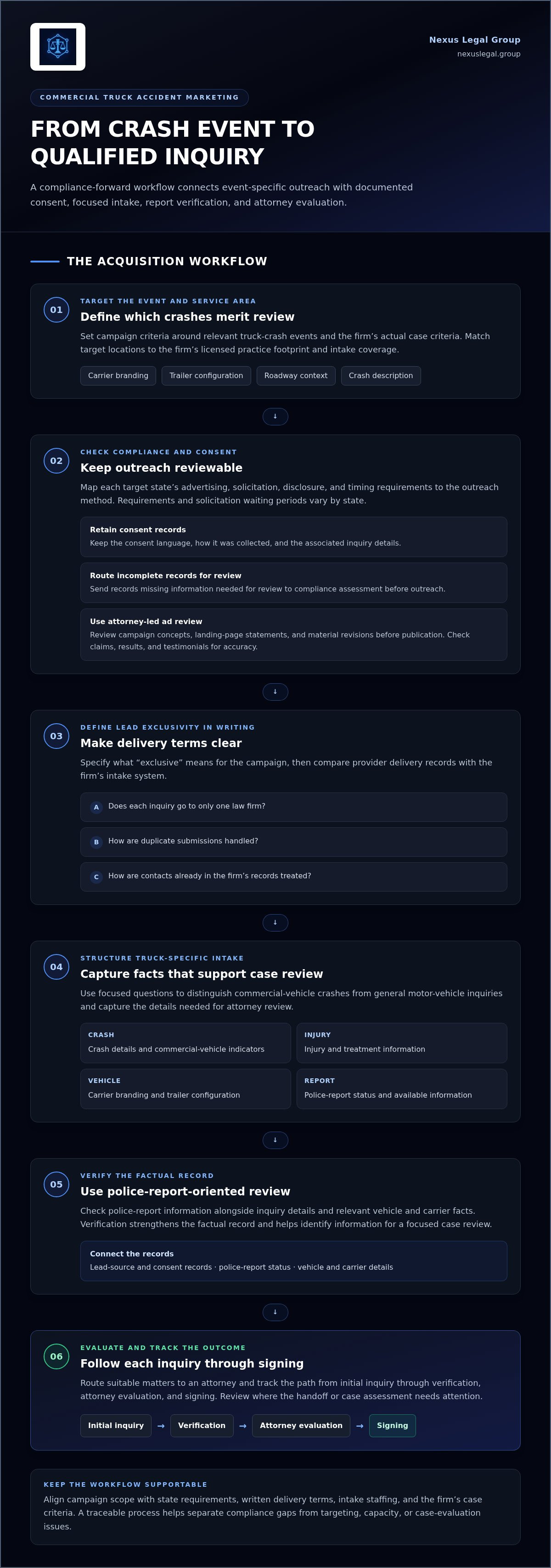
Commercial truck accident marketing is more effective when it follows a compliance-forward, event-first model: organize outreach around identifiable crash events, document consent, and assess each inquiry through structured intake and report verification. Clear consent records from lead-generation providers support compliance with the Telephone Consumer Protection Act (TCPA) and state marketing laws. The goal is a disciplined path from event signal to qualified inquiry, not simply a higher lead count.
Broad reach can generate activity, but it doesn’t show whether an inquiry involves a commercial vehicle, includes useful crash details, or is exclusive. A stronger process connects lead-source and consent records with police-report status and relevant vehicle and carrier details, giving the firm a clearer basis for review.
This article explains how to assess compliance and exclusivity, structure FMCSA-informed intake around truck-crash facts, verify police-report information, and measure progress toward signed cases. Each stage contributes to a traceable acquisition workflow. Specialized case-acquisition support can fit once the firm has defined its evaluation criteria.
Key Takeaways
- Assess consent documentation and lead-handling practices as part of your firm’s compliance and case-evaluation process.
- Define what lead exclusivity means for your campaigns, including how truck-specific targeting distinguishes commercial crashes from general motor-vehicle inquiries.
- Structure intake around crash details, injury and treatment information, police-report status, and commercial-vehicle indicators such as carrier branding and trailer configuration.
- Use police-report-oriented verification to strengthen the factual record and identify details that support a focused case review.
- Track the path from initial inquiry through verification, attorney evaluation, and signing to identify where your acquisition workflow can improve.
Law-firm responsibility for compliance and case evaluation
State bar rules and solicitation waiting periods vary by state. Before launching a campaign, map each target state’s requirements for lawyer advertising, solicitation, disclosures, and timing to the specific outreach method. One nationwide schedule may not fit every jurisdiction.
Maintain clear consent documentation from lead-generation providers to support compliance with the Telephone Consumer Protection Act (TCPA) and state marketing laws. Set a consistent recordkeeping process: retain the consent language, how it was collected, and the associated inquiry details. Route records missing information needed for review to compliance assessment before outreach.
Attorney-led ad review helps ensure legal claims and case messaging receive professional oversight. Assign an attorney to approve each campaign concept, landing-page statement, and material revision before publication. For example, review whether a truck-crash advertisement accurately describes the firm’s work and avoids implying a specific result for every injured person.
Review case results and testimonials with the same care. Confirm that each result is accurately described and testimonials reflect genuine client experiences. Distinguish past outcomes from promises about future cases. A focused review can also clarify what sets the firm’s message apart, such as commercial-vehicle experience, a defined geographic focus, or a particular intake process, and align the campaign with that distinction.
Define lead exclusivity in writing. Specify whether an inquiry goes to only one law firm, whether duplicate submissions count as separate inquiries, and how the provider handles contacts already in the firm’s records. Firm-owned advertising accounts can give the firm visibility into campaign settings, creative approvals, and performance history. Document account access and approval responsibilities before launch.
Let market availability and firm capacity shape campaign scope. Compare targeted locations with the firm’s licensed practice footprint and intake coverage. Assess whether the team can review inquiries, identify commercial-vehicle indicators, and route suitable matters to an attorney. If intake staffing cannot support a planned market, narrow the campaign rather than creating an unmanaged queue.
Use a repeatable evaluation sequence: review consent records, confirm state-specific approvals, inspect the campaign message, and test the intake handoff. Track each inquiry through attorney review and the firm’s case decision. This creates a clear record of responsibility and helps distinguish compliance gaps from targeting or capacity issues.
Requirements depend on the jurisdiction and outreach method, so campaign timing and disclosures may need to be adjusted state by state.
Are the truck accident leads exclusive to my firm?
Exclusivity depends on delivery terms. Define whether each inquiry goes to one law firm, how duplicates are handled, and whether previously known contacts are excluded. Put those conditions in writing before a campaign begins, then compare delivery records with the firm’s intake system. A written definition distinguishes exclusive delivery from a campaign that merely targets a narrow audience.
Truck-specific targeting separates commercial collisions from general motor-vehicle traffic. Build campaign criteria around signals such as carrier branding, trailer configuration, roadway context, and crash descriptions. The framework titled “Commercial Truck Accident Marketing: A Compliance-Forward Event-First Model” puts these event signals at the center of campaign design. For example, an advertisement about a tractor-trailer collision can lead to a landing page asking whether a commercial vehicle was involved. This creates a focused path from advertising to intake without treating every vehicle-crash inquiry as a truck case.
Geography should match the firm’s authorized practice footprint and staffing. Map target locations, then compare expected inquiry flow with the people assigned to review submissions and route them to an attorney. If the team covers only selected states or regions, narrow targeting accordingly. Nationwide reach is useful only when intake coverage and case review can support it. Define who handles inquiries if campaign activity exceeds planned capacity.
Start campaign research with the firm’s actual case criteria. Identify the truck-crash types, locations, and facts that warrant attorney review. Audit search terms and landing-page submissions for mismatches, such as inquiries about passenger vehicles rather than commercial carriers. Test a focused campaign segment, review lead quality with intake staff, and scale only when the handoff works consistently. Use the “Commercial Truck Accident Marketing: A Compliance-Forward Event-First Model” framework to connect these checks to event-specific targeting.
Pay-per-click costs vary by market and campaign. Event-based conversion depends on targeting, landing-page clarity, inquiry quality, and how the firm handles each submission. Assess results across these factors instead of relying on a universal conversion rate.
To build a compliant, event-first campaign, define the target event and geography, approve the advertising and landing-page language, document consent procedures, and set written lead-delivery terms. Test the intake route, audit submissions against case criteria, and adjust targeting based on attorney review and staffing capacity.
Landing pages should connect the campaign message to a practical intake sequence. Ask for the crash date, location, vehicles involved, and police-report status, then provide a clear way to submit the inquiry. Campaign support should include a defined process for routing submissions and reviewing recurring intake gaps. Firms assessing how event-focused acquisition fits their workflow can explore event-driven case acquisition.
FMCSA-informed intake workflow
The Federal Motor Carrier Safety Administration (FMCSA) is among the regulatory considerations in truck accident litigation. Intake should capture facts that help an attorney identify the commercial vehicle, carrier, crash circumstances, and potential evidence. A structured form also gives firms seeking consistent case screening a shared starting point.
Begin with the event record. Ask for the crash date, time, location, vehicles involved, a brief collision description, and whether a police report exists. Then collect information about injury severity, medical treatment to date, and lost work. These details help intake staff distinguish a personal injury inquiry from a potential wrongful death matter and route it for appropriate review.
Next, record commercial-vehicle indicators while the caller can still describe the scene. Ask whether the vehicle displayed carrier branding, what the trailer configuration looked like, and what roadway context the caller remembers. For example, a branded tractor-trailer on an interstate presents different identification details from a delivery truck on a local street. Keep observations separate from assumptions about liability.
Use a consistent intake sequence so critical fields don’t get buried in free-text notes. A practical workflow is:
- Identify the event: capture the date, time, location, vehicles, and crash description.
- Classify the inquiry: record injuries, treatment, lost work, and whether the inquiry involves a wrongful death.
- Flag commercial details: note carrier branding, trailer configuration, and roadway context.
- Record report status: note whether a police report exists and any identifying details the caller provides.
- Route for review: send the completed intake to the designated attorney or case-review team.
Structured, report-linked intake connects those answers with accident-report details when available. It helps reviewers compare caller-provided information with the event record, identify gaps, and decide what to clarify. Keep the source of each detail visible. A caller’s account, a report entry, and an attorney’s assessment are distinct types of information.
Rapid follow-up depends on routing, not on an invented response-time promise. Assign each new inquiry to an intake owner, flag missing crash details, and record each contact attempt in the case system. If the caller doesn’t know the carrier’s name, note that clearly and use available event details to guide later review. This helps distinguish incomplete identification from a negative case assessment.
Evidence gathering starts with precise questions, not conclusions. Ask what photographs, witness details, or report information the caller already has, and record the source of each item. Don’t treat an intake response as proof of fault. The attorney can evaluate liability alongside the crash circumstances and relevant FMCSA issues during case review.
Police-report-oriented verification
Police-report-oriented verification connects an inquiry to a documented crash event before the firm evaluates representation. It helps intake staff identify mismatches, clarify missing details, and route serious inquiries for attorney review.
Report-Based Lead Checks
Start by comparing the inquiry with available police-report details, including the crash date, location, vehicles, and involved parties where recorded. Check whether the report’s event description aligns with the caller’s account. For example, don’t treat a reported tractor-trailer collision as verified solely because an inquiry mentions a truck; the event details should also correspond.
Record the report identifier and source alongside each matched detail. If the caller gives a different location or vehicle description, preserve both accounts rather than silently replacing one. The difference can guide a follow-up question. Report-based checks establish an information trail, but don’t determine fault or resolve liability.
Lead Quality Review
Lead-quality review combines event consistency with intake completeness. Assess whether the inquiry identifies a crash, a potential commercial vehicle, reported injuries, and a clear next step for contact. A missing carrier name may call for clarification, while conflicting crash locations may require closer review before the inquiry proceeds to an attorney.
Separate verification status from case value. A report match can help identify the event, but it doesn’t establish that the matter is suitable for litigation or that the firm should offer representation. Track each inquiry as matched, incomplete, or needing clarification, and document the reason for that status.
For consistent handling, use a short review sequence. First, compare the event date and location. Next, align the vehicle description and involved parties where available. Then note discrepancies, missing fields, and follow-up actions. This makes the basis for an intake decision visible to the team reviewing the file.
Consider an inquiry describing a serious collision involving a branded truck while the available report lists a different vehicle type. Keep the inquiry open for clarification rather than marking it verified or rejected immediately. Record who will follow up and which detail needs resolution, such as the carrier name or report’s event identifier.
Verification also improves campaign feedback. Intake staff can categorize inquiries by report match, missing information, or event mismatch, then share those patterns with the team managing lead quality. For example, repeated confusion between commercial and passenger vehicles may signal that campaign wording or intake prompts need adjustment.
Finally, keep source material distinct from legal assessment. A police report is one record to review, while caller statements and other evidence may add context. An attorney can evaluate the complete information before deciding whether to pursue the matter. This process provides a more traceable basis for handling inquiries without treating a report match as a case outcome.
Signed truck accident cases
Event-first truck accident marketing is most useful when a firm can assess which crash categories lead to suitable signed matters. Instead of treating every inquiry equally, compare the characteristics of signed and declined cases. This can show whether campaign focus matches the firm’s actual case criteria and capacity.
Review case status alongside the reason for the decision. An inquiry may not become a signed case because the firm can’t establish contact, the matter falls outside its criteria, or the person chooses different representation. Recording these distinctions gives the firm more insight than a single lead-to-signing total, without assuming every decline reflects a marketing problem.
Delivery-truck matters also need careful classification. A collision involving a UPS, FedEx, or Amazon vehicle may raise questions about the vehicle’s use and the responsible parties. USPS-related claims require separate consideration: most USPS accident claims proceed under the Federal Tort Claims Act, which permits claims against the federal government under limited circumstances. Campaign language should identify the event without implying a legal conclusion.
Audience selection should reflect the firm’s case profile, not just broad interest in truck crashes. A firm can distinguish inquiries involving delivery vehicles, tractor-trailers, or other commercial vehicles, then assess which categories align with its accepted matters. This comparison helps refine audience definitions while keeping the message relevant to people describing a specific type of injury.
Search visibility can support this distinction through pages addressing the language people use for commercial trucking injuries. A page about delivery-truck collisions, for example, can explain what information helps the firm assess an inquiry. Review whether visitors submit relevant details and whether the resulting matters fit the firm’s criteria, rather than measuring visibility by traffic alone.
Past results can provide context, but they should never imply a typical outcome. In one semi-truck collision case involving a fatigued driver, a law firm recovered $2.1 million. Treat that as an individual result, not a forecast for other truck accident cases. Attorney-reviewed descriptions should distinguish prior case outcomes from statements about what a prospective client may recover.
Use signed-case reviews to identify patterns in fit, not to pressure intake staff to sign every inquiry. Compare accepted and declined matters by event category and documented reason for the decision. If a campaign repeatedly produces inquiries outside the firm’s criteria, adjust its focus. If suitable matters are declined, examine the firm’s internal evaluation process. This distinction supports more informed campaign-performance decisions.
Nexus Legal Group: High-Intent MVA Case Acquisition
Nexus Legal Group provides High-Intent MVA Case Acquisition for firms building a structured path from crash inquiry to case review. Its Police Report Generated MVA Leads and Emergency Services Generated MVA Leads connect acquisition with event information, while Automated Verification supports lead review. These services can fit firms seeking more traceable motor-vehicle accident inquiries alongside their own intake and attorney evaluation processes.
For firms refining an event-first approach, the next step is to align acquisition needs with campaign criteria, report information, and internal review workflows. Nexus Legal Group focuses on case acquisition, not legal representation, so the law firm remains responsible for evaluating and representing prospective clients.
Set the Next Campaign in Motion
Turn the framework into an operational plan by choosing one commercial crash category and defining what a useful inquiry must contain. Set the campaign’s geographic boundaries, identify the team responsible for intake, and decide how attorney feedback will shape the next review. A compliance-forward, event-first model for commercial truck accident marketing becomes more actionable when each campaign has a defined purpose and review path.
Use the first campaign to establish a baseline for decisions, not to promise a particular outcome. Track whether inquiries match the intended event, whether staff can review them efficiently, and where information gaps interrupt the handoff. These observations can guide targeting and intake adjustments before the firm expands its approach.
Nexus Legal Group can support firms evaluating case acquisition within this model. Share your campaign priorities and workflow goals to discuss how acquisition support can fit your firm’s operational plan.
A focused next step can turn strategy into a more deliberate acquisition process.
Frequently Asked Questions
What makes this different from generic truck accident marketing?
Event-first marketing organizes outreach around identifiable crash events rather than relying only on broad truck-injury messaging. This can help a firm align its advertising, intake questions, and review criteria with a specific collision type. For example, a campaign focused on delivery-vehicle crashes can ask about vehicle markings and delivery context, while a broader campaign may attract inquiries that don’t involve commercial vehicles.
Does this program guarantee signed clients or case outcomes?
No marketing or case-acquisition program can promise that an inquiry will become a signed client or produce a particular case outcome. Nexus Legal Group offers High-Intent MVA Case Acquisition, but signing depends on factors including the person’s circumstances, the firm’s criteria, and attorney evaluation. Assess performance by tracking the path from inquiry to review and signing, without treating a lead or past result as a prediction.
How soon can a firm receive commercial-catastrophic event intelligence?
Timing depends on when event information becomes available and whether it can be matched to useful details. A firm can define actionable intelligence, such as an identifiable commercial vehicle, location, and report information, then track when each element enters its workflow. This helps distinguish event discovery from later verification and attorney review without assuming every crash can be identified on the same schedule.
What federal and state rules govern attorney advertising for truck accident cases?
Federal considerations include the Telephone Consumer Protection Act (TCPA), while state marketing laws and state bar rules can also affect attorney advertising and solicitation. Requirements may vary by jurisdiction and contact method. Firms can set up a state-by-state review process for advertisements, disclosures, consent records, and outreach language, then document approval before campaigns run. This is especially useful when a campaign targets audiences across multiple states.
What restrictions apply to targeted legal advertising after a commercial truck crash?
Restrictions depend on the state, advertising format, and whether the communication is general advertising or direct solicitation. Distinguish public-facing ads from individual outreach, review timing and content under applicable state rules, and retain consent documentation for lead-based contact. Avoid implying that a person has a claim or promising a result. Use attorney-reviewed language that accurately describes the firm’s services.
How can law firms identify and verify truck accident events using public records?
Use available police-report information to compare an inquiry’s crash date, location, and vehicle details with a documented event. Emergency-services data may also provide event-related information. Access and detail depend on the record and applicable processes. Keep the source attached to each fact, note mismatches for follow-up, and treat a record match as event identification, not proof of fault or case merit.
What are compliant methods for contacting crash victims and families?
Use outreach channels supported by documented consent and apply relevant state advertising and solicitation rules before contact. Keep the initial message factual, clearly identify the law firm, and avoid pressure or claims about likely outcomes. For family inquiries after a fatal crash, use particularly careful language and route questions to trained staff. Record contact preferences and requests to stop further communication in the intake system.
How does event-first marketing compare with pay-per-click and mass-media advertising?
Pay-per-click advertising reaches people through search activity, while mass media distributes a message broadly. Event-first marketing organizes targeting and follow-up around identifiable crash information. These approaches can serve different roles: broad media may build awareness, while event-based campaigns can focus on specific commercial-vehicle contexts. Compare them by inquiry relevance, intake completeness, and attorney-review outcomes rather than impressions or traffic alone.