Better Workflows for Commercial Truck Injury Cases
Learn a better workflow for commercial truck and catastrophic injury cases to preserve evidence, prove liability, and build a compelling, winning legal claim.
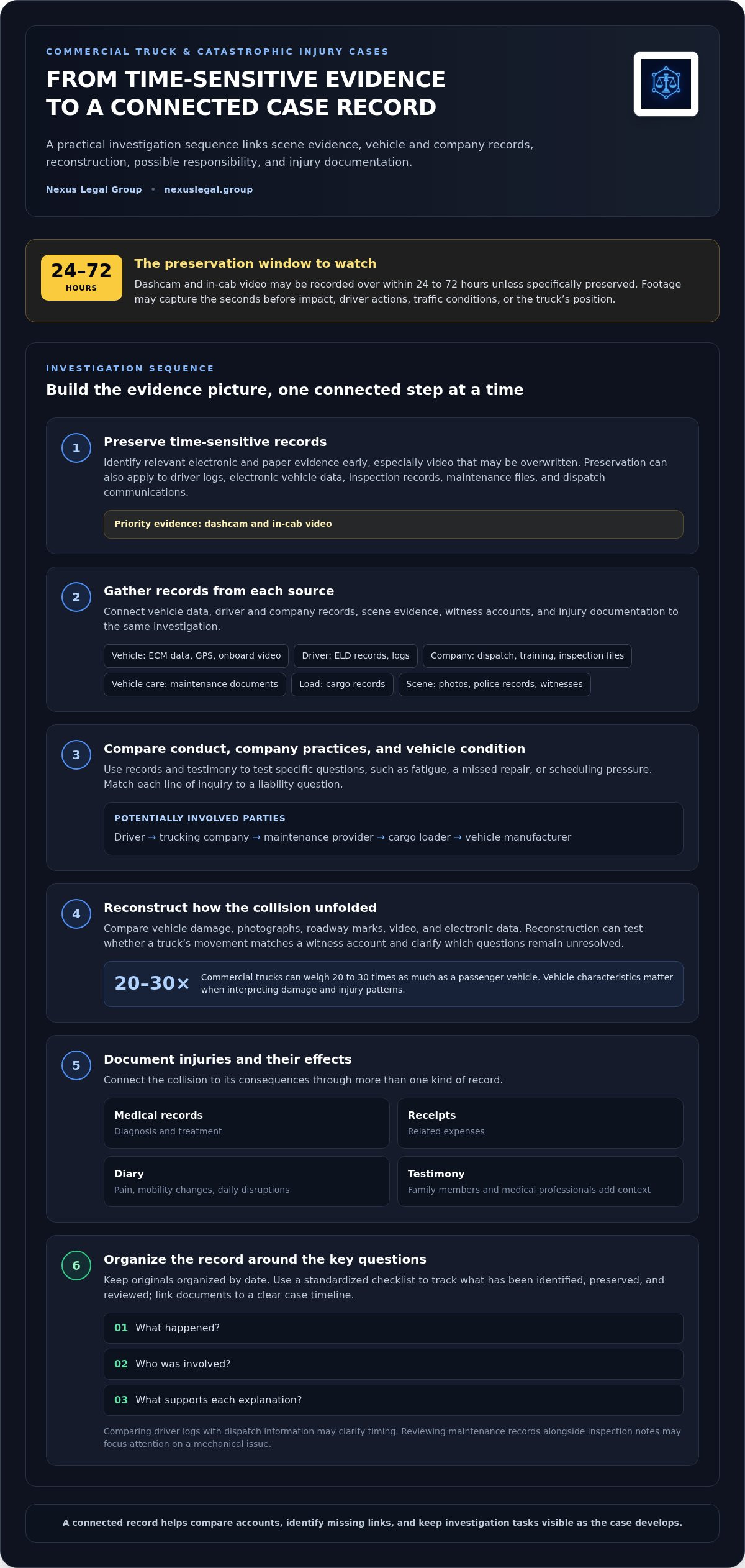
A better workflow for commercial truck and catastrophic injury cases begins with preserving time-sensitive evidence, then connecting the crash reconstruction to potential responsibility and the harm suffered. Dashcam and in-cab video may be recorded over within 24 to 72 hours unless specifically preserved. Early organization helps keep vehicle data, driver and company records, witness accounts, and injury documentation connected to the same investigation.
It’s natural to focus first on what happened at the scene, but a truck case often depends on evidence held by multiple people and organizations. The sequence matters: a missing record or unclear connection between the collision and its consequences can make the full picture harder to establish.
This article explains how evidence gathering, accident reconstruction, and liability analysis fit together in a practical case workflow. You’ll learn which records can help clarify how a crash occurred, how investigators assess possible responsibility among drivers and companies, and how injury documentation supports a claim. Together, these steps offer a clearer framework for developing complex truck and catastrophic injury cases.
Key Takeaways
- Connect physical evidence, witness accounts, and injury documentation to build a coherent account of how a collision unfolded.
- Use accident reconstruction to test competing explanations against the available scene and vehicle evidence.
- Trace responsibility across the driver, trucking company, maintenance providers, cargo handlers, and other potentially involved parties.
- Assess trucking-company practices and vehicle records alongside driver conduct to identify evidence that may shape the claim.
- Understand how available insurance coverage can influence claim strategy, particularly when injuries are catastrophic.
Evidence gathering and accident reconstruction
A sound truck accident investigation connects scene evidence, vehicle records, witness accounts, and medical documentation. Case-management software can centralize these materials, while standardized checklists track evidence requests and follow-up tasks. A better workflow for commercial truck and catastrophic injury cases also places each item on a clear case timeline.
Electronic and Documentary Truck Evidence
Electronic and documentary truck evidence includes vehicle data, driver records, company files, and physical records tied to the accident. Together, these materials can help explain the events leading to impact and identify people or businesses that may be liable. Examples include electronic logging device records, engine control module data, onboard video, GPS, dispatch communications, driver logs, inspection reports, maintenance documents, and cargo records.
Paper and scene evidence adds context. Photographs, police records, witness information, body shop receipts, medical records, and diaries can document damage, injuries, and their effects on daily life. A witness account may describe a truck changing lanes, while photographs show the resulting vehicle positions. Comparing these sources helps assess whether negligence, a mechanical issue, or cargo movement contributed to the collision.
Preserving Evidence
Evidence preservation means protecting relevant electronic and paper records from loss, alteration, or routine deletion. Dashcam and in-cab video may be recorded over within 24 to 72 hours unless specifically preserved. Early attention to that window matters because footage can capture the seconds before impact, driver actions, traffic conditions, or the truck’s position.
Preservation also applies to driver logs, electronic vehicle data, inspection records, maintenance files, and dispatch communications. A lawyer can identify relevant records and seek to preserve them as the investigation develops. Keep original photographs, police documents, receipts, and medical paperwork organized by date. A clear record trail helps distinguish evidence created at the time from later recollections.
Investigating Trucking Companies and Drivers
Investigating a trucking company and its driver means comparing their conduct, policies, and vehicle condition with the available evidence. Driver logs and electronic logging device records can help establish driving and duty timelines. Dispatch messages may provide context about route instructions or scheduling pressure, while training and inspection records can clarify company practices.
Maintenance documents can show what work was performed, when inspections took place, and whether a reported defect appears in the vehicle’s history. Cargo records can help determine how a load was arranged or secured. These lines of inquiry matter because potential responsibility may involve the driver, trucking company, maintenance provider, cargo loader, or vehicle manufacturer.
Accident reconstruction uses physical evidence and recorded information to assess how a crash unfolded. Investigators may compare vehicle damage, photographs, roadway marks, video, and electronic data. For example, they can assess damage locations and scene images alongside onboard video to test whether a truck’s movement matches a witness’s account. Reconstruction can also clarify which questions remain unresolved.
The scale of a collision affects how investigators interpret damage. Commercial trucks, including 18-wheelers and semi-trucks, can weigh 20 to 30 times as much as a passenger vehicle. That difference can shape vehicle damage and injury patterns. Reconstruction should therefore connect the physical scene with vehicle characteristics, rather than treating a truck accident like an ordinary car accident.
Injury documentation is another part of the evidence record. Medical records describe diagnosis and treatment, while receipts can document related expenses. A diary may record pain, changes in mobility, or disruptions to daily routines; testimony from family members and medical professionals can add context. Together, these materials help connect the collision to its consequences without relying on a single account.
A standardized checklist can track whether each evidence category has been identified, preserved, and reviewed. Software can link a police record, witness statement, repair receipt, and medical document to the same timeline. This structure helps a legal team spot missing links, compare conflicting accounts, and keep investigation tasks visible as the case develops.
For a more complete assessment, organize evidence by source and question: what happened, who was involved, and what supports each explanation? Comparing a driver log with dispatch information, for example, may clarify timing. Reviewing maintenance records alongside inspection notes may focus attention on a mechanical issue. This evidence map supports a better workflow for commercial truck and catastrophic injury cases by connecting investigative findings to specific liability questions.
How do lawyers investigate trucking companies, drivers, and maintenance records?
Lawyers investigate a trucking company by connecting the driver’s actions, company decisions, and vehicle condition to the collision. The goal is to test specific explanations, such as fatigue, a missed repair, or scheduling pressure, against records and testimony. Each line of inquiry should answer a liability question, not simply add documents to a file.
The investigation typically begins by identifying the driver, employer, vehicle owner, maintenance providers, and cargo-related businesses involved. A lawyer can then map each party’s role against the timeline: who assigned the route, controlled the truck, serviced it, and loaded the cargo. That map helps distinguish a driver-level issue from a company practice or third-party contribution.
Driver records provide one comparison point. Lawyers may review logs, dispatch information, training materials, and qualification records alongside the route and collision timeline. According to the Federal Motor Carrier Safety Administration, drivers of property-carrying commercial vehicles generally may drive no more than 11 hours after 10 consecutive hours off duty. Comparing the recorded work period with dispatch details can help identify questions about fatigue or schedule pressure.
A discrepancy in a record is a lead to investigate, not proof by itself. For example, if a log’s timeline appears inconsistent with dispatch messages, a lawyer can compare both records with trip details and witness accounts. This may clarify whether the difference reflects a recording issue, an incomplete timeline, or a fact relevant to negligence. Any conclusion depends on how the records fit together.
Company practices matter because a driver’s conduct may be part of a larger operational system. Investigators can examine training materials, route expectations, dispatch communications, and internal reports related to safety concerns. A pattern of tight scheduling or inadequate training may raise different questions from an isolated driving decision. The goal is to connect a company decision to the circumstances of the accident.
A maintenance investigation follows the truck’s service history from a reported concern through inspection, repair, and return to operation. Work orders, inspection documents, parts records, and communications can show what condition was observed and what action followed. For example, a recurring brake concern documented across service entries calls for comparison with repair notes and the vehicle’s condition after the crash.
The timing and detail of each maintenance entry can change its significance. A repair record may describe a completed fix, an unresolved concern, or an inspection that found no defect. Lawyers compare dates, vehicle identifiers, technician notes, and later service records to establish the sequence of events. This can help determine whether a mechanical issue existed before the collision and whether it may be related to the crash.
Third-party maintenance providers may hold records separate from the trucking company’s files. Identifying the service provider and locating its work orders can fill gaps in the vehicle’s history. A lawyer may also compare the provider’s documentation with the carrier’s inspection records. Differences in dates or descriptions can guide follow-up questions, but do not establish fault on their own.
Interviews and records reviews work best when they address specific inconsistencies. If a driver describes a route differently from dispatch records, investigators can ask about the route, timing, and instructions. If a maintenance entry conflicts with an inspection note, they can clarify who performed the work and what the note describes. Focused questions preserve the distinction between documented facts and later interpretation.
A structured case file can link each record to a responsible party, event, and unresolved question. This makes it easier to identify missing company or vendor documents and update the liability analysis as new information arrives. For law firms building an intake pipeline around motor vehicle cases, high-intent MVA case acquisition can support the connection between incoming inquiries and case review.
Because records and electronic information can be time-sensitive, preserving driver logs, electronic data, and maintenance records early can help strengthen a truck accident claim. Other evidence may include photographs, video, witness information, police records, inspection records, maintenance documents, and dispatch communications. Comparing these materials can help clarify whether a repair concern, operational decision, or driver conduct contributed to the collision.
Scheduling pressure from a trucking company can push drivers past legal driving limits or sensible safety standards, while poor trucking company training and cost-cutting on regular vehicle maintenance can contribute to accidents. A personal injury attorney can investigate a truck accident, identify responsible parties, review records and company policies, calculate damages, and negotiate for compensation. The comparison includes passenger cars weighing 4,000 pounds alongside commercial trucks, highlighting the difference in vehicle scale.
How do commercial truck insurance policies and coverage limits affect claim strategy
Insurance information helps shape a truck accident claim by showing which policies may apply, whom they cover, and what limits may be relevant. It does not establish fault or determine the value of injuries. A practical review connects policy terms with evidence about the crash, the parties involved, and documented losses.
For interstate trucks, Federal regulations require at least $750,000 in liability coverage, with minimums reaching $5 million for vehicles hauling hazardous materials, according to the Federal Motor Carrier Safety Administration. Those minimums provide context, but they do not establish the coverage available in every claim. The vehicle’s use, cargo, policy wording, and facts of the collision all matter.
A policy limit is the maximum amount an insurer may owe under the applicable coverage terms. The relevant limit depends on the policy and the claim, so investigators identify the insured parties, covered vehicles, policy period, and applicable provisions. For example, a policy covering a trucking company’s fleet may differ in scope from coverage associated with a separate vehicle owner or business.
Lawyers typically compare insurance documents with the liability investigation. The declarations page can identify named insureds, covered vehicles, and stated limits; the full policy provides definitions, conditions, and exclusions that can affect a claim. A truck’s registration, dispatch records, and company documents may help clarify which business controlled the vehicle and whether that business appears in the insurance documentation.
The involvement of multiple potentially responsible parties can make coverage analysis more complex. A driver, trucking company, maintenance provider, cargo loader, or vehicle manufacturer may be relevant to the liability investigation. Each relationship raises a distinct question: does a policy cover that party, and does it address the conduct connected to the collision? Separate entities may have separate insurance arrangements.
Claim strategy should track liability and coverage together. If evidence points to a maintenance issue, for example, the review can identify the maintenance provider and examine records linking its work to the truck’s condition. If cargo handling appears relevant, investigators can identify the loader and assess its role. This avoids assuming that the trucking company’s policy is the only potential source of coverage.
Documented injuries and losses also inform how a claim is presented. Medical records, treatment details, lost wages, and rehabilitation expenses help describe the collision’s impact. In a catastrophic injury case, evidence may include ongoing care needs and reduced earning capacity. Organizing these records alongside policy information helps explain the claim’s factual basis without treating a coverage limit as proof of damages.
Insurers may dispute whether a policy applies, which party it covers, or how the evidence supports liability. A structured file can link each disputed issue to the relevant policy language, witness account, company record, or medical document. For example, a claim involving a driver and a separate cargo company requires clear documentation of each party’s role and the evidence supporting that connection.
Police records can establish early details for a case file, including the vehicles and parties identified after a collision. Linking those details to later coverage and liability reviews helps maintain a consistent intake record. Policy analysis proceeds alongside, rather than in place of, investigation into fault and injury-related losses.
Commercial truck insurance coverage may range from 300,000 to $750,000 for some carriers. That range can help frame questions during a claim review, but it should not be treated as confirmation of a particular carrier’s policy or the amount available for a specific loss. The policy documents and the identity of the insured parties remain central. A claimant can use the stated coverage as context while checking whether the carrier, vehicle, and events at issue fall within the policy’s terms. This keeps early expectations grounded in records rather than assumptions about the size of the business.
Large commercial operations may have commercial truck insurance coverage of 1 million or more. That possibility can make it important to identify every relevant business and insurance arrangement, rather than focusing only on the first policy located. Still, a larger stated limit does not by itself establish that a particular party is insured, that the collision is covered, or that the limit applies to the claim. Matching policy terms to the liability evidence and documented losses helps guide which coverage questions to pursue and how to present the claim. Coverage review can inform strategy, but it does not replace proof of responsibility or damages.
Nexus Legal Group: High-Intent MVA Case Acquisition
Nexus Legal Group supports plaintiff law firms seeking a structured pipeline of motor vehicle accident inquiries, including commercial truck injury cases. Its High-Intent MVA Case Acquisition connects firms with prospective cases, while Police Report Generated MVA Leads and Emergency Services Generated MVA Leads can add incident-based context to intake. Automated Verification helps assess incoming inquiries.
These services are designed for firms seeking to strengthen MVA case acquisition and intake workflows, not to investigate an individual claim. Police reports and details about people involved can inform an intake review, while attorneys determine whether a matter meets the firm’s criteria. Consider this approach when case acquisition and verification are operational priorities.
To discuss MVA case acquisition, contact Nexus Legal Group or visit Nexus Legal Group.
Build the Next Stage of Your Case Workflow
A better workflow for commercial truck and catastrophic injury cases depends on consistent decisions, clear ownership, and reliable information flow. For a law firm, the next step is to review how an inquiry moves from initial intake to evaluation, and where delays or missing details can interrupt that transition. A defined process helps teams identify the information they need, route inquiries appropriately, and maintain continuity as a matter progresses.
Review your current intake process with a practical focus. Identify which details help your team assess an MVA inquiry, who reviews them, and how the information reaches those responsible for case evaluation. This review can clarify whether your acquisition and verification approach supports your firm’s priorities.
If you’re refining your process, contact Nexus Legal Group to discuss how its MVA case acquisition services can support your firm’s intake objectives.
Clear workflows lay a stronger foundation for focused case review and sustainable growth.
Frequently Asked Questions
What are the key steps in a commercial truck accident injury case workflow?
A typical workflow moves from intake and initial case review to investigation, damages assessment, and resolution planning. At intake, record the collision date, locations of treatment, involved vehicles, and any insurer communications. The legal team can then identify open questions and assign follow-up tasks. As evidence and medical information develop, the team updates its assessment and prepares for negotiation or, if needed, trial.
What evidence should be preserved immediately after a commercial truck crash?
Preserve original photos and videos, the crash report, insurer correspondence, repair documents, and records of medical visits. Keep digital files in their original form, retain a backup, and note who captured each item and when. For example, a dated photograph of vehicle damage is more useful when paired with the repair estimate. Record witness names and contact details while they’re readily available.
What should clients expect during a truck accident case, from intake through settlement or trial?
Clients can expect an initial interview, document review, investigation, claim evaluation, and discussion of resolution options. The legal team may request information about medical treatment, effects on work, insurance communications, and daily limitations. The parties may later negotiate a settlement or proceed through litigation toward trial. For example, a new treatment plan may change how future care needs are documented and presented during negotiations.