Law Firm Marketing ROI Benchmarks: How to Measure Performance in 2026
Discover real law firm marketing ROI benchmarks for 2026. Learn how to track channel performance, connect spend to signed cases, and measure true legal growth.
What if a channel that looks expensive is producing more valuable clients than one with a lower cost per lead? That’s why law firm marketing ROI benchmarks can mislead when studies use different definitions, reporting periods, or conversion stages. A click, an inquiry, a qualified prospect, and a retained client are not interchangeable outcomes.
It’s reasonable to want a clear answer about which marketing channels are working. The challenge is connecting activity to financial outcomes when prospects may interact with several channels and take time to decide. Strong inquiry volume can also hide weak qualification or gaps in intake. A benchmark is useful only when its metric, conversion stage, and time period fit your firm’s economics.
This article offers a consistent framework for comparing channel performance in 2026 without treating industry averages as guarantees. You’ll learn how to define comparable metrics, connect spend with qualified inquiries and signed cases, and account for intake and attribution. Use the findings to identify practical measurement improvements and allocate resources based on client outcomes, not activity alone.
Key Takeaways
- Use law firm marketing ROI benchmarks as reference points, not universal targets. Compare only metrics with aligned definitions, sources, and conversion stages.
- Separate campaign activity from qualified inquiries, signed clients, and financial outcomes to see where performance changes along the client journey.
- Set a consistent attribution window and inquiry cohort before comparing campaigns, and make assumptions visible in your reporting.
- Build internal baselines by channel and practice area, then choose review intervals that fit your intake volume and case decision timeline.
- Track inquiry qualification alongside signed cases to connect acquisition activity with more meaningful growth measures.
What Do Law Firm Marketing ROI Benchmarks Actually Measure?
A benchmark only has meaning when you know what it measures. Marketing return on investment compares value attributable to marketing with the investment required to generate it. The familiar ROI calculation uses profit rather than revenue: subtract the investment from attributable profit, then compare the result with that investment. If your firm uses revenue instead, label the measure clearly. Revenue and profit answer different questions.
Return on Investment (ROI) provides the foundational concept, but firms still need to define which costs, outcomes, and attribution rules apply. Law firm marketing ROI measures the attributable financial return from marketing relative to its attributable investment, using definitions and time periods suited to the firm’s case economics. No single formula accounts for every firm’s case mix, accounting methods, or conversion timeline.
Keep performance stages distinct. Impressions, clicks, and website visits describe activity. Inquiries and consultations show engagement. Qualification and signed clients indicate progression toward business outcomes. Revenue received and profit attributable to acquired matters offer a later view. A strong result at one stage does not prove success at the next. For example, a campaign may generate many inquiries but few prospects who meet the firm’s criteria.
Which law firm marketing metrics belong in an ROI discussion?
Use consistent definitions for each measure. Cost per inquiry divides channel investment by inquiries attributed to that channel. Cost per qualified inquiry uses only inquiries that meet the firm’s stated criteria. Cost per consultation measures investment against completed consultations, while cost per signed client compares investment with clients who retain the firm. Acquisition cost should state whether it covers marketing alone or a broader set of costs.
Conversion rate shows the share of prospects progressing between defined stages; ROI assesses attributable financial return against investment. They are related, but not interchangeable. Before comparing channels, align what counts as an inquiry, qualified prospect, consultation, signed client, and conversion. Otherwise, identical labels can hide different counting rules. For instance, one report may count every submitted form as an inquiry, while another excludes duplicates or incomplete records.
Why does marketing ROI differ across law firms?
Practice area, case economics, serviceable reach, firm capacity, and intake processes all shape results. A signed client in one practice area may have a different expected value from a signed client in another, and a firm’s case mix can shift over time. Capacity matters too: inquiry volume has limited value if the firm cannot assess and handle those prospects effectively.
Timing also changes the picture. Some legal matters take longer to progress from first inquiry to signed client and then to financial realization. A short reporting window may capture campaign spend and inquiries while missing later outcomes. Set the observation period to reflect the firm’s decision timeline. Identify pending outcomes rather than treating them as failures or confirmed returns.
That requires a measurement system connecting source data, intake stages, signed matters, and financial records. A broader law firm growth infrastructure framework can help organize those inputs while keeping the definition of ROI specific to the firm’s economics. These distinctions are the foundation for using law firm marketing ROI benchmarks responsibly.
How to Measure Law Firm Marketing ROI Across the Client Journey
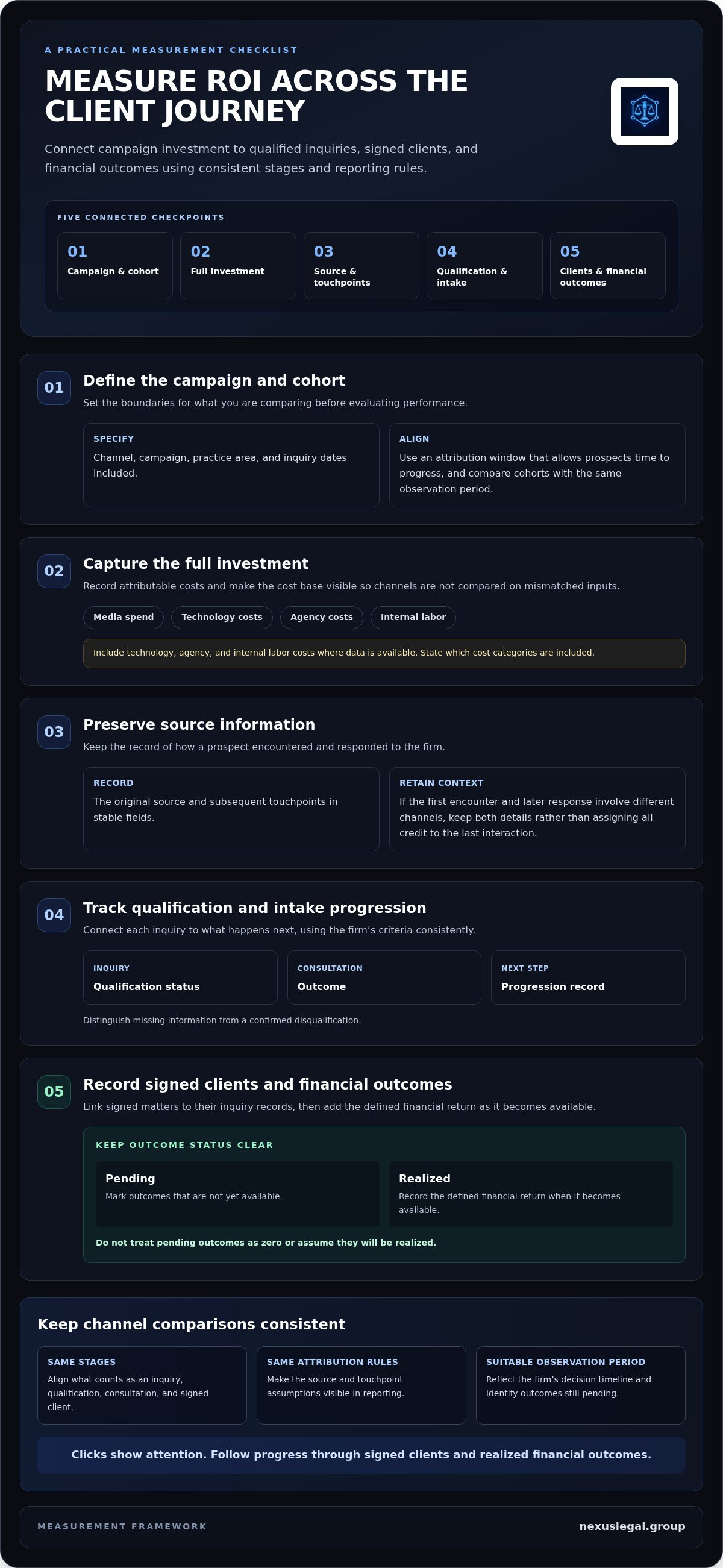
Reliable measurement connects campaign investment to what happens after an inquiry arrives. Use the same stages, attribution rules, and reporting period across channels so your comparison reflects performance rather than inconsistent tracking.
- Define the campaign and cohort. Specify the channel, campaign, practice area, and inquiry dates included. Use an attribution window that gives prospects time to progress, and compare cohorts with the same observation period.
- Capture the full investment. Record attributable media spend and, where data is available, technology, agency, and internal labor costs. State which cost categories are included so one channel is not compared with another using a narrower cost base.
- Preserve source information. Record the original source and subsequent touchpoints in stable fields. If a prospect first encounters the firm through one channel and later responds through another, retain both details rather than assigning all credit to the last interaction.
- Track qualification and intake progression. Connect each inquiry to its qualification status, consultation outcome, and next step. Apply the firm’s criteria consistently, and distinguish missing information from a confirmed disqualification.
- Record signed clients and financial outcomes. Link signed matters to their inquiry records, then add the defined financial return as it becomes available. Mark pending outcomes rather than treating them as zero or assuming they will be realized.
Clicks show attention; signed-client and realized-revenue tracking show whether that attention progressed into business outcomes and how those outcomes relate to investment. This downstream view adds context without implying that a single touchpoint caused the result.
How should a firm calculate marketing ROI?
Use a formula that makes the return definition explicit: (attributable return − attributable marketing investment) ÷ attributable marketing investment. The return may be revenue, gross profit, or another defined value, but label it clearly and apply it consistently. If you use revenue, do not describe the result as profit-based ROI. Revenue does not account for the costs of delivering legal services.
How can intake data improve attribution?
Structured intake records make the client journey traceable. Maintain consistent source, touchpoint, qualification, consultation, and signed-client fields, then connect them to later financial records. This helps show where prospects advance or drop off. Automated intake and verification can support more consistent data capture across those stages.
Document assumptions alongside each report: which costs were included, how source credit was assigned, which cohort was observed, and what counts as a completed outcome. These controls make law firm marketing ROI benchmarks more useful because internal figures and external comparisons are less likely to rely on mismatched definitions.
For firms evaluating acquisition inputs as part of a connected measurement system, growth infrastructure for plaintiff firms can be considered alongside source tracking, verification, and intake outcomes.
How to Compare Law Firm Marketing Benchmarks Without Misreading Them
A published figure is a point of comparison, not a performance target by default. Before using law firm marketing ROI benchmarks to guide decisions, establish what each statistic counts, who was measured, when the data was collected, and how the result was calculated. A channel average can offer context, but it may not describe a firm with a different practice mix, operating capacity, or path from inquiry to signed client.
Use a comparison record that makes gaps visible instead of blending figures from different studies into a single “industry average.” For every statistic, capture these fields:
- Metric: Name the measure, such as cost per inquiry, conversion rate, or return.
- Source and date: Record the original publisher and publication or data-collection period.
- Sample: Note who or what was included, such as firms, campaigns, or inquiries, and any stated sample size.
- Definition: Document the numerator, denominator, included costs, and conversion stage.
- Intended interpretation: State whether the finding is comparable to your firm or useful only as context.
If a source omits a field, mark it as unstated rather than filling the gap with an assumption. Missing methodology may be a reason not to use the number to guide resource allocation.
What makes a law firm marketing benchmark comparable?
Comparison requires alignment across the metric, population, reporting period, and denominator. A cost-per-lead figure based on media spend alone does not match one that includes labor, technology, or agency fees. Likewise, “conversion” could mean an inquiry, completed consultation, signed client, or revenue event. Confirm the stage and cost scope before drawing conclusions. If they differ, treat the figures as separate measures.
When should firms distrust a headline marketing statistic?
Pause when methodology is missing, the sample is vague, the reporting period is old, or a claim assigns causation without explaining how it was established. Budget share and channel adoption describe allocation or use, not effectiveness. Separate reported survey findings from benchmark ranges, your firm’s internal baseline, and aspirational targets. They answer different questions and should not be presented as interchangeable evidence.
Use current primary research when it provides a clear source, date, population, and methodology. Otherwise, omit the figure or label the uncertainty plainly. A reported finding may help frame a question, but it is not a universal target unless its definitions and context fit your firm.
Comparison standards should also preserve the integrity of acquisition practices. Measurement is more useful when source, qualification, and outcome are tracked alongside ethical and compliant lead generation. A consistent approach to compliant legal lead generation can sit within that measurement framework, while each external benchmark remains subject to its own evidence and definitions.
How to Set Practical Marketing ROI Benchmarks for Your Firm
External averages can help frame a decision, but your operating target should start with your own data. Build an internal baseline by channel, practice area, inquiry cohort, and conversion stage. This helps distinguish a channel producing qualified inquiries from one generating activity that rarely progresses, while accounting for differences in case mix and intake capacity.
An internal baseline turns external benchmarks into context for decisions grounded in your firm’s economics, intake performance, and case outcomes. Establish it before setting targets, and keep the underlying definitions stable as you track change.
How should firms turn benchmarks into operating targets?
Start with the business objective, such as increasing qualified inquiries or signed clients in a particular practice area. Document the current baseline, measurement window, and constraints that could affect results, including intake capacity and the time cases take to progress. Review leading indicators alongside downstream outcomes so you can locate friction instead of reacting to one number in isolation.
Use scenario bands rather than treating one market average as a required target. For example, set a conservative case based on recent internal performance, a working case based on a defined operational change, and an ambitious case that depends on clearly stated assumptions. These are planning scenarios, not forecasts or promised outcomes. Record what would need to be true for each scenario, such as consistent source capture or available intake capacity.
Choose a review cadence that fits both inquiry volume and the firm’s case decision timeline. Frequent checks can surface intake or tracking issues, while a longer outcome review may be needed to assess signed matters and financial results. Avoid changing targets because a small cohort fluctuates. Interpret movement in light of the number and maturity of the inquiries being assessed.
How can firms interpret results when attribution is incomplete?
Keep unattributed inquiries and outcomes in a separate category. Do not assign them to the channel that seems most likely or most useful to the report. Apply the same cohort definitions across periods, and note where multiple touchpoints make channel credit uncertain. This preserves the distinction between observed results and attribution assumptions.
Look for patterns across the journey: whether inquiries are qualified, advance to consultation, and become signed clients. If a channel appears weak at the inquiry stage but contributes to later conversions through an earlier touchpoint, last-click reporting may understate its influence. Describe that limitation rather than claiming certainty. For broader channel planning, consider how different lead generation approaches for trial lawyers fit the firm’s measurement system, while keeping acquisition quality and downstream outcomes visible.
Revisit the baseline when the firm changes its practice-area focus, intake process, cost definitions, or attribution rules. Preserve prior versions so a measurement change is not mistaken for a performance change. This creates a practical operating reference: external data informs the discussion, while internal evidence guides resource allocation.
Explore growth infrastructure for plaintiff firms
Connect Marketing ROI to Qualified Case Acquisition and Firm Growth
Case acquisition is one input in a firm’s marketing system, not a complete measure of return on its own. To understand its contribution, track the path from acquisition spend and inquiry delivery through qualification, intake handling, signed-client status, and later financial outcomes. Keep acquisition costs distinct from internal intake and case-handling costs so reports show which investment each figure represents.
Qualified inquiries provide a more useful operational signal than raw lead volume alone. A large count of records says little about whether inquiries fit the firm’s criteria or progress through intake. Qualification adds context, while signed-client tracking shows a later stage. Neither should substitute for the other or be treated as proof of realized financial return.
Where does case acquisition fit in a marketing ROI model?
Use a shared record that follows each inquiry across the workflow. At minimum, align source and campaign information with these separate stages:
- Acquisition: Identify the source and record the acquisition investment using consistent cost categories.
- Verification: Record verification status as its own field, using the same definition across reporting periods.
- Intake: Capture qualification and intake outcomes separately, including records that remain unresolved.
- Engagement: Note whether the inquiry progresses to a consultation or another defined next step.
- Client and financial outcome: Track signed-client status first, then connect later financial outcomes when available.
This structure helps identify where movement slows without attributing every outcome to the acquisition source alone. It also makes clear whether a reported figure reflects delivered inquiries, qualified opportunities, signed clients, or financial results. The value of the measurement depends on stable definitions and downstream records that remain usable as the inquiry progresses.
What should a firm measure when scaling acquisition?
Before expanding an acquisition channel, review source, verification status, intake outcome, and signed-client status as distinct fields. Check whether each cohort is complete enough to interpret and whether unresolved records are being mistaken for unsuccessful outcomes. If reporting shows a gap between delivered inquiries and qualified prospects, investigate that stage before drawing conclusions from volume alone.
Nexus Legal Group provides high-intent motor vehicle accident case acquisition and mass tort case generation. Its MVA acquisition combines AI-driven marketing precision with automated inquiry verification. The workflow uses police reports, emergency-services data, and reverse-append technology to obtain detailed accident reports and participant details. These are measurable acquisition inputs; assess their contribution through the firm’s own qualification, intake, and signed-client records rather than assuming a result from the source type alone.
A practical next step is to align acquisition reporting with the outcome definitions already used by the firm. Record source, verification, qualification, intake, and signed-client fields consistently, then evaluate each cohort through the same stages. This gives law firm marketing ROI benchmarks a clearer connection to growth decisions while keeping reported outcomes tied to evidence.
Make Your Next Marketing Decision More Measurable
Choose one upcoming resource decision and define what evidence would make it easier to act. You might identify a reporting gap, refine how the firm assesses acquisition opportunities, or set a review point for a planned investment. Keep the next step specific and manageable so the team can learn from the result and use that learning in future planning.
Used this way, law firm marketing ROI benchmarks can support a disciplined growth process, not just a comparison with outside figures. Each review can sharpen the questions your team asks and strengthen the connection between marketing decisions and the firm’s priorities.
Keep building on what you learn, and make each next decision with greater clarity and confidence.
Frequently Asked Questions
What is a good marketing ROI for a law firm?
A good result supports the firm’s growth goals without creating financial or operational strain. Set a minimum acceptable outcome based on your own economics, then assess whether performance is sustainable across comparable groups of matters. A single strong case or short-term surge can skew the picture, so consider whether returns remain healthy across a broader set of outcomes and account for the resources needed to serve them.
How do you calculate marketing ROI for a law firm?
Before calculating, decide which financial records count as the return. For example, distinguish fees actually received from projected fees tied to open matters, and apply the same treatment to adjustments or reversed payments. Then reconcile the marketing report with finance records using a shared campaign or cohort identifier. This makes the result easier to audit and reduces the risk of reporting expected income as realized performance.
How much should a law firm spend on marketing?
Set spending within a budget the firm can sustain while campaigns and cases develop. Establish the maximum investment the firm is prepared to commit before the next review, and define what evidence would justify maintaining or reallocating that budget. Include operational readiness in the decision: increasing demand without enough capacity to assess and serve prospects can create a bottleneck rather than support growth.
Which marketing channel has the highest ROI for law firms?
No channel reliably leads for every firm. The strongest option depends on the firm’s practice focus, target-client behavior, case economics, and ability to turn interest into retained matters. Rather than ranking channels by visibility or popularity, evaluate whether each reaches the intended audience and contributes to the firm’s objectives. A channel can be strategically useful even if it is not the largest source of inquiries.
How long does it take to see ROI from law firm marketing?
The timeline depends on how quickly prospects move through the firm’s case process and when financial results become observable. Use historical records to estimate the intervals between first inquiry, signed engagement, and later financial events. That internal timeline can guide review dates more effectively than a generic waiting period. Early signals can inform operational adjustments, but they should not be mistaken for a complete financial assessment.
What is the difference between cost per lead and client acquisition cost?
Cost per lead focuses on generating inquiries; client acquisition cost focuses on obtaining clients. To make the distinction useful, specify how repeat contacts, duplicate records, and inquiries that do not meet the firm’s criteria are handled in lead counts. Also decide whether the client-level measure includes only campaign expenses or additional acquisition-related resources. Clear counting rules help teams interpret changes without mistaking a different denominator for improved performance.
Can law firms compare their marketing ROI with industry benchmarks?
Yes, but use law firm marketing ROI benchmarks as a prompt for investigation, not as a scorecard. If an external figure differs sharply from your results, examine whether a firm-specific factor explains the gap, such as a change in matter mix, client demand, or operating capacity. Then test a defined adjustment and evaluate its effect within your own reporting system before making a larger resource decision.