Technology to Streamline Law Firm Intake: A 2026 Buyer’s Guide
Discover the right technology to streamline law firm intake. Learn how to map your workflow, eliminate handoffs, and choose the best tools for your practice.
What if adding another intake tool creates more handoffs instead of fewer? The right technology to streamline law firm intake should address a specific point in the workflow, from capturing an inquiry to verifying details and assigning the next step. Without clear roles, even capable systems can leave staff re-entering information or chasing missing details.
Slow responses and manual checks can make inquiry handling inconsistent. It’s tempting to look for one platform that solves everything, but intake technology works best when each tool has a defined role and a clear handoff. Staff should retain judgment where context matters.
This guide compares intake options by workflow fit, verification capability, human oversight, and operational value. You’ll learn how to identify the right problem to solve, assess inquiry quality, and connect upstream acquisition and verification with your firm’s internal process. For example, Nexus Legal Group’s MVA acquisition and verification capabilities can supply information before an inquiry reaches the firm, while the firm manages its own intake workflow.
Key Takeaways
- Map where inquiry handling slows down, repeats work, or loses continuity before choosing technology to streamline law firm intake.
- Separate repeatable steps that can be automated from decisions that require staff review, and define clear handoffs.
- Compare intake automation, CRM or case-management systems, communications tools, and verification support by their role in your workflow, not their feature count.
- Record a baseline for your current process, then pilot a solution and assess its value against your own measures.
- Consider acquisition and verification as upstream support. Nexus uses police reports, emergency-services data, and reverse-append technology for MVA inquiries.
Why law firms use technology to streamline intake workflows
Delayed responses, repeated data entry, and unclear handoffs can turn one inquiry into a string of disconnected tasks. A prospective client might submit a form, receive no clear acknowledgment, repeat details on a later call, then wait while staff work out who should follow up. The problem may not be a lack of effort. It may be a process with too many manual steps or no visible owner at key transitions.
Streamlined intake is a coordinated set of tools and processes that helps a firm capture, review, route, and follow up on inquiries with less avoidable friction. The goal is consistent operations, not an automatic increase in signed matters. Technology can organize information and make next steps easier to track, but it cannot guarantee that an inquiry meets the firm’s criteria or becomes a signed case. Staff remain central to assessing context and deciding how to proceed.
Intake tools sit within a broader legal-technology ecosystem that includes practice management, document automation, and client relationship systems. The Legal Technology Overview provides useful context. To choose a tool, focus on the specific point in your intake workflow where work slows down or information gets lost.
Where intake friction appears in a plaintiff firm
Trace an inquiry from its arrival through the initial response, information capture, verification, and follow-up. At each stage, ask what information is collected, who owns the next action, and how the rest of the team can see that action. Common bottlenecks include a form that requires duplicate entry, a verification step with no assigned owner, or a follow-up task that remains in one person’s inbox.
Look for recurring patterns before assuming every delay calls for new technology. A short-lived increase in inquiries can create a temporary queue. A repeated backlog at the same stage may point to a process constraint, capacity mismatch, or unclear handoff. Review inquiry records over time to distinguish a volume fluctuation from a recurring breakdown. If staff can’t tell whether an inquiry is awaiting review, verification, or contact, make ownership and status easier to see.
What better intake operations should accomplish
Effective intake operations make each inquiry’s status and next action clear. Staff should be able to capture relevant information consistently, see what still needs review, and route the inquiry to the appropriate person or workflow. Automation can handle routine recording and task assignment, while staff manage judgment-based evaluation and communication that requires context.
Timely routing matters, but the right standard depends on the firm’s staffing and process. A software feature alone won’t resolve unclear ownership. Visible status, assigned responsibility, and recorded follow-up help managers see where work is accumulating and help staff understand what they own. That visibility supports accountability and improvement without confusing faster administration with better case quality.
How intake technology connects inquiry capture, verification, and follow-up
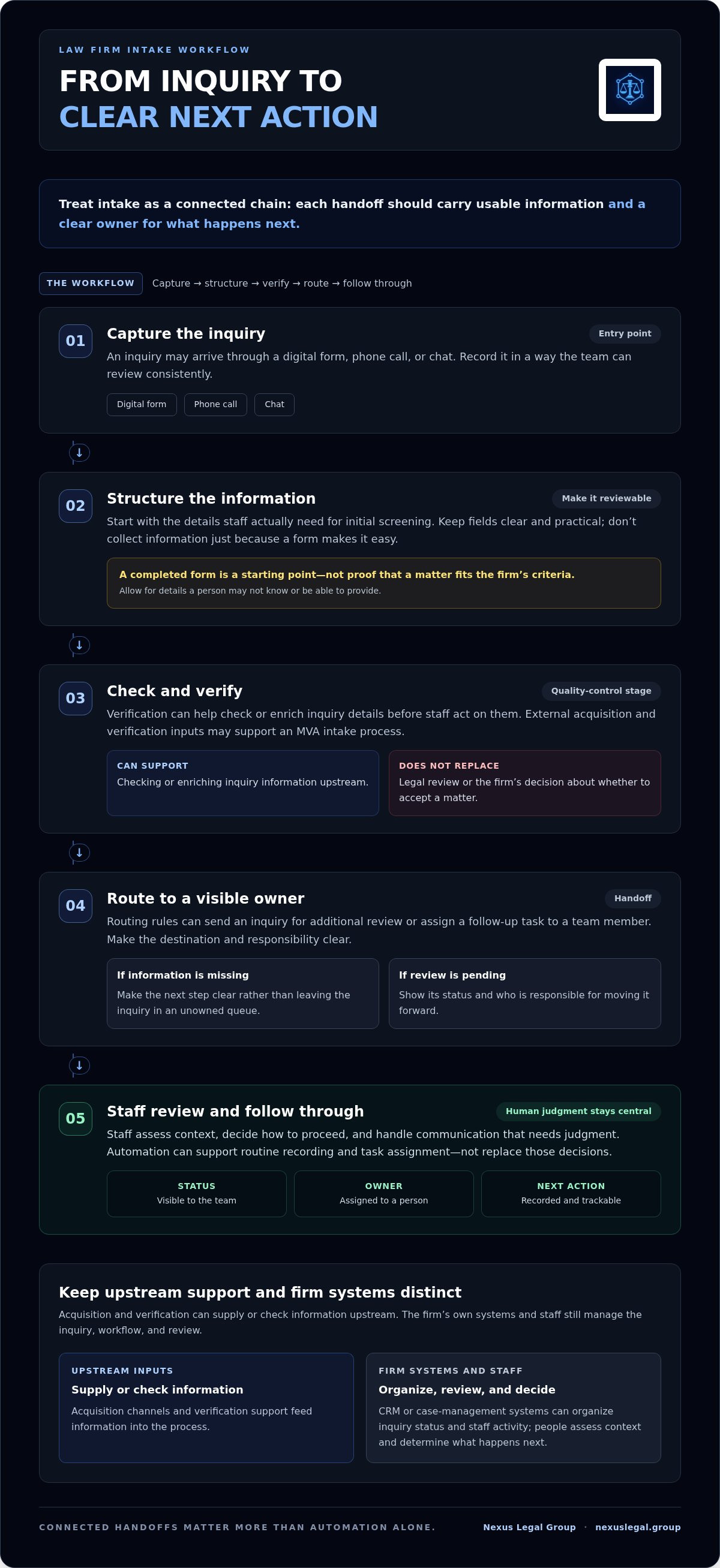
An intake workflow is a chain of decisions, not a single form or automation feature. An inquiry may arrive through a digital form, phone call, or chat. Information is then captured, checked, routed, and followed up on by the appropriate staff member. Each stage should pass along usable information and a clear next action. Connected handoffs matter more than automation alone: an automated task still creates friction if its result doesn’t reach the person responsible for the next step.
When assessing technology to streamline law firm intake, distinguish the firm’s systems of record from the inputs that feed them. A CRM or case-management platform can organize inquiry status and staff activity. Acquisition channels and verification support can supply or check information upstream, but they don’t replace the firm’s records, workflow, or review.
Inquiry capture and structured information
Forms, calls, and chat capture information in different ways. The firm should still be able to review it in a consistent structure. Start with the screening process staff actually use. Identify what they need for an initial review, then make relevant fields clear and practical to complete. Don’t collect details simply because a form builder makes it easy to add another field.
Required fields can reduce incomplete submissions, but they should reflect real intake needs and allow for situations where a person doesn’t know or can’t provide an answer. A completed form is a starting point, not proof that a matter fits the firm’s criteria. Staff still need context and a defined process for assessing the information.
Verification, routing, and human follow-through
Verification is a distinct quality-control stage. It can help check or enrich inquiry details before staff act on them, but it doesn’t replace legal review or determine whether the firm should accept a matter. For example, external acquisition and verification inputs can support an MVA intake process, while the firm remains responsible for recording the inquiry, reviewing its context, and deciding what happens next.
Routing rules can assign inquiries according to the firm’s workflow, such as sending an item for additional review or assigning a follow-up task to a team member. Make the destination and owner visible. Define what happens when information is missing or a review is pending. For a closer look at this operational layer, read Automated Intake for Plaintiff Firms.
Use automation for repeatable actions, such as organizing captured information or flagging a follow-up task. Keep people involved when the next step depends on context, judgment, or direct communication. Nexus Legal Group’s case acquisition and verification support can contribute upstream information to a firm’s intake operations. The firm’s internal systems and staff manage the inquiry through its own process.
Which law firm intake technology fits your workflow?
The right choice depends on where work stalls, not on how many features a platform advertises. Map the problem first. Repeated copying suggests an administrative automation need. Scattered matter details point to a record-management issue. Concerns about inquiry information call for a defined verification process. Technology to streamline law firm intake should address that specific gap and make the next handoff clearer.
Compare technology by the problem it solves
Use this comparison to identify the role a tool would play. Categories can overlap, but each should have a defined responsibility in the workflow.
| Technology category | Primary role | Workflow fit | Handoff needs | Implementation considerations |
|---|---|---|---|---|
| Intake automation | Reduce repetitive administrative steps | Useful where staff repeatedly organize or enter the same inquiry details | Make the resulting task or status visible to its owner | Align automated steps with the firm’s actual screening sequence; define exceptions for incomplete or unusual inquiries |
| CRM or case-management system | Maintain organized inquiry or matter records | Useful when information and activity are fragmented across records or staff workflows | Clarify when an inquiry becomes a matter and who updates its status | Establish which system is the source of record and how staff will maintain consistent data |
| Communications tools | Support inquiry conversations and follow-up | Useful when calls, messages, or follow-up activities are difficult to track | Ensure the conversation and next action are accessible to the responsible staff member | Define how communication activity is recorded and how unresolved inquiries are surfaced |
| External verification support | Check or enrich inquiry information upstream | Useful when information quality is a distinct concern before firm-side review | Specify how verified information reaches the firm’s intake workflow | Keep verification separate from the firm’s legal review and matter decisions |
Balance automation with staff judgment
Automation can support staff, but it doesn’t inherently replace judgment. A rule can route an inquiry based on captured information, while a person may still need to interpret an unclear account, request context, or decide whether to escalate it. Build exception handling into the process. Missing details, conflicting information, and inquiries that don’t fit routine paths should go to an assigned reviewer, not an unattended queue.
Before selecting a platform, list which actions are routine and which require human attention. Then define who receives an exception, how its status is recorded, and what makes it ready to return to the standard workflow. This keeps automation bounded and accountable. An automated status shouldn’t imply that meaningful review has taken place.
Technology selection is one part of a wider operating model. A law firm growth-infrastructure perspective connects intake operations with the systems and inputs that support firm growth, including acquisition and verification. Keep internal records, workflow tools, and external support in complementary roles.
How to evaluate and implement intake technology
Choose technology to streamline law firm intake by testing whether it addresses a documented process problem. Don’t assume a larger feature set will improve operations. Before comparing options, record a baseline for your current workflow using measures tied to the issue you want to resolve. These might include inquiry status visibility, completeness of captured information, follow-up completion, or handoff errors.
Build a requirements framework before comparing tools
Document how inquiries arrive, where information is entered or repeated, who owns each handoff, and which failures recur. Separate essential workflow requirements from optional features. Record internal expectations for user access, security, and data handling, and assign an owner to exceptions. This framework keeps comparisons grounded in actual firm processes rather than vendor language or appealing features that don’t address the bottleneck.
- Map the workflow. Trace a typical inquiry from arrival through staff follow-up. Note the systems, people, and manual steps involved, including where work pauses or information changes hands.
- Define requirements. Turn the process map into specific needs. If staff re-enter the same details, prioritize reducing duplicate entry. If inquiry status is unclear, require a visible way to track the next action.
- Compare fit. Assess each option against essential requirements, handoffs, exception paths, and data-handling expectations. Record where a tool fits and where staff would still need a separate process.
- Pilot a contained workflow. Test the proposed approach on a limited process before expanding it across the firm. Identify who will use it, who will handle exceptions, and how staff can report problems during the test.
- Review and refine. Compare pilot results with the baseline and gather staff feedback. Check whether the targeted task is easier, handoffs are clearer, and exceptions reach an owner. Adjust the workflow before deciding whether to expand.
Pilot, measure, and refine the workflow
Plan for adoption as well as setup. Staff need to understand what is changing, which steps remain theirs, how to record an exception, and where to raise a concern. A tool that works in a demonstration can create new friction if responsibilities are unclear or the process doesn’t match daily work. Use the pilot to uncover gaps, revise instructions, and confirm that the workflow is usable for everyone expected to follow it.
Success measures should reflect the problem being solved, not the number of features deployed. If the goal is to reduce repetitive entry, review whether duplicate work declines. If the goal is clearer routing, examine whether inquiries reach the assigned next step and exceptions are visible. Tie the review to the firm’s own process rather than an assumed industry benchmark.
Connect intake technology with verified case acquisition
Firm-side intake systems organize the inquiries a plaintiff firm receives. Acquisition and verification support operate upstream, shaping what information can reach that workflow. Keeping those roles distinct helps firms assess technology to streamline law firm intake without confusing an inquiry source with a system for managing inquiries. Nexus Legal Group provides case acquisition and verification support that can feed a firm’s intake operations. The firm retains control of its own review, communication, and case-management processes.
For motor vehicle accident matters, Nexus’s acquisition approach uses police reports, emergency-services data, and reverse-append technology to obtain accident reports and details about people involved. These sources and verification processes can provide structured information for the firm’s next intake steps. They don’t determine whether an inquiry meets the firm’s criteria, guarantee a matter will be signed, or replace the firm’s internal evaluation.
Where acquisition and firm-side intake meet
The operational handoff should clarify what information is provided, where it enters the firm’s intake process, and who owns the next action. Staff can then review the inquiry, identify missing context, and continue communication within the firm’s established workflow. Acquisition and verification provide an upstream input; internal intake and case-management tools track the firm’s subsequent activity.
For a broader view of how targeted acquisition can support a firm’s growth objectives, explore the Data-Driven Case Acquisition perspective. The useful question isn’t whether outside support replaces intake software. It’s whether the information arrives through a defined handoff that staff can review and act on.
Assess fit for a plaintiff firm’s intake objectives
Start with the matter types the firm intends to pursue and the operational capacity available to review incoming inquiries. A strong fit aligns acquisition with those objectives, applies a clear verification process, and defines how information passes to the firm for follow-up. If the handoff creates duplicate entry or unclear ownership, the upstream input may not resolve the firm’s actual bottleneck.
Evaluate the process as a connected sequence: relevant inquiry information is sourced and verified, delivered for firm-side review, and handled according to the firm’s own criteria. A clear boundary between these stages supports quality control without treating verification as legal judgment or suggesting acquisition alone produces signed cases. Nexus’s lead generation is ethical and compliant. Firms can assess how acquisition and verification fit alongside their internal processes and capacity.
For plaintiff firms considering how external acquisition and verification could support intake objectives, a growth-infrastructure discussion can clarify the intended handoff and operational fit.
Set the next intake improvement in motion
Start with one recurring point of friction. Identify who owns it and what evidence would show that the process is working better. This gives your team a practical basis for assessing technology to streamline law firm intake, then refining the workflow as operating experience reveals what needs attention. Progress comes from a process staff can understand and sustain, not simply from adding another system.
As you plan, consider where upstream growth support belongs alongside the firm’s internal intake operations. A clear boundary between those functions keeps responsibility for review, communication, and case decisions with the firm while supporting a more coherent growth strategy.
With a defined objective and a workflow your team can own, you can move forward with greater clarity and improve intake operations over time.
Frequently Asked Questions
Can technology streamline law firm intake without replacing intake staff?
Yes. A firm can use technology to reduce administrative work while keeping staff available to people who need clarification or can’t complete a digital form. Before launch, decide how someone can request human assistance and what alternative intake route is available. This makes the process more accessible without requiring every inquiry to use the same channel. It also helps the firm avoid treating a form submission as the only valid starting point.
What technology should a law firm use for client intake?
Look for capabilities that help staff manage inquiry information and activity, such as source attribution, duplicate detection, a record of prior contact, and clear task ownership. These requirements can help distinguish a general case-management system from a tool designed to support prospective-client intake. Define what staff need to see and record before choosing a system, so the decision reflects the firm’s actual workflow.
How can a law firm measure whether intake technology is working?
Look beyond total inquiry volume. Compare results by referral source and matter type, then follow each group through meaningful stages such as completed screening, consultation, and signed matter. This can show whether a process change affects the kinds of inquiries the firm wants to handle, rather than simply increasing activity. Interpret the patterns carefully: a change in conversion alongside a new tool doesn’t, by itself, prove that the tool caused it.
Is AI reliable enough to qualify legal inquiries?
Reliability depends on how the firm defines the task and tests the output. Before using AI to sort inquiries, compare its classifications with staff assessments on a representative set of past examples. Review obvious mismatches as well as borderline cases, where a short or ambiguous description may be categorized too confidently. Use the results to decide whether AI is useful for a limited screening task and where staff need to review its output.
What happens if intake automation routes an inquiry incorrectly?
Prepare a recovery path that staff can use without relying on the original routing rule. For example, staff can reassign an inquiry that reached the wrong team while preserving its contact history, then record the routing issue for later review. Make it easy to identify inquiries with no active owner. That helps prevent a correction from creating another information gap or requiring the prospective client to repeat details.
Does law firm intake technology need to connect with a CRM or case-management system?
Not in every situation. First define the minimum information that must move between tools, such as inquiry source, contact details, current status, and relevant activity. Then determine whether the firm can transfer and maintain those fields accurately without creating duplicate records. If systems remain separate, document the transfer point and ownership clearly. Base the decision on reliable recordkeeping, not connectivity for its own sake.