Red Flags During Client Intake for PI Cases: A Practical Screening Checklist
Spot red flags during client intake for PI cases effectively. Use this practical screening checklist to ask the right questions and document clean handoffs.
A mismatch in an intake account isn’t a verdict. It’s a reason to ask a better question. Red flags during client intake for PI cases can point to missing context, conflicting details, or a process risk that needs attorney review. Treating every concern as an automatic rejection may cause staff to miss information that could clarify the inquiry.
Inconsistent accounts and incomplete information can slow screening and take time across the firm. A consistent approach helps intake staff distinguish between a concern that needs a neutral follow-up question and an issue that remains unresolved. It also gives the next reviewer a clearer record for case evaluation.
This checklist explains which warning signs warrant closer review, how to ask focused, non-leading questions, and what to document before handing an inquiry to an attorney. It also shows how organized verification can connect inquiry details with the information needed for a clear handoff.
Key Takeaways
- Use red flags during client intake for PI cases as prompts for clarification, not automatic reasons to reject an inquiry.
- Review incident facts, injury and treatment details, prior contacts, and expectations for gaps or inconsistencies that need follow-up.
- Classify each concern as clarified, unresolved, or significant enough for attorney review. Keep automated checks separate from firm judgment.
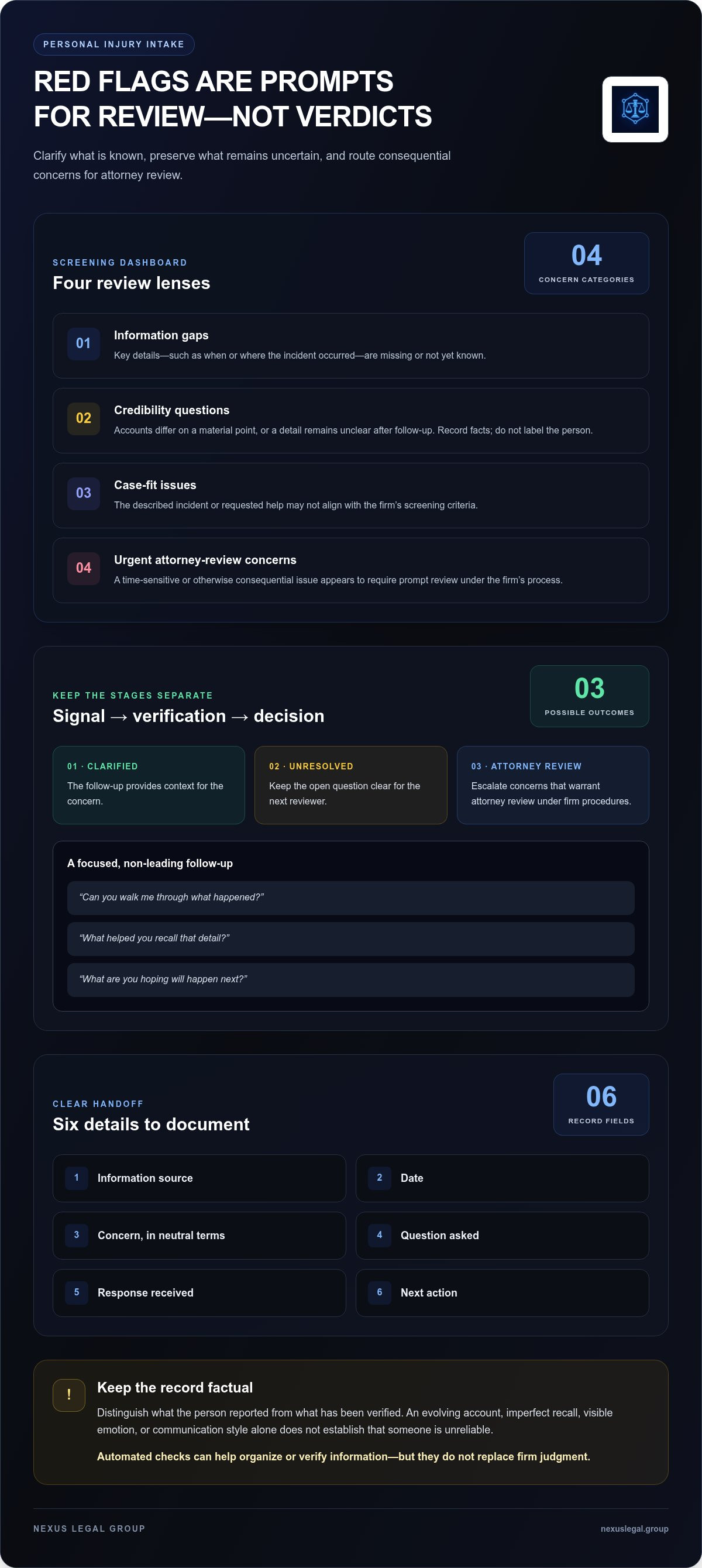
- Document the information source, date, concern, question asked, response, and next action to support a clear handoff.
- Build a repeatable screening process around timely responses, consistent verification, and disciplined review, rather than inquiry volume alone.
Red Flags During Client Intake for PI Cases: What They Signal, and What They Do Not
An intake red flag is an inconsistency, missing detail, or other risk signal in a prospective personal injury account that requires clarification or review. It identifies a question to resolve, not a conclusion about the claim. A single concern does not establish that a matter lacks merit. Context, verification, and appropriate attorney review may change how the information is understood.
For consistent screening, sort concerns into four categories:
- Information gaps: Key details, such as when or where an incident occurred, are missing or not yet known.
- Credibility questions: Accounts differ on a material point, or a detail remains unclear after follow-up. There may be an explanation, so record the facts rather than labeling the person.
- Case-fit issues: The described incident or requested help may not align with the firm’s screening criteria.
- Urgent attorney-review concerns: A time-sensitive or otherwise consequential issue appears to require prompt review under the firm’s process.
This distinction keeps an early signal from becoming an unsupported decision. A neutral question can clarify what is known, what remains uncertain, and what needs a different level of review. Consistent screening also helps prospective clients receive a professional, respectful experience instead of different responses depending on who handles the inquiry. The broader professional framework includes the Model Rules of Professional Conduct. Firms should apply their own procedures and relevant professional guidance to intake decisions.
Why a first-contact account may be incomplete
At first contact, a person may be in pain, stressed, uncertain about details, or relying on an imperfect recollection. They may remember additional information later or clarify an answer after a focused question. An evolving account is not automatically a contradiction. Identify what changed, when it changed, and whether the difference concerns a material detail. Communication style, visible emotion, or imperfect recall alone isn’t proof that someone is unreliable.
Signal, verification, and decision are separate stages
Follow a simple sequence: record the concern in neutral terms, ask a focused question, document the response, then use the firm’s escalation process if an important issue remains unresolved. Note the information source and distinguish what the person reported from what has been verified. Automated checks can help organize or verify information, but they don’t replace firm judgment.
An intake flag is a prompt to verify information, not a legal conclusion about the merits of a case. That distinction is central to handling red flags during client intake for PI cases consistently: clarify what can be clarified, preserve unresolved questions for review, and avoid turning an initial concern into an automatic rejection.
Which Personal Injury Intake Details Deserve Closer Review?
Review the details that shape the incident account, reported injuries and care, prior contacts, and the person’s expectations. A gap or difference calls for a neutral follow-up, not a finding about credibility or case merit. Use open-ended questions, and preserve the person’s wording when it helps clarify what they know firsthand.
Conflicting or incomplete accident accounts
Check whether the incident date, location, and sequence of events are clear. If the account changes, ask, “Can you walk me through what happened?” or “What helped you recall that detail?” Clarify which parts the person remembers directly and which they learned from a report, witness, or another source. A police or crash report may offer details to compare with the account, but it may not capture the full context. Record the reported information and any differences that still need review.
Injury, treatment, and prior-contact gaps
Ask what symptoms or injuries the person reports, when they noticed them, and what care they say they sought. If there’s a gap in the timeline, ask what was happening during that period instead of assuming the gap proves or disproves anything. Treatment decisions and timelines vary, so record the answer without drawing a medical or legal conclusion.
Clarify whether the person has contacted an attorney, insurer, or another firm about the incident. If representation status is unclear, record the question and response for attorney review rather than making an assumption. Practical guidance on assessing a potential client also highlights the value of careful evaluation over relying on a single impression.
Expectations and requested help
Ask what the person hopes the firm can help with and what they understand about the process. Misaligned expectations may reflect uncertainty, not bad faith. A neutral prompt such as “What are you hoping will happen next?” gives staff useful context without suggesting an answer or promising an outcome.
Across all four categories, keep the record factual: identify the source, capture the answer, and flag unanswered questions for the next reviewer. For firms refining MVA inquiry acquisition and verification, structured inquiry information can support a more organized handoff from initial screening to case evaluation.
How to Assess Red Flags Without Rejecting a Viable PI Inquiry
A useful screening process separates the initial signal from the next action. After a focused follow-up, classify the concern as clarified, unresolved, or material enough for attorney review. This keeps staff from treating every discrepancy as disqualifying while ensuring important questions don’t disappear during a handoff.
| Signal | Follow-up | Escalation |
|---|---|---|
| Clarified: The person explains a date difference or provides context for a missing detail. | Record the explanation and distinguish the person’s account from any independently verified information. | Continue screening under the firm’s usual criteria. Note any remaining question. |
| Unresolved: The response doesn’t resolve a gap or leaves accounts inconsistent. | Ask one neutral, focused question. Record the answer and what remains unclear. | Refer the issue through the firm’s defined review process if it remains material. |
| Attorney review: A concern involving liability, injury, prior representation, or case fit may affect evaluation. | Summarize the relevant facts without drawing a legal conclusion. | Route it promptly to the appropriate attorney or reviewer under firm procedures. |
Resolve discrepancies with focused follow-up
Ask one question at a time and invite the person to explain the difference in their own words. For example: “I have two different dates noted. Which date do you recall, and what might explain the difference?” Avoid suggesting a preferred answer. Then label the information accurately: reported by the person, verified through a source, or staff interpretation. Keeping these categories distinct makes the record easier to assess and reduces the risk of an assumption being repeated as fact.
Escalate concerns that remain material
Unresolved liability details, injury information, prior-representation questions, or case-fit concerns should follow the firm’s review process. Intake staff can identify and document the issue without making legal conclusions beyond their assigned role and training. Clear escalation criteria also help staff apply the same standard across calls, forms, and other inquiry channels, limiting decisions based on individual interpretation.
Automation can organize incoming information, flag missing fields, and support verification, but it can’t replace firm judgment about context or next steps. Use consistent verified MVA inquiry standards and automated plaintiff-firm intake workflows as part of a broader process: technology structures the information, staff clarify it, and designated reviewers assess unresolved concerns. This makes red flags during client intake for PI cases easier to handle consistently without turning an initial signal into an automatic rejection.
A Repeatable PI Intake Checklist for Documenting and Escalating Concerns
A consistent record turns an initial concern into a reviewable item rather than a subjective label. Use the same sequence across intake channels, adapting the questions to the inquiry and the firm’s approved process.
- Capture the initial account. Record the person’s description of the incident and identify the source, such as a phone call, form, or follow-up conversation. Separate what the person reports from information obtained elsewhere.
- Identify the precise concern. Note the specific gap or inconsistency, such as different incident dates in two sources. Avoid broad labels like “unreliable” or “weak case.”
- Ask a focused question. Record the question and response, using the person’s wording where useful. Keep the exchange neutral and don’t insert an explanation the person hasn’t provided.
- Verify relevant details. Note what information was checked, the source, and the date of the check. Keep independently checked information distinct from the person’s account and staff observations.
- Record what remains open. State whether the concern was clarified, remains unresolved, or needs additional review. Identify the next action and the person or team responsible for it.
- Escalate using firm criteria. Route material concerns through the firm’s established review process. Include a concise summary of the issue and supporting information, without promising an outcome or making a legal conclusion outside the staff member’s role.
- Confirm the handoff. Ensure the receiving reviewer can see the open question, its status, and the assigned next step. Update the record when new information arrives so the concern doesn’t disappear between screening and evaluation.
Record facts, sources, and unresolved questions
A useful note makes clear what is known and how it became known. For example: “Caller reports the collision occurred on Tuesday; report lists Wednesday; asked caller to clarify date; caller is unsure; date discrepancy remains open; assigned for review.” This captures the source, date, concern, question, response, and next action without turning uncertainty into an established fact.
Set a consistent review and handoff threshold
Firm-approved criteria help staff decide when additional verification or attorney review is appropriate, regardless of who received the inquiry. Any external legal, privacy, advertising, or professional-conduct requirements should be checked for the applicable jurisdiction rather than treated as universal. A documented process for compliant legal lead generation can also help firms align inquiry acquisition and verification with disciplined intake review.
Turn PI Intake Red Flags Into a More Reliable Case-Acquisition Process
Effective screening balances four operating priorities: respond promptly, verify consistently, document clearly, and escalate appropriately. A red flag should move through a defined review path, not disappear in an inbox or become an automatic rejection. When staff apply shared criteria across calls, forms, and follow-ups, the firm can assess inquiries using reliable information rather than individual assumptions.
That discipline also changes how firms evaluate acquisition performance. Inquiry volume alone doesn’t show whether the information is usable or whether open questions reach the right reviewer. A stronger process connects inquiry sourcing to verification and intake follow-through, helping teams distinguish details that are ready for review from those that still need clarification. This is where a structured approach to red flags during client intake for PI cases supports both case evaluation and operational consistency.
Connect inquiry sourcing with intake verification
For motor vehicle accident inquiries, police reports, emergency services data, and reverse append technology can help obtain accident report details and information about those involved. These sources can give intake teams additional context to compare with a person’s account, while leaving room to document differences and ask follow-up questions. Source information supports review; it doesn’t replace the person’s account or the firm’s judgment. Police report-generated MVA inquiries can contribute to a more organized screening process.
Nexus Legal Group provides growth infrastructure for plaintiff firms, combining AI-driven marketing precision with intake verification. Its MVA inquiry acquisition includes police report-based and emergency services-generated leads, as well as reverse append capabilities to obtain accident report details. Structured verification helps firms organize incoming information for the next stage of review, without treating technology as a substitute for attorney evaluation.
Establish the next operational step
Translate the screening approach into a practical handoff: align intake questions with firm-approved criteria, record the source and status of each concern, verify relevant information, and route unresolved material issues for attorney review. Make ownership clear so the next person knows what remains open and what action is expected. The goal is a controlled process, not a promise of a particular case outcome, conversion rate, or legal result.
For firms refining acquisition and verification as part of their intake operations, explore plaintiff-firm growth infrastructure.
Build a More Reliable Intake-to-Review Process
Red flags during client intake for PI cases are prompts to clarify, verify, and document, not automatic reasons to reject an inquiry. Consistent questions help staff distinguish a resolved gap from an issue that remains open, while clear ownership and attorney review keep important concerns moving through the intake process.
Reliable case acquisition depends on more than inquiry volume. It also depends on the quality and organization of the information teams receive. Nexus Legal Group supports plaintiff firms with high-intent MVA inquiry acquisition and automated verification, using police report and emergency services data to add relevant context for screening and review.
A disciplined intake process gives your team a practical foundation for evaluating inquiries and making informed handoffs. Strengthen that foundation with growth infrastructure built around acquisition and verification.
With clear records, consistent verification, and thoughtful escalation, your team can approach each inquiry with greater confidence and care.
Frequently Asked Questions
What are the most common red flags during client intake for PI cases?
Common red flags during client intake for PI cases include conflicting incident details, missing or unclear timelines, unanswered injury or treatment questions, prior attorney or insurer contact, and expectations that need clarification. Each calls for focused follow-up, not automatic rejection. Ask neutral questions, then record the concern, response, source, and next action. This gives the next reviewer a clear view of what is known and what remains open.
Should a personal injury firm reject an inquiry because the caller’s story changes?
No. An account may become more complete as the person recalls details or reviews records. Identify exactly what changed, ask neutral questions, and distinguish firsthand recollection from information received later. Document the explanation in clear, factual language. If a material inconsistency remains unresolved, route it through the firm’s established review process. Intake staff should not turn a change in the account into an unsupported conclusion about credibility or case merit.
How should intake staff handle gaps in medical treatment information?
Ask what care the person reports receiving, when it occurred, and whether they can explain any gap in the timeline. Record the answer without assuming that a particular treatment history proves or disproves a claim. Intake staff shouldn’t diagnose injuries or make legal conclusions. If questions remain unresolved, document and escalate them according to the firm’s review process so the appropriate reviewer can assess the information.
Can an automated intake system identify red flags in PI cases?
Automation can organize responses, surface missing fields, compare available information, and route items for review. It can’t independently supply context a person hasn’t provided or replace appropriate human judgment. Firms should define which signals trigger follow-up, preserve a clear record of each information source and response, and ensure unresolved or material concerns reach the appropriate reviewer. Use technology to structure the workflow, not to make an unsupported case decision.
What information should a law firm document when it finds an intake concern?
Record the concern in neutral language, its information source, the date, the follow-up question, the person’s response, any relevant verification, and the next action or assigned reviewer. Separate reported facts from staff observations and assumptions. A consistent record helps colleagues understand what remains unresolved and supports a reliable handoff. It also prevents an initial impression from being repeated later as if it were an established fact.
When should a PI intake red flag be escalated to an attorney?
Escalate when a concern remains unresolved after clarification, may materially affect case fit or evaluation, or falls outside the intake team’s role. The firm should define its review thresholds and apply them consistently. Staff should document the issue and response, then route it through the established process without promising an outcome. Legal analysis belongs with the appropriate attorney, not with intake staff acting beyond their assigned role.
How can a firm reduce false positives during personal injury intake screening?
Use the same neutral questions and review criteria across staff, distinguish incomplete information from contradictory information, and give people an opportunity to clarify. Don’t rely on demeanor, assumptions, or one answer in isolation. Review documented decisions periodically for consistency, and adjust questions when recurring confusion leads to unnecessary escalation. This helps staff focus on information that needs verification instead of treating ordinary uncertainty as proof of a problem.