How to Verify a Potential Client’s Injury Claim: A Law Firm Workflow
Learn how to verify a potential client's injury claim with our step-by-step law firm workflow. Spot discrepancies, organize facts, and streamline your intake.
Knowing how to verify a potential client's injury claim starts with treating the initial account as a starting point, not a final answer. A caller may describe the incident accurately in broad terms while details that matter for the next intake step remain unclear. A single document rarely resolves every question.
Inconsistent timelines, missing records, or different descriptions of an incident can complicate screening. Rather than making a premature decision, compare the available information systematically, record what aligns, and flag what needs clarification or attorney review.
This guide outlines a practical workflow for checking incident details, the claimant’s account, available reports, and supporting documents. You’ll learn how to identify gaps and discrepancies without treating them as automatic grounds to decline a matter, and how to route sufficiently documented inquiries for attorney review. For motor vehicle accident (MVA) intake, police-report and emergency-services data, supported by automated verification, can add incident context while leaving legal review to the firm.
Key Takeaways
- Learn how to verify a potential client’s injury claim by treating intake checks as fact organization, not proof of liability, causation, or case value.
- Use a consistent sequence to capture the account, compare available sources, document discrepancies, and route unresolved questions for review.
- Assess identity, chronology, report details, injury accounts, and supporting materials while recognizing what each signal cannot establish on its own.
- Standardize intake records with fields for source, timestamp, claim detail, verification status, and follow-up owner.
- Use police-report and emergency-services data, including reverse-append methods, to add incident context to MVA inquiries without replacing attorney review.
How to verify a potential client’s injury claim without confusing screening with proof
For intake teams, how to verify a potential client's injury claim begins with a clear boundary: screening organizes information for review, but it does not decide whether a claim is legally valid. First, check the claimant’s identity, capture the reported incident and injury, and identify what supporting information is available or missing. This gives the firm a coherent starting record without turning an early inquiry into a conclusion about fault, causation, or case value.
Preliminary verification checks and organizes reported facts and available supporting information; an attorney’s merits assessment determines how those facts may bear on a legal claim. Separate the record into three categories: what the claimant reported, what an independent source supports, and what remains unconfirmed. For example, the caller’s description of a collision is claimant-provided information. A report matching the date and location is an independent point of comparison. An unclear intersection or conflicting time remains an open question.
What does verifying an injury claim mean during intake?
At this stage, verification means assembling a traceable account and identifying gaps for follow-up, not testing every legal issue. An inquiry that appears plausible and has some document support is still different from a proven claim. Evidence can take different forms, and this overview of the rules and legal principles that govern the proof of facts helps frame why gathering information is distinct from determining what it proves. Intake notes should preserve that distinction.
Apply the same fields and review standards whether an inquiry arrives by phone, web form, or another channel. Consistency helps staff compare like information, reduces reliance on individual judgment, and gives an attorney a clearer view of what is documented and what needs clarification. Treat a discrepancy as a prompt to investigate, not an automatic reason to accept or reject the matter.
Which facts should a firm establish first?
Begin with the basics, following the firm’s procedures for recording identity and preferred contact details. Then capture when and where the incident reportedly happened and how the claimant says it occurred. Use neutral language, preserve the person’s account as given, and distinguish direct statements from staff summaries or information obtained elsewhere.
Record the reported injury and care to date in the claimant’s own terms, without presenting the description as a medical finding. Note whether supporting information has been mentioned or provided, and mark missing items for follow-up. The goal is a usable intake record: enough structure to compare the account with available information and route unresolved questions for attorney review.
How to verify an injury claim by comparing statements, reports, and records
A useful comparison process preserves where each detail came from and what it may support. Capture the claimant’s account first. Identify available independent sources, compare the same incident details across them, log differences without interpretation, and route unresolved questions for follow-up or attorney review. This sequence makes intake more complete without turning screening into a finding about the claim.
Corroboration across sources improves the completeness of an intake record, not the legal certainty of the claim. A police crash report may help confirm details such as the reported date, location, involved parties, or documented sequence. It is one source, however, and should not be treated as a complete assessment of fault, injury causation, or case merits. For legal context, the Federal Rules of Evidence address evidence in federal proceedings. Comparing intake information is not the same as deciding admissibility or applying those rules to a case.
How should firms compare the claimant’s account with an incident report?
Review matching details side by side: incident date, location, parties, sequence of events, and reported mechanism of injury. If a caller describes a rear impact but the report’s narrative appears to describe a different sequence, record the difference as an unresolved question. It may reflect incomplete information, different perspectives, or an error. Intake staff should not label it dishonesty without further review.
Record where the report came from, when it was obtained, and any visible limitations, such as missing narrative details. Keep the report’s content distinct from staff interpretation so the next reviewer can trace each entry to its source.
What can injury and treatment information corroborate?
Compare the claimant’s reported symptoms and care chronology with available, claimant-authorized treatment information. The timeline may help identify when care was reported, which details appear consistent, and where dates or transitions are unclear. Record what the source says rather than filling gaps with assumptions. Treatment documentation can support a record of reported care, but by itself it does not establish fault or medical causation.
To apply how to verify a potential client's injury claim consistently, log each comparison with the source, detail checked, status, and follow-up question. For example, if the account describes symptoms beginning at the scene but the available information starts with a later visit, note the timing gap for review. Firms building structured MVA intake can use data-supported MVA inquiry workflows to add incident context alongside their own review.
Which verification signals matter, and which discrepancies need careful review?
Assess each signal for what it supports, then record its limits. A missing document or detail is not automatically a contradiction; it may simply create a follow-up task. A material inconsistency occurs when sources give conflicting information about a key point, such as the incident date or sequence. Do not resolve either situation by assumption. This framework helps intake teams apply how to verify a potential client's injury claim consistently while keeping conclusions within the appropriate scope.
| Signal | What it may support | What it cannot establish |
|---|---|---|
| Identity consistency | That names and identifying details align across the inquiry and available documents. | That every account detail is accurate or that a legal claim is valid. |
| Incident chronology | A coherent sequence of reported events and timing. | Fault or the cause of an injury. |
| Incident-report details | Information recorded about the event, such as its reported location or involved parties. | A final liability ruling or a complete account of the incident. |
| Injury account | Consistency in the claimant’s description of symptoms and reported care over time. | Medical causation or the full extent of an injury. |
| Available supporting documents | Whether specific reported details have documentary support. | That the documents resolve every factual or legal question. |
How should intake teams handle inconsistent accounts?
Document the exact difference, the sources compared, and the review date. Then ask neutral questions that invite clarification, such as, “Can you walk me through the sequence from your perspective?” Avoid wording that suggests an answer or assigns intent. If a material difference remains unresolved, flag it for attorney assessment rather than labeling the claimant’s account as deceptive or deciding the matter during intake.
What does an incident report verify, and what does it not verify?
An incident report is one source about a reported event, not a final determination of liability. Its availability, detail, and scope can vary with the incident and the source. Record what the document actually contains, and identify absent or unclear details as follow-up items. For additional acquisition context, see MVA lead and police-report sourcing information.
Keep the distinction practical: a report may align with part of an account while leaving other questions open. Comparing its information with the claimant’s account and available supporting documents improves the intake record, but does not replace legal review.
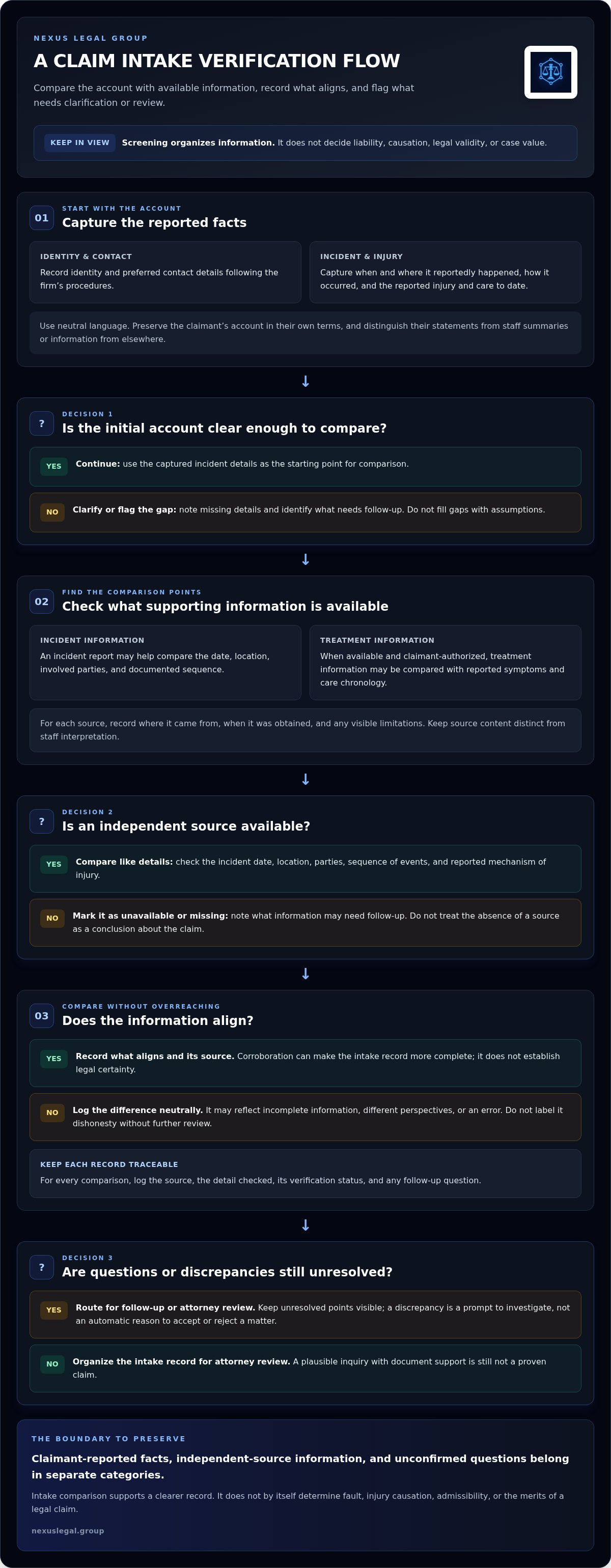
How to build a repeatable injury-claim verification workflow for intake teams
A repeatable workflow makes each inquiry easier to review, regardless of who receives it or which channel it arrives through. To apply how to verify a potential client's injury claim consistently, capture the account, record available sources, compare key details, log gaps, and route the inquiry according to firm criteria.
- Capture the initial account. Record identity and contact details according to firm procedures, along with the reported incident, injury, and care timeline.
- Identify available sources. Note which reports or supporting documents have been mentioned, received, or reviewed. Keep claimant statements separate from information obtained elsewhere.
- Compare relevant details. Check the incident chronology and other key facts across the account and available sources. Record both matches and differences.
- Log gaps and assign follow-up. State what remains unclear, what information may resolve it, and who owns the next step.
- Route for review. Send sufficiently documented inquiries for attorney assessment under the firm’s criteria, and escalate unresolved material questions.
Automated plaintiff-firm intake resources can provide additional workflow context alongside the firm’s own procedures. For MVA inquiries, automated verification can help organize information for staff review, while the firm’s intake criteria determine how each inquiry moves forward.
What information should the intake record preserve?
Use consistent fields so reviewers can trace each detail to its source: source type, date and time received or reviewed, claim detail, verification status, and follow-up owner. Preserve the claimant’s account as a distinct entry from information obtained elsewhere, and record document receipt separately from document review. This prevents “received” from being mistaken for “verified.”
Choose neutral status labels staff can apply consistently, such as reported by claimant, source received, matches available information, follow-up needed, or referred for attorney review. These labels describe workflow progress, not legal conclusions. Collect only information appropriate to the intake task and handle it through established firm procedures.
When should an inquiry move to attorney review?
Route an inquiry when the available initial facts are coherent enough for legal assessment under the firm’s criteria. Escalate unresolved material differences, unclear injury timelines, or complex incident details rather than trying to determine their significance at intake. The record should make open questions visible, not hide them behind a broad status label.
Automated verification can help organize or flag information for staff review, but it should not replace staff judgment or an attorney’s assessment. A clear handoff summarizes what was reported, which sources were reviewed, what remains uncertain, and who is responsible for follow-up.
How structured verification and data-supported MVA acquisition fit together
Structured verification connects inquiry sourcing with a firm’s intake process. Police-report and emergency-services data can add context about a reported motor vehicle incident, while the prospective client provides their own account of what happened. Keeping those information streams distinct lets intake staff compare details and identify questions without presenting source-derived data as a substitute for the claimant’s statement or the firm’s review.
How can external incident data support inquiry verification?
External incident data can help connect an MVA inquiry with reported event information and potentially involved participants. Reverse append methods can obtain accident-report and participant details, giving intake teams additional material to compare with an inquiry. Record the source and treat the information as supporting context, not as complete or conclusive evidence.
This distinction strengthens how to verify a potential client's injury claim: label what came from the prospective client, what came from an external source, and what still needs confirmation. A matching date or participant detail can support a more complete intake record, but it does not establish liability, causation, or case value. Automated verification supports screening and organizes information for review; the firm remains responsible for legal evaluation.
What should firms expect from a verification-supported acquisition workflow?
Case-acquisition support can produce different outcomes, including qualified MVA inquiries and signed cases. These are distinct stages, not interchangeable descriptions. An inquiry may enter the firm’s intake workflow for review, while a signed case reflects a separate outcome. In either situation, structured source information can help staff understand the context and determine the appropriate next step under firm procedures.
Build the workflow around clear sourcing, consistent verification, and a transparent handoff. Ethical, compliant processes should guide how inquiry information is handled, without implying that automated checks make legal decisions. Firms can connect data-supported acquisition with their own intake criteria and attorney review.
Make Every Intake Review More Consistent
A disciplined approach to how to verify a potential client's injury claim gives intake teams a practical way to organize the account, compare available sources, and identify what still needs clarification. The goal is a complete, traceable intake record, not a premature conclusion about liability, causation, or case value.
Use consistent fields to distinguish claimant statements from source-derived details, document discrepancies neutrally, and route open questions for attorney review. For MVA inquiries, automated verification can support screening, while police-report and emergency-services data can add incident context. Reverse append methods can obtain accident reports and participant details, giving firms additional information to assess within their own workflow.
When these capabilities complement rather than replace firm review, verification becomes a structured part of case acquisition and intake operations. Nexus Legal Group provides high-intent MVA case acquisition, using automated verification and incident data to support firms’ intake workflows.
With a clear process and well-documented handoffs, your team can make each inquiry easier to assess and move forward with greater confidence.
Frequently Asked Questions
How do you verify a potential client’s injury claim?
Use a consistent intake process to compare the claimant’s account with available incident information and supporting documents. Record identity and contact details according to firm procedures, then capture when, where, and how the incident reportedly occurred, along with the reported injury and care timeline. Separate claimant statements from independently sourced details, note what remains unconfirmed, and route unresolved questions for follow-up or attorney review. Screening organizes facts; it does not prove a claim.
Can a police report prove who was at fault in an injury claim?
No. A police report can provide information about a reported incident, but it should not be treated as a final determination of fault. Compare its details, such as the reported date, location, involved parties, or event sequence, with the claimant’s account and other available information. Note the report’s source and any gaps. If key details differ, document the discrepancy and route it for review rather than drawing a conclusion from the report alone.
What documents help verify a personal injury claim?
Useful supporting material may include an incident or police report, photographs or video of the scene, witness information, and available claimant-authorized information about treatment and care dates. For a reported lost-income issue, relevant employment or income documentation may help clarify the information provided. The appropriate sources depend on the inquiry. Record what each item supports, when it was received or reviewed, and which questions remain open. No single document establishes every aspect of a claim.
How should a law firm handle inconsistencies in an injury claim?
Document the specific conflicting details, the sources compared, and the date of review. Ask neutral, non-leading questions to clarify timing, terminology, or sequence, and preserve the claimant’s explanation separately from staff interpretation. A difference may reflect incomplete information or differing accounts; it should not automatically be treated as dishonesty. If a material discrepancy remains unresolved, flag it for attorney assessment rather than making a legal judgment during intake.
Does a medical record prove that an accident caused an injury?
No. Treatment documentation may help establish what care was recorded and when, but it does not by itself determine that an accident caused an injury. Compare the available timeline with the claimant’s account, note unclear dates or transitions, and avoid filling gaps by assumption. Keep the source’s documented information distinct from the claimant’s description and from any conclusion about causation. Questions about the legal significance of that information belong in attorney review.
When should an injury inquiry be escalated to an attorney?
Route an inquiry for attorney review when the initial facts are organized enough for assessment under the firm’s criteria, or when unresolved issues need legal judgment. Examples include conflicting incident details, an unclear injury timeline, or a complex event that intake staff cannot readily reconcile across sources. Provide a concise handoff showing what was reported, what information was reviewed, and what remains uncertain. Escalation is a review step, not a finding for or against the claim.
Can automated verification replace a law firm’s intake review?
No. Automated verification can support screening by organizing or checking inquiry information, but it does not replace the firm’s intake process or attorney judgment. Treat automated results as one input: staff should retain source details, note unresolved questions, and follow established procedures for review and routing. For MVA inquiries, police-report or emergency-services data can add incident context, but the firm must assess the information within its own workflow.