Improving Case Selection for Profitability: The Plaintiff Firm Framework
Discover actionable intake strategies for improving case selection for profitability. Protect your plaintiff firm's margins and eliminate dead-end claims today.
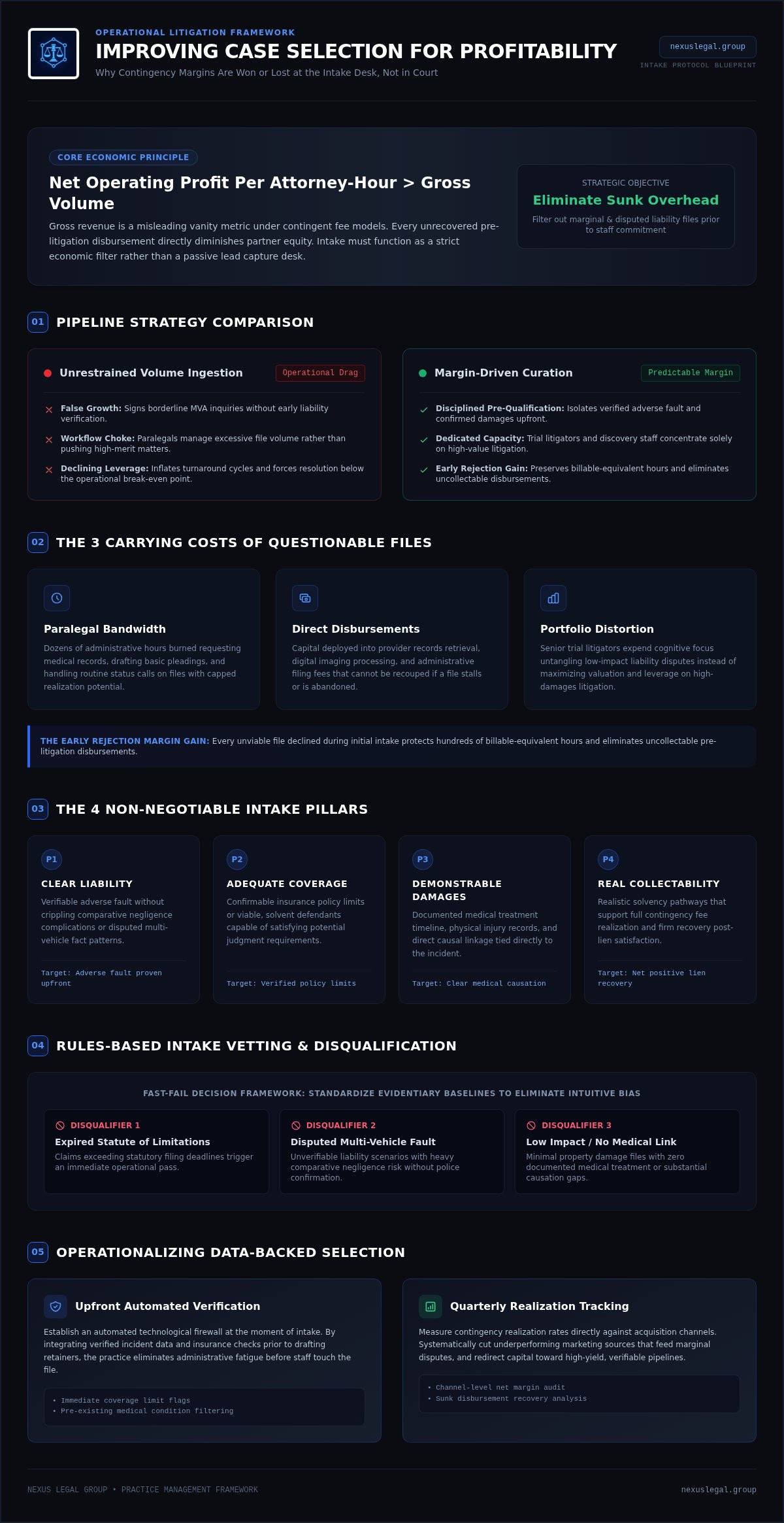
Contingency fee profitability is decided at the intake desk, not in the courtroom. When paralegals and associate attorneys burn valuable hours chasing marginal or disputed-liability files, operational margins collapse long before settlement talks begin. That is why improving case selection for profitability has become the defining operational priority for modern plaintiff practices seeking sustainable growth.
You already know the frustration of watching staff spend weeks untangling questionable accident claims only to resolve them below your operational break-even threshold. Pumping more raw volume into your pipeline won't solve that squeeze; it only accelerates overhead and exhausts your team. In this guide, you'll discover how elite litigation firms engineer data-driven intake criteria, leverage verified incident data upfront, and standardize scoring frameworks to protect realization rates while maximizing caseload profitability. Below, we examine the precise triage systems required to eliminate dead-end files before your firm incurs substantial administrative fatigue and sunk disbursement expenses.
Key Takeaways
- Understand why unrecovered pre-litigation disbursements directly erode contingency margins, turning high caseload volume into operational drag.
- Implement the four essential evaluation pillars to standardize evidentiary baselines before your staff expends time on open files.
- Adopt a rules-based vetting matrix to remove subjective intuition and systematically flag coverage limits or pre-existing medical history.
- Leverage automated verification and upfront incident datasets, establishing an early firewall for improving case selection for profitability.
- Track quarterly realization metrics by acquisition channel to cut underperforming marketing sources and focus resources on verifiable, high-yield files.
The Economics of Case Selection: Why Law Firm Profitability Starts at Intake
Gross revenue can be a dangerously misleading vanity metric for personal injury firms. Under the standard contingent fee model, every unrecovered disbursement directly diminishes partner equity. When your practice takes on questionable liability files or low-limit policies, you aren't just betting on speculative recoveries; you're actively financing administrative drag. True operational health is measured by net operating profit per attorney-hour, not total case volume.
Systemic intake triage serves as your primary lever for expanding margins. By treating intake as a strict economic filter rather than a passive lead capture desk, you ensure that every committed staff hour yields predictable returns. Prioritizing systematic evaluation protocols is the foundational step toward improving case selection for profitability across your entire firm.
The True Cost of Marginal Contingency Files
Every opened file incurs hard and soft overhead immediately. Carrying costs accumulate quickly across paralegal workflow hours, medical record retrieval charges, client communication touchpoints, and docket management tracking:
- Paralegal bandwidth: Dozens of hours spent requesting records, drafting basic pleadings, and handling routine status calls on files with capped returns.
- Direct disbursements: Substantial capital deployed into provider document requests, digital imaging processing, and administrative service fees that cannot be recouped if a file stalls.
- Portfolio distortion: Senior litigators spending cognitive energy managing low-impact disputes instead of maximizing high-damages litigation.
Early rejection margin gain: Every unviable file declined at intake preserves hundreds of billable-equivalent hours and eliminates uncollectable disbursements. This directly expands your net margin by redirecting finite trial team capacity toward your highest-value files.
Shifting from Volume-Based Ingestion to Margin-Driven Curation
Signing every borderline motor vehicle collision inquiry creates a false sense of pipeline growth. In practice, unrestrained ingestion chokes legal workflows. Your paralegals spend their days managing file volume rather than pushing high-merit matters toward settlement or trial. This imbalance inflates turnaround cycles across the entire practice.
Every firm operates within finite operational boundaries. Trial litigators and discovery paralegals can only handle a set number of active files before quality slips and negotiation leverage declines. Transitioning from sheer volume ingestion to margin-driven curation requires dedicated law firm growth infrastructure that isolates verified liability and confirmed damages before retainers are sent. When you align intake screening with contingency economics, improving case selection for profitability becomes a repeatable operational process rather than guesswork.
Core Criteria for Improving Case Selection in Motor Vehicle Accident Files
Sustainable contingency growth relies on disciplined pre-qualification standards. As outlined in the legal definition of contingency fees, compensation depends entirely on successful recovery, which makes risk allocation an operational concern rather than a purely theoretical one. To ensure high realization rates, elite practices evaluate inbound inquiries against four non-negotiable pillars:
- Clear Liability: Verifiable adverse fault without crippling comparative negligence issues.
- Adequate Coverage: Confirmable insurance policy limits or viable solvent defendants.
- Demonstrable Damages: Documented medical treatment and direct causation tied to the crash.
- Real Collectability: Solvency pathways that support full fee realization post-lien satisfaction.
Every firm needs an objective scoring rubric to eliminate immediate disqualifiers before staff open a matter. Expired statutes of limitations, disputed multi-vehicle liability, or minimal property damage without documented injury should trigger an immediate pass. Systematizing these baselines is essential for improving case selection for profitability across your intake pipeline.
Assessing Liability and Comparative Fault Early
Resolving fault discrepancies early stops marginal claims from congesting your workflow. Intake teams must review officer narratives, point-of-impact damage profiles, and citation details before committing attorney resources. This diligence is especially vital in jurisdictions governed by modified comparative fault rules, such as 51% bar thresholds adopted in states like Louisiana, where exceeding the fault threshold completely eliminates recovery. Integrating vetted data driven case acquisition allows teams to corroborate initial narratives against independent accident documentation before onboarding.
Insurance Coverage and Policy Limit Verification
A catastrophic injury file with a statutory minimum policy yields virtually no recovery for your firm after covering medical liens and client payouts. Intake screening must verify whether the at-fault motorist carried personal minimum limits, commercial fleet coverage, or supplementary umbrella policies. Paralegals should also assess uninsured/underinsured motorist provisions on the claimant's own policy immediately. When policy caps are inadequate, verify secondary paths to collection before spending capital on expert reviews.
Evaluating Objective Physical Damages and Treatment Consistency
Adjusters aggressively devalue files characterized by vague soft-tissue complaints and treatment gaps. Your intake rubric must reward objective physical evidence, such as emergency room admissions, diagnostic scans showing structural fractures, or immediate specialist referrals. Gap-in-treatment red flags are critical: if a prospective client waited three weeks to seek care post-collision, defense counsel will leverage that delay to argue lack of proximate cause. Firms looking to automate these verification firewalls can explore automated intake solutions to pre-qualify injury severity and insurance metrics before sending retainers.
Eliminating Intuitive Bias: Building a Repeatable Intake Vetting Matrix
Subjective intuition is often the quiet killer of contingency practice margins. When intake decisions rely on an attorney's gut feeling or an intake agent's sympathy, low-value matters slip into pre-litigation unnoticed. Establishing a rules-based vetting matrix removes emotion from the equation, replacing optimism with verifiable scoring criteria. In practice, systematically improving case selection for profitability requires transforming intake from a freeform conversation into an objective diagnostic process.
By tracking conversion patterns alongside ultimate settlement realizations, leadership can continuously calibrate scorecard thresholds. If files with specific liability profiles consistently underperform at settlement, your matrix updates immediately to filter them out. This continuous feedback loop ensures that your caseload consistently reflects files with high recovery potential.
Standardizing the Intake Questionnaire and Scripting
Intake representatives need tightly scripted discovery questions that uncover critical vulnerabilities during the initial call. Rather than recording general impressions, staff must gather quantifiable data points:
- Treatment timeline: Immediate transport via EMS versus outpatient visits delayed past 72 hours.
- Pre-existing history: Prior claims, chronic anatomical pain, or concurrent physical therapy in the same body zones.
- Physical impact evidence: Total vehicle repair cost estimates, airbag deployment records, and drivability status post-collision.
Screening for these variables prevents premature retainer delivery. Staff should only issue engagement agreements after all mandatory threshold conditions are documented and verified.
Implementing Multi-Tiered Sign-Off and Rejection Protocols
A resilient intake architecture uses clear stage-gate tiers to protect senior litigators from administrative bottlenecks while maintaining firmwide quality control. Clear-liability files meeting specific threshold criteria qualify for automated sign-off, expediting client retention. Conversely, borderline files with comparative fault questions route to an intake manager or assigned litigation partner for mandatory review before any retainer is signed.
Equally critical is a compliant non-engagement workflow. Declining unprofitable files requires prompt, written non-engagement notices outlining the statute of limitations warning without providing substantive legal advice. This standardized off-ramp safeguards your practice against prospective client malpractice claims while preserving operational focus on high-yield claims.
Leveraging Upfront Incident Data and Automated Verification Systems
Traditional intake workflows rely heavily on uncorroborated claimant phone interviews, forcing paralegals to spend days chasing records just to determine basic case viability. Modern practices bypass this manual delay by integrating third-party incident datasets before dedicating legal staff hours. Injecting verified documentation directly into your intake funnel is one of the fastest mechanisms for improving case selection for profitability.
Instead of discovering crippling comparative fault weeks into pre-litigation, automated verification systems pull objective collision metrics immediately. This pre-screening protocol slashes intake evaluation cycles from several business days down to minutes, allowing your firm to commit resources only to files with verified merit.
Integrating Police and Emergency Response Data at Ingestion
Claimants often present distorted loss facts due to stress or misremembered collision details. Integrating official emergency response records and law enforcement collision documentation gives your team immediate clarity on liability factors before you issue a retainer:
- Citation tracking: Identify precise traffic code violations, failure-to-yield determinations, and field sobriety results logged by responding officers.
- Commercial identifiers: Pinpoint Department of Transportation registration markers and commercial carrier profiles to confirm viable policy limits early.
- Incident conditions: Confirm environmental conditions, road geometry, and physical vehicle resting positions without waiting weeks for state report distribution.
Reviewing police report generated MVA leads demonstrates how independent accident documentation confirms verifiable fault metrics before a single attorney billable-equivalent hour is expended.
Deploying Automated Verification to Eliminate Manual Overhead
Manual administrative follow-ups create friction that degrades conversion rates and burdens paralegals. Automated verification platforms validate contact details, verify insurance coverage parameters, and corroborate crash data in real time. Deploying reverse append workflows allows your staff to extract accurate incident participants, passenger rosters, and registered vehicle details using minimal initial intake variables.
This automated data enrichment creates an impenetrable firewall against low-margin claims. Rather than allowing questionable files to enter your pre-litigation pipeline, your intake architecture evaluates liability, coverage, and damages automatically. Understanding how automated intake for plaintiff firms functions will help you scale caseload margins without expanding administrative payroll.
Operationalizing Data-Backed Selection into Long-Term Practice Growth
Sustainable scaling begins when leadership treats intake data as financial intelligence. High-volume plaintiff practices frequently track gross revenues while ignoring which acquisition channels yield the highest net realization rates. Auditing closed files quarterly reveals the true operational yield of each marketing source, isolating the channels that generate profitable settlements from those that merely create administrative friction. Closing this analytical loop is the ultimate step in improving case selection for profitability.
Reallocating marketing spend toward channels that consistently produce documented, verifiable matters protects firm capital. Just as importantly, it shields associate attorneys and paralegals from the exhaustion of working files that eventually resolve below break-even thresholds. Disciplined case curation safeguards firm morale, reduces staff turnover, and provides the focus necessary for high-stakes litigation.
Measuring Realization Rates and Case Velocity Metrics
To accurately measure matter economics, practices must look beyond topline settlement figures and evaluate case velocity alongside fee realization:
- Net fee realization per hour: Divide total collected attorney fees by the combined attorney and paralegal hours invested across the life of the file.
- Pre-litigation velocity: Monitor the exact number of days required to move an intake from onboarding through initial demand presentation.
- Litigation feedback loops: Conduct regular post-mortem reviews where senior trial counsel share settlement impediments with intake leadership to recalibrate screening thresholds.
If two separate matters each generate identical legal fees, but one resolves in five months with minimal administrative overhead while the other requires eighteen months of contentious discovery, their operational profitability is vastly different. Velocity dictates capacity.
Partnering with High-Intent Acquisition Infrastructure
Relying on generic web form submissions often floods your team with unverified inquiries, forcing staff to play detective rather than advocate. Shifting toward exclusive, litigation-ready pipelines ensures your staff spends their time evaluating confirmed facts rather than chasing unresponsive leads or unverified claims.
When litigation departments receive inquiries backed by objective police records and third-party verified incident data, file velocity accelerates from day one. Practices looking to build a sustainable, scalable operation can partner with Nexus Legal Group to implement high-intent case acquisition infrastructure designed around pre-verified loss facts. By aligning strict intake vetting with reliable growth systems, your firm secures predictable margins and long-term practice value.
Engineering Your Firm's Intake Engine for Maximum Realization
Contingency margins are won or lost long before a file enters pre-litigation. By replacing subjective intake hunches with a standardized qualification matrix, you insulate your practice from the debilitating carrying costs of low-limit policies and disputed liability. Elite practices know that improving case selection for profitability requires factual verification at the point of ingestion. Direct integration of official police reports, emergency response datasets, and rapid reverse append technology gives your intake specialists the objective evidence needed to qualify files immediately.
Transitioning to exclusive, litigation-ready MVA inquiries powered by automated verification eliminates staff fatigue and safeguards your litigation disbursements. When your pipeline is anchored in verified data, your trial teams can focus entirely on maximizing recovery across high-yield matters.
Frequently Asked Questions
How does improving case selection directly increase plaintiff firm profitability?
Focusing on improving case selection for profitability expands operating margins by eliminating unrecoverable pre-litigation disbursements and reducing wasted staff hours. When your intake team screens out files with disputed liability or insufficient insurance, attorneys allocate their time exclusively to viable, high-recovery claims. This operational discipline raises fee realization per attorney-hour, accelerates docket turnover, and ensures firm capital isn't trapped in matters resolving below your break-even threshold.
Will establishing stricter case selection criteria reduce my firm overall revenue?
Stricter criteria might reduce total opened file volume, but it reliably protects net profit. Chasing vanity case counts creates operational bloat, tying up paralegals on files that settle for nominal sums. By focusing on quality over sheer quantity, your litigators build greater leverage on high-merit claims. You'll likely see net contingency revenue rise alongside improved realization rates, even if your gross active file count declines.
What are the most common red flags to look for during initial MVA intake screening?
Primary red flags include medical treatment delays exceeding 72 hours, prior identical injuries without documented objective aggravation, and minimal property damage lacking structural vehicle intrusion. Disputed multi-vehicle fault narratives and statutory minimum insurance limits without available umbrella or underinsured motorist coverage also signal high operational risk. Identifying these warning signs at intake stops your staff from investing resources into inherently compromised files.
How can small to mid-sized law firms automate case vetting without ballooning overhead?
Smaller practices can automate vetting by deploying established case acquisition and verification platforms rather than hiring expanding administrative teams. Integrating third-party automated verification tools allows your staff to validate insurance profiles, screen contact validity, and verify initial crash metrics instantly. This automated firewall elevates intake consistency, ensuring improving case selection for profitability remains achievable without adding substantial recurring overhead to your firm's monthly balance sheet.
How do police accident reports and reverse append technologies improve intake accuracy?
These technologies extract objective crash data directly from official law enforcement and emergency services records. Instead of relying solely on subjective claimant memories, reverse append tools pull accurate vehicle identification numbers, registered owners, and cited traffic violations in minutes. Having immediate access to the investigating officer's initial narrative provides an unbiased foundation to confirm clear adverse liability before your team commits to issuing a formal retainer.
What key performance indicators should a law firm track to evaluate case selection success?
Firms should monitor net fee realization per attorney-hour, average cycle velocity from ingestion to demand, and dropped file percentages during pre-litigation. Tracking the disbursement recovery rate across closed matters reveals whether staff are spending capital on non-performing inventory. Regularly evaluating these metrics across individual marketing channels shows management exactly which referral or acquisition pipelines generate the highest net contingent return.
How does an automated intake scoring system handle complex or catastrophic liability claims?
Automated systems use rules-based tiering to identify and escalate catastrophic injuries immediately. While straightforward claims are scored and routed automatically, matters involving commercial carriers, commercial death, or severe structural injuries trigger immediate alerts for partner-level review. This multi-tiered workflow ensures high-stakes files receive rapid attorney evaluation without getting trapped in basic administrative queues, giving catastrophic claimants immediate access to senior litigators.