Law firm intake verification systems Guide for Success
Our guide to law firm intake verification systems shows you how to automate lead validation, eliminate junk inquiries, and secure high-intent, scalable growth.
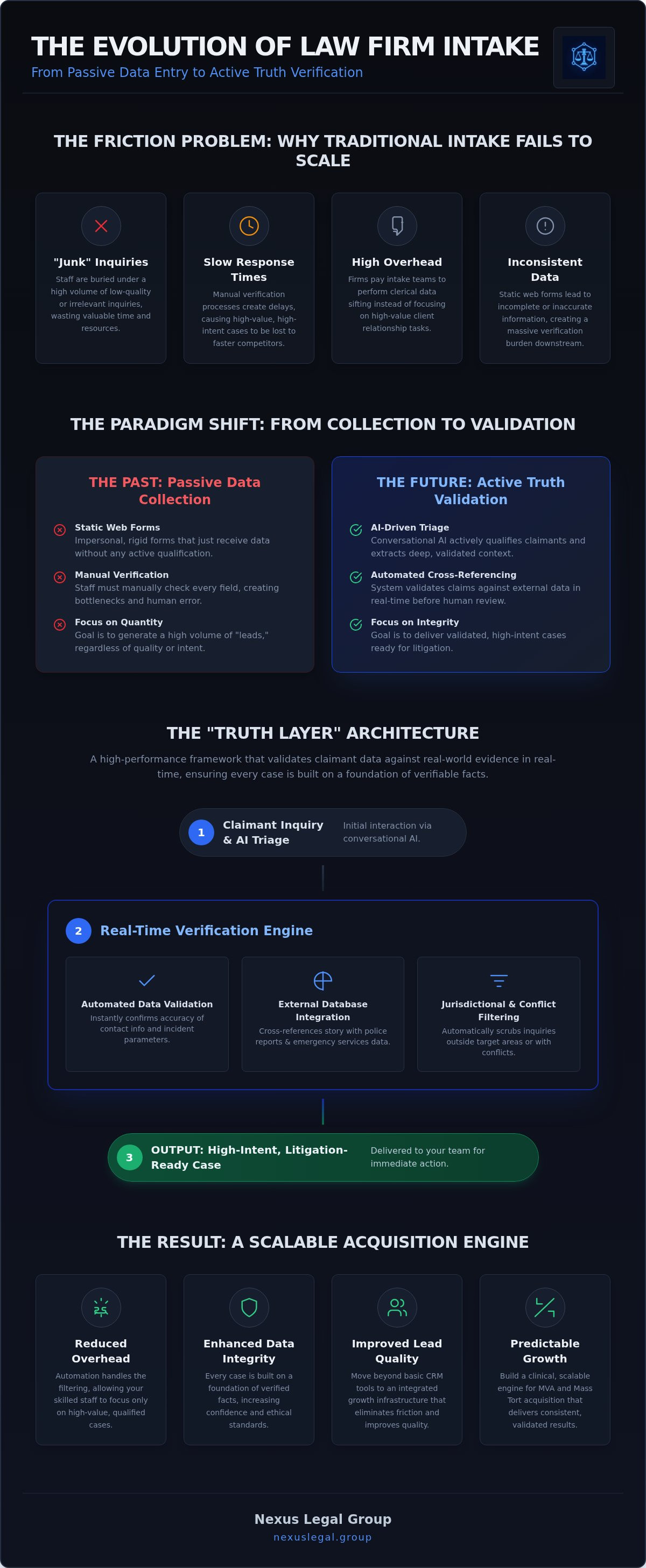
In the current legal market, intake is no longer about collecting data; it's about verifying truth through automated cross-referencing before a human ever intervenes. You've likely felt the operational strain of a staff buried under "junk" inquiries while high-value cases slip through the cracks due to slow response times. This friction isn't just a nuisance; it's a structural failure that prevents elite plaintiff firms from scaling. Implementing advanced law firm intake verification systems is the foundational step to moving past these bottlenecks and regaining control over your firm's growth.
This guide will show you how to transform your front-end operations into a high-performance engine that delivers validated, high-intent cases ready for litigation. We'll explore how modern growth infrastructure uses police report data and reverse append technology to eliminate inconsistent data collection. You'll discover a blueprint for a scalable acquisition model that reduces overhead and ensures your team only focuses on the inquiries that actually move the needle. By the end, you'll have a clear path to building a predictable, clinical system for case acquisition.
Key Takeaways
- You'll learn how modern law firm intake verification systems shift your focus from passive data collection to active truth validation through automated cross-referencing.
- We'll examine the "Truth Layer" architecture. This framework uses police reports and emergency services data to verify claimant stories before they reach your team.
- You'll see why top-tier firms are replacing basic CRM tools with integrated growth infrastructure to eliminate friction and improve lead quality.
- We'll define the specific protocols needed to set a "litigation-ready" threshold, ensuring your intake staff only handles high-intent, qualified cases.
- You'll discover how to build a scalable acquisition engine that delivers predictable results for MVA and mass tort litigation.
What is a Law Firm Intake Verification System in 2026?
In 2026, the legal industry has moved past the era of simple lead generation. A law firm intake verification system is no longer just a digital form or a CRM plugin; it's a high-performance technological framework designed to validate claimant data against real-world evidence in real-time. While traditional intake focused on the passive collection of contact details, modern systems prioritize the rigorous verification of incident facts. This shift ensures that every inquiry landing on an attorney's desk isn't just a "lead," but a litigation-ready inquiry. For elite plaintiff firms, this clinical precision is the only way to eliminate the friction that typically bottlenecks growth.
The primary goal has moved from quantity to systemic integrity. Firms don't need more inquiries; they need validated data that confirms liability and injury before a human ever picks up the phone. By treating intake as growth infrastructure rather than a clerical task, firms can drastically reduce overhead. You're no longer paying a team to sift through "junk" calls. Instead, you're implementing a filter that only allows high-intent, qualified cases into your workflow.
The Core Components of Verification
True verification goes beyond checking if a phone number has the correct number of digits. It involves a multi-layered validation process that operates as the foundational layer of your firm's acquisition engine. Effective law firm intake verification systems integrate several critical technical stages:
- Automated data validation: This involves instantly confirming the accuracy of contact information and basic incident parameters through digital handshakes.
- External database integration: The system cross-references claimant stories with police reports and emergency services data. This confirms that an incident actually occurred at the stated time and location.
- Jurisdictional and conflict filtering: The infrastructure automatically scrubs inquiries that fall outside your targeted geographic area or present a clear conflict of interest.
Why Static Web Forms are Obsolete
Static web forms are a relic of a less efficient era. They create a "friction problem" where high-intent claimants are frustrated by rigid, impersonal boxes, while low-intent inquiries flood the system with incomplete data. These forms don't think; they just receive. This creates a massive burden on your intake staff who must then manually verify every single field.
The 2026 standard has shifted toward AI-driven conversational triage. This approach mimics a high-level interview, adapting to the user's responses to extract deep, validated context. Unlike a form that sits waiting for input, these systems actively qualify the claimant. They ensure that the final output is a signed case or a high-probability opportunity. By removing the guesswork, you create a scalable, predictable engine for case acquisition that doesn't rely on manual labor to separate the wheat from the chaff.
The Architecture of Advanced Intake: Data vs. Dialogue
Effective law firm intake verification systems don't just facilitate a conversation; they validate it. While conversational AI handles the initial interaction, the backend infrastructure performs real-time data enrichment to build what we call the "Truth Layer." This architecture ensures that the narrative provided by a claimant aligns with objective reality before any human intervention occurs. By cross-referencing dialogue with hard data, firms can maintain high ethical standards and ensure every signed case is built on a foundation of verifiable facts. This systematic approach is essential for understanding High Conversion MVA Leads, as it separates genuine high-intent inquiries from those that lack the necessary legal merit.
This dual-track system operates as a powerful engine for business expansion. It moves beyond the limitations of human memory and potential bias by grounding the intake process in empirical evidence. When a system can simultaneously engage a claimant and verify their claims against external datasets, the result is a massive reduction in operational friction. This creates a sense of controlled urgency, allowing your firm to pursue high-value cases with total confidence in the underlying data integrity.
Leveraging Police and Emergency Services Data
Automating the retrieval of accident reports allows for immediate validation of a claimant's story. Instead of waiting days for manual checks, modern growth infrastructure connects directly to emergency services databases to confirm the time, location, and parties involved. This data is used to confirm liability and assess the severity of injuries through vehicle damage reports and medical dispatch notes. Integrating police report data effectively removes "claimant recall" errors by providing an objective record of the incident before the intake process proceeds. This level of technical mastery allows firms to operate with a sense of security, knowing their pipeline is filled with validated inquiries rather than guesswork.
Reverse Append Technology in Case Vetting
Reverse append technology is a critical component for completing the evidentiary picture with minimal initial input from the user. If a claimant provides only a phone number or an email, advanced law firm intake verification systems can automatically identify participants, witness details, and even vehicle registration information. This process fills the technical gaps in the initial contact, identifying potential witnesses and other involved parties without requiring the claimant to provide an exhaustive list of details. For MVA inquiries, this precision is vital because it turns a simple inquiry into a comprehensive, litigation-ready case file. If you're looking to implement this level of precision, exploring validated case acquisition models can provide the foundational layer your firm needs to scale efficiently.
Standalone CRM Tools vs. Growth Infrastructure
Buying a SaaS subscription doesn't mean you've solved your intake problem. Many firms fall into the trap of purchasing standalone CRM tools, expecting them to function as a complete solution. In reality, there's a massive difference between a tool and a system. Elite practices are moving away from "DIY" automation builds because they realize that legal professionals shouldn't be software architects. Instead, they're investing in Law Firm Growth Infrastructure, a comprehensive framework that treats case acquisition as a mechanical, predictable process.
Standalone tools often lack the integrated law firm intake verification systems required to actually validate a case before it enters your pipeline. When you rely on a fragmented stack of apps, you're essentially building a bridge with missing planks. You might capture data, but you aren't verifying truth. Scaling case flow requires an infrastructure mindset where every component, from marketing to the final signed retainer, is part of a single, well-oiled machine.
The Hidden Costs of Disconnected Systems
Operating with disconnected tools creates "silent friction" that erodes your profit margins. When your intake process isn't natively integrated with your verification data, your staff wastes hours on manual data entry. This isn't just a productivity issue; it's a revenue killer. In high-competition niches like MVA or mass torts, a delay of even a few minutes in verification can mean the difference between signing a high-value client and losing them to a faster competitor. Fragmented setups also increase the risk of non-compliant lead handling, as data security often breaks down at the seams between different software providers. You don't just lose time; you lose the systemic integrity required for elite-level growth.
The Advantage of End-to-End Acquisition
The true advantage of an integrated system is the shift from receiving raw inquiries to receiving signed cases. You shouldn't be in the business of chasing leads; you should be in the business of litigating validated claims. This is where the precision of AI-driven marketing meets rigorous intake. Nexus Legal Group provides this foundational layer by delivering exclusive, litigation-ready inquiries that have already passed through a clinical verification process. By integrating marketing directly with intake, we ensure that the data collected at the first point of contact is the same data used to verify the case's merits. It's a seamless progression that allows you to scale your firm without adding the typical overhead associated with manual intake management. This approach delivers a scalable, predictable engine for case acquisition that works behind the scenes.
Implementing a High-Intent Intake Protocol: A 2026 Framework
Scaling a practice requires more than just a high volume of inquiries; it demands a disciplined approach to how those inquiries are processed. Implementing high-intent protocols within your law firm intake verification systems allows you to establish a clear "litigation-ready" threshold. This ensures your legal team isn't bogged down by administrative vetting. Instead of treating every call as a potential lead, you're transitioning to a model where only validated cases enter your workflow. This shift requires a fundamental change in how you train your intake staff. They must move from being "lead catchers" to "verification managers" who handle inquiries that have already passed through a rigorous automated filter.
By leveraging Automated Intake for Plaintiff Firms, you can engineer a growth engine that operates with clinical precision. This framework doesn't just collect data; it prepares cases for immediate action.
Step 1: Defining Quality Metrics
You can't automate what you haven't defined. Start by identifying the non-negotiable data points required for case acceptance. For MVA cases, this might include a confirmed police report or specific injury severity markers. For mass torts, it could be a verified proof of use or medical diagnosis. Once these are established, you can set automated disqualification triggers. These triggers act as a protective barrier for your attorneys' time, instantly scrubbing inquiries that don't meet your firm's specific practice area requirements. It's about building a system that says "no" automatically so your team can say "yes" to the right cases more often.
Step 2: Automating the Verification Trigger
The moment an inquiry hits your system, the verification trigger should fire. Advanced infrastructure should initiate police report lookups or emergency services data retrieval instantly. If a claimant's story is missing key details, AI-driven follow-ups can secure that information without human intervention. This ensures 24/7/365 coverage. Your firm remains "active" even when the office is closed, capturing and verifying high-intent inquiries while your competitors are offline. This level of automation eliminates the "recall error" and ensures the data is accurate from the start.
Step 3: Measuring Operational Efficiency
A successful implementation relies on data-driven refinement. You should track "Time to Verification" as a primary KPI. The faster you can move an inquiry from "raw" to "verified," the higher your conversion rate will be. Analyze the performance of verified inquiries against any unverified outliers to see the impact on your bottom line. Finally, use your actual litigation outcomes to refine your intake filters. If certain data points consistently lead to higher settlements, adjust your verification triggers to prioritize those inquiries. It's a continuous loop of optimization.
Nexus Legal Group: Engineering Growth Through Validated Acquisition
Nexus Legal Group functions as the foundational layer for elite plaintiff firms looking to move beyond the limitations of traditional lead generation. We don't sell raw data; we engineer growth infrastructure. By integrating advanced law firm intake verification systems directly into our acquisition models, we ensure that every inquiry delivered to your firm is litigation-ready. This approach eliminates the administrative burden of manual vetting, allowing your attorneys to focus on high-stakes litigation rather than clerical data validation. Our system operates as a powerful, high-performance engine that drives expansion from behind the scenes, providing the technical mastery required to scale in a competitive market.
Our commitment to ethical and compliant lead generation standards is non-negotiable. We understand that for an elite firm, reputation and results are inextricably linked. That's why our mechanics are rooted in clinical precision. We don't just find claimants; we validate their stories against objective evidence to ensure systemic integrity. This results-driven focus is why our inquiries consistently outperform traditional sources that lack a rigorous verification component. You can explore our growth strategies in action to see how this technical framework translates into signed cases.
Precision Case Acquisition for MVA
Our MVA acquisition model leverages the clinical precision of emergency services and police report data. By utilizing reverse append technology, we secure detailed accident reports and confirm participant details before a case is ever presented to your team. This level of automated verification ensures that the cases you receive are exclusive and high-intent. You're not competing for the same cold leads as every other firm; you're receiving pre-vetted inquiries that have already passed through our rigorous "Truth Layer" checks. This reduces firm friction and allows your intake team to operate with total confidence in the data they're handling.
Scalable Mass Tort Infrastructure
For firms looking to scale mass tort litigation, we provide institutional-grade infrastructure that sources high-quality claimants at scale. We use AI-driven marketing precision to identify potential claimants and then apply our automated vetting protocols to filter them against specific medical and proof-of-use requirements. This systematic approach ensures that your firm can handle massive case volumes without a corresponding increase in overhead. Partnering with Nexus Legal Group means adopting a scalable, predictable engine for case acquisition that is grounded in the practical, rigorous realities of modern legal operations. We provide the foundational layer you need to sustain institutional-grade growth without the typical friction of manual intake management.
Transitioning to a System of Verifiable Growth
The evolution of legal intake in 2026 is defined by a move away from manual vetting and toward automated truth validation. By implementing sophisticated law firm intake verification systems, your practice can finally eliminate the friction of low-intent inquiries and focus exclusively on high-value cases. This infrastructure ensures that every case file is built on a foundation of objective data, from police reports to emergency services records.
You've seen the difference between buying a disconnected tool and building a comprehensive growth engine. Elite firms don't leave their acquisition to chance or DIY automation. They leverage AI-driven marketing precision and rigorous verification to deliver litigation-ready MVA inquiries and exclusive, data-verified cases. This systematic approach isn't just about efficiency; it's about establishing a scalable, predictable foundation for your firm's future.
It's time to stop chasing leads and start litigating validated claims. With the right systems in place, your firm's potential for expansion is limitless.
Frequently Asked Questions
What is the difference between an intake form and a verification system?
An intake form is a passive data collection tool, while a verification system is an active validation framework. Forms rely on unverified claimant input which often leads to "junk" data. In contrast, law firm intake verification systems cross-reference user responses against real-world evidence, such as police reports and emergency services databases, to ensure the narrative is factually accurate before it reaches your staff. This technical mastery instills a sense of security through clinical precision.
How does automated verification improve case conversion rates?
Automated verification improves conversion by isolating high-intent inquiries and eliminating the delay caused by manual vetting. When you validate a claimant's story instantly, your firm can move to sign the case while the intent is at its peak. This reduces the friction that typically causes prospects to contact competitors. By delivering litigation-ready inquiries, the system ensures your team spends time only on cases with the highest probability of success and systemic integrity.
Can an intake system really verify police reports in real-time?
Yes, advanced growth infrastructure utilizes direct integrations with emergency services and law enforcement databases to retrieve incident data immediately. This process allows the system to confirm the date, location, and parties involved in a motor vehicle accident. By automating this retrieval, firms can bypass the manual recall phase where claimants might provide inaccurate details. This real-time validation ensures that the inquiry is built on an objective, verifiable record that eliminates recall errors.
Is automated legal intake compliant with ethical standards?
Automated systems are specifically designed to maintain high ethical and compliant lead generation standards. These systems utilize rigorous logic to ensure that all data collection adheres to legal requirements and jurisdictional rules. By removing human bias and ensuring consistent data handling, automated verification actually reduces the risk of non-compliant interactions. Nexus Legal Group prioritizes these standards to deliver inquiries that are both high-quality and ethically sourced for elite plaintiff firms nationally.
How does reverse append technology help personal injury lawyers?
Reverse append technology allows lawyers to complete a case profile using minimal initial input, such as a phone number or email address. The system automatically retrieves missing data points like vehicle registration, participant identities, and witness details. This creates a comprehensive evidentiary picture without placing the burden on the claimant. For personal injury firms, this means receiving a more complete case file much faster than traditional manual methods would allow, driving growth through technical mastery.
What makes an inquiry 'litigation-ready'?
An inquiry is considered litigation-ready when it has passed through a clinical verification process that confirms liability, injury severity, and jurisdictional eligibility. It isn't just a name and a number; it's a validated claim supported by external data like accident reports. This level of preparation means your attorneys can review a case and decide on representation immediately, without needing additional rounds of basic factual discovery or manual story-checking, ensuring a high return on investment.
Will automated systems work for high-value mass tort cases?
Automated verification is essential for managing the high volume of inquiries typical in mass tort litigation. These systems use AI-driven filters to verify specific proof-of-use or medical diagnosis requirements at scale. By automating the initial vetting process, firms can handle thousands of potential claimants while ensuring that only those who meet the strict criteria for the tort are moved forward. This maintains institutional-grade efficiency and systemic integrity during massive case acquisition campaigns.
How do I integrate a verification system with my existing legal CRM?
Modern growth infrastructure is designed for seamless connectivity with industry-standard legal CRMs through secure API integrations. The system acts as a foundational layer that sits in front of your CRM, cleaning and validating data before it ever populates your database. This ensures that your existing workflow remains intact while benefiting from higher data integrity. Integration is a technical process that focuses on eliminating manual entry and creating a unified, automated pipeline for business expansion.