Acquiring Commercial Catastrophic MVA Cases
Evaluate the RTCAT commercial catastrophic program: trace crash signals to qualified inquiries, assess case fit, verification, intake capacity, and compliance.
For a commercial catastrophic acquisition program, inquiry quality matters more than volume alone. A large number of inquiries can create more verification and follow-up work without helping your team prioritize the events that fit its case criteria. Evaluating the RTCAT commercial catastrophic program means tracing the path from crash signal to qualified inquiry and checking how each step fits your firm’s intake capacity.
Earlier visibility into serious commercial crashes can help your team organize review, but an event signal is not a signed case or a legal assessment. Event-related information can guide intake priorities. Attorneys determine whether a matter meets the firm’s acceptance criteria.
Use this practical framework to assess event sourcing, inquiry qualification, operational readiness, and compliance. Start by comparing the program’s role with your firm’s case profile and follow-up workflows. The goal is a deliberate acquisition decision, with a clear understanding of what happens between a crash event and an inquiry your team can evaluate.
Key Takeaways
- Assess commercial catastrophic acquisition by relevance to your firm’s case criteria, not by inquiry volume alone.
- Trace how an inquiry moves from event signal through information enrichment and automated verification to your intake team.
- Compare event relevance, qualification criteria, verification, and intake readiness against your firm’s priorities.
- Use event information to prioritize review, not as proof of a viable claim or a substitute for attorney evaluation.
- Evaluate how Nexus’s RTCAT commercial catastrophic program fits your case focus and capacity for inquiry review.
Why commercial catastrophic MVA acquisition requires more than lead volume
A firm evaluating commercial catastrophic matters must prioritize them alongside existing casework and other acquisition channels. A high inquiry count does not show whether the events involve commercial vehicles, match the firm’s intended case profile, or fit its intake process. To assess program value, compare the inquiries with your own criteria and review capacity rather than looking at volume in isolation.
Keep four stages distinct. Event visibility is an initial indication that a crash may be relevant. An inquiry is information associated with a person seeking or considering contact. Verification checks whether the inquiry information is usable and consistent. The firm’s legal assessment is a separate, attorney-directed decision about whether a matter meets its standards for representation.
What makes commercial catastrophic acquisition distinct?
The focus is a serious motor vehicle accident involving a commercial vehicle and an injury profile the firm is equipped to evaluate. Catastrophic injury can describe severe trauma, including spinal cord or brain injuries. This catastrophic injury overview offers general context, not a substitute for medical or legal assessment.
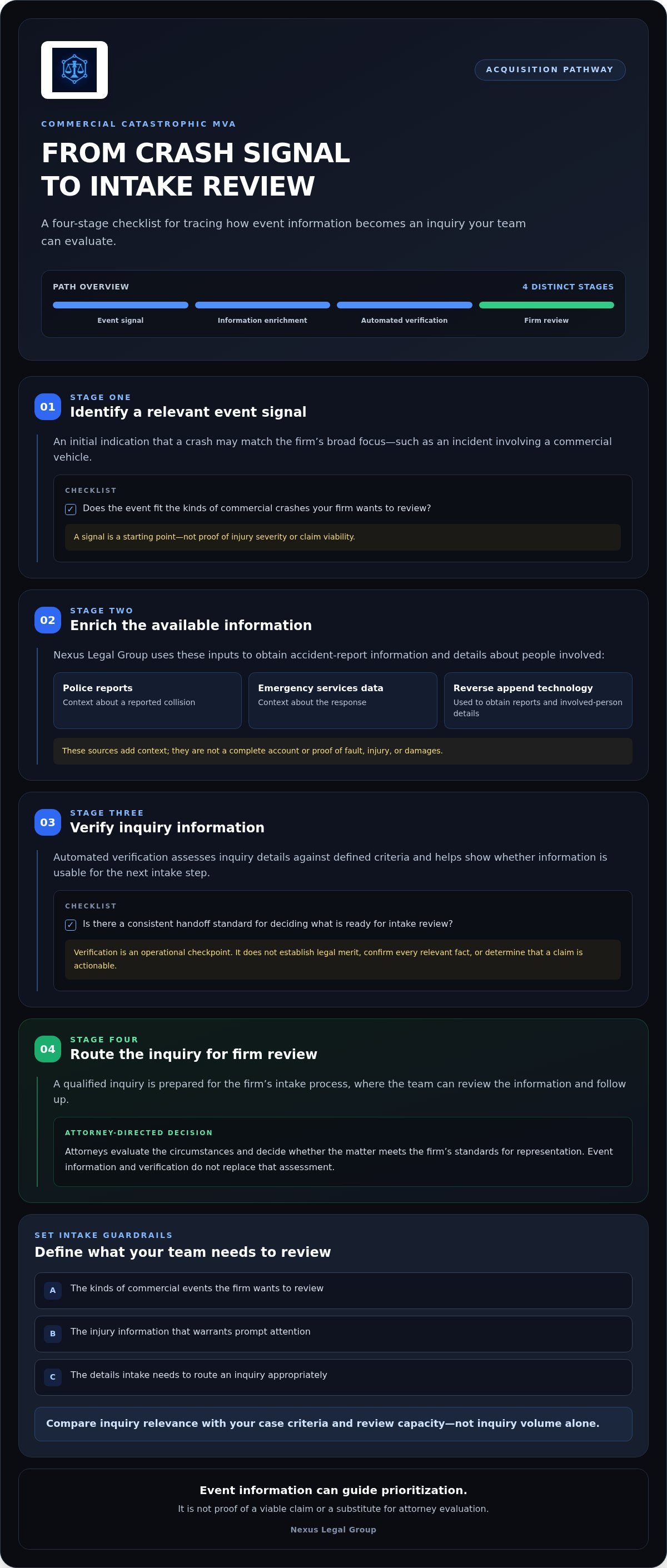
Before expanding acquisition, define your priorities in practical terms: the kinds of commercial events your firm wants to review, the injury information that warrants prompt attention, and the details intake needs to route an inquiry appropriately. These criteria help staff distinguish a potentially relevant event from one outside the firm’s focus. Commercial vehicle involvement does not by itself prove fault, and an injury description does not determine case merit.
Why early visibility is only one part of the equation
Early event information can give your team a starting point for organizing review, but it is an indicator, not a completed qualification decision. Nexus Legal Group’s MVA acquisition approach uses police reports, emergency services data, and reverse append technology to obtain accident reports and details of people involved. These inputs can add context, but none alone establishes liability, injury severity, or whether a claim has merit.
Verification and attorney review serve different purposes. Verification helps assess whether inquiry details are reliable and actionable for intake follow-up. Attorneys evaluate the circumstances under the firm’s own case-acceptance standards. Keeping the steps separate prevents a data signal from being mistaken for a legal conclusion.
Early event information can inform prioritization, not determine legal merit. When assessing the RTCAT commercial catastrophic acquisition program, consider how event visibility and verified inquiries fit your case criteria and review capacity. Leave case decisions to your attorneys.
How a commercial catastrophic acquisition path moves from event signal to inquiry
A structured acquisition path separates information about a crash from an inquiry your firm can review. For commercial catastrophic MVA matters, think of the process in four stages: identify a potentially relevant event, enrich the available information, verify inquiry details, then route a qualified inquiry for firm review. Each stage has a distinct purpose. None replaces an attorney’s decision about representation.
- Relevant event signal. An event signal identifies a crash that may match the firm’s broad focus, such as an incident involving a commercial vehicle. It is a starting point for gathering context, not proof of injury severity or claim viability.
- Information enrichment. Nexus Legal Group uses police reports, emergency services data, and reverse append technology to obtain accident-report information and details about people involved. These inputs can help build a clearer picture of the event before intake review.
- Automated verification. Verification assesses inquiry information against defined criteria, helping the firm understand what is ready for intake review. It does not turn an event record into a signed case or determine legal merit.
- Qualified inquiry. The inquiry is prepared for the firm’s intake process. Attorneys still evaluate the circumstances and decide whether the matter meets the firm’s standards.
What event-related information can contribute
Police reports and emergency services data can provide context about a reported collision and response. Reverse append technology is used to obtain accident reports and details of people involved. These sources contribute information, but they are not a complete account of what happened or proof of fault, injury, or damages. For broader context on commercial crash reporting, consult the FMCSA crash facts and statistics.
The distinction matters in day-to-day intake. An event record can help staff decide what needs attention. An inquiry must include information the team can review and follow up on. Neither step is a legal evaluation. A verified MVA lead standard should make clear what information has been checked while leaving case acceptance to the firm’s attorneys.
Where verification fits in the acquisition path
Automated verification helps assess whether inquiry information aligns with defined criteria and is usable for the next intake step. It supports a consistent handoff, but it does not establish that a claim is actionable, confirm every relevant fact, or replace attorney judgment. Treat verification as an operational checkpoint, not a legal conclusion.
Firms mapping this process to their acquisition and intake workflows can review Nexus Legal Group’s MVA case acquisition approach to understand how event-related information and verification fit together. Use available information to organize review, then let the firm determine what the inquiry means for its practice.
How firms can evaluate commercial catastrophic acquisition program fit
Program fit is a systems question. The acquisition profile should match the matters your firm intends to pursue, and incoming inquiries should move through your review process without obscuring attorney judgment. Use the criteria below to identify alignment and gaps before expanding a channel. The assessment should reflect your firm’s priorities, not a universal definition of a catastrophic case.
| Criterion | Firm-side evaluation | Fit signal |
|---|---|---|
| Event relevance | Which commercial vehicle events match the firm’s intended matter profile? | The event context supports prioritization against criteria the firm has defined. |
| Qualification criteria | What information should route an inquiry for intake review, and what requires attorney evaluation? | Review stages are distinct and expectations are clear. |
| Verification | What inquiry details are assessed, and how are verified inquiries distinguished from legal conclusions? | Verification supports consistent review without implying case acceptance. |
| Intake readiness | Who receives, reviews, documents, and follows up on incoming inquiries? | Ownership and next steps are clear within the firm. |
Align acquisition criteria with the firm’s target matters
Start by defining the commercial vehicle involvement and catastrophic-matter priorities your attorneys want intake to identify. Specify which event details warrant review, which inquiry characteristics matter, and what information is needed before a matter reaches an attorney. Keep these internal criteria separate from what may be available at the event stage. An early record may not contain every detail the firm ultimately needs.
Set standards that reflect the firm’s practice focus and review processes. A preferred matter profile is a prioritization framework, not a universal qualification rule or a determination that an individual has a viable claim.
Assess the handoff into intake operations
Map the route from receipt to resolution: who accepts an inquiry, who checks it against intake criteria, where the review is documented, and who owns follow-up. Consider current staffing and how this work fits alongside other acquisition channels. If the designated team cannot review inquiries promptly, relevant information may not integrate cleanly into operations.
Use this map to assess Nexus’s RTCAT commercial catastrophic program. Nexus provides exclusive MVA inquiries and automated verification, while your firm defines what its staff and attorneys need at each review stage. Clear automated plaintiff-firm intake workflows make responsibilities visible without replacing attorney assessment.
Program fit depends on alignment between acquisition criteria and a firm’s operational capacity. When the case profile is defined, intake ownership is assigned, and the firm can review inquiries consistently, leadership has a clearer basis for deciding whether this acquisition channel supports its growth plan.
Addressing the central concern: event data is not case qualification
Early information about a commercial crash can help your firm decide what to review and how to organize intake. It cannot, by itself, establish that a person has a viable claim. An event record may describe a collision, but it does not necessarily explain what caused it, establish the nature or extent of an injury, or show whether the facts meet the firm’s case criteria.
Keep four decisions separate: whether relevant event data is available, whether inquiry information has been verified, whether attorneys see a legal basis to proceed, and whether the firm and prospective client decide to enter a representation relationship. Treating these as distinct checkpoints helps prevent an operational signal from being mistaken for a legal conclusion.
What verification can and cannot establish
Verification assesses inquiry information against defined criteria. It can support intake review by helping organize available details, but it does not determine liability, establish ultimate case value, or guarantee that an inquiry will satisfy every firm’s threshold. “Qualified inquiry” describes an intake status, not a legal finding or promise of a signed case.
For example, a verified inquiry may contain information that warrants attorney review while leaving material questions unanswered. The firm can identify what needs further evaluation through its own process. Verification is useful when its scope is clear: it helps distinguish information ready for review from an attorney’s assessment of the matter.
Keep the attorney’s case assessment in the proper place
Acquisition technology can support the movement and organization of inquiry information, but it cannot replace legal judgment. Attorneys assess the circumstances, apply the firm’s criteria, and decide whether to pursue representation. The individual’s decision to engage the firm is also separate from event identification or inquiry verification.
Verification organizes inquiry information; the law firm determines legal fit. This division of responsibility is central to evaluating the RTCAT commercial catastrophic program. Nexus Legal Group uses an ethical and compliant lead generation approach, while the firm retains control over legal assessment and representation decisions. A compliance-forward acquisition process should make those boundaries clear in its information flow and handoff, without implying that a data point decides the outcome.
For an internal review, document what each stage establishes and what it does not: data availability, verification status, attorney findings, and the firm’s representation decision. This gives intake staff a consistent way to characterize an inquiry and helps attorneys receive information without inheriting an unsupported conclusion. Firms can also make compliance-forward lead generation part of a broader acquisition strategy.
When the RTCAT commercial catastrophic program fits a firm’s growth plan
The RTCAT commercial catastrophic program fits firms that have made commercial catastrophic matters a defined growth priority, established criteria for routing inquiries, and assigned capacity to review them. Acquisition infrastructure supports the firm’s process; it does not provide legal representation or decide which matters the firm accepts. Assess fit by connecting the program’s role to your case profile and operating model.
A practical readiness check for firm leaders
Before introducing a new acquisition channel, align the people responsible for case strategy, intake, and follow-up. Use this checklist to identify readiness and workflow questions that need an owner:
- Target matters: Have attorneys described the commercial vehicle and catastrophic-matter priorities the firm wants to review?
- Review ownership: Is it clear who receives inquiries, checks them against intake criteria, and routes them for attorney assessment?
- Workflow fit: Do existing staffing and follow-up processes provide a defined path for new inquiries alongside current matters?
- Expectations: Does the team understand that acquisition inputs and verification do not guarantee a signed case, legal merit, or a successful outcome?
These questions distinguish strategic interest from operational readiness. A firm might have a clear commercial case focus but still need to assign inquiry ownership or decide where intake documentation is recorded. Identify and resolve those gaps before expanding, rather than treating additional inquiry flow as a complete growth strategy.
Discuss program alignment with Nexus Legal Group
Nexus Legal Group provides MVA case acquisition infrastructure for plaintiff firms, including the RTCAT commercial catastrophic program. Your firm remains responsible for evaluating matters and making representation decisions. Start an alignment discussion with your growth objectives, the case criteria your attorneys have defined, and your team’s capacity to review and follow up on inquiries.
Bring the readiness questions into the discussion. Clarify how the acquisition approach relates to your intended matter profile, what information supports intake review, and how the inquiry handoff fits your internal responsibilities. This keeps the evaluation focused on practical alignment rather than assumptions about volume or outcomes. It also helps firm leaders identify next steps, such as refining intake criteria or clarifying review ownership, before integrating a new channel into existing operations.
If your priorities and intake capacity align, discuss how the program can support your firm’s acquisition objectives.
Make your next acquisition decision deliberate
Turn program fit into an internal decision before adding another channel. Document the commercial catastrophic matters your firm aims to review, the information intake needs to route inquiries, and who owns each stage of review. Then decide how leadership will assess whether incoming inquiries align with those priorities. A clear operating brief connects expansion to the firm’s strategy and day-to-day capacity.
Use that framework to assess whether the RTCAT commercial catastrophic program aligns with your objectives. A strong acquisition plan is one your team can assess, manage, and refine without confusing inquiry activity with case outcomes. This gives firm leaders a practical basis for deciding what to pursue and how to evaluate alignment over time.
With clear priorities and ownership in place, your firm can move forward with greater confidence and purpose.
Frequently Asked Questions
What is commercial catastrophic MVA case acquisition?
Commercial catastrophic MVA case acquisition helps plaintiff firms identify and review inquiries related to serious crashes involving commercial vehicles. It connects event-related information with the firm’s intake process and chosen matter profile. For example, a firm may prioritize particular commercial vehicle events or injury indicators, then route relevant inquiries for review. Acquisition supports case sourcing; it does not determine whether a claim is legally viable or whether the firm should accept it.
How does the RTCAT commercial catastrophic program work?
The RTCAT commercial catastrophic program is a case acquisition option for plaintiff firms. Nexus uses event-related information, including police reports and emergency services data, with automated verification. These inputs help organize inquiry review, but they do not guarantee what the firm will receive or accept. The firm’s intake team and attorneys assess matters under its own criteria.
Does early crash information prove that a case is viable?
No. Early crash information may help a firm decide which event or inquiry to review, but it does not establish fault, prove the nature or severity of an injury, or show that a claim meets legal requirements. For instance, a report identifying a commercial vehicle may prompt follow-up while important facts remain unresolved. Treat the information as a review aid and reserve viability decisions for the firm’s attorneys.
What information can be used in commercial MVA case acquisition?
Nexus Legal Group uses police reports, emergency services data, and reverse append technology to obtain accident reports and details of people involved. Automated verification is also part of its MVA case acquisition offering. These inputs provide context for inquiry review, but they are not a complete account of an incident or a substitute for the firm’s investigation. Distinguish information available during acquisition from what attorneys need to evaluate a matter.
How should a law firm assess whether an acquisition program fits?
Start by defining the commercial matters your firm wants to review and the criteria intake will use to route inquiries. Then assign responsibility for review, documentation, and follow-up, and consider whether your team can handle this work alongside existing channels. A practical test is to walk through a sample inquiry from receipt to attorney review. Note where it fits, what details are needed, and who is responsible at each step.
Are commercial catastrophic accident inquiries the same as signed cases?
No. An inquiry is information for the firm to review; it is not automatically an executed engagement or an accepted matter. A signed case is a separate status in which an engagement has been formalized. Nexus Legal Group offers both qualified inquiries and signed cases within its broader offerings. Firms should understand the status of each matter and apply their own intake and attorney review process before treating it as retained.
Does Nexus Legal Group provide legal representation for accident victims?
No. Nexus Legal Group provides case acquisition infrastructure for plaintiff law firms, not direct legal representation for accident victims. Its work supports firms seeking MVA inquiries through acquisition inputs and automated verification. The law firm and its attorneys handle legal evaluation and decide whether to offer representation. This distinction helps firms assess Nexus as an acquisition resource while keeping client representation and case decisions within their own practice.