Access Crash Data Before the Police Report
Learn what critical crash intelligence before the report can reveal, how to verify crash details, and which factors determine claimant eligibility early.
A crash report isn’t the only source of critical crash intelligence before the report is available. Early information can help law firms assess an incident, while claimant eligibility depends on specific criteria, including emergency response, hospital transport, fault, legal representation, and insurance. Critical crash intelligence before the report from Nexus Legal Group helps clarify what early information may show and what still requires verification.
Treat the official report as a starting point for understanding what happened and who was involved. But verifying an incident and assessing claimant eligibility are separate steps. Early information can guide review, but it should not replace the report or determine eligibility on its own.
This article explains what crash information may be available before a report is ready, how to verify report details, and which claimant eligibility factors matter. It also distinguishes connected crash data from an official report and accident reconstruction.
Key Takeaways
- Identify which early crash details may help assess a serious incident, and distinguish an initial lead from verified information.
- Use the report to confirm incident details, then assess eligibility against the relevant criteria, including emergency response, hospital transport, fault, legal representation, and insurance.
- Understand why timing matters: accident data must enter the program no more than three days after the accident, and outreach must honor applicable state waiting periods.
- Separate crash intelligence from the official police report and accident reconstruction; each serves a different role in building an incident record.
- For law firms seeking MVA inquiries, Nexus Legal Group offers police report-generated leads, emergency services-generated leads, and automated verification.
Critical-crash information for serious motor-vehicle events
Before a police report is available, early crash intelligence can help organize what is known about a serious motor-vehicle event. It may identify an incident, describe the emergency response, and connect people, vehicles, and related records. This information can support an initial review, but it serves a different purpose from a completed report: it offers an early view, not a final account of every fact. Track the source and status of each detail as information develops.
Program tiers can distinguish cases by injury severity and vehicle type. Relevant categories include:
- Bodily injury: A standard crash category covers incidents involving bodily injury.
- Catastrophic injury or fatal outcome: A catastrophic category applies when the injured person is transported directly from the scene to a hospital, or when the event involves a fatal outcome.
- Commercial vehicle with bodily injury: A commercial category applies when a commercial vehicle is involved, commercial insurance coverage exists, and bodily injury occurred.
- Commercial vehicle with catastrophic injury or fatal outcome: This category combines commercial coverage and vehicle involvement with catastrophic injury or a fatal outcome.
These distinctions matter because a commercial vehicle alone does not establish the more severe category. The injury outcome, direct transport from the scene, and commercial insurance coverage shape how an event is classified. For example, a delivery-vehicle crash with bodily injury differs from a commercial-vehicle crash involving a fatal outcome. Careful classification keeps the initial review aligned with the available facts.
Connected data can reveal relationships that separate records may obscure. A person may appear in one incident record while a vehicle appears in another jurisdiction’s record. Connecting the records can help determine whether they relate to the same event or separate incidents. That connection is an investigative lead, not proof that every linked detail is accurate or that a person qualifies as a claimant.
For an initial review, sort information into three groups: the reported event, the people and vehicles associated with it, and the injury or response details. Record the source and jurisdiction for each item. Compare details using consistent identifiers, such as the vehicle or incident, and flag conflicts for later verification. This creates a clear, traceable picture without treating an early data match as a conclusion about fault or eligibility.
Serious-crash intelligence is most useful when it narrows the review to relevant incidents and clarifies what still needs verification. Injury severity, transport from the scene, commercial coverage, and links among people, vehicles, and incidents all inform the assessment. A structured program can organize these factors while keeping preliminary information separate from verified report details.
Crash report verification and claimant eligibility
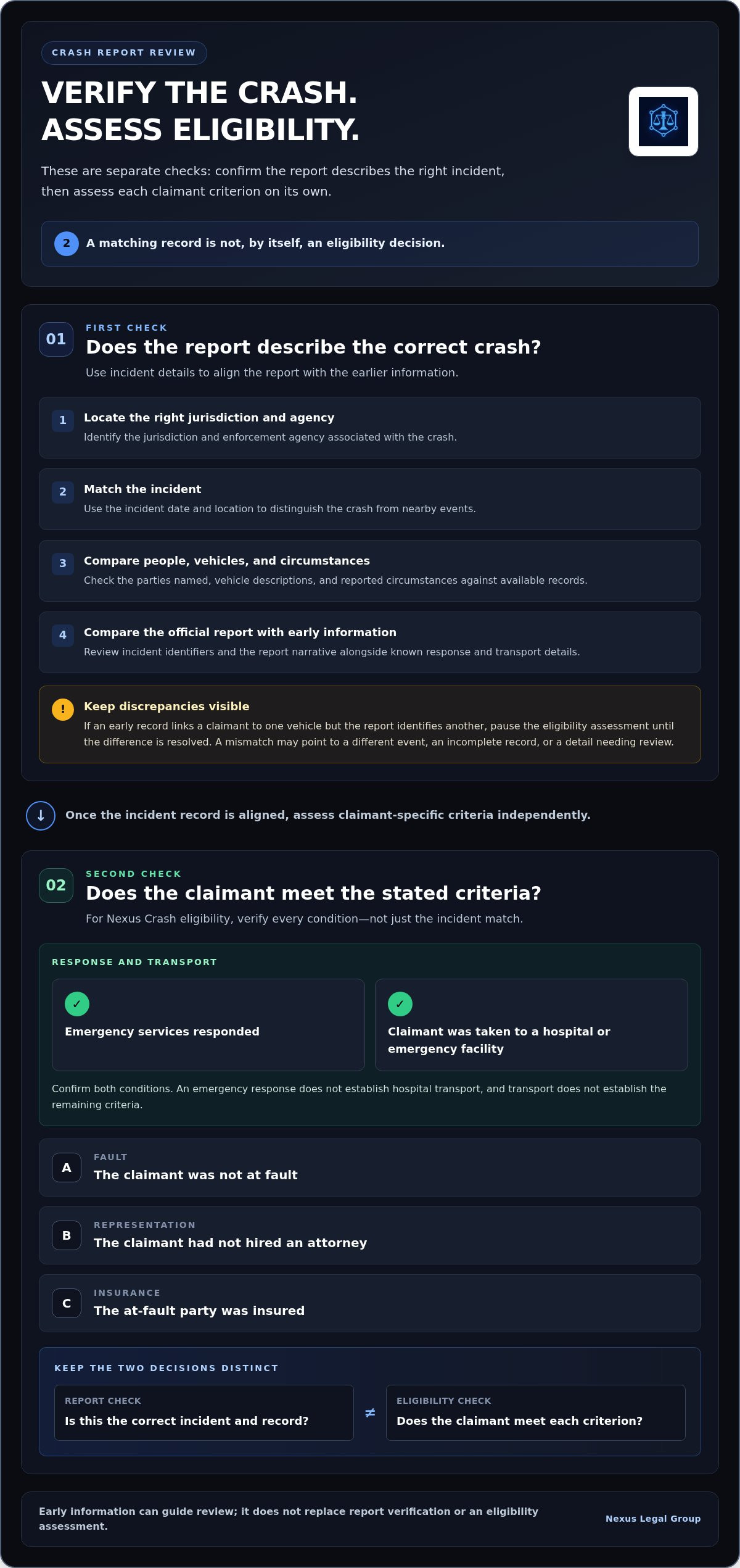
A reliable review separates two questions: does the report describe the correct crash, and does the claimant meet the relevant eligibility criteria? Each requires different checks. A matching name alone does not establish that records concern the same incident or that the claimant qualifies.
Start by identifying the jurisdiction and enforcement agency associated with the crash. Use the incident date and location to distinguish it from nearby events, then compare the people and vehicles named in available records. Check details such as vehicle description, involved parties, and reported circumstances. A mismatch in location or vehicle information may indicate a different event, an incomplete record, or a detail that needs further review.
When a police report becomes available, compare its incident identifiers and narrative with the earlier information. Check whether it names the expected parties and vehicles and whether its account aligns with known response and transport details. Keep discrepancies visible rather than silently replacing one version with another. For example, if an early record associates a claimant with one vehicle but the report identifies another, pause the eligibility assessment until the difference is resolved.
For Nexus Crash eligibility, the criteria are specific: emergency services must have responded, and the claimant must have been taken to a hospital or emergency facility. The claimant must not have been at fault or hired an attorney, and the at-fault party must have been insured. Assess each condition independently. An emergency response does not establish hospital transport, and hospital transport does not establish fault status or insurance coverage.
- Response and transport: Confirm emergency services responded and the claimant went to a hospital or emergency facility.
- Fault and representation: Assess whether the claimant was not at fault and had not hired an attorney.
- Insurance: Establish whether the at-fault party was insured.
- Record alignment: Match the report to the incident, parties, and vehicle before relying on its details.
These checks prevent a record match from being mistaken for an eligibility decision. A report can support incident verification, while eligibility depends on the claimant-specific facts above. Keep the source of each detail clear, especially when records come from different jurisdictions or enforcement processes. This also streamlines later review: the reviewer can see which conditions are supported and which remain unresolved.
For law firms organizing this workflow, automated verification for MVA leads can help structure report matching and eligibility review. Police report-generated MVA leads and reverse append services can also support obtaining accident reports and details of people involved.
How quickly can crash intelligence be obtained after a motor vehicle accident?
Timing starts with data entry, not with the release of a police report. The program requires accident data to enter no more than three days after the accident. This is an entry window, not a promise that every report or detail will be available within three days. An incident may generate early information while the official report is still in progress.
Outreach timing has a separate control: applicable state waiting periods must be observed before contact. An early data match therefore does not mean immediate outreach. The event date, when data enters the program, the relevant jurisdiction, and its waiting period all affect the sequence. Keep these milestones separate when assessing how information moves from an incident record to a contact workflow.
A clear timeline can be organized around these steps:
- Record the accident date. Use it to assess whether the data entered the program within the three-day window.
- Track data entry. Note when the incident information becomes available to the program, rather than assuming the report date is the same.
- Identify the jurisdiction. The applicable state waiting period shapes when outreach may proceed.
- Separate each milestone. Record data entry, report availability, verification, and permitted outreach as distinct events.
This sequence explains why two crashes from the same day may follow different timelines. Data for one incident may enter within the required window, while information for another arrives later. A state waiting period can also delay outreach after entry. Neither situation changes the three-day entry requirement; they illustrate that data timing and contact timing are separate parts of the process.
Report availability follows its own timeline. The incident location, responsible reporting agency, record completion, and access process can affect when a report is ready for review. These factors are separate from the program’s data-entry window. A report that becomes available later can still verify incident details, while earlier data can help organize an initial review.
For a practical timing check, first compare the accident date with the program’s data-entry date. Then identify the jurisdiction and account for its applicable waiting period before evaluating outreach. Finally, record when the report becomes available and when its details are checked against the incident. This creates a traceable chronology without treating early intelligence as a completed report or assuming every stage moves at the same speed.
The RTCAT™ framework may cover commercial-vehicle, fleet, trucking, rideshare, delivery, bus, construction, severe-injury, and fatal motor-vehicle events. Connecting data across jurisdictions can reveal relationships among people, vehicles, and incidents that disconnected systems may hide. The page identifies fugitive apprehensions, trafficking rescues, stolen vehicle recovery, and weapons seizures as possible outcomes of routine crash responses, citations, and reports.
For Nexus Crash, first live transfers and new client matters follow separate typical timelines after setup: firms ordinarily receive their first live transfers around weeks three to five after setup, and their first new client matters around weeks three to six. Nexus Crash names a firm only after the injured person requests legal information and agrees to be contacted, with consent recorded in the firm’s name. This consent step is separate from when incident data enters the program.
How does crash intelligence differ from a police crash report or accident reconstruction?
Crash intelligence, a police crash report, and accident reconstruction answer different questions. Intelligence organizes available information to identify an event, associated people and vehicles, and related records. A police crash report documents an incident investigated by law enforcement. Accident reconstruction analyzes how a collision may have occurred. Critical crash intelligence before the report from Nexus Legal Group is an early information layer, not a documented account or technical opinion.
Early intelligence can connect records across jurisdictions and surface relationships that isolated systems may not show. For example, a vehicle associated with one incident record may also appear in another jurisdiction’s data. That connection can guide further review, but it does not establish fault, injury severity, or the full sequence of events.
A police crash report serves a different purpose: it records details gathered through the responding agency’s investigation. Its contents can help identify involved parties, vehicles, location, and reported circumstances. The report may help verify whether an earlier lead concerns the same crash. It is the agency’s documented account, not accident reconstruction or an automatic determination of legal responsibility.
Accident reconstruction focuses on collision mechanics. It may assess physical evidence and event details to evaluate vehicle movement or how impact occurred. For example, a question about a vehicle’s path before impact requires a different analysis from matching a person and vehicle to an incident record. Reconstruction adds technical interpretation; it does not replace the report or the work of connecting records.
Use each source for its proper function:
- Crash intelligence: Organize and connect incident, person, vehicle, and jurisdictional information.
- Police crash report: Review the responding agency’s documented account and incident details.
- Accident reconstruction: Examine collision mechanics and evaluate how the crash may have unfolded.
For example, if preliminary information links a person to a commercial-vehicle crash, first verify the incident and vehicle match through records. Then compare the report’s account with available information. If the unresolved question concerns vehicle movement or impact sequence, reconstruction addresses that narrower issue. This order keeps identity verification separate from mechanical analysis.
Connected records can also reveal investigative patterns beyond an individual collision. Routine crash and citation data may support broader law-enforcement investigations, while connected systems can help agencies turn isolated entries into actionable decisions. This differs from claimant screening: a data relationship may direct attention to a person, vehicle, or incident, but each conclusion depends on the purpose and quality of the underlying record.
The practical distinction is straightforward: use intelligence to locate and connect, the report to review documented incident details, and reconstruction to analyze collision mechanics. Track which source supports each conclusion so an early data match is not mistaken for a report finding or technical analysis.
What are the risks of relying on preliminary or unverified crash information?
An early crash record can help identify an event, but an incorrect match can distort the review from the outset. A shared name, similar vehicle description, or nearby crash location may connect records from separate incidents. Treating that link as established fact can lead later decisions to rely on the wrong person, vehicle, or event.
Jurisdictional differences create another risk. A record from one agency may use different identifiers or contain details that do not align with another agency’s entry. For example, a vehicle connected to a crash in one jurisdiction may appear in a separate incident record elsewhere. A data connection can prompt investigation, but it does not prove both records describe the same event.
Preliminary information may also leave important fields incomplete. An early entry may identify a vehicle but omit injury details, transport information, or the status of an insurance inquiry. Treating those gaps as negative findings may screen out a potentially relevant claimant. Treating assumed facts as established may move an unsuitable lead forward without the required review.
Fault presents a separate verification challenge. A preliminary description of a collision may not establish who was at fault. Likewise, identifying an at-fault party does not establish that the party was insured. Because claimant eligibility depends on specific conditions, assess fault and insurance independently rather than inferring either from a brief incident summary.
- Identity risk: Compare names, vehicle details, location, and incident identifiers before linking records.
- Completeness risk: Mark missing injury, transport, fault, or insurance details for follow-up.
- Classification risk: Keep an early incident category separate from verified crash circumstances.
- Decision risk: Assess each eligibility condition on its own evidence.
A controlled review makes these risks visible. Retain the source and date associated with each detail. Compare identifiers across records and flag conflicts instead of choosing the most convenient version. Then verify the police report against the incident and involved parties. Finally, assess claimant-specific criteria using information that supports each finding. This sequence preserves the distinction between a lead, a verified record, and an eligibility assessment.
For example, if an early record lists hospital transport but the report identifies a different person, pause the match and resolve the identity discrepancy. Don’t carry the transport detail forward as if it belongs to the claimant. Recording the conflict and its resolution gives later reviewers a clear basis for their decisions.
At a low level of data sophistication, agency data remains isolated through manual paper entry; at a high level, it is digitally connected and can inform actionable decisions. These levels describe how information is handled, not whether an individual crash detail has been verified. Even connected records require source checks and claimant-specific review before supporting an eligibility finding.
Nexus Legal Group: High-Intent MVA Case Acquisition
Nexus Legal Group supports plaintiff law firms seeking motor-vehicle-accident inquiries through High-Intent MVA Case Acquisition. Its Police Report Generated MVA Leads and Emergency Services Generated MVA Leads help firms identify relevant opportunities through different crash-information sources.
Automated Verification supports the review of incoming information and helps distinguish a lead from details that need further validation. These offerings suit firms seeking a structured approach to MVA lead acquisition and crash-related records, rather than treating preliminary information as a final eligibility decision.
To explore how Nexus Legal Group’s MVA case acquisition can fit your firm’s needs, visit nexuslegal.group.
Build a Clear Path from Crash Data to Case Review
For a plaintiff firm, early crash information is most valuable when it fits a defined operational pathway. Decide who reviews an incoming lead, how its source is recorded, and when verified information moves to intake. A consistent handoff helps teams assess opportunities while keeping decisions and responsibilities clearly documented.
Critical crash intelligence before the report from Nexus Legal Group can support a more deliberate approach to case acquisition. Align information flow with your firm’s intake priorities so staff understand how each opportunity moves through review. Clear ownership and consistent documentation make the process easier to manage as new inquiries arrive.
Identify where your current workflow needs more structure, then decide what information and handoffs would help your team act with clarity.
A well-defined process gives your team a stronger foundation for thoughtful growth.
Frequently Asked Questions
What information can crash intelligence provide before an official crash report is available?
Crash intelligence may offer an early view of the incident, emergency response, and connections among people, vehicles, and related events. For example, linked records may help distinguish a commercial-vehicle crash from a separate incident involving the same person or vehicle. Treat these details as leads for organizing a review, not substitutes for the official report. Recording the source of each item helps guide later comparison.
What does crash intelligence cost, and is there a consultation fee?
Fees are fixed by tier and set in advance; they do not depend on matter value, settlement, or recovery.