Tracking Cost Per Signed Retainer: The 2026 ROI Framework for Elite Firms
Master legal ROI by tracking cost per signed retainer. Discover our loaded formula to cut intake friction, vet leads, and scale your firm's profitability.
A low cost per lead might actually be draining your law firm's profit margins. When intake teams spend dozens of hours chasing unvetted form fills and unresponsive inquiries, standard digital metrics fail to reveal the true health of your pipeline. You already know the frustration of celebrating high lead volume while your team struggles to convert those prospects into viable case files. That's why high-performing practices are abandoning surface-level campaign data and prioritizing tracking cost per signed retainer to protect their operational capacity and accurately attribute revenue across channels.
In this guide, you'll learn how to move beyond vanity metrics and implement a precise system for tracking and optimizing your true cost per signed retainer. We'll break down the loaded mathematical formula for acquisition, demonstrate how automated verification eliminates intake friction, and map out an infrastructure that delivers predictable, litigation-ready case growth.
Key Takeaways
- Shift your strategic focus from deceptive front-end leads to actual profitability by tracking cost per signed retainer across every procurement channel.
- Calculate your firm's true acquisition expense using a loaded formula that accounts for direct spend, manual vetting hours, and intake software overhead.
- Discover how high-intent sourcing models, including police report data and reverse append verification, systematically filter out unqualified inquiries before they reach your staff.
- Bridge the gap between your marketing channels and case management system by integrating automated qualification workflows that protect your team's billable hours.
- Transform your client acquisition into predictable growth infrastructure that delivers litigation-ready files without requiring bloated internal call centers.
Beyond the Lead: Why Cost Per Signed Retainer is the Only Metric That Matters
Many plaintiff firms fall into the vanity metric trap because marketing agencies love reporting low Cost Per Lead (CPL). A dashboard showing fifty-dollar inquiries feels like a win on paper. In practice, cheap leads usually signal low intent. Chasing unvetted submissions burns staff hours, increases overhead, and masks underlying pipeline failures. Prioritizing lead volume over case yield guarantees that your intake department spends its day disqualifying contacts instead of signing viable plaintiffs.
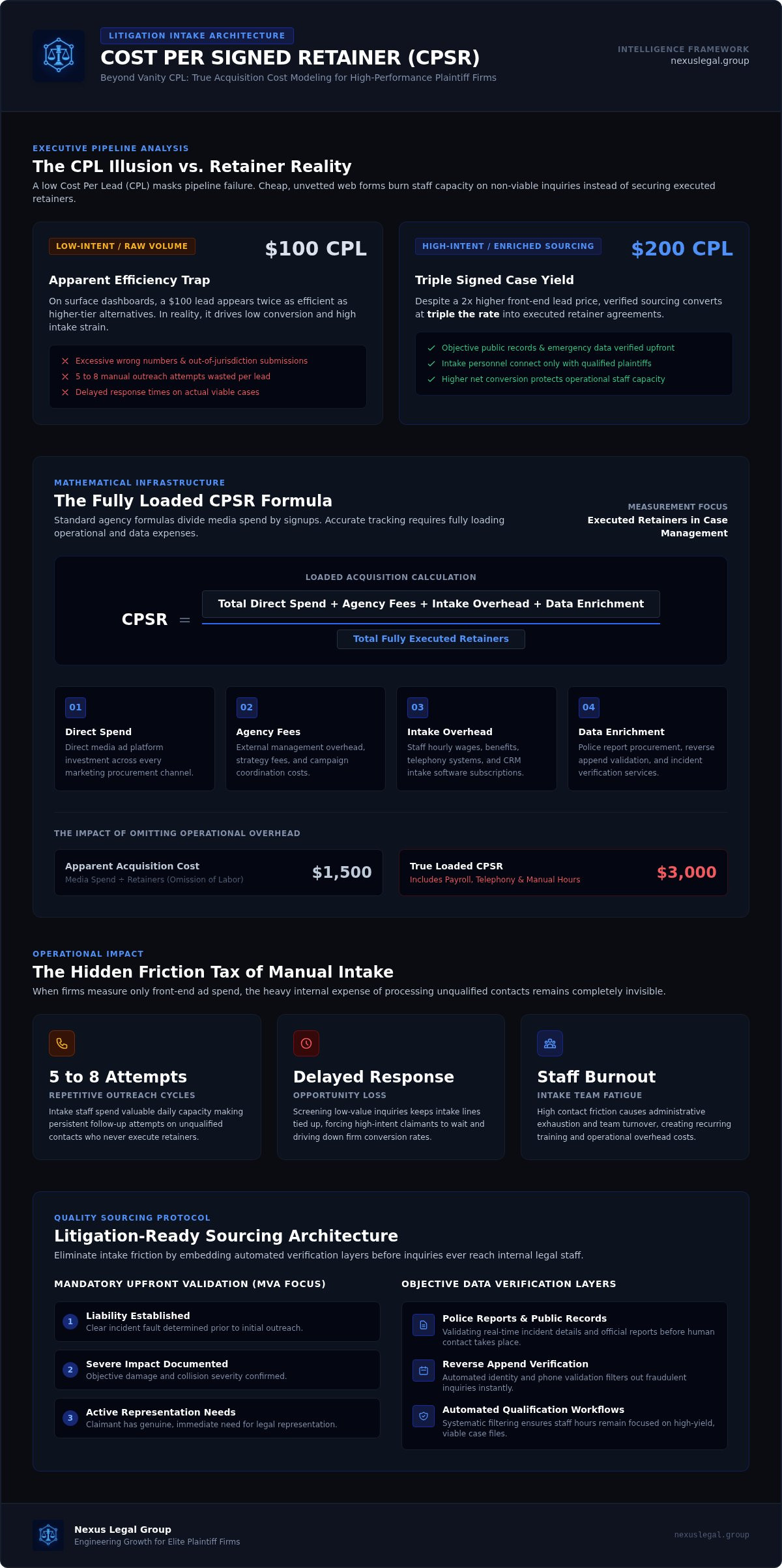
Cost Per Signed Retainer (CPSR) shifts the focus from raw activity to verified client acquisition. It represents the loaded capital required to put an executed agreement into your case management system. By tracking cost per signed retainer, you immediately expose structural friction points across your intake pipeline, identifying exactly which marketing channels yield actual revenue and which merely generate noise. Case quality directly dictates firm scalability; high-yield files streamline caseloads, while volume-driven models collapse under administrative strain.
The CPL vs. CPSR Divide
Front-end lead costs tell you nothing about case viability. In fact, high-volume web submissions often create severe operational bottlenecks:
- Intake team fatigue: Staff members waste hours dialing wrong numbers, unqualified callers, and out-of-jurisdiction claimants.
- Opportunity loss: Delayed follow-up on viable cases occurs while intake staff process low-value inquiries.
- Distorted channel performance: Platforms delivering a $100 CPL look twice as efficient as those delivering a $200 CPL, even if the latter converts to signed cases at triple the rate.
Transitioning from generic lead generation to systematic case acquisition aligns marketing expenditures directly with firm expansion.
Defining Litigation-Ready Inquiries
In high-stakes motor vehicle accident (MVA) acquisition, an inquiry is high-intent only when liability, severe impact, and active representation needs are established upfront. Modern intake architectures rely on automated verification and objective public records, such as emergency services data and police reports, to validate incident details before human contact takes place. Integrating these vetting layers into your law firm growth infrastructure ensures that your intake personnel connect exclusively with claimants who meet your rigorous filing criteria. When you adopt a model centered on tracking cost per signed retainer, automated screening becomes the essential filter that reduces intake friction and drives sustainable growth.
The CPSR Formula: Calculating Your True Acquisition Cost
Most agencies calculate acquisition cost by dividing media spend by signed cases. That simplistic formula leaves out the operational reality of running a practice. When you measure only direct ad invoices, you ignore the internal labor required to sift through low-grade submissions. A fully loaded calculation accounts for the actual capital and administrative energy spent converting an inquiry into an executed contract.
The foundational formula for accurate tracking looks like this:
CPSR = (Total Direct Spend + Agency Fees + Intake Overhead + Data Enrichment) / Total Fully Executed Retainers
Intake overhead includes staff wages, software subscriptions, and telephony tools. Data enrichment covers upfront verification investments, such as police report procurement and identity validation. Omitting these variables introduces a significant friction tax; you might record an apparent $1,500 acquisition that actually cost your firm $3,000 once intake payroll and manual vetting hours enter the ledger. Elite practices maintain operational clarity by tracking cost per signed retainer using this loaded approach to expose budget leakage early.
The Hidden Costs of Manual Intake
Manual vetting carries an invisible, heavy price tag. Calculate your hourly intake cost per file by factoring in hourly wages, benefits, and management oversight across every processed record:
- Repetitive outreach cycles: Staff members making five to eight follow-up attempts on unqualified contacts rapidly consume daily capacity.
- Delayed response consequences: Spending time screening unqualified calls causes high-intent claimants to wait, directly driving down conversion rates.
- Administrative burnout: High contact friction leads to employee turnover, adding recurring recruitment and onboarding expenses to your balance sheet.
Deploying automated verification filters out invalid contacts instantly, letting your team focus exclusively on viable claimants.
Attribution Modeling for 2026
Last-click attribution fails in modern case generation because serious claimants interact with multiple touchpoints before retaining counsel. In motor vehicle accident claims, attribution represents the continuous technical mapping of an incident from verified public crash data through intake qualification to an executed retainer agreement. Sophisticated workflows now leverage AI-driven matching to bridge public record sourcing with downstream case retention, giving partners clear visibility into channel-specific yield. Integrating this level of transparency into your intake pipeline helps you deploy capital where it delivers verified clients. If you want to eliminate intake leakage entirely, you can upgrade your practice with high-intent MVA case acquisition that delivers verified files directly to your docket.
By consistently tracking cost per signed retainer with loaded operational data, you protect your margin against hidden administrative costs.
Lead Quality vs. Volume: How High-Intent Sourcing Lowers CPSR
Generic search campaigns flood intake queues with ambiguous claims, minor property damage disputes, and individuals simply seeking general legal advice. High-intent sourcing flips this dynamic by identifying claimants based on objective incident data rather than speculative keywords. When your firm evaluates procurement through the lens of tracking cost per signed retainer, the financial advantage of data-validated inquiries becomes obvious. A smaller volume of high-intent inquiries routinely delivers more retainers at a fraction of the fully loaded intake cost.
Consider the math behind shared web inquiries compared to exclusive, data-backed files. A campaign generating one hundred unverified leads at low front-end costs often converts at just 2% to 5%, yielding two or three cases while consuming dozens of intake hours. Conversely, high-intent inbound inquiries convert at 15% to 25% or higher. Even when upfront procurement costs appear higher on paper, your true acquisition cost drops sharply because your intake team doesn't waste days sorting through non-viable contacts.
The Data Enrichment Advantage
Integrating emergency services data and crash telemetry removes ambiguity before your intake staff dials a number. By leveraging police report generated MVA leads alongside reverse append technology, intake teams verify crash severity, involved parties, and insurance carrier details upfront. This automated verification eliminates non-meritorious claims at the threshold. Instead of chasing unconfirmed claimants, your intake specialists step into conversations with verified incident reports already attached to the file.
Exclusive vs. Shared Leads
Shared leads destroy intake economics. When three or four firms race to contact the same claimant, response windows shrink to seconds, and conversion rates plummet. This dynamic causes a geometric spike in your effective acquisition overhead. Elite plaintiff practices rely on exclusive, 1-to-1 sourcing to construct a defensible procurement moat. Direct, litigation-ready inquiries bypass vendor bidding wars, keeping intake morale high and administrative overhead low. Disciplined tracking cost per signed retainer confirms that exclusive, pre-verified files consistently protect your firm's operating margin.
Implementing a Precision Tracking System in Your Firm
Transforming your practice from reactive ad buying to predictable client procurement requires a systematic operational framework. You can't optimize what you don't accurately log. To build an airtight pipeline, follow this four-stage execution roadmap:
- Step 1: Unify ad channels with your CMS. Connect your procurement platforms directly to your legal Case Management System (such as Filevine or Lead Docket) through automated webhooks. This step ensures every raw inquiry carries source parameters straight into the intake record.
- Step 2: Automate intake qualification. Deploy AI-driven intake screening tools to validate minimum criteria, verify geographic parameters, and run conflict checks before your intake specialists dial out.
- Step 3: Define a standardized 'Signed Retainer' milestone. Establish an immutable conversion trigger that fires only when a fully countersigned fee agreement lands in your document repository. Avoid triggering conversion tags on verbal confirmations or unsigned digital documents.
- Step 4: Audit speed-to-contact metrics. Log the exact seconds elapsed between initial file creation and first staff engagement. Immediate response windows drive peak conversion rates, while delays compound overhead costs.
By instituting these rigorous checkpoints, your firm moves past speculative ad reporting. Consistent, disciplined tracking cost per signed retainer becomes a natural operational routine rather than a manual spreadsheet headache.
Leveraging Growth Infrastructure
Elite litigation practices treat case acquisition as technical infrastructure rather than creative marketing. Implementing automated intake for plaintiff firms allows your team to leverage reverse append protocols that pull official collision reports and verify involved parties within minutes of an incident. This automated enrichment strips friction from intake, ensuring your staff spends their time closing qualified claimants rather than chasing public records.
Continuous Optimization Loops
Modern data pipelines require proactive recalibration. Conduct CPSR audits on a strict weekly cycle to reallocate capital away from deteriorating channels and directly into verified data streams. Pair these data reviews with weekly call audits to ensure intake specialists engage high-intent inquiries with speed and procedural consistency. When internal workflows operate cleanly, tracking cost per signed retainer functions as a reliable growth engine that scales your active docket efficiently.
Nexus Legal Group: Engineering Growth for Elite Plaintiff Firms
Traditional marketing vendors deliver raw clicks and unverified form submissions, shifting the burdensome task of qualification onto your staff. Nexus Legal Group operates as an institutional partner, engineering growth infrastructure that supplies plaintiff practices nationwide with verified, high-intent cases. By replacing speculative lead generation with systematic data enrichment, we help your firm protect its operating margins while consistently lowering CPSR across every practice area.
Our operational framework focuses on eliminating intake noise entirely. We synthesize official police report feeds, emergency services logs, and reverse append verification into a streamlined procurement engine. This automated system validates critical collision details, liability markers, and involved parties before an intake specialist ever dials out. You receive litigation-ready files rather than ambiguous contacts, allowing your firm to maintain strict standards while tracking cost per signed retainer with institutional clarity.
Litigation-Ready Inquiries as a Service
Scaling a premier personal injury practice requires strict ethical governance and rock-solid compliance protocols. Our case acquisition protocols adhere strictly to national advertising standards, TCPA guidelines, and DPPA regulations, ensuring your files remain audit-proof and defensible from day one. High-capacity practices partner with Nexus to secure exclusive, 1-to-1 files that bypass the volatility of shared-lead exchanges. You can explore our high-intent MVA acquisition solutions to see how pre-verified files remove administrative drag and scale your caseload sustainably.
Next Steps for Your Firm
Transitioning to an engineering-driven acquisition strategy begins with an honest audit of your firm's operational overhead. Take these practical actions to modernize your case pipeline:
- Calculate your true friction tax: Total your staff intake hours, software tools, and lost opportunity costs to measure your fully loaded acquisition metrics.
- Retire shared lead vendors: Eliminate competitive bidding models that force your intake team into high-stress outbound marathons with low yields.
- Deploy data-first sourcing: Adopt automated verification architectures that vet claim details through verified incident logs before file acceptance.
Adopting these foundational adjustments turns your pipeline into a scalable, high-yield asset. When you commit to tracking cost per signed retainer as your primary growth benchmark, partnering with an infrastructure-first team ensures every dollar spent contributes directly to verifiable, executed cases.
Transform Your Acquisition Pipeline Into Scalable Infrastructure
Relying on surface-level marketing numbers restricts your firm's revenue potential and exhausts your intake team. Shifting your strategic focus to tracking cost per signed retainer gives leadership total transparency into the true unit economics of case procurement. When you factor intake overhead into your calculations and eliminate manual vetting friction, you immediately protect staff capacity while securing healthier profit margins.
Long-term firm growth demands an institutional approach to client acquisition. Deploying AI-driven precision acquisition alongside automated verification technology ensures your team engages exclusively with litigation-ready MVA inquiries. This systematic approach removes administrative noise, accelerates intake velocity, and creates an operational foundation that supports continuous docket expansion.
When your acquisition systems operate on verified data, growing your caseload shifts from an uncertain gamble into a predictable operational discipline.
Frequently Asked Questions
What is a good cost per signed retainer for MVA cases in 2026?
Elite plaintiff practices evaluate acquisition costs against case equity, setting their target ceiling between 8% and 20% of the anticipated net legal fee. While exact acquisition expenses fluctuate based on channel competitiveness and docket profile, maintaining costs within this proportional bracket protects firm margins. Tracking this ratio ensures your capital deployment aligns directly with long-term litigation profitability rather than arbitrary front-end benchmarks.
How do I track marketing spend back to a specific signed case?
Integrate your acquisition channels directly with your legal case management platform using automated webhooks and campaign parameter mapping. Every incoming record must inherit source data tags that persist through intake review and document execution. Rigorous, end-to-end tracking cost per signed retainer allows leadership to identify precisely which data pipelines generate executed agreements versus those that simply produce unqualified calls.
Does automated intake verification actually lower my CPSR?
Automated verification reduces the intake friction that drives up operational payroll. By instantly checking crash telemetry, validating contact identity, and confirming accident details before human outreach, you eliminate wasted dialing hours on unviable records. Your intake staff spends their working day engaging pre-qualified claimants, which shortens the conversion window and significantly compresses labor expenses per retained client.
What is the difference between Cost Per Lead and Cost Per Signed Retainer?
Cost Per Lead measures the expense of securing an unvetted inquiry, whereas Cost Per Signed Retainer measures the total loaded expenditure required to secure an executed agreement. CPL ignores staff hours, software subscriptions, and vetting friction. Transitioning to tracking cost per signed retainer accounts for direct advertising, intake labor, and verification tools to reveal the true unit cost of firm expansion.
Can I use police report data to lower my acquisition costs?
Integrating verified police crash records lowers overall acquisition costs by providing objective liability and injury data at the outset. Because official reports establish incident severity and involved parties prior to staff outreach, intake teams bypass manual discovery. Engaging claimants with validated incident reports yields substantially higher conversion rates, cutting the total marketing and labor spend required per case.
How does reverse append technology improve my law firm's ROI?
Reverse append technology matches initial contact inquiries against public incident records and emergency response logs in real time. This automated enrichment delivers official accident reports and insurance details directly into the file before initial staff outreach. Equipping intake specialists with complete crash facts immediately accelerates speed-to-contact, boosts signing rates, and eliminates internal administrative research.
What are the hidden costs of managing an intake team?
Managing an internal intake team carries substantial expenses beyond baseline hourly wages. Unscreened inquiries introduce an operational friction tax through repeated follow-up attempts, management oversight, and staff turnover caused by outbound calling fatigue. Sifting through unqualified leads also introduces opportunity loss when personnel delay outreach to high-value claimants while processing administrative dead ends.
Is tracking CPSR necessary for mass tort case acquisition?
Tracking CPSR is vital for mass tort litigation because docket profitability depends on strict claimant qualification criteria and extended case timelines. High inquiry volumes often mask claimants who fail complex medical or product exposure criteria. Measuring the loaded acquisition cost per signed retainer ensures firms don't overspend on broad campaigns that burden intake staff with non-qualifying submissions.