Commercial Catastrophic Accident Programs for Law Firms
Explore how a commercial catastrophic accident program helps law firms identify truck claims, assess inquiries promptly, and navigate compliance and case fit.
A commercial catastrophic accident program for law firms is a coordinated campaign to identify potential serious-injury truck accident claims and support the firm’s intake process. Its value depends on reaching relevant prospective clients through consent-based advertising and having the capacity to evaluate each inquiry promptly. It is a focused case-acquisition strategy, not a substitute for the firm’s legal judgment or intake decisions.
Firms need more than broad audience attention: they need a process that connects relevant inquiries with careful, timely evaluation. This article explains how commercial trucking campaigns target catastrophic injury cases, which operational and compliance considerations shape them, and how lead-generation support can fit into a law firm’s approach to truck accident claims.
Key Takeaways
- Separate catastrophic accident insurance from a legal-services campaign: one concerns policy coverage, while the other supports law firms’ efforts to identify and evaluate potential truck accident claims.
- Assess how policy limits, deductibles, and exclusions affect a catastrophic accident claim before drawing conclusions about available coverage.
- Build intake processes that can promptly assess serious-injury inquiries, while keeping case acceptance and legal decisions with the law firm.
- Understand why each prospective matter requires independent evaluation, including its facts, potential fit, and the firm’s capacity to handle it.
- See how reverse-append MVA leads can help connect accident reports with details about people involved in a crash.
Catastrophic truck accident legal-services commercial
A commercial catastrophic accident program for a law firm is a targeted campaign to identify and evaluate inquiries about serious truck accidents. It connects a defined audience with legal advertising through a structured, consent-based process. The campaign does not determine whether a claim has merit or whether the firm should accept it. Those decisions remain with the law firm. For example, a collision involving a commercial truck may prompt an inquiry, but the firm must assess the facts, potential injuries, and its capacity to respond.
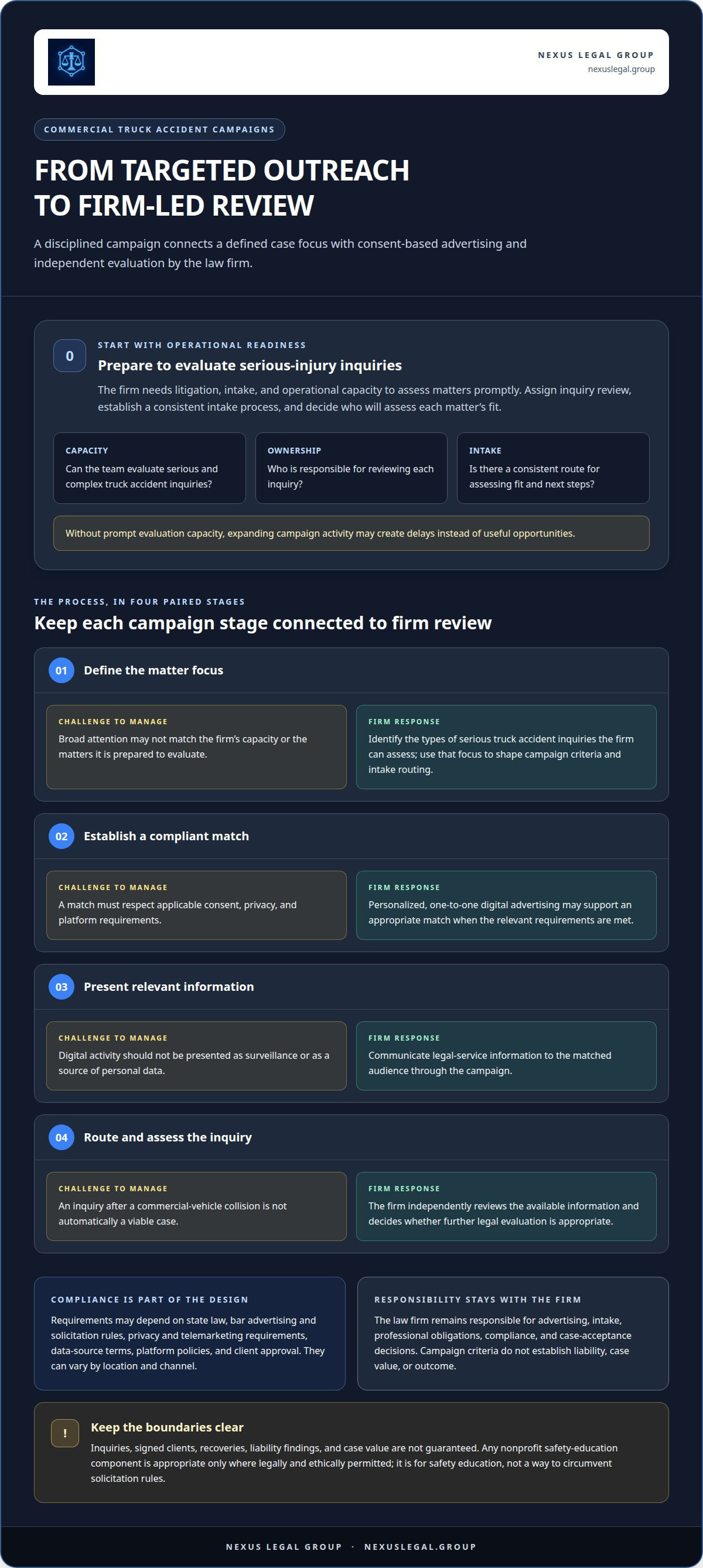
Start with operational readiness. Firms need the litigation, intake, and operational capacity to evaluate serious and catastrophic injury matters promptly. Assign responsibility for reviewing inquiries, establish a consistent intake process, and determine who will assess each matter’s fit. A campaign can attract attention, but it cannot replace a prepared legal team. If a firm cannot promptly evaluate a complex truck accident inquiry, expanding campaign activity may create delays instead of useful opportunities.
How the campaign process works
A disciplined commercial process connects audience identification, consent, advertising, and firm-led review. Each stage has a distinct role, so the sequence matters:
- Define the matter focus. The firm identifies the types of serious truck accident inquiries it has the capacity to evaluate. This focus helps shape campaign criteria and intake routing.
- Establish a compliant match. Personalized, one-to-one digital advertising may support an appropriate match when compliance requirements are met. The match must follow applicable consent, privacy, and platform requirements.
- Present relevant information. Advertising communicates legal-service information to the matched audience. Digital activity is not presented as surveillance or as a source of personal data.
- Route and assess the inquiry. The law firm reviews each prospective matter independently. Its intake team assesses the information available and determines whether further legal evaluation is appropriate.
This structure separates audience targeting from legal judgment. For example, an inquiry after a highway collision involving a commercial vehicle is not automatically a viable case. The firm must evaluate the circumstances, available information, and fit with its practice. Campaign criteria can guide routing, but they do not establish liability, case value, or outcome. That distinction keeps the process focused on qualified evaluation, not unsupported promises.
Compliance is part of the operating design, not an afterthought. Nationwide availability depends on applicable state law, bar advertising and solicitation rules, privacy and telemarketing requirements, data-source terms, platform policies, and client approval. Requirements can vary by location and channel. Participating firms remain responsible for their advertising, intake, professional obligations, case-acceptance decisions, and compliance. A campaign framework cannot transfer those responsibilities to a marketing process.
Some programs also include a nonprofit safety-education component. It is appropriate only where legally and ethically permitted, and must not be used to circumvent solicitation rules. Its purpose is safety education, not covert promotion. Firms should also understand the limits of campaign outcomes: inquiries, signed clients, recoveries, liability findings, and case value are not guaranteed. Each prospective matter requires independent evaluation by the law firm.
A useful commercial framework aligns three operational elements: a defined case focus, a compliant way to reach an appropriate audience, and a firm prepared to assess inquiries. If one is missing, campaign activity can become disconnected from the firm’s actual capacity. A clear intake route and independent review help maintain that connection, while the firm retains control over advertising decisions and which matters it accepts.
Keep the campaign’s role clear: advertising may provide information, but the firm remains responsible for evaluating each inquiry. The program’s nonprofit safety-education component is appropriate only where legally and ethically permitted, and is not intended to circumvent solicitation rules.
Treat that limitation as a firm boundary when deciding whether the component belongs in a campaign. Review whether the educational purpose is genuine, whether the proposed use is permitted in the relevant setting, and whether readers could interpret it as an effort to get around solicitation restrictions. If anything is unclear, resolve the concern before proceeding rather than assuming a nonprofit label makes the use acceptable. State the component’s purpose explicitly and do not present it as a route to an inquiry. These checks do not expand what is allowed; they help keep any proposed use within the stated conditions.
What exclusions, coverage limits, and claim risks apply to catastrophic accident programs?
First, distinguish insurance coverage from a legal-services campaign. A catastrophic accident policy may help pay eligible expenses under its terms; a law firm campaign supports identifying and evaluating potential claims. Neither establishes liability for a truck collision. For example, an injured person may have a school accident policy and a separate potential claim arising from a crash. Each follows a different process.
Coverage limits set the maximum amount payable under the policy, while deductibles determine how much must be paid before coverage responds. Those figures describe different plan options, not a single standard. The actual limit and covered expenses depend on the policy terms.
A deductible can affect when catastrophic coverage begins. In that arrangement, the base policy may cover expenses first, with the catastrophic policy responding after its deductible conditions are met. When reviewing a claim, distinguish the deductible from the coverage limit. They affect different points in the payment sequence.
Base accident coverage can also be limited. Some voluntary base accident plans may pay only 50% of an athlete’s medical bills. Those figures illustrate why the existence of a base policy doesn’t, by itself, establish how much an injured person can recover. The policy’s payment basis, covered expenses, and coordination with other coverage all matter.
Where exclusions and claim risks arise
Exclusions identify circumstances or expenses the policy does not cover. Their effect depends on the policy language, so do not assume that two plans with similar limits cover the same losses. For example, a plan’s stated limit does not show whether a particular medical expense qualifies. A careful review separates four items: the covered person, covered event, eligible expense, and applicable limit.
- Coverage fit: Confirm whether the policy applies to the person and accident involved.
- Payment order: Identify whether the base plan pays first or coverage operates on an excess basis.
- Deductible: Determine what expenses count toward the threshold.
- Remaining limit: Establish how much coverage remains after eligible payments.
Claim-related confusion can arise when a family expects the catastrophic policy to pay immediately, but a base policy or deductible applies first. Another risk is confusing policy benefits with a truck accident claim. Insurance terms govern policy payments; they do not decide who caused a collision or whether another party is legally responsible. A law firm evaluates those questions separately, based on the crash facts and available information.
Some catastrophe cash policies use a different payment structure, with an initial lump sum followed by monthly benefits for a period such as five years. That differs from reimbursement of medical bills and can affect how a claimant understands payment timing and benefit type. Before assessing a claim, distinguish cash benefits from medical-expense coverage, then match each benefit to its policy terms.
For a law firm, the practical sequence is to identify the policy type, read its exclusions and payment conditions, then separate coverage questions from crash-liability questions. Accident-report details may support initial matter review, but they don’t determine policy coverage. A separate accident-report and involved-party information process can help organize relevant crash details for that review.
It may help pay eligible medical bills for a covered person after a covered accident. Which injuries and expenses qualify depends on the policy terms, payment basis, deductible, and remaining limit.
Nexus Legal Group: Reverse Append MVA Leads To Obtain Accident Reports and Details of those involved
Nexus Legal Group supports law firms that need structured accident information to assess potential motor vehicle accident matters. Its Reverse Append MVA Leads help obtain accident reports and details about people involved, giving intake teams relevant information for initial review. Police Report Generated MVA Leads and Automated Verification can also support case-acquisition workflows. These services help organize inquiry evaluation; they do not determine liability, policy coverage, or whether a firm should accept a case. The law firm retains those decisions and independently evaluates each prospective matter.
Consider this support when your firm needs accident-report details to inform intake for a potential truck accident claim. Contact Nexus Legal Group to discuss how its lead services can fit your firm’s case-acquisition process.
Build a More Deliberate Case-Acquisition Workflow
The next step is to align a commercial catastrophic accident program with your firm’s intake capacity, case criteria, and review process. Treat campaign development as an operational decision: define the matters your team can assess, establish how inquiries enter intake, and keep case-acceptance decisions with the firm. This gives your team a practical framework for deciding whether targeted acquisition supports its objectives.
Nexus Legal Group supports law firms through High-Intent MVA Case Acquisition, Police Report Generated MVA Leads, and Automated Verification. These offerings can support a structured workflow for identifying and reviewing potential motor vehicle accident matters, while your firm retains control of its legal and intake decisions.
A focused process creates a clear path from inquiry to independent evaluation. Move forward with a case-acquisition approach that fits your firm’s priorities.
Frequently Asked Questions
What is a commercial catastrophic accident program?
A commercial catastrophic accident program is a targeted case-acquisition approach that helps law firms reach and assess potential serious-injury claims, rather than an insurance policy covering accident expenses. For example, a firm handling commercial vehicle matters might use a campaign to generate relevant inquiries, then route them through its intake process for review. The firm decides whether each matter fits its practice and whether to pursue it.