Critical Crash Intelligence: Smarter MVA Acquisition
Learn how critical crash intelligence combines AI event patterns and injury claim data to assess risk and support informed MVA acquisition decisions.
U.S. bodily injury paid-claim frequency increased 11% over two years, while the average paid bodily injury claim increased 10.3% over the prior year. For MVA acquisition, critical crash intelligence turns safety-critical event information into a clearer view of crash risk by considering both how often injury claims occur and how severe they are.
A crash record rarely captures the full picture. AI tools can reveal patterns across event details, while claim frequency and severity add context for assessing which events may warrant closer attention. The challenge is interpreting these signals together without treating any one indicator as a complete risk assessment.
This article explains how AI analyzes safety-critical events, how bodily injury claim patterns inform risk assessment, and why the limits of these signals matter. You’ll get a practical framework for understanding how critical crash intelligence can support more informed MVA acquisition decisions.
Key Takeaways
- Understand how crash intelligence draws on safety-event information and AI analysis to identify contributing factors and patterns.
- Assess platform pricing by examining how the data, integration, and analysis requirements shape the model.
- Recognize why privacy, data ownership, and organizational barriers affect how road-safety information can be shared.
- Account for complexity and unpredictable machine-learning failures when evaluating the limits and security needs of these systems.
- See how police report generated MVA leads, emergency services generated MVA leads, and automated verification can support high-intent case acquisition.
Who provides critical crash intelligence in the United States?
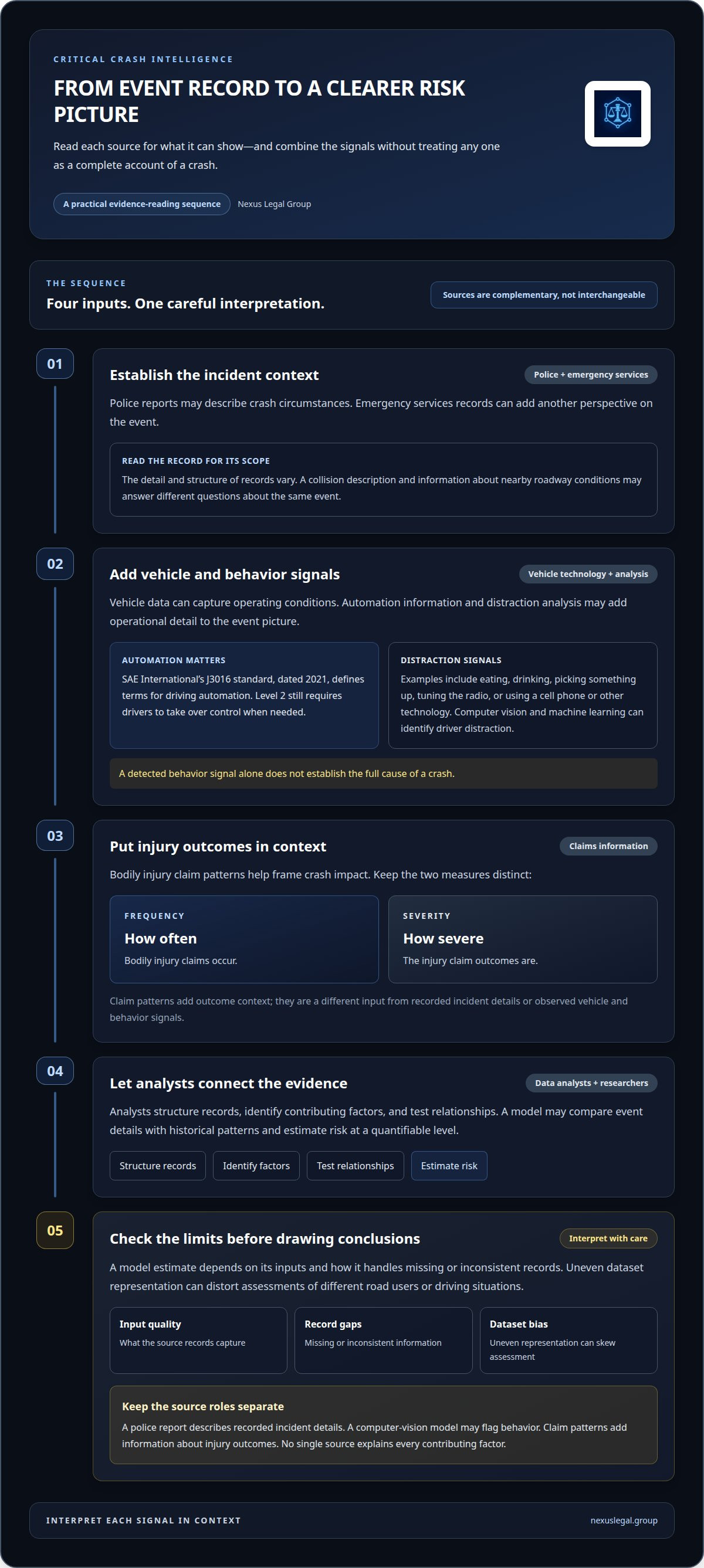
In the United States, crash intelligence comes from public agencies, vehicle technology companies, data analysts, insurers, and researchers. Each contributes a different part of the picture: a police crash report may describe an event, vehicle data may capture operating conditions, and an analytical model may identify patterns across records. No single source explains every contributing factor. Critical crash intelligence is more useful when analysts interpret these distinct inputs together.
Public agencies and first responders contribute records related to roadway incidents. Police reports may document crash circumstances, while emergency services records can provide another perspective on the event. The detail and structure of these records vary, so analysts need to understand what each source captures before combining them. A collision description and an account of nearby roadway conditions, for example, may answer different questions about the same event.
Vehicle manufacturers and technology developers contribute another layer through work involving driving automation and in-vehicle systems. SAE International’s J3016 standard, dated 2021, defines terms related to driving automation systems for on-road motor vehicles. Level 2 automation still requires drivers to take over control when needed. That distinction matters: an analyst interpreting an event must account for the driver’s role, rather than treating automation as fully autonomous operation.
Driver behavior also informs an assessment. The National Highway Traffic Safety Administration defines distracted driving as activities that divert attention from driving. Examples include eating, drinking, picking something up, tuning the radio, or using a cell phone or other technology. Computer vision and machine learning methods can automatically identify driver distraction. These methods help analyze observable behavior, but detected signals alone don’t establish the full cause of a crash.
Data analysts and research teams connect sources by structuring records, identifying contributing factors, and testing relationships. A model may compare event details with historical patterns, then estimate risk at a quantifiable level. That estimate depends on its inputs and treatment of missing or inconsistent records. Analysts also need to account for dataset bias, since uneven representation can distort assessments of different road users or driving situations.
For a practical assessment, distinguish the role each source plays:
- Incident records: Police and emergency services information can establish event context.
- Vehicle and behavior signals: Automation data and distraction analysis can add operational detail.
- Claims information: Bodily injury claim frequency and severity can help frame crash impact.
- Analytical systems: Data specialists and researchers evaluate patterns, model limits, and potential bias.
These roles overlap, but their outputs aren’t interchangeable. A police report describes recorded incident details, a computer-vision model may flag behavior, and claim patterns add information about injury outcomes. Critical crash intelligence depends on knowing which provider supplies each input and how an assessment is used. Separating these roles makes risk analysis easier to interpret and helps prevent a model signal from being mistaken for a complete account of an event.
The wider operating context can shape the questions analysts ask, but it isn’t direct evidence about an individual collision. The programme recommends international cooperation with projects or partners from the United States, Japan, Singapore, and Australia. Such cooperation can support comparisons of vehicle technology and analysis across different settings while keeping local crash records and conditions distinct. Intelligence is strongest when broad context guides inquiry rather than replacing event-specific evidence.
Market conditions offer another backdrop for interpreting changes in the vehicle fleet. Nearly 7 million fewer vehicles were sold in the United States during 2021-2025 than during 2016-2020. These figures describe the market and fleet, not the cause of a crash. Governance is also developing: 37 U.S. states had published some form of AI guidance or framework as of June, and five states required districts to adopt their own AI policies. Such policy variation is relevant when considering how AI tools are developed and used, but it does not establish the reliability of any particular crash analysis. Analysts still need to assess the underlying records, methods, and limits of each source.
What are the costs and pricing models for crash intelligence platforms?
Crash intelligence platforms don’t follow one universal pricing structure. A contract may charge for access, data volume, selected analytical functions, or implementation work. A team reviewing event records through a dashboard, for example, has different requirements from one integrating data into internal systems. Costs depend on what the organization needs the platform to process and deliver, not simply on the software label.
Subscription pricing groups platform access into a recurring package. The package can vary by number of users, data sources, analytical tools, or service levels. A small team might need a few accounts and standard reporting, while a larger operation might require broader access and customized workflows. The key is to understand what the subscription covers, including data access, updates, support, and additional modules.
Usage-based pricing ties charges to activity. A provider might measure records processed, searches performed, API calls, or data volume. This structure can suit organizations whose demand changes over time, but forecasting depends on expected usage. A sudden increase in event records, for instance, can affect spending if the contract charges by processed record. Clear definitions of billable activity help teams estimate how changing workloads affect costs.
Some agreements combine a base subscription with usage charges or one-time implementation work. An organization might pay for platform access, then incur additional charges as it adds integrations or increases processing volume. Implementation effort depends on the condition and structure of source data, the number of systems involved, and the reporting configuration. A written scope should distinguish recurring access from setup, integration, training, and optional analytical components.
Data access can also affect total cost. A platform that analyzes police reports, vehicle signals, or claims information may involve different data arrangements. The contract should identify which sources are included, how records are refreshed, and whether permitted use differs by source. A dashboard displaying existing information is not the same as a service that acquires, standardizes, and connects multiple datasets.
Evaluate a proposal by mapping each charge to a business requirement:
- Access: Identify account limits, user roles, and included platform functions.
- Volume: Clarify whether records, searches, storage, or API activity affect charges.
- Data: List included sources and distinguish access from data preparation.
- Integration: Separate initial configuration from ongoing maintenance or changes.
- Expansion: Determine how additional users, datasets, or analytical features affect the agreement.
Compare scenarios before choosing a model. Estimate a normal workload, then consider a higher-volume period and a change in data sources. If a team adds historical records to its regular event analysis, for example, usage-based charges may behave differently from a fixed subscription. Compare the same functions and data scope, or the apparent price difference won’t reflect equivalent services.
For plaintiff firms, platform analytics and case acquisition are distinct budget decisions. A technology platform organizes or analyzes information; acquisition services focus on connecting firms with potential MVA matters. Firms assessing that operational side can review MVA case acquisition capabilities alongside their separate analytics requirements.
What privacy laws and data-sharing rules apply to crash intelligence in the U.S
In the United States, privacy and data-sharing decisions for crash intelligence depend on the information involved, its source, and the organizations handling it. A police report, an emergency response record, and a vehicle-generated signal can raise different access and ownership questions. There’s no useful one-size-fits-all assumption for combining them. Each data flow needs a defined purpose, authorized users, and documented handling conditions.
The European Commission programme identifies privacy, data ownership, and organizational barriers as issues for road-safety data collection and sharing. These questions also provide a practical framework for U.S. projects. For example, an agency providing crash records and a firm analyzing them need clarity about permitted use, retention, and onward sharing. Access alone doesn’t determine who can reuse information or for which analysis.
Start by mapping the data lifecycle. Identify who collects each input, who receives it, what the analysis produces, and where the results are stored. A project combining incident reports with driving-behavior signals should document whether the system retains source records, derived indicators, or both. This distinction helps teams set access controls around sensitive inputs while allowing approved users to work with appropriate analytical outputs.
Data ownership also affects collaboration. A public agency, a technology provider, and a research group may each control different records or systems. Before sharing, define which party supplies each dataset, who can access it, and whether recipients can create or redistribute derived data. Organizational barriers can include incompatible formats, unclear responsibilities, or separate approval processes. A shared purpose statement and written data agreement can clarify these boundaries.
Data-sharing programs should make information useful across systems. The European Commission programme calls for FAIR principles: Findable, Accessible, Interoperable, and Reusable. A dataset is findable when teams can locate it through consistent descriptions. It is accessible when approved users have a defined way to retrieve it. Interoperability requires compatible structures, while reusability depends on context explaining how records were produced and how to interpret them.
Apply these principles without treating accessibility as unrestricted access. A project can use role-based permissions, purpose limitations, and documented retention decisions as governance controls. An analyst, for instance, may need an aggregated trend rather than direct access to identifiable source records. The appropriate level of detail depends on the analysis task and the data-sharing terms established by participating organizations.
Before a U.S. crash-intelligence project exchanges information, its governance plan should specify:
- Purpose: The safety or analytical question the data supports.
- Authority and ownership: Which organization provides each input and controls its use.
- Access: Which roles can view source records or derived outputs.
- Compatibility: How formats and definitions will be aligned for analysis.
- Lifecycle: How information is retained, updated, and handled when the project ends.
These steps make data-sharing arrangements more explicit, but they don’t replace applicable legal review. U.S. organizations should assess the rules that apply to their records, jurisdictions, and intended uses before exchanging data. A careful governance structure allows analysts to connect useful safety information while keeping purpose, ownership, and access decisions visible throughout the project.
What are the risks, limitations, and cybersecurity concerns of crash intelligence systems
A crash intelligence system can influence decisions under pressure, while handling complex inputs and competitive demands. These conditions matter because fast-paced operation, system complexity, and competitive pressure can make AI accidents more likely. A model that processes roadway events quickly still needs clear limits, tested outputs, and defined human oversight. Speed alone doesn’t make an assessment dependable.
Machine-learning systems can fail unpredictably and potentially cripple the systems in which they’re embedded. In a crash-analysis workflow, faulty input or model output could disrupt later processing or misdirect attention. A system might classify an event from incomplete records, then pass that assessment into a downstream report. The risk lies not only in the model but also in how connected systems use its output.
Complexity can make failures harder to detect. Modern AI systems’ data intensity, opacity, and unpredictability challenge traditional safety certification approaches. A team may see a risk score without knowing which inputs shaped it. That makes it harder to distinguish a meaningful signal from a model artifact. Documenting inputs, output definitions, and known limitations gives reviewers a basis for questioning results.
Bias creates another limitation. If training data underrepresents particular road users, vehicle types, or roadway conditions, a model may perform unevenly in those cases. A system intended to improve safety should account for dataset bias and assess whether results treat road users fairly. Analysts can compare model behavior across relevant data groups, inspect recurring errors, and revise data or evaluation methods when disparities appear.
Cybersecurity adds a separate operational concern. Crash intelligence systems may connect data sources, analysis tools, user accounts, and reporting workflows. Each connection creates a point where access and data integrity need protection. A compromised account, altered input, or disrupted integration could affect the reliability or availability of analysis. These are risks to consider in system design, not evidence that a particular platform has suffered an incident.
Practical controls should address the whole workflow, not just the model:
- Limit access: Assign permissions according to each user’s role and task.
- Protect data integrity: Track changes to source records and analytical outputs.
- Test failure modes: Examine how the system responds to incomplete, inconsistent, or unexpected inputs.
- Maintain oversight: Define which decisions require human review before action.
- Plan continuity: Establish how essential work proceeds if an integration or model becomes unavailable.
These controls support disciplined use, but they don’t eliminate model limitations. A prediction identifies patterns and possible relationships; it doesn’t establish the cause of an individual crash. Teams should distinguish observed evidence from model-generated estimates and make that distinction clear in reports. Critical crash intelligence is most useful when analysts can explain the system’s role, identify uncertainty in its inputs, and intervene when an output conflicts with the recorded event.
The Safe System Approach recommends shifting road safety management from reactive crash investigations toward proactive interventions before serious crashes occur. The programme recommends considering real-time countermeasures to reduce immediate risk for all road users alongside existing Intelligent Transport Systems services.
Policymakers should invest in AI standards development and testing capacity to help establish resources for safe, reliable AI systems. They should also work across borders to reduce AI accident risks, including through research and development alliances and intergovernmental organizations.
Nexus Legal Group
Nexus Legal Group helps plaintiff firms connect crash-related information with MVA case acquisition. Critical crash intelligence helps frame event patterns, while acquisition workflows focus on identifying relevant inquiries and organizing intake. Police report generated MVA leads and emergency services generated MVA leads connect acquisition with incident information, while automated verification supports the intake process.
When your firm wants crash intelligence to inform how potential MVA cases enter its pipeline, these services offer a practical next step. Critical crash intelligence and case acquisition serve distinct roles, and aligning them can help your team build a more considered intake strategy.
Contact Nexus Legal Group to discuss your MVA case acquisition needs.
Turn crash insight into a stronger acquisition strategy
Use critical crash intelligence as one input to a disciplined MVA acquisition strategy, not as a substitute for case-level assessment. The next step is to align the information your firm can use with an intake process that helps your team evaluate incoming opportunities consistently.
Nexus Legal Group supports this operational focus through High-Intent MVA Case Acquisition, Police Report Generated MVA Leads, and Automated Verification. These offerings connect crash-related information with acquisition and intake workflows, helping plaintiff firms focus on how potential cases enter their pipeline. Start by identifying where your current process needs stronger event context or verification, then consider how MVA acquisition can address that need.
A more deliberate connection between crash information and intake can give your team a clearer foundation for its next growth decision.
Frequently Asked Questions
What does “critical crash intelligence” mean?
It means using crash-related information to assess patterns, contributing factors, and potential injury risk. For example, an analyst could compare event circumstances with bodily injury claim trends to help prioritize MVA inquiries for review. The resulting assessment can inform decisions, but it doesn’t establish fault or explain every detail of an individual collision. Its value depends on interpreting the information in context.
What does crash intelligence software or service do?
Crash intelligence software organizes and analyzes event information, while related services may apply crash details to a specific business workflow. Critical crash intelligence can help firms frame their assessment of potential MVA inquiries, but it is distinct from case acquisition. Nexus Legal Group provides High-Intent MVA Case Acquisition, with police report generated MVA leads and automated verification supporting acquisition and intake.
What data sources and technologies are used for crash intelligence?
Sources can include police reports, emergency services information, vehicle-related signals, and bodily injury claim patterns. Machine learning can analyze relationships across records, while computer vision can identify observable driver behavior. For example, a review might consider whether a distraction indicator appears alongside a recorded event detail. Critical crash intelligence draws meaning from the relationships among these separate inputs, rather than treating any single signal as a complete account.