Reducing No-Show Rates for Initial Consultations: A Law Firm Playbook
Learn proven strategies for reducing no-show rates for initial consultations. Improve client intake, streamline reminders, and boost your law firm's bookings.
Reducing no-show rates for initial consultations takes more than sending extra reminders. When a prospective client misses an appointment, staff time is lost, but the reason may not be obvious. Scheduling friction, unclear expectations, and inconsistent follow-up can all make it harder for someone to attend.
A repeatable process gives each step an owner, sets clear expectations for the consultation, and makes it straightforward to confirm or reschedule. Even a high-intent inquiry needs a clear path from booking to conversation. Inquiry acquisition and appointment operations are distinct parts of the intake journey, so firms should measure and manage them separately.
This playbook explains how to standardize booking and confirmation, coordinate reminders across communication channels, and track attendance and drop-off points. Use the steps to identify where prospective clients disengage and give your team a professional consultation process it can review and refine.
Key Takeaways
- Use one consistent definition of a no-show so attendance reports compare like with like.
- Map each step from inquiry through consultation, and assign clear ownership for accurate appointment details.
- Match reminders and scheduling options to the friction they address. More reminders alone won’t fix confusing booking or rescheduling.
- Measure reducing no-show rates for initial consultations with a shared calculation, while tracking cancellations and reschedules separately.
- Connect inquiry source, verification, and attendance reporting to identify where prospective clients disengage. Keep appointment operations within the firm’s workflow.
Why Initial Consultation No-Shows Happen at Law Firms
A missed consultation appears in the calendar, but the reason may not. The prospective client may have forgotten, misunderstood what would happen, had trouble joining, or experienced a change in circumstances. Treat nonattendance as a process signal, not proof of a person’s intent. Reviewing what happened can help the firm find points in the intake journey that need clarification.
Start with one definition that the entire team can apply: An initial consultation no-show is a scheduled first meeting for which the prospective client does not attend and does not cancel within the firm’s defined cancellation window. Reuse this wording in team procedures and dashboards. The broader concept of a no-show is discussed in Understanding the “No-Show” Phenomenon, but each firm needs an operational definition that fits its appointment records.
Which booking-stage friction points can lead to a missed consultation?
Review the handoffs between inquiry and booked appointment. If no one owns confirming the details, a prospective client may receive incomplete or inconsistent information. A slow response or a long scheduling exchange can also interrupt the process. These are possible friction points, not proven causes. Intake notes and follow-up conversations can help establish what happened.
Check that the confirmation explains the consultation’s purpose, format, time, and how to attend. For a remote meeting, unclear access instructions may create a barrier. For any format, a difficult rescheduling process can leave someone unsure how to report a change. Separate confirmed information from hypotheses: record what the prospective client or staff member reported, then review recurring patterns before changing the process.
How should firms define an initial consultation no-show?
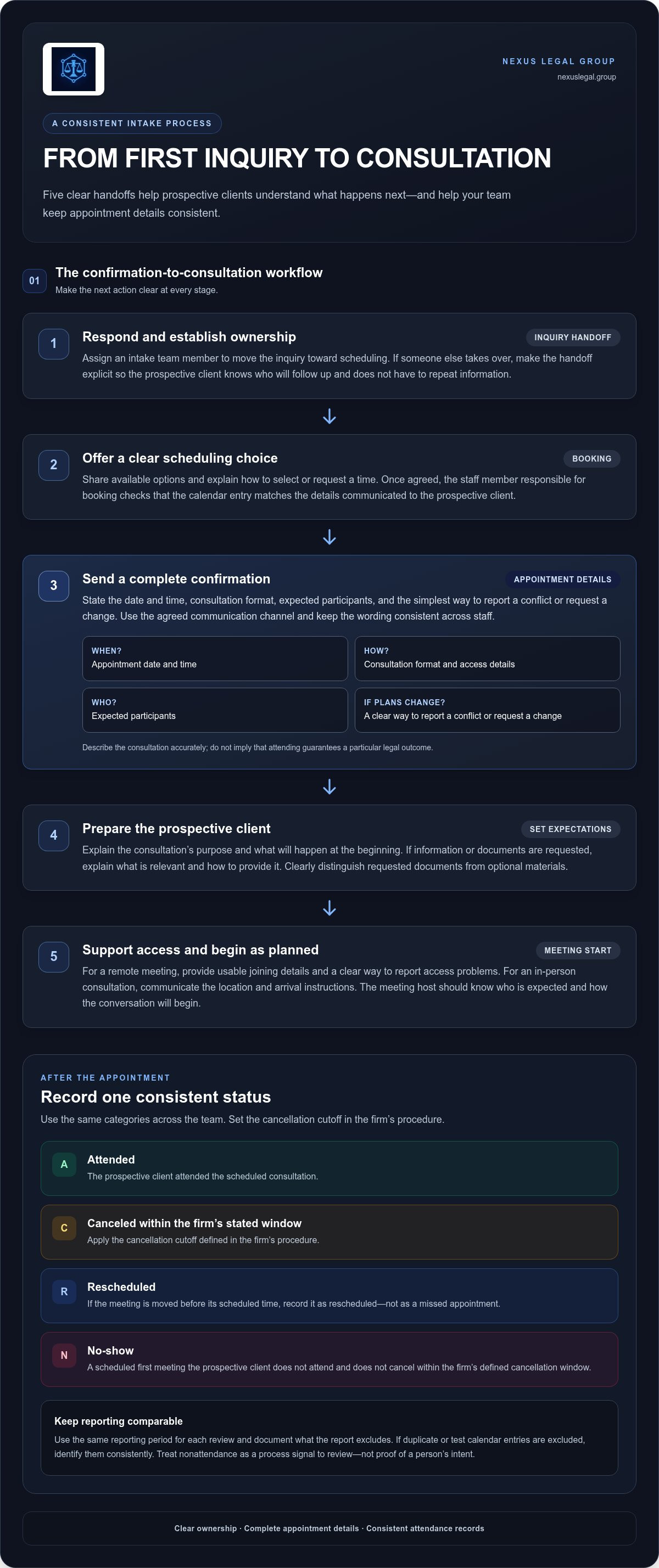
Give every appointment one status: attended, canceled within the firm’s stated window, rescheduled, or no-show. Set the cancellation cutoff in the firm’s procedure so staff can distinguish a timely cancellation from nonattendance. If a meeting is moved before its scheduled time, record it as rescheduled, not as a missed appointment. Otherwise, reports may count a changed plan as a failure to attend.
Use the same reporting period for each review, such as a calendar month or another defined interval, and document what the report excludes. For example, a firm might exclude duplicate or test calendar entries if its records identify them consistently. The exact choices matter less than applying them consistently and explaining them in plain language. This way, a change in the reported rate reflects appointment outcomes rather than different staff members using different labels.
Clear categories give the firm a useful starting point for reducing no-show rates for initial consultations. Once the team can distinguish attendance, cancellations, rescheduling, and nonattendance, it can investigate whether scheduling handoffs, appointment instructions, or changing circumstances need attention. This avoids treating every missed meeting as the same problem.
Build a Confirmation-to-Consultation Workflow That Reduces Friction
A reliable workflow makes the next action clear at every stage, from the first response to the start of the meeting. To reduce no-show rates for initial consultations, define who owns each handoff and what information the prospective client should receive. The steps below offer a consistent path without adding unnecessary work.
- Step 1: Respond and establish ownership. Assign an intake team member to move the inquiry toward scheduling. If someone else takes over, make the handoff explicit so the prospective client does not have to repeat information or wonder who will follow up.
- Step 2: Offer a clear scheduling choice. Share available options and explain how to select or request a time. Once the time is agreed, the staff member responsible for booking should check that the calendar entry matches the details communicated to the prospective client.
- Step 3: Send a complete confirmation. State the appointment date and time, consultation format, expected participants, and the simplest way to report a conflict or request a change. Use the communication channel the prospective client has agreed to use, and keep the wording consistent across staff.
- Step 4: Prepare the prospective client. Explain the consultation’s purpose and what will happen at the beginning. Provide relevant preparation instructions, and clearly distinguish between requested documents and optional materials.
- Step 5: Support access and begin as planned. For a remote meeting, provide usable joining details and a clear way to report access problems. For an in-person consultation, communicate the location and arrival instructions. The meeting host should know who is expected and how the conversation will begin.
What should a consultation confirmation communicate?
A confirmation should answer practical questions without requiring another call: When is the consultation? How will it take place? Who is expected to participate? What should the prospective client do if plans change? A concise template can standardize these details across email, text, or another agreed channel. Describe the consultation accurately, and do not imply that attending guarantees a particular legal outcome.
How can firms prepare prospective clients before the meeting?
Preparation should reduce uncertainty, not create another intake burden. If the firm requests information or documents, explain what is relevant and how to provide it. Label optional materials clearly. Identify who will participate and how the discussion will begin. Include easy-to-follow access instructions and a clear contact route for troubleshooting if the prospective client cannot join.
Review the workflow as a connected intake process. Inquiry response, scheduling, confirmation, preparation, and meeting ownership should each have a named responsible role. Firms reviewing upstream inquiry quality alongside their own appointment operations can explore growth infrastructure for plaintiff firms.
Compare Reminders, Scheduling Design, and Intake Readiness
Different attendance barriers call for different responses. A reminder can prompt someone who understands the appointment, but it cannot make an inconvenient time workable or clarify expectations that were never explained. When reducing no-show rates for initial consultations, compare each option by the problem it addresses, the work it requires, and the signals that can help show whether it is making a difference.
When do reminders help, and when are they insufficient?
Reminders reinforce an appointment the prospective client has understood and agreed to attend. Their usefulness depends on clear message content, a channel the person has agreed to use, and timing that fits the firm’s process. There is no universal cadence to prescribe without firm-specific evidence. If someone does not know how to join or reschedule, sending more reminders may repeat the message without resolving the barrier.
How do scheduling flexibility and intake readiness affect attendance?
Scheduling design determines whether the available appointment options fit a prospective client’s availability and whether changing a time is straightforward. Intake readiness is different: it means the person understands the consultation’s purpose and what to expect, not that the firm has made assumptions about case merit. Clarifying expectations during booking may address uncertainty more directly than adding another message later.
Comparison of attendance interventions
Reminders: Reinforce an understood appointment. Implementation effort: set consistent wording, use agreed channels, and establish a firm-specific timing approach. Suitable signal: attendance and timely cancellation patterns by reminder status, where records allow reliable comparison.
Scheduling design: Address limited appointment options or a difficult rescheduling path. Implementation effort: review how appointment times are offered and how prospective clients request changes. Suitable signal: scheduling completion, rescheduling, and cancellation patterns.
Intake readiness: Address uncertainty about the consultation’s purpose, format, or preparation. Implementation effort: align explanations across intake staff and booking communications. Suitable signal: questions or reported confusion before the meeting, alongside attendance outcomes.
Use these signals as diagnostic clues, not proof of cause. A reminder may be delivered but not read, and a cancellation may reflect changed circumstances rather than a process defect. Pair appointment records with staff feedback and, where appropriate, what prospective clients report. Keep observed events distinct from explanations in review notes.
Test changes in a controlled way when operations allow. For example, revise the confirmation language while keeping scheduling options and reminder practices stable, then review relevant signals over a consistent reporting period. Next, assess whether scheduling flexibility needs a separate adjustment. Changing several elements at once makes results harder to interpret. No single tactic eliminates no-shows, but coordinated, measured improvements can help reveal which friction points the firm can reduce.
Measure No-Show Rates and Improve the Follow-Up Process
A useful attendance metric depends on consistent records, not a complicated dashboard. Start with the same appointment categories and no-show definition across the team, then calculate the rate over a stable reporting window. The result can show whether missed consultations are changing, but it cannot explain why. Pair the numbers with intake-team feedback and follow-up outcomes to identify where a workflow test may help.
Which consultation attendance metrics should a firm track?
No-show rate = missed consultations ÷ consultations scheduled. Use the same unit and reporting period each time, and state how cancellations and reschedules are handled so the denominator remains clear. Record scheduled, attended, canceled, rescheduled, and missed appointments as distinct outcomes. If the firm changes its definitions or exclusions, document the change. Otherwise, a shift in the metric may reflect new counting rules rather than a change in attendance.
Also track the booking-to-consultation interval when the records support it. Segment results by operational variables that can guide action, such as booking channel or consultation format. Keep comparisons readable: if one group has few appointments, do not treat a small change as a reliable pattern. These measures are diagnostic signals, not proof that a particular channel or format caused a missed meeting.
What should happen after a prospective client misses a consultation?
Follow up professionally and without judgment, and make the next step clear. For example: “We weren’t able to connect for your consultation. If you’d like to reschedule, reply here and we can discuss another time.” Use the communication channel the person has agreed to use, and record whether they respond, reschedule, decline, or remain unreachable. If they share a barrier, document it as reported rather than inferring a reason.
Review the records regularly. Intake staff can compare missed appointments with cancellations and reschedules, then look for recurring signals such as confusion about the consultation format, difficulty changing an appointment, or a pattern associated with a particular booking path. Treat these as questions to investigate, not conclusions. Ask staff what they observed and check whether prospective clients reported similar obstacles.
Choose one friction point for the next workflow test. Record the proposed change, the group or process it applies to, the reporting window, and the metric the team will review. Assign an owner to make the change and keep other steps stable where practical. Then compare outcomes using the same definitions. This makes the improvement cycle actionable: identify a signal, test a focused adjustment, and retain or revise it based on what the records show. Reducing no-show rates for initial consultations becomes a measurable operational effort rather than a series of untracked reminders.
Connect Consultation Attendance to a More Reliable Law Firm Intake System
Consultation attendance is one stage in a broader intake journey. To understand where prospective clients disengage, firms need a coherent view of how an inquiry arrived, what verification occurred, when an appointment was scheduled, and whether the person attended, canceled, or rescheduled. Connected records help staff investigate handoffs instead of treating each missed meeting as an isolated calendar event.
How does inquiry readiness fit into consultation attendance?
Clear, verified inquiry information can give intake staff a more informed starting point for the next conversation and help preserve relevant details as an inquiry enters the firm’s own intake workflow. But inquiry verification is not appointment confirmation. It does not establish that a consultation was booked, that the prospective client received the details, or that they attended. Verification also does not replace the firm’s legal evaluation.
Keep these stages distinct in records and team procedures. A useful intake view can connect inquiry source and verification status to booking and attendance outcomes, while preserving ownership of each operational handoff. This makes it easier to ask focused questions: Are particular inquiries reaching scheduling? Are appointment outcomes being recorded consistently? Do staff have the information needed to continue the conversation? The answers guide process review without assuming that inquiry quality alone determines attendance.
For plaintiff firms, Nexus Legal Group provides upstream growth infrastructure that includes high-intent MVA case acquisition and automated inquiry verification. Its MVA acquisition approach uses police reports, emergency services data, and reverse append technology to obtain detailed accident reports and participant details. These capabilities support inquiry quality and intake readiness, while appointment scheduling, reminders, and attendance operations remain part of the firm’s workflow. Plaintiff firm intake insights offer additional context for building connected processes.
What is a practical next step for firms reviewing their intake system?
Audit the journey from inquiry receipt through consultation outcome. For each handoff, note what information moves forward, who is responsible, and where the record is updated. Identify the transition with the least visibility, such as the point between a verified inquiry and a completed booking, then choose one measurable workflow change. Assign an owner to implement it and a reviewer to assess the result using consistent attendance categories.
Better upstream information may support intake readiness, but it cannot guarantee attendance. Firms make progress by connecting acquisition, verification, booking, and outcome reporting while measuring each stage on its own terms. That gives teams a practical basis for refining the process and reducing no-show rates for initial consultations without attributing outcomes to a single input.
Make Attendance Part of Your Growth Plan
Use the next review cycle to connect intake performance with the firm’s broader growth priorities. As inquiry volume changes, assess whether the team’s ownership, communication, and reporting practices support a clear path from first contact to consultation. The goal is not to eliminate every missed appointment. It is to build a process that surfaces friction early and gives staff a consistent way to respond.
For plaintiff firms, reducing no-show rates for initial consultations is one part of a stronger intake system. Nexus Legal Group combines AI-driven marketing precision with rigorous inquiry verification, including high-intent motor vehicle accident inquiry acquisition. These upstream capabilities support intake readiness, while the firm remains responsible for its appointment workflow and attendance follow-up.
With clear ownership and disciplined review, your team can keep improving the prospective client experience as the firm grows. To strengthen the upstream side of your intake process, explore Nexus Legal Group’s growth infrastructure.
Frequently Asked Questions
How do you calculate a law firm consultation no-show rate?
Divide the number of missed initial consultations by the number of consultations scheduled during the same reporting period. Multiply by 100 to express the result as a percentage. For example, if a firm records 8 missed appointments out of 80 scheduled consultations, the rate is 10%. Keep the counting rules consistent over time, and report cancellations and reschedules separately so they do not distort the result.
How far in advance should a law firm send consultation reminders?
There is no reminder schedule that fits every firm or prospective client. Choose timing based on your scheduling process, the communication channel the person agreed to use, and what your own records show. A firm might test an earlier message against its current practice, then compare attendance and rescheduling over a consistent period. Keep appointment details and next steps clear in each message rather than relying on extra reminders to resolve uncertainty.
Can a prospective client reschedule after missing an initial consultation?
A firm may be able to offer another appointment, depending on its scheduling policy and capacity. A nonjudgmental follow-up can make the option clear: “If you’d still like to speak with our team, reply to this message and we can discuss a new time.” Record the request and updated appointment status so the original missed meeting is not confused with the rescheduled consultation.
Should law firms charge a fee for a missed initial consultation?
That decision depends on the firm’s business model, consultation policy, and any professional or jurisdiction-specific requirements that apply. Do not assume a fee is appropriate or permitted in every situation. If a firm adopts a fee policy, it should be reviewed by qualified counsel, communicated clearly before an appointment is booked, and applied consistently. Firms can also evaluate operational alternatives, such as making rescheduling straightforward and tracking missed appointments.
Do virtual consultations reduce law firm no-show rates?
Virtual meetings may remove barriers such as travel, but they can introduce others, including difficulty accessing a meeting link or using the necessary technology. Their effect on attendance can vary by firm and prospective-client needs, so do not assume the format alone will reduce missed appointments. Compare virtual and in-person outcomes using the same reporting definitions, and record access problems separately from other reasons when they are reported.
What should a law firm do after someone misses an initial consultation?
Follow up professionally, offer a clear way to request another time, and record the result. For example, note whether the person replied, rescheduled, declined, or did not respond. If they share why they missed the meeting, record it as their stated reason rather than a staff assumption. Reviewing these outcomes can help the firm identify where its process may need adjustment and support reducing no-show rates for initial consultations.
Should prospective clients bring documents to an initial legal consultation?
They should follow the firm’s specific instructions rather than assume a standard set of documents is required. If the firm requests materials, identify which items are relevant and whether they are required or optional for the meeting. For example, a prospective client may be asked to bring or have a particular record available, while other paperwork can wait. Clear guidance helps people prepare without creating unnecessary work or uncertainty.