Mass Tort Law Legal Intake Optimization: How to Evaluate a Growth Partner
Find the right mass tort law legal intake optimization company. Learn how to verify claimants, reduce friction, and turn campaign inquiries into signed cases.
What if a mass tort campaign’s response volume says little about the inquiries your team can actually evaluate? A mass tort law legal intake optimization company should connect campaign acquisition to verification and firm-side progression, not focus on lead volume alone. For plaintiff firms, the distinction matters: a qualified inquiry and a signed case are separate outcomes.
A growth partner should reduce friction, not add more incomplete, duplicate, or poorly matched inquiries to an already demanding intake process. To assess that, define optimization across the full path, from campaign intent through automated verification and a clear handoff to the firm. Each step should align with your mass tort priorities and make ownership clear.
This article explains how to assess that process using operational criteria, distinguish inquiry quality from signed-case results, and identify a repeatable acquisition workflow. Nexus Legal Group combines AI-driven marketing precision, automated verification, and mass tort case generation to connect campaign response with qualified inquiries and signed cases. That gives firms a clearer basis for evaluating growth performance.
Key Takeaways
- Map the claimant journey from campaign response through verification, handoff, and firm disposition to identify where intake friction occurs.
- Separate acquisition support from the law firm’s review so each stage has clear ownership and expectations.
- Evaluate a mass tort law legal intake optimization company by its acquisition approach, verification process, deliverables, and workflow fit, not by volume claims alone.
- Set campaign scope, qualification criteria, handoff ownership, and disposition categories before launch to create a repeatable process.
- Track progress at each stage, including inquiry completeness, verification status, firm review, and final disposition.
What Mass Tort Legal Intake Optimization Should Actually Improve
Campaign response is only the start of a claimant’s path. A mass tort law legal intake optimization company should strengthen the process between that first response and the firm’s decision about what happens next. That means improving how well an inquiry fits the campaign, how information is verified, how the inquiry is handed off, and how follow-up and disposition are recorded. More responses alone don’t show whether those steps are working.
Mass tort intake optimization is the coordinated improvement of inquiry fit, verification, handoff, and follow-up from campaign response through firm-side review. The aim is to make each stage clearer and more useful, not to blur distinct outcomes into one headline metric.
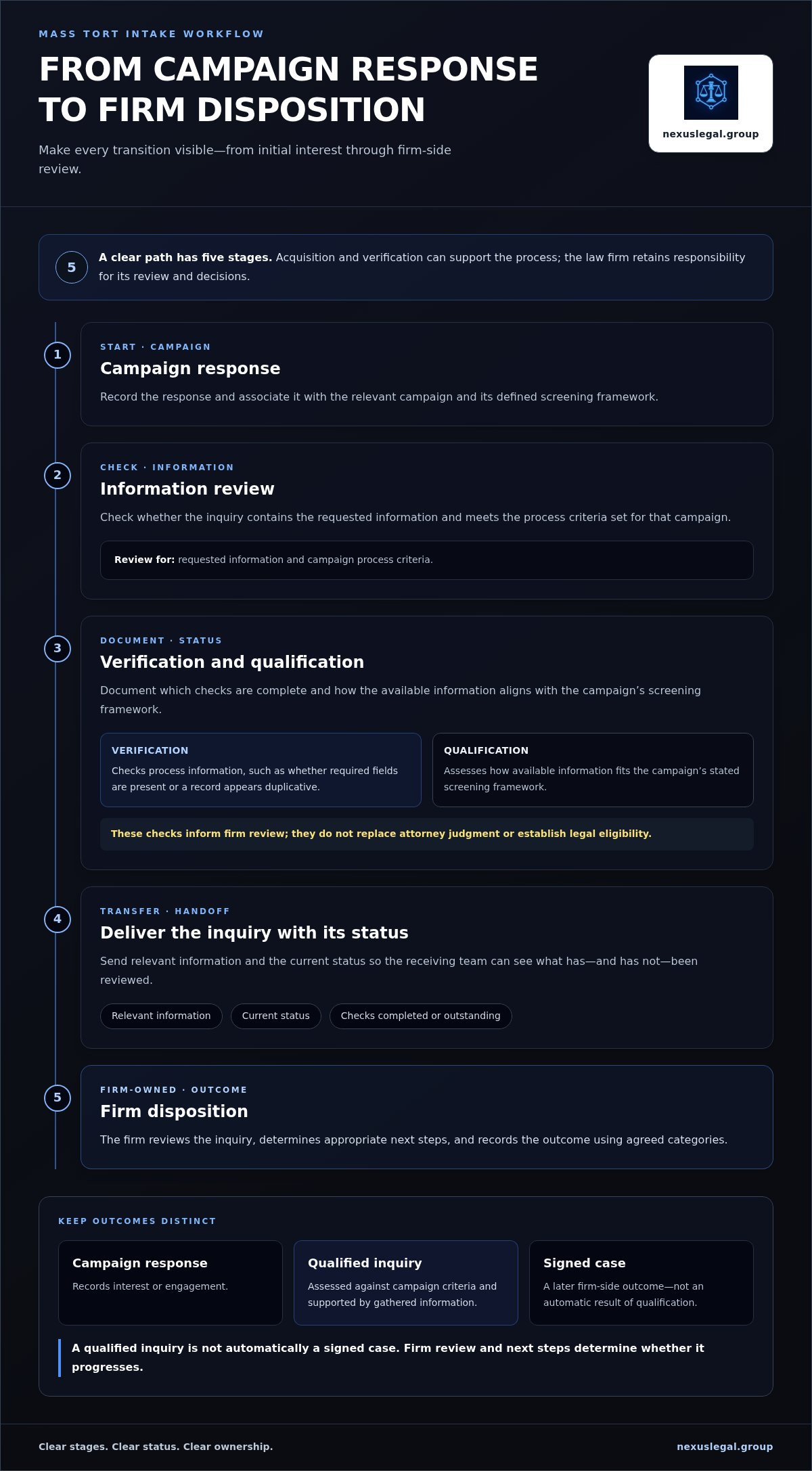
Keep three outcomes separate. A campaign response records interest or engagement. A qualified inquiry is assessed against the relevant campaign criteria and supported by the information gathered. A signed case reflects a later firm-side outcome. A qualified inquiry is not automatically a signed case. The firm’s review and next steps determine whether it progresses.
How mass tort acquisition differs from general legal intake
Mass tort campaigns are matter-specific. Eligibility context, relevant questions, and documentation needs can vary, so a single generic screening approach may not capture what a particular firm needs to review an inquiry. The Mass Tort Law Explained overview provides general background on the category, but campaign criteria should be shaped around the specific matter and the firm’s priorities. Define those criteria before acquisition begins, then apply them consistently when assessing fit.
Where intake friction affects claimant progression
Friction can appear at each transition: a consumer responds, information is collected and reviewed, the inquiry is delivered, and the firm records a disposition. Missing details can make review harder; duplicate records can create avoidable work; and an unclear handoff can leave staff unsure who owns the next step. Mapping these transitions helps teams locate process gaps without treating every inquiry as equivalent.
- Fit: Compare the information gathered with the campaign’s stated screening criteria.
- Verification: Record what has been checked and what remains for firm review.
- Handoff: Make the inquiry’s status and next action clear to the receiving team.
- Follow-up: Capture the firm’s review outcome so the inquiry does not remain in an undefined state.
Raw volume can conceal these distinctions. A large response count doesn’t indicate how many inquiries meet campaign criteria, contain usable information, or receive a recorded firm disposition. Review stage-level records instead: response, completeness, verification status, duplicate status, delivery, and disposition. These measures help identify whether friction originates in acquisition, verification, or the firm-side handoff.
Start with a shared definition of each stage and a consistent way to record its status. This gives the firm and its growth partner a common operational view, clarifies what acquisition support has delivered, and preserves the distinction between a verified inquiry and a signed case.
How an Optimized Mass Tort Intake Workflow Moves from Inquiry to Disposition
A workable intake process makes each transition visible: from a person responding to a campaign, to an inquiry being checked, delivered to the firm, reviewed, and assigned a disposition. This sequence helps teams distinguish acquisition support from legal evaluation and identify where an inquiry is waiting for action. A mass tort law legal intake optimization company can support acquisition and verification, while the firm retains responsibility for its review and decisions.
- Campaign response: Record the response and associate it with the relevant campaign and its defined screening framework.
- Information review: Check whether the inquiry contains the requested information and meets the process criteria set for that campaign.
- Verification and qualification: Document which checks have been completed and how the available information aligns with the screening framework.
- Delivery: Send the inquiry with relevant information and its current status so the receiving team can see what has and has not been reviewed.
- Firm disposition: The firm reviews the inquiry, determines appropriate next steps, and records the outcome using agreed categories.
Verification and qualification are related but distinct
Verification checks inquiry information against defined process criteria, such as whether required fields are present or whether the record appears duplicative. Qualification assesses how the available information fits the campaign’s stated screening framework. These steps can inform firm review, but they don’t replace attorney judgment or establish legal eligibility. Use precise status language so a completed check isn’t mistaken for a merits decision.
Verification confirms process information; it does not determine the legal merits or establish that a person is eligible to pursue a claim. Clear wording prevents an operational status from being interpreted as a legal conclusion.
Designing a clear intake handoff
At delivery, include the available campaign-relevant information, its verification status, any incomplete fields, and a clear indication of what remains for firm review. Agree in advance on who receives the inquiry and who records follow-up and disposition. A structured automated intake framework for plaintiff firms can help teams define status and ownership across the handoff without conflating acquisition support with the firm’s review.
For example, if an inquiry arrives with a required detail missing, its status should make that gap visible rather than presenting the record as fully reviewed. The firm can then decide how to handle it and record the result. Consistent handoff fields also make it easier to compare similar inquiries and spot recurring process gaps.
Use a small, agreed set of status categories, such as received, information incomplete, verified for process criteria, delivered, under firm review, and disposition recorded. Define what each category means and who updates it. When inquiries remain in one stage, teams can identify whether the delay is in information gathering, delivery, or firm-side review instead of treating all pending records alike. This sequence aligns with a broader mass tort case generation and verified inquiry approach, where acquisition support and firm decisions remain distinct.
How to Evaluate a Mass Tort Legal Intake Optimization Company
Compare operating methods, not just the number of inquiries a company says it can generate. A useful evaluation explains how campaign strategy connects to verification, what the firm receives, and how the handoff fits the firm’s review process. It also defines the difference between a qualified inquiry and a signed case, so reporting doesn’t present one as evidence of the other.
Acquisition approach: Look for a clear explanation of how campaign-specific criteria shape audience and inquiry development. Broad claims about “high quality” are difficult to assess without a description of the campaign’s intended fit.
Verification: The process should specify what information is checked, how the status is recorded, and what remains for firm review. A clear description is more useful than an unsupported promise of perfect accuracy.
Deliverable: Establish whether the output is a response, a qualified inquiry, or a signed case, and define each term in reporting. Volume alone doesn’t define the deliverable.
Workflow fit: Confirm how inquiry details and status reach the firm, who owns follow-up, and how the firm records its disposition. Responsibilities should be visible rather than left for the receiving team to infer.
Use these dimensions as a comparison framework. A mass tort law legal intake optimization company should describe its process in operational terms: the criteria it uses, the checks it performs, the status it reports, and the boundary between acquisition support and firm-side evaluation. Be cautious with broad quality language, guaranteed outcomes, or reporting that emphasizes response volume without explaining progression.
Questions that reveal process quality
Assess whether campaign-specific criteria shape inquiry review, what verification status accompanies delivery, and how the firm records disposition. Definitions for deliverables, exclusions, and reporting terms should be precise. Clear process details let your team compare the workflow with its priorities and identify assumptions before a campaign begins.
How to assess compliance-forward operations
Review how consent, communications, and information handling are represented in the workflow, including what is documented and what the firm is expected to review. A compliant legal lead generation reference can help frame this operational discussion. Align the firm’s review with its own counsel and policies; a company’s description should not substitute for that internal assessment.
Process evidence should be specific enough to assess without relying on assurances. A defined verification status and consistent reporting terms are observable; a claim that every inquiry is “ideal” is not. Compare how each process handles the same campaign criteria and deliverable, then assess which gives your team a clearer view of inquiry progress and firm-side outcomes.
For firms evaluating acquisition support alongside verification, Nexus Legal Group’s mass tort case generation connects AI-driven marketing precision with automated verification, qualified inquiries, and signed cases as distinct outcomes.
How Plaintiff Firms Can Implement Intake Optimization and Measure Progress
Make optimization operational before a campaign begins. Agree on what the campaign is intended to acquire, which screening criteria apply, how inquiries will be handed to the firm, and which outcomes will be recorded. These decisions give acquisition and intake teams a shared reference point, making it easier to identify process gaps without relying on generic industry benchmarks.
Establish operating definitions and responsibilities
Define a campaign response, a qualified inquiry, and a signed case as distinct statuses. Specify what information supports each status and avoid using one label as a proxy for another. Assign firm-side owners for review, follow-up, and disposition recording. Decide how incomplete or duplicate information will be flagged, routed, or closed. Clear definitions reduce ambiguity in reporting and make handoffs easier to manage.
Use a rollout sequence that fits the firm’s existing intake process:
- Set scope: Document the campaign focus, its qualification criteria, and the information the firm needs to review an inquiry.
- Map ownership: Identify who receives inquiries, who handles firm-side review and follow-up, and who records disposition.
- Agree on statuses: Define the stages used in reporting, including incomplete information, verification status, firm review, and disposition.
- Capture a baseline: Review the firm’s existing records for the same campaign or a comparable period, using available stage-level measures and noting gaps in the data.
- Review and adjust: Compare campaign results with the baseline and stated objectives, then document any changes to criteria, handoff, or follow-up procedures.
Keep measures tied to decisions the team can make. Track inquiry completeness, verification status, delivery to the firm, whether firm review is recorded, and the disposition category. Where the data allows, compare how many inquiries progress from one recorded stage to the next. Interpret those patterns against the firm’s own baseline and campaign goals, not an invented benchmark or a volume target detached from case progression.
Use feedback loops to refine campaign intake
Schedule a consistent review between the people responsible for acquisition and the firm-side intake owners. Look for repeat patterns in recorded outcomes, such as the same missing information appearing in inquiries or a disposition category that frequently lacks a clear explanation. Use documented feedback to refine campaign criteria or clarify handoff instructions. Where practical, change one process element at a time and record the change so the team can assess its effect.
Reporting should answer what the firm needs to decide next: whether inquiries are complete, where they are in review, and what outcomes have been recorded. Response totals provide context, but they shouldn’t stand in for those measures. A mass tort law legal intake optimization company can support acquisition and verification; the firm’s defined process provides the structure for review, follow-up, and outcome feedback.
How Nexus Connects Mass Tort Case Generation with Verified Intake Outcomes
For plaintiff firms, growth infrastructure should connect campaign acquisition with the information and verification processes that support firm-side review. Nexus Legal Group brings AI-driven marketing precision and automated verification to mass tort case generation, supporting a structured path from campaign response to inquiry delivery. This approach connects acquisition activity with the firm’s priorities without treating every response as the same outcome.
What Nexus brings to a mass tort acquisition program
Nexus supports plaintiff firms with mass tort case generation, qualified inquiries, and signed cases. These deliverables represent different stages: a qualified inquiry is an acquisition outcome, while a signed case reflects a later result. Distinguishing them in planning and reporting gives the firm a clearer view of what is generated and what progresses through its own review.
Automated verification adds a defined check within the acquisition process and can support a more consistent inquiry handoff. Combined with AI-driven marketing precision, it connects campaign activity with inquiry information for the firm to assess. It doesn’t replace the firm’s review or determine legal merits. The value is in connecting acquisition and verification while describing outcomes accurately and avoiding unsupported guarantees.
Nexus delivers ethical and compliant leads and signed cases for mass tort litigation. For firms, this is most useful when considered alongside the campaign’s operating process: how inquiries are developed, what verification represents, and how information is presented for review. Keep internal review aligned with firm policies and counsel, and use clear deliverable definitions so acquisition support isn’t confused with legal evaluation.
Turning firm priorities into a practical next step
A focused discussion begins with the firm’s priorities, not a generic volume target. Identify the matter or campaign focus, the inquiry characteristics the firm wants to assess, and the team member responsible for receiving and reviewing inquiries. Then define the deliverable that best fits the objective, whether the program is centered on qualified inquiries, signed cases, or both as separate outcomes.
Before discussing campaign fit, firms can prepare a short operating brief that captures:
- Campaign objectives: The matter priorities and acquisition outcome the firm intends to evaluate.
- Intake ownership: The person or team responsible for inquiry review, follow-up, and recording outcomes.
- Workflow needs: The information and status that should accompany an inquiry at handoff.
- Success measures: The stage-level indicators the firm will use to assess progress against its own baseline.
This gives both sides a concrete basis for aligning acquisition, verification, and firm-side intake. As a mass tort law legal intake optimization company, Nexus connects these growth activities while preserving the distinction between qualified inquiries and signed cases. Firms can use the discussion to clarify campaign objectives, desired deliverables, and how the process should fit their existing intake workflow.
Set the Next Growth Decision in Motion
Turn your evaluation into a focused growth conversation. Treat intake optimization as an ongoing part of campaign planning, with room to reassess how acquisition goals align with the firm’s priorities. A mass tort law legal intake optimization company should fit into that operating picture and support a process your team can evaluate over time.
Bring a clear campaign objective and a practical view of your current intake workflow to the discussion. Together, these provide a basis for identifying where acquisition support fits and how to assess progress against your goals. Nexus Legal Group supports mass tort case generation, qualified inquiries, and signed cases, combining AI-driven marketing precision with automated verification.
A deliberate next step can help your firm build a growth process that stays aligned with its priorities.
Frequently Asked Questions
What does a mass tort legal intake optimization company do?
A mass tort law legal intake optimization company connects campaign response with inquiry review and firm-side progression. Nexus supports this process through campaign acquisition and automated verification, with deliverables defined as qualified inquiries, signed cases, or both. For example, a firm can distinguish an inquiry checked against stated process criteria from one that still needs information before review. The firm retains responsibility for its legal assessment.
How is mass tort intake different from personal injury intake?
Mass tort intake is organized around a specific matter and its screening context, while personal injury intake often centers on an individual incident and its circumstances. The questions and supporting information a firm needs can therefore differ by campaign. A practical approach is to create separate screening prompts for each matter rather than reuse a general injury form unchanged. The firm can then review whether each prompt captures information relevant to its own evaluation.
How can a law firm tell whether a mass tort inquiry is qualified?
A firm can assess qualification by comparing the information provided with the campaign’s defined screening criteria. For example, if a criterion asks about a particular product or exposure, the inquiry should record a clear response or flag that the information is missing. Qualification indicates alignment with the campaign framework, not a legal conclusion. Establish criteria before review and document how uncertain or incomplete responses are categorized.
Can automated verification replace a law firm's intake review?
No. Automated verification can check information against defined process criteria, but it doesn’t make the firm’s legal assessment or decide what action is appropriate. If an inquiry passes a verification check yet contains an unclear response, the firm may still need to review it. Use labels that describe exactly what automation checked, then keep a separate status for the firm’s evaluation. This prevents process completion from being mistaken for legal approval.
What should a firm measure when optimizing mass tort intake?
Measure whether inquiries contain the information needed for review, what verification status is recorded, and whether the firm has documented a disposition. Add context that helps interpret those measures, such as campaign source or the reason an inquiry was paused, where those details are available and appropriate to track. Compare results with the firm’s own baseline and objective. This makes reporting useful for operational decisions without relying on a universal benchmark.
How can firms reduce incomplete or duplicate mass tort inquiries?
Start by reviewing the intake questions: keep them relevant to the campaign, make required responses clear, and avoid collecting details that don’t support the firm’s screening process. Establish a consistent method for identifying possible duplicates, such as comparing available contact details and campaign records before treating entries as separate inquiries. Flag uncertainty rather than silently merging records. Reviewing recurring gaps can show whether instructions or question wording need clarification.
Does a qualified mass tort inquiry mean the claimant has signed with a firm?
No. A qualified inquiry is an acquisition-stage outcome, while a signed case is a separate firm-side result. A person may meet campaign screening criteria but still need further review or choose not to proceed with the firm. Keep these statuses distinct in records and reports. For example, track the inquiry as qualified when it meets the defined criteria, then update its status only when the firm records a later outcome.