AI driven legal case acquisition Guide for Success
Master AI driven legal case acquisition. This guide helps you transform your intake with real-time data to find exclusive, high-quality MVA and tort cases.
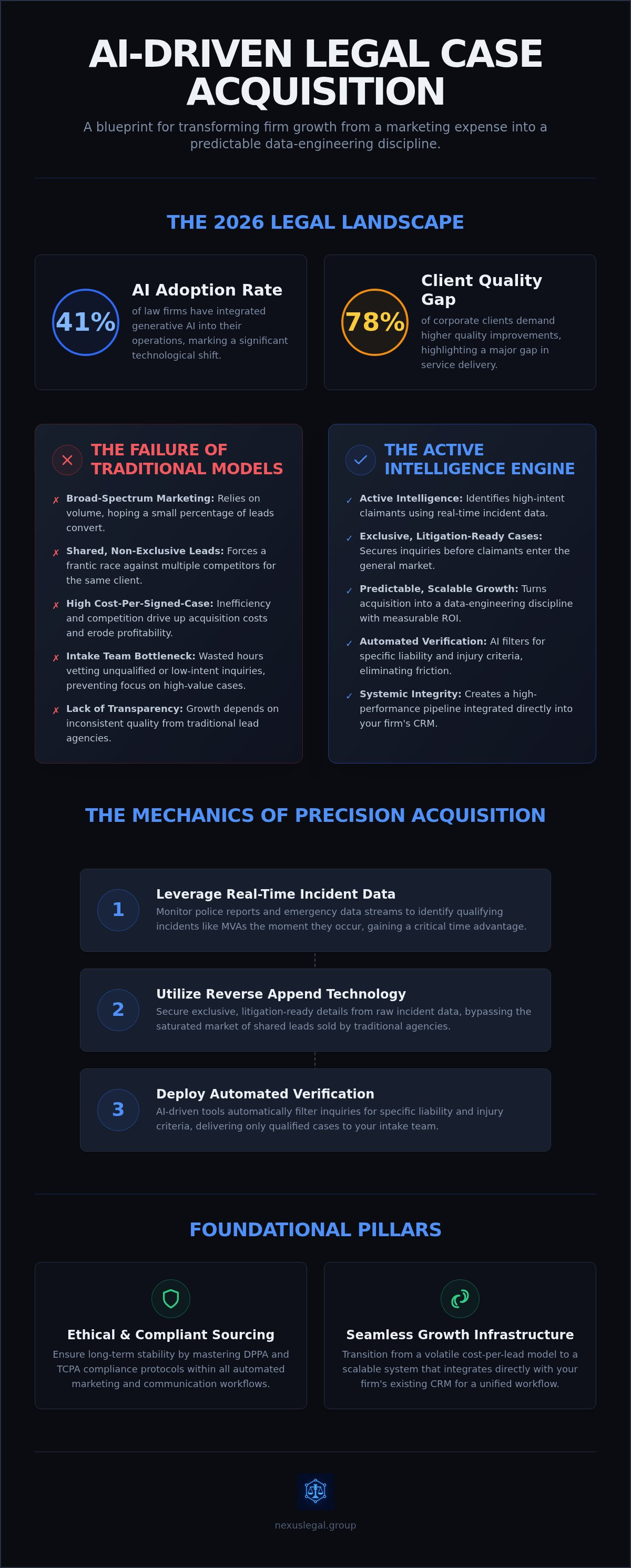
In 2026, 41% of law firms have integrated generative AI into their operations, yet a staggering 78% of corporate clients still demand higher quality improvements than they currently receive. This gap represents a massive opportunity for firms willing to move beyond basic automation toward a sophisticated system of AI driven legal case acquisition. You likely recognize the frustration of paying high costs for unqualified inquiries that waste your intake team's time and inflate your cost-per-signed-case. It's a common friction point that prevents even the most ambitious firms from achieving true scalability or maintaining clear transparency in their lead sourcing.
This guide provides a clinical blueprint for leveraging real-time incident data and automated verification to secure exclusive, litigation-ready cases. We'll show you how to transform your firm's growth from a fluctuating marketing expense into a predictable data-engineering discipline. You'll learn to eliminate intake friction and maintain full ethical compliance while building a high-performance engine for MVA and mass tort acquisition. We will explore the mechanics of reverse append technology and systemic integrity, ensuring your firm operates as a strategic architect of its own expansion.
Key Takeaways
- Shift your strategy from broad-spectrum marketing to active intelligence that identifies high-intent claimants using real-time incident data.
- Learn to utilize reverse append technology and police reports to secure exclusive, litigation-ready details that traditional agencies often miss.
- Streamline your operations by deploying AI driven legal case acquisition tools that automatically filter for specific liability and injury criteria.
- Ensure long-term stability by mastering DPPA and TCPA compliance protocols within your automated marketing and communication workflows.
- Transition from a volatile cost-per-lead model to a scalable growth infrastructure that integrates seamlessly with your firm's existing CRM.
The Evolution of Case Acquisition: From Passive Leads to Active Intelligence
The transition from passive lead generation to active intelligence represents a fundamental shift in how elite firms operate. Historically, case acquisition was a volume-based game where firms purchased broad-spectrum leads, hoping a small percentage would convert into viable litigation. This approach is inherently inefficient. In 2026, 41% of law firms have adopted generative AI to solve these operational gaps. Successful firms now view acquisition as a data-engineering discipline rather than a simple marketing expense. By utilizing predictive modeling, these organizations identify litigation-ready claimants with high precision. This evolution is a core component of modern Legal technology, shifting the focus from administrative organization to surgical case identification.
Implementing a system for AI driven legal case acquisition marks a departure from reactive strategies. Instead of waiting for a potential client to see a billboard or search for an attorney, firms now use real-time data to find individuals who have just experienced a qualifying incident. This proactive stance ensures that the firm is the first point of contact, securing exclusivity before the claimant enters the general market. It is a controlled, technical approach to business expansion that eliminates the friction of traditional outreach.
The Failure of Traditional Lead Generation Models
Traditional lead generation creates a systemic bottleneck that prevents firm scaling. Most agencies sell shared leads, which forces your intake team into a frantic race against multiple competitors. This dynamic drives up the cost-per-signed-case and erodes your total profitability. When your team spends 40 hours a week vetting non-exclusive inquiries, they aren't focusing on high-value litigation. Volume without intent is a liability. It creates significant friction in your workflow and leads to wasted resources on unqualified inquiries that never had a chance of signing. Elite firms can't afford to let their growth depend on the inconsistent quality and lack of transparency found in traditional agencies.
Defining Growth Infrastructure for 2026
True scalability requires moving beyond peripheral tools to a foundational growth infrastructure. This means integrating AI driven legal case acquisition directly into your firm's operational DNA. We view this as a high-performance engine designed for technical mastery and results. It isn't just about getting more calls; it's about the systemic integrity of your entire pipeline. When you utilize real-time incident data and automated verification, you eliminate the guesswork. Precision in your data leads directly to higher case conversion rates. Your firm becomes a strategic architect of its own expansion, relying on logical systems and automation rather than the hope of a successful ad campaign.
The Mechanics of Precision: Police Reports and Reverse Append Technology
The shift toward active intelligence requires a deep understanding of incident-based data sourcing. While traditional SEO models focus on capturing "intent" through search queries, AI driven legal case acquisition prioritizes the "incident" itself. By monitoring emergency services data streams and police reports in real-time, firms identify qualifying motor vehicle accidents the moment they occur. This technical approach bypasses the saturated market of shared leads, allowing you to secure exclusive inquiries before a claimant even begins their search for representation. It's a transition from reactive marketing to a proactive, systemic architecture of firm growth that relies on clinical data precision rather than consumer search behavior.
Leveraging Real-Time Incident Data
Speed-to-lead isn't just a metric; it's a competitive requirement in high-stakes MVA litigation. When your acquisition system integrates directly with police report data, you gain an immediate temporal advantage. Automated data collection protocols ingest raw incident reports, extracting critical variables such as impact severity, vehicle demographics, and preliminary fault determinations. This eliminates the manual labor involved in traditional vetting and research. Instead of assigning staff to monitor public records, the system populates your intake pipeline with verified participant details automatically. This ensures your team is the first to engage with a claimant, drastically reducing the friction typically associated with early-stage case acquisition.
The Role of Data Enrichment in Litigation Readiness
Raw incident data requires a layer of technical enrichment to become truly actionable for an elite firm. Reverse append technology serves as the bridge between a simple accident report and a litigation-ready case profile. By cross-referencing fragmentary data points—such as a name or a vehicle registration—against comprehensive national databases, the system generates a complete claimant overview. This enrichment includes verified contact information, insurance coverage details, and historical data that informs injury severity assessments.
The result is a high-performance intake workflow where every inquiry is backed by a verified accident report and a screened participant profile. This level of clinical precision allows your firm to focus exclusively on high-value litigation, ensuring your resources aren't wasted on unverified or shared data. To understand how these data streams integrate with your existing workflows, you can explore our acquisition infrastructure. By layering AI driven legal case acquisition over enriched incident data, you build a predictable stream of signed cases that are ready for immediate legal action.
Automated Verification: Eliminating Friction in the Intake Workflow
Automated verification is the essential filter that transforms raw incident data into a signed case. While the previous section focused on sourcing incident data through police reports, this phase ensures that every inquiry meets the rigorous standards of an elite plaintiff firm. It isn't enough to know an accident occurred; you must confirm the viability of the litigation. By integrating AI driven legal case acquisition systems, firms programmatically verify liability, insurance coverage, and injury severity before a human ever initiates contact. This eliminates the systemic noise of unqualified inquiries and ensures your team's energy is directed toward high-value outcomes.
Engineering High-Intent Case Flow
Establishing algorithmic parameters is vital for maintaining a litigation-ready status across your entire pipeline. Your automated system should reflect the same clinical standards your senior partners apply when vetting a case manually. This involves cross-referencing accident details against specific qualifiers like clear third-party liability, sufficient policy limits, and immediate medical intervention. By engineering high-intent case growth through automated intake, you ensure that only the most promising opportunities enter your CRM. This level of automated intake verification mirrors elite firm standards, converting a chaotic influx of inquiries into a steady, high-intent flow that requires minimal manual intervention.
Reducing the Cost of Acquisition Through Automation
Large, manual intake call centers represent a significant overhead burden that often introduces more friction than value. Traditional models rely on human operators who may lack the technical precision to vet complex MVA or mass tort cases accurately. Automation replaces this operational bottleneck with 24/7 responsiveness and technical mastery. AI driven legal case acquisition tools engage claimants the moment an incident is identified, collecting and verifying data with surgical precision. You can achieve massive scale and maintain a predictable stream of signed cases without ever increasing your administrative headcount. Automating the initial vetting process allows your attorneys to focus on high-value litigation tasks rather than basic administrative sorting. This shift results in a lower cost-per-signed-case and an accelerated path from inquiry to settlement.
Navigating Ethical and Compliant Data Sourcing
Maintaining ethical standards is a non-negotiable requirement for elite firms. In 2026, the regulatory environment has tightened significantly, with the Texas Responsible AI Governance Act and new California AI mandates setting high bars for disclosure and data handling. Effective AI driven legal case acquisition requires a clinical adherence to the Driver's Privacy Protection Act (DPPA) and the Telephone Consumer Protection Act (TCPA). You must ensure that every data point sourced from police reports or emergency services is handled with surgical precision to avoid compliance risks. This isn't just about avoiding fines. It's about protecting the institutional integrity of your organization as you scale.
The Data-Driven Standard for Compliance
A robust acquisition system creates an immutable audit trail for every inquiry. This documentation is essential for demonstrating Compliant Legal Lead Generation. By automating the tracking of data provenance, AI ensures consistent adherence to state bar guidelines without the variability of human error. The system functions as a strategic architect, ensuring that every participant detail obtained through reverse append technology is verified against current 2026 DPPA nuances. It's about building a foundational layer of security that protects the firm's licensure while driving aggressive, predictable growth. You can't rely on manual oversight when dealing with the speed and volume of modern data streams.
Protecting Firm Reputation in Automated Systems
Your firm's reputation is its most valuable asset. Automated claimant interactions must be professional, respectful, and fully transparent. In accordance with ABA Formal Opinion 512, lawyers using generative AI must adhere to core duties of competence and confidentiality. This means vetting your growth infrastructure partners for institutional-grade compliance. Florida Bar Opinion 24-1 specifically requires investigating an AI provider's data retention policies to safeguard confidential information. You don't want your data embedded in a public model where it might lack attorney-client privilege. Ethical acquisition isn't a hurdle. It is a powerful, high-performance engine that ensures long-term systemic integrity and security.
Implementing Growth Infrastructure for Scalable Case Flow
Transitioning from traditional marketing to tech-enabled acquisition requires a fundamental shift in how your firm views its pipeline. In the past, firms treated case acquisition as a peripheral marketing function, often outsourced to agencies with little transparency. By 2026, elite plaintiff practices have realized that sustainable growth depends on an integrated infrastructure rather than isolated ad campaigns. Implementing a system for AI driven legal case acquisition isn't just about adding new software. It's about building a foundational layer that connects real-time data sourcing directly to your firm's operational core. This shift allows you to move away from the volatility of lead volume and toward the predictability of litigation-ready cases.
Strategic Growth Frameworks
A successful transition relies on a Law Firm Growth Infrastructure that prioritizes technical mastery and systemic integrity. You need to set clear benchmarks for case quality and acquisition speed that align with your firm's specific litigation goals. For example, scaling mass tort or MVA volume shouldn't result in a diluted caseload. Instead, your infrastructure should use automated filters to maintain precision even as you increase inquiry volume. By integrating AI driven legal case acquisition tools directly into your existing CRM, you create a seamless flow where data is enriched and verified before your attorneys ever review it. This ensures that your team's time is spent on high-value litigation rather than administrative sorting.
Measuring success in this new environment requires a focus on sophisticated metrics that go beyond simple cost-per-lead. You should track your ROI based on the cost-per-signed-case and the eventual litigation rates of those inquiries. When your acquisition system is a well-oiled machine, you'll see a significant reduction in intake friction and an increase in the conversion of raw data into actionable cases. This level of efficiency is what defines the elite firm of the future, where scalability is achieved through technical precision rather than just increasing headcount.
The Nexus Approach to End-to-End Infrastructure
Nexus Legal Group functions as a strategic architect for your firm's expansion. We don't just provide leads; we provide the foundational layer for elite practices to scale with confidence. Our approach focuses on delivering exclusive, litigation-ready inquiries that have already passed through rigorous automated verification and data enrichment stages. This eliminates the bottleneck of manual vetting and allows your firm to operate as a high-performance engine. For partners seeking operational excellence, the next step is moving beyond the limitations of traditional agencies. By adopting an end-to-end infrastructure, you secure a predictable stream of signed cases while maintaining full ethical compliance at scale.
Building the Future of Litigation-Ready Growth
The era of relying on broad-spectrum marketing and shared leads has reached its clinical end. To maintain a competitive edge in 2026, elite plaintiff firms must adopt a data-engineering approach to business expansion. You've seen how real-time incident data and reverse append technology transform raw accident reports into verified, litigation-ready inquiries. By implementing a system for AI driven legal case acquisition, your firm eliminates the friction of manual intake and ensures full compliance for MVA and mass tort acquisition. This isn't just about volume; it's about the systemic integrity of your entire pipeline.
Transitioning to a specialized growth infrastructure allows your team to focus on high-value litigation. It's about creating a predictable, scalable engine that drives your practice forward with technical mastery and clinical reliability. You now have the blueprints to replace manual bottlenecks with automated precision. Now is the time to build your foundational layer for sustained operational excellence and secure your firm's position as a market leader.
Frequently Asked Questions
What is AI-driven legal case acquisition?
AI driven legal case acquisition is a sophisticated growth infrastructure that replaces traditional marketing with a data-engineering discipline. It utilizes predictive modeling and real-time incident data to identify high-intent claimants before they enter the general market. This system moves beyond passive lead generation by actively sourcing and verifying litigation-ready cases. It's a technical solution designed for elite firms that value operational excellence and the elimination of intake friction in their acquisition pipeline.
How does reverse append technology help personal injury lawyers?
Reverse append technology enriches fragmentary incident data by cross-referencing it with comprehensive national databases. This process allows personal injury lawyers to obtain detailed accident reports and participant contact information from minimal initial data points. It's a critical tool for verifying insurance coverage and injury severity during the intake phase. By automating this data enrichment, your firm secures a complete case profile, ensuring every inquiry is backed by verified, actionable evidence before outreach begins.
Are AI-generated legal inquiries compliant with state bar ethics?
Compliance depends on the system's adherence to DPPA and TCPA regulations. These technical platforms maintain institutional-grade ethics by creating immutable audit trails for every inquiry. They are programmed to follow 2026 standards, including recent state bar opinions on data confidentiality and generative AI usage. Ensuring your growth infrastructure is built on a foundational layer of documented sourcing protects your firm's reputation while maintaining a scalable and secure engine for business expansion.
How do police reports integrate with automated case acquisition?
Police reports serve as a primary data source for identifying qualifying motor vehicle accidents as they occur. Automated systems ingest these raw reports in real-time, extracting participant details and preliminary fault determinations with clinical precision. This integration provides a significant speed-to-lead advantage, allowing your firm to engage with litigation-ready claimants immediately. It eliminates the manual labor of monitoring public records, replacing it with a steady, automated stream of enriched incident data for your intake team.
What is the difference between a lead and a litigation-ready inquiry?
A lead is typically a shared, unverified inquiry that often lacks specific intent or qualifying criteria. In contrast, a litigation-ready inquiry is an exclusive, vetted case profile that has passed through rigorous automated verification. These inquiries are screened for liability, insurance limits, and injury severity before they reach your CRM. This clinical distinction ensures your firm avoids wasting time on unqualified inquiries, focusing instead on high-value litigation that is ready for immediate legal action.
Can AI-driven systems scale for both MVA and mass tort cases?
The infrastructure is engineered to scale across multiple litigation types, including high-volume MVA and complex mass tort cases. Algorithmic filters maintain precision by verifying specific claimant eligibility criteria at scale. This allows elite firms to expand their caseload without increasing their administrative overhead or compromising on case quality. Whether you're targeting specific motor vehicle accident demographics or broad mass tort classes, the system provides a predictable and consistent flow of signed, litigation-ready cases.
How does automated verification reduce law firm overhead?
Automated verification reduces overhead by eliminating the requirement for large, manual intake departments. The system programmatically vets inquiries 24/7, ensuring that only cases meeting your firm's specific criteria move forward. This reduces the cost-per-signed-case and accelerates the intake workflow by removing human friction. By automating the initial vetting of liability and insurance coverage, you allow your senior legal staff to focus exclusively on high-value litigation tasks rather than basic administrative sorting.
What data sources are used for high-intent MVA acquisition?
High-intent acquisition utilizes real-time emergency services data streams, police reports, and comprehensive participant databases as its primary sources. These streams provide the foundational data required to identify motor vehicle accidents the moment they happen. By layering AI driven legal case acquisition over these enriched sources, firms can secure exclusive inquiries with surgical precision. This approach focuses on the incident itself rather than waiting for a claimant to initiate a search, ensuring a proactive and high-intent pipeline.